

Most workplace conflict is not a clash of personalities. It starts with something much more ordinary: nobody knows who owns a task, two people were told different priorities, or a message landed with the wrong tone. If you are a college student on a group project or a young professional in a first job, the most useful thing you can do is learn to spot these patterns early, because each one has a fix that is cheaper before the argument than after it. Below are eight common scenarios, what causes them, and how to resolve them. We also show where a shared task list with clear owners, like the one in Optio, removes the trigger entirely.
TL;DR
- The most common conflicts come from unclear ownership, broken handoffs, mixed priorities and misread messages, not from bad people.
- Researchers group the sources of conflict into task, process, relationship and status problems. Naming which one you have tells you what to fix.
- Fix the problem, not the person: agree on the issue, brainstorm options together, and confirm out loud that everyone accepts the solution.
- A shared list of tasks, owners and deadlines prevents a large share of these disputes before they start.
- Bullying, harassment and discrimination are not ordinary conflict. They go to HR or a manager, not to a peer negotiation.
Table of Contents
- Why workplace conflict happens in the first place
- Eight real-life workplace conflict examples
- The same conflicts, sorted by type
- How to resolve a conflict with a coworker
- When conflict is not just conflict
- What managers and team leads can do
- The generational angle for early-career workers
- Prevent the next conflict with a shared plan
- Where Optio fits
- Our perspective
- FAQ
- Sources
Why workplace conflict happens in the first place
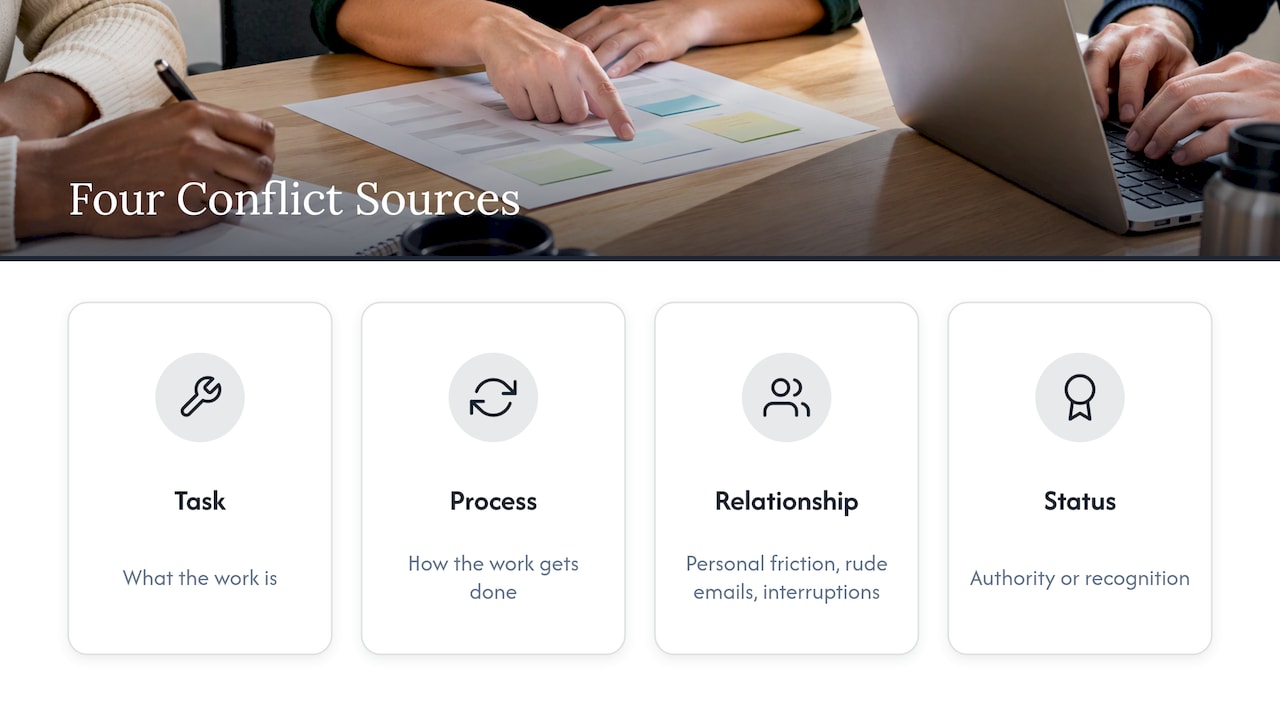
Before the examples, it helps to know the causes behind them. The University of Minnesota’s HR office describes four sources of conflict: task, process, relationship and status. Task conflict is about what the work is. Process conflict is about how it gets done. Relationship conflict is personal friction, such as rude emails or interrupting. Status conflict is about who has authority or recognition.
The organizational behavior textbook from OpenStax adds the structural causes that sit underneath: task interdependence, unclear jurisdiction, communication problems, shared resources and a lack of common performance standards. In plain terms: the more your work depends on someone else’s, and the less clear it is who does what, the more likely you are to fight.
That is why a group project is such a good training ground. Everyone depends on everyone, nobody has formal authority, and deadlines are fixed.
Eight real-life workplace conflict examples
The scenarios below follow patterns documented by HR researchers, including the 16 conflict examples compiled by AIHR. The short pictures are illustrations of those patterns, written for the situations you are likely to meet.
1. The email that sounded angry
A teammate replies to your draft with one line and no greeting. You read it as irritation and answer sharply. Now you are in an argument that began with a missing “thanks.” AIHR lists the tone misread in email or Slack as a classic example, where one person lashes out at a message that was never meant as hostile.
What works: Use a reset. Something like “I may be reading this wrong, can we talk for five minutes?” AIHR suggests agreeing to handle sensitive topics live, by call or in person, rather than in text. Minnesota’s guidance on delayed response fits here too: wait before you answer something that stung.
2. The handoff that never happened
One person finishes the research and assumes the next person has it. The next person assumes it is still coming. The deadline passes. AIHR names broken handoffs and missed deadlines as a standard scenario, and its fix is to map the process, assign clear ownership and use shared checklists and digital spaces.
This is the conflict a task tool is made for. In Optio, you can organize a project into tasks, track time and use smart reminders, so the question “who has this now?” has a visible answer instead of a tense one.
3. Two bosses, two priorities
The University of Florida’s extension service illustrates conflicting goals with a bank teller told by one manager that speed comes first and by another that quality service does. Young professionals hit this when two senior colleagues each hand over “urgent” work. You cannot win. Whichever you do first, someone is unhappy.
What works: Do not choose in silence. Lay both requests side by side, with deadlines, and ask them to agree on the order. AIHR’s advice for priority clashes is that leadership clarifies the strategy. Your job is to make the clash visible, politely, with the list in hand. A prioritized task list helps you do this. Our guide to understanding prioritization techniques walks through ways to rank competing work.
4. The meeting that decided nothing
Eight people talk for an hour and leave with different memories of what was agreed. A week later, two of them have done the same thing and one has done nothing. AIHR lists meetings that end without decisions, and duplicate work where teammates unknowingly produce the same report.
What works: End every meeting by stating the decisions, the owner of each and the date. Write them down where everyone can see them. Our tips on meeting productivity with mobile task tools cover how to turn meeting talk into assigned tasks.
5. Two people, one assignment, no clear owner
Harvard’s Program on Negotiation gives two employees openly arguing over responsibility for a work assignment as one of its three illustrative disputes. It is the most familiar student scenario: both of you think the other should write the conclusion, or both of you wrote it.
OpenStax calls this a jurisdictional ambiguity. The cure is boring and effective: one name per task, written down at the start, with a due date.
6. Feedback that was too vague or too blunt
AIHR describes two opposite versions. In one, feedback is so vague that the recipient tiptoes around the next conversation. In the other, direct feedback offends a colleague from a culture where criticism is delivered more gently.
University of Minnesota guidance recommends reflective listening, restating what you heard before you respond, plus non-reactive statements and building rapport. A practical script: “Here is what I heard. Here is the one thing I need changed by Friday. Does that work for you?”
7. Unfair treatment and favoritism
AIHR includes inconsistent remote-work approvals that create fairness disputes, and a manager’s friend getting the high-profile clients. These are status conflicts: the issue is not the work, it is who gets what. Maynooth University’s guide lists perceived unfairness among the individual sources of conflict.
What works: Stick to specifics and ask about the rule. “What are the criteria for who gets the client work?” is a question. “You play favorites” is an accusation. If the criteria do not exist, that is the real finding to take to a manager.
8. A reorganization nobody explained
When leadership discusses staffing privately, rumors fill the gap. AIHR lists layoff rumors from information gaps, and role anxiety with questions about leadership’s motives after a reorganization. As a junior employee you cannot fix the communication, but you can ask your manager directly what your role is and what is expected of you in the next quarter.
The same conflicts, sorted by type
| Scenario | Type of conflict | Root cause | First fix |
|---|---|---|---|
| Misread email | Relationship | Tone lost in text | Switch to a live conversation |
| Broken handoff | Process | No clear owner | Name one owner per step |
| Two bosses | Task / status | Conflicting priorities | Ask leaders to rank them |
| Meeting with no decisions | Process | No recorded outcome | Write decisions, owners, dates |
| Two people, one task | Task | Jurisdictional ambiguity | Assign it by name |
| Vague or blunt feedback | Relationship | Style differences | Restate, then request one change |
| Favoritism | Status | Unclear criteria | Ask for the rule |
| Reorganization | Status | Information gap | Ask what your role is |
Notice how often the first fix is “write it down and name an owner.”
How to resolve a conflict with a coworker
Maynooth University’s guide recommends problem-focused rather than people-focused resolution. Here is how that looks in practice.
- Take the person out of the issue. Describe the problem as a thing on the table between you: “The report has two owners,” not “You keep taking my work.”
- Wait until you are calm. A short delay protects the relationship. Do not wait so long that the issue hardens.
- Listen first. Repeat back what the other person said until they agree you got it right.
- Brainstorm more than one solution. Then rank them by how acceptable each is to both of you.
- Confirm acceptance out loud. The guide stresses that silence is not agreement. A quiet teammate who is not asked can bring the conflict back later.
- Put the outcome in writing. Who does what, by when. Put it in the shared task list so it does not depend on memory.
The last step is where most people stop short. An agreement that lives only in a conversation is the start of the next conflict.
When conflict is not just conflict
Everything above assumes a normal disagreement between people with roughly equal standing. Bullying, discrimination and harassment are different. Intimidation from a supervisor, repeated verbal abuse or unequal treatment based on who you are should not be solved by negotiating with the person doing it. Report it to HR, a trusted manager or, at a school, the relevant student office. If you are in the US and believe you face discrimination, the Equal Employment Opportunity Commission is the federal body that handles those complaints.
A 2025 randomized trial in a pharmaceutical company found that a program building psychological safety, meaning employees can speak up without fear, led to significantly less bullying and supervisor intimidation. Healthy teams make it easier to raise problems early.
What managers and team leads can do
If you are leading a student project or your first small team, your behavior sets the pattern. A study of 5,456 employees in a US health care system over eight years found that employees whose managers held high-quality conflict conversations had fewer formal grievances and lower turnover. Quality mattered, not just having the meeting.
SHRM reports on Emtrain data showing that managers with strong leadership skills, as rated by their direct reports, had fewer conflicts on their teams. Supervisors who want structured skills for handling staff disagreements can look at liability training for supervisors as part of their development.
Not every conflict is harmful. A study of 117 project teams, reported by the Restorative Justice Institute, found that task conflict went with better performance when psychological safety was high. Debating the idea is healthy when people trust each other. Debating each other is not.
The generational angle for early-career workers
Researchers at the London School of Economics surveyed more than 1,400 employees and found that 37% of Gen Z and 30% of millennials reported low productivity. Where workplaces used inclusive practices across age groups, those figures fell to 18% and 13%. Employees under managers more than 12 years older were nearly 1.5 times as likely to report low productivity.
The takeaway for you: a gap in age or experience between you and your manager is a normal source of friction. Ask early how your manager likes to receive updates, and share how you work best.
Prevent the next conflict with a shared plan
Look back at the eight scenarios. Five of them, the handoff, the two bosses, the meeting, the double assignment and part of the feedback problem, come down to the same gap: no shared, visible record of who owns what and by when.
Here is a simple routine you can start on your next project:
- Day one: list every task, name one owner for each and set a due date.
- Every meeting: end with decisions, owners and dates, entered the same day.
- Midweek: a five-minute check on what is blocked, before it becomes a fight.
- When priorities clash: show both requests, with dates, to the people who set them.
For more on making this routine stick, see our pieces on team collaboration for groups and the 30/60/90 plan for team efficiency without burnout.
Where Optio fits
Optio is a mobile app for task, team and time management, made for college students and young professionals. It covers task management, team collaboration, time tracking, goal setting and project organization, with smart reminders and Google Calendar integration. You can color-code the different parts of your life, so the group project, the job and personal goals each have their own lane. Users are called Centurions, and Optio is their second-in-command.
The core features are free to use, with advanced capabilities planned for a paid subscription. If your next conflict could start with “I thought you had that,” start with a plan everyone can see: try Optio’s Prioritization Station.
If you want to go deeper on ranking work when everything feels urgent, read why setting priorities matters.
Our perspective
We built Optio around a simple observation: most of the friction young teams feel is a visibility problem. When a task has no name beside it, people fill the silence with assumptions, and assumptions turn into arguments.
That is why we focus on the plain things. Who owns this? When is it due? What comes first? A team that can answer those three questions at a glance spends its energy on the work and not on guessing what everyone else is doing.
We are an indie-built app, and we listen to our community of Centurions about what makes teamwork easier. Simplicity and flexibility guide what we build, because a tool that is hard to update is a tool nobody uses.
Conflict will always be part of working with other people, and some of it is useful. Our aim is to take the avoidable kind off the table, so the disagreements you do have are about ideas and not about who dropped the ball.
Optiostation
FAQ
What is the most common example of conflict in the workplace?
Unclear ownership and poor communication show up again and again. Researchers cite task interdependence, unclear jurisdiction and communication problems as leading structural causes. In practice that means missed handoffs, duplicate work and messages that land the wrong way.
Is all workplace conflict bad?
No. Maynooth University’s guide notes that conflict can challenge assumptions and increase cooperation and innovation. The key is keeping it about the task and the idea, and making sure everyone feels safe to speak.
How do I handle a conflict with my manager?
Request a private conversation, describe the specific issue instead of the person, and ask what outcome they need. Confirm the agreement in writing afterward. If the behavior involves intimidation, verbal abuse or discrimination, take it to HR instead of handling it alone.
How can students practice conflict resolution?
Group projects are the best practice ground. Assign one owner per task at the start, hold short check-ins, and use the problem-focused steps above when something goes wrong. Our 30-day plan to develop teamwork skills gives a structured way to build the habit.
Sources
- Conflict Sources, University of Minnesota Office of Human Resources
- Causes of Conflict in Organizations, OpenStax Organizational Behavior
- 16 Conflict Examples & How To Resolve Them, AIHR
- Understanding Conflict in the Workplace, University of Florida IFAS
- Conflict Management for Workplace Disputes, Harvard Program on Negotiation
- Guide on Handling Challenging Scenarios in the Workplace, Maynooth University
- Effectiveness of a Group-Based Psychological Safety Intervention, PMC
- Integrated Conflict Management Systems Pay Off with Lower Turnover, ILR Review
- Proactive HR: How to Reduce Workplace Conflict in 3 Steps, SHRM
- The Hidden Costs of Workplace Conflict, Restorative Justice Institute
- Generational diversity is on the rise, LSE Business Review
