

The best goal setting tips come down to five habits: pick a goal that matters to you, make it specific and dated, break it into small tasks, plan for obstacles, and check your progress on a schedule. Most goals fail in the gap between a good intention and a Tuesday afternoon with nothing scheduled. This guide closes that gap for college students and early-career professionals, with examples you can copy and adjust.
TL;DR
- Start with a reason. Finish the sentence ‘I want to _ so that I can _’ before you write the goal itself.
- Use SMART criteria, but treat them as a checklist to revise a goal, not a form to fill in once.
- Turn every goal into a step-by-step plan where each task has an objective and a due date.
- Add buffer time and name your likely obstacles in advance, because time is what students most often say gets in the way.
- Review weekly, celebrate small wins, and change the goal when your circumstances change.
Table of Contents
- Start with why, not what
- Make the goal SMART, and then keep editing it
- Turn the goal into a plan with dates
- Adapt the advice to academic, career and personal goals
- Plan for time and for things going wrong
- Track progress, celebrate, and revise
- Our perspective: a goal is only as good as its next task
- Put your goals into a system
- FAQ
- Sources
Start with why, not what
Most advice begins with the format of a goal. Better advice begins with its purpose. A career center at Augsburg University recommends tying every goal to a reason, using the prompt ‘I want to _ so that I can _’. The point is practical: knowing the purpose clarifies what to do, what to skip, and how to push through obstacles.
Try it on two goals:
- ‘I want to get a 3.5 this term so that I can keep my scholarship.’
- ‘I want to finish a certification so that I can move from coordinator to analyst work within a year.’
If you cannot finish the sentence, the goal probably belongs to someone else: a parent, a roommate, a job posting. That is worth knowing before you spend three months on it. The University of New Mexico’s engineering student success center takes the same approach and starts from your values, then sets goals, builds action plans and aligns daily, weekly and term goals with them.
If you want a structured way to connect goals with what matters to you, this approach to goals and personal priorities is a useful companion exercise.
Make the goal SMART, and then keep editing it
SMART is the framework nearly every university guide recommends, and for good reason. The University of Colorado Boulder’s student guide defines it as Specific, Measurable, Attainable, Relevant and Timely, with a start and end date. OpenStax’s College Success chapter gives the same five parts and adds detail: a specific goal defines the goal clearly, a measurable goal has outcomes you can actually measure, an attainable goal is within your ability, and a time-bound goal sets a timeframe.
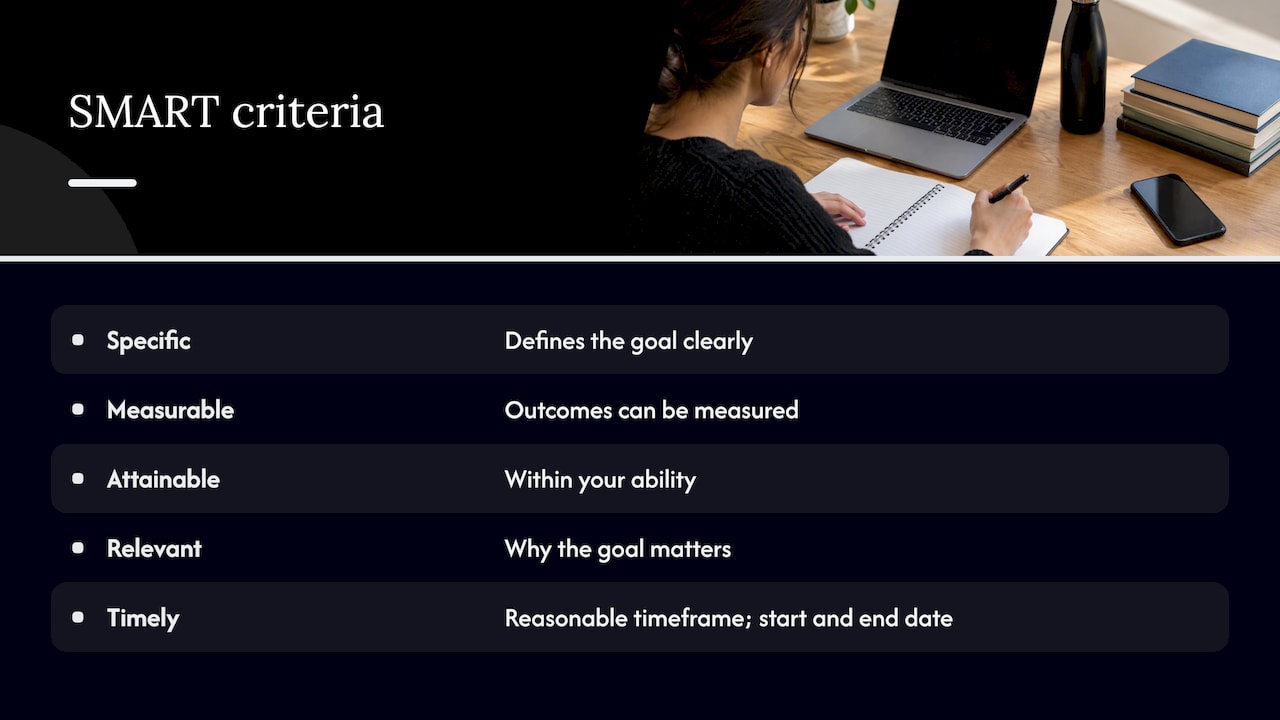
The U.S. Consumer Financial Protection Bureau’s SMART tool turns those letters into questions you can answer on paper. It asks what will be achieved, how much or how many, whether the goal is reachable with your tools and support, why it matters, and whether the timeframe is reasonable. Those last two questions catch most bad goals.
A before-and-after example
| Version | Goal |
|---|---|
| Vague | Do better in organic chemistry |
| SMART | Raise my exam average from 78 to 85 by the final by completing four practice problem sets a week and attending office hours every other Thursday |
| Why | So that I keep my GPA above the cutoff for the pre-med track |
The SMART version tells you what to do on Monday. The vague one does not. If you want more models, we collected examples of SMART goals for academic and career success and a SMART goal template for students. For the basics, see what SMART goals are.
Keep the goal honest
One caution: difficulty matters. A USC student wellness article quotes a psychologist who argues goals should be specific and generally quantifiable, while unrealistically difficult goals can produce frustration and reduce motivation. But easy is not the answer either. A 2021 practical guide from the New South Wales Centre for Education Statistics and Evaluation says specific and challenging goals increase effort compared with vague and easy ones. Aim for a goal that stretches you but that you can explain a path to.
Australia’s healthdirect adds two small wording tips: phrase goals positively and match them to your strengths. ‘Read for 20 minutes before bed’ works better than ‘stop scrolling at night.’
Turn the goal into a plan with dates
A goal tells you where you are going. A plan tells you what to do next. OpenStax recommends writing a step-by-step action plan that lists each task, its objective and when it is due, and treating the completion of each task as a goal in its own right.
Here is the process in five steps:
- Write the goal in one sentence with its deadline.
- Work backward. List the milestones that must be true before the deadline. For a final exam, that might be finishing the review of all units two weeks out.
- Split milestones into tasks small enough to finish in one sitting, ideally under an hour.
- Give every task a date. A task without a date is a wish.
- Put the dates where you will see them: your calendar, your task list, your phone.
Healthdirect makes the same case for smaller steps: realistic steps reduce overwhelm, preserve focus and make giving up less likely. Harvard Health’s guide agrees, recommending that you break large goals into smaller ones and reward progress.
This works for big technical goals too. Learning to fly, for example, is a long sequence of knowledge and practice blocks, and these ground school study tips for faster progress show how a broad goal gets sliced into dated study tasks. If your plan involves a lot of tasks, our guide to managing tasks effectively and our weekly planning checklist will help you keep it lean.
Adapt the advice to academic, career and personal goals
The same framework bends differently depending on the area. The table shows what to emphasize.
| Area | What to emphasize | Example task |
|---|---|---|
| Academic | Deadlines set by others, so work backward from exam and assignment dates | Draft the thesis statement by Friday |
| Career | Skills and evidence you can show, with a longer horizon of 6 to 12 months | Complete one portfolio project per month |
| Personal | Frequency and consistency over outcomes | Walk 20 minutes, four days a week |
Academic goals
Your calendar already has fixed points: syllabus dates, exams, registration. Start there and schedule the work before each one. Our guide to academic goal setting walks through the term-level version, and 4-week student growth goals show how to start with behaviors instead of grades. Behaviors such as hours studied are in your control. Grades are not entirely.
Career goals
Early-career goals are fuzzier because nobody hands you a syllabus. Choose a direction, then define evidence: a project shipped, a certification passed, a stakeholder you worked with. A SMART career development goal example can serve as a model. The University of New Mexico advice applies here too: check each goal against your values so you do not chase a title you do not want.
Personal goals
Health, money and relationships respond best to small repeated actions. USC’s guide suggests targeting one goal at a time, starting with a realistic action, making a specific plan, using cues and rewards, and adjusting your environment. A person who tries to overhaul sleep, fitness, and budget in the same week usually ends up changing none.
Plan for time and for things going wrong
Students know the problem. In a CampusWell survey cited by USC, 41 percent of students said not having enough time was the top thing keeping them from their goals. That points to two tips that rarely appear in a goal template.
Add buffer. The Augsburg guide notes that people tend to overestimate what they can do and underestimate outside disruptions, so it recommends adding buffer time. It offers 25 percent as one author’s example, not a rule. A reasonable habit: when you estimate a task at four hours, schedule five.
Name your obstacles in advance. USC’s guide lists anticipating obstacles as part of the plan. Use an if-then sentence: ‘If I miss my morning study block, I will do it right after dinner.’ It takes thirty seconds to write and removes a decision at the moment you are least motivated.
Limit how many goals are active. Pick one to three at a time. Everything else goes on a someday list. Our piece on prioritization techniques covers ways to decide what makes the cut, and our guide to time management skills for school and work covers the scheduling side.

Track progress, celebrate, and revise
A goal you never look at is decoration. An education research brief recommends that once a goal and plan exist, you keep evaluating, recording how often you worked, how much time you spent and which strategies you used, then compare results with the goal.
A simple weekly review takes ten minutes:
- What did I finish, and how does it compare with the plan?
- Which task kept slipping, and why?
- What is the one change for next week?
- What deserves a small celebration?
Celebrating is not fluff. Both Harvard Health and Augsburg recommend rewarding progress and celebrating small wins. Harvard also suggests using visual reminders and changing the approach when obstacles arise.
When to change the goal
Changing a goal is not failure. A Harvard Health source describes goal setting as a learning process, where abandoning or revising an initial goal can reveal what you actually want. Revise when the facts change: a new job, a heavier course load, a different major. Persist when the only thing that changed is your mood.
If self-judgment is making you avoid the work, Augsburg suggests focusing on continuing rather than on self-improvement, and on lessons from setbacks and feedback from others. Telling a mentor, classmate or friend about the goal also helps; the Colorado Boulder guide lists recruiting a support system among its tips.
Our perspective: a goal is only as good as its next task
We built Optio as an indie app, with feedback from the people who use it, so we see the same pattern in the messages we get. People rarely lack ambition. They lack a visible next step. A semester goal sits in a notebook, a work goal sits in a review document, and neither shows up on the day when something else is competing for attention.
So our view is simple. Keep fewer goals, write each one with its reason, and put the first task in front of you today. Separate the areas of your life so a work deadline does not silently eat your fitness goal, and review on a fixed day so that revision becomes routine instead of a crisis. We call the people who use Optio Centurions and the app their second-in-command for a reason: the job of a good assistant is not to set your goals, it is to make sure the orders you gave yourself get carried out.
— Optiostation
Put your goals into a system
Once you have a goal, a plan and dated tasks, they need a home. Optio is a mobile app for students and young professionals that combines task management, time tracking, goal setting, project organization, color-coded life areas, smart reminders and Google Calendar integration. You can give each area of life its own color, attach tasks to a goal, and let reminders do the remembering. The core features are free, with advanced capabilities planned behind a subscription.
If you want to see how it fits your routine, try Optio’s Prioritization Station.

Not ready for an app? Read our guides to task management software and what a productivity app does, and try the weekly review on paper first.
FAQ
What will I do to meet my goals?
Write the specific actions, not the intention. List each task, what it is meant to achieve and when it is due, then schedule the first one within 48 hours. OpenStax recommends treating each completed task as a small goal, which keeps momentum visible.
What is the best advice on setting goals?
Start with why the goal matters, then make it specific, measurable and dated. Keep it challenging but realistic, since goals that are far too hard tend to frustrate. Review it weekly and revise when your circumstances change.
How many goals should I work on at once?
One to three is a sound range for most students and early-career professionals. USC’s guide advises targeting one goal at a time when you are building a new habit. Park the rest on a someday list and revisit it at the end of the term or quarter.
What are the key goal setting techniques?
The most common are SMART criteria, the ‘I want to _ so that I can _’ purpose statement, backward planning from a deadline, buffer time, and a weekly review. They work best in combination: purpose picks the goal, SMART shapes it, backward planning schedules it, and the review keeps it alive.
What should I do when I fall behind?
Look at the cause before blaming yourself. If the plan was too ambitious, shrink the task and add buffer. If the circumstances changed, revise the goal. If motivation dipped, return to your reason and restart with the smallest next task.
Sources
- University of Colorado Boulder: 8 tips for setting (and achieving) your goals
- OpenStax College Success: Goal Setting and Motivation
- Augsburg University Strommen Center: Goal Setting
- University of New Mexico Engineering Student Success Center: Goal Setting and Personal Development
- Consumer Financial Protection Bureau: Setting SMART goals tool
- healthdirect: Goal setting
- USC: From vision to victory, a student’s guide to setting goals
- NSW CESE: Growth goal setting, what works best in practice
- Harvard Health: Get SMART about your goals
- Opportunity Education: Goal Setting research brief
- Ground school study tips
