

TL;DR:
- SMART goals provide a clear framework that turns vague ambitions into actionable plans. They emphasize specific, measurable, achievable, relevant, and time-bound criteria to improve goal success. Regular review and tracking are essential to maintain progress and adapt goals as needed.
SMART goals are a goal-setting framework that ensures your objectives are Specific, Measurable, Achievable, Relevant, and Time-bound. George T. Doran introduced this framework in a 1981 management review, and it has since become the standard in education, business, and personal development. The problem with most goals is not lack of ambition. It is lack of structure. Saying “I want to do better in school” gives you nothing to act on. A SMART goal replaces that vague wish with a clear plan you can measure, adjust, and complete.
What are SMART goals and what does each letter mean?
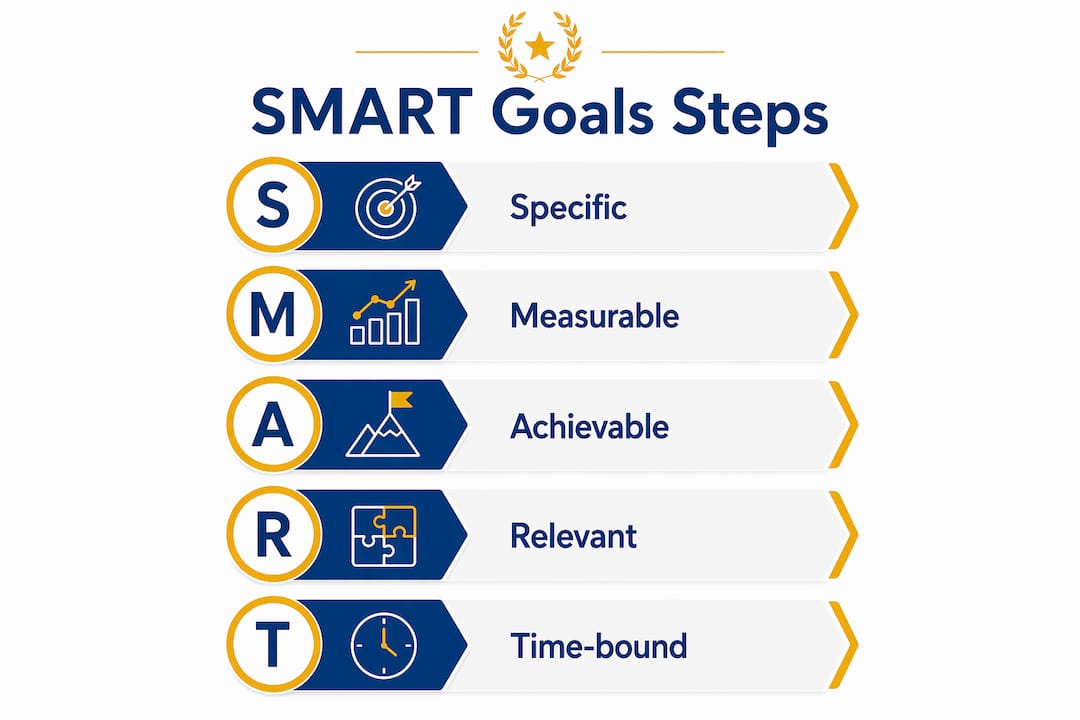
SMART is an acronym where every letter defines a quality your goal must have. Together, the five criteria turn a rough idea into a working plan.
- Specific: Your goal must answer what, who, where, and why. “Improve my GPA” is not specific. “Raise my GPA from 2.8 to 3.3 in my economics major by the end of the spring semester” is.
- Measurable: You need a number, a milestone, or a clear indicator of progress. Without measurable indicators, managing or adjusting a goal effectively is impossible. Measurement tells you whether you are on track or need to change course.
- Achievable: The goal must be realistic given your current resources, skills, and time. This does not mean easy. It means possible with real effort.
- Relevant: The goal must connect to something that actually matters to you or your career. The Relevant criterion is the most overlooked of the five, yet it is the one that prevents you from spending months on work that leads nowhere.
- Time-bound: Every goal needs a deadline. Without a clear deadline, goals lose urgency and get pushed aside by whatever feels most pressing that day.
Pro Tip: Write your goal out in one sentence that hits all five criteria before you commit to it. If you cannot fit all five into one clear sentence, the goal is not ready yet.
Each criterion addresses a specific failure mode in traditional goal setting. Vague goals give you nothing to measure. Unmeasurable goals give you no feedback. Unrealistic goals kill motivation. Irrelevant goals waste your time. Goals without deadlines never get done.

Do SMART goals limit ambition or support it?
SMART goals do not shrink your ambitions. They give your ambitions a structure to stand on. The misconception comes from the word “Achievable,” which some students interpret as “aim low.” That reading misses the point entirely.
SMART goals translate bold visions into achievable plans by providing the structure required to accomplish them. Wanting to become a published writer is a vision. Setting a SMART goal to submit three short stories to literary magazines by june 30 is how that vision becomes real. The ambition stays intact. The framework just makes it executable.
The real risk is what researchers call the Achievability Trap. Goals set too easy produce no growth. Goals set too hard produce discouragement and abandonment. The target zone is stretch goals: objectives that require genuine effort and push your current limits without being so far out of reach that failure feels inevitable. That balance is where motivation lives.
Relevance plays a supporting role here. A goal can be specific, measurable, and time-bound but still drain your energy if it does not connect to something you care about. Before you finalize any goal, ask yourself whether achieving it actually moves you closer to where you want to be. If the answer is no, the goal needs to change, not just the deadline.
Pro Tip: Use a step-by-step SMART approach to test whether your goal is a stretch target or a ceiling. If you can complete it without changing your current habits, it is too easy.
How to set and track SMART goals effectively
Setting a SMART goal is a process, not a single moment of inspiration. The most effective approach starts before you write the goal down.
Ask three questions first:
- Why does this goal matter? If you cannot answer this in one sentence, the goal lacks the relevance to survive a hard week.
- What exactly needs to happen? Define the outcome in concrete terms. Numbers, deliverables, and milestones all count.
- How does this align with my broader priorities? A goal that conflicts with your other commitments will lose every time.
These questions come from a practitioner checklist designed to separate real projects from wishes. They work because they force you to think about context before you commit to execution.
Once the goal is written, pair it with a tracking system. Here are the most reliable methods for students and young professionals:
- Weekly check-ins: Set a 15-minute review every Sunday. Ask: what progress did I make, what blocked me, and what needs to change next week?
- Milestone markers: Break the goal into three to five checkpoints with their own mini-deadlines. Hitting a checkpoint gives you momentum and early warning if you are falling behind.
- Quantified metrics: Attach a number to every measurable criterion. “Read more” becomes “read two chapters per day.” Numbers remove ambiguity.
- A living document: Keep your goals in a place you can edit. Treating goals as a living document with regular reflection and recalibration is what separates people who finish from people who restart.
The GROW model pairs well with SMART for this reason. GROW (Goal, Reality, Options, Will) helps you define the why and what before SMART refines the how. Using both frameworks together gives you fuller goal clarity than either one alone.
Pro Tip: Use Optiostation to assign each SMART goal its own task thread with a deadline and progress notes. Reviewing it weekly takes under five minutes and keeps the goal from going stale.
What do effective SMART goal examples look like?
The fastest way to understand the framework is to see it in action. The table below contrasts vague goal statements with their SMART counterparts across common student and early-career situations.
| Vague goal | SMART version |
|---|---|
| Get better at public speaking | Complete one Toastmasters session per week for 8 weeks and deliver a 5-minute prepared speech by march 31 |
| Network more | Connect with 3 professionals in my field on LinkedIn each week and schedule 2 informational interviews by the end of this semester |
| Improve my writing | Write 500 words of original content every weekday for 6 weeks and submit one article to a campus publication by april 15 |
| Learn Excel | Complete a 10-hour Excel certification course on Coursera by february 28 and apply pivot tables in my next internship project |
| Study harder | Study for 90 minutes each weekday using the Pomodoro Technique and raise my midterm grade by at least one letter grade |
Each SMART version hits all five criteria. The goal is specific about what needs to happen. It is measurable with a number or deliverable. It is achievable within a realistic timeframe. It is relevant to academic or career growth. And it has a firm deadline.
A few patterns worth noting:
- Certifications work well as SMART goals because they have built-in deadlines, measurable outcomes (pass or fail), and direct career relevance.
- Skill-building goals need a performance indicator, not just a completion indicator. Finishing a course is not the same as demonstrating the skill.
- Networking goals are often too vague. Adding a number (three contacts per week) and a deadline (end of semester) turns a habit into a goal.
The Pomodoro Technique appears in the study example because it is a named, measurable method. Saying “study more effectively” is not measurable. Saying “use Pomodoro blocks” is.
Vague goals like “improve” provide nothing to measure, plan, or evaluate. SMART goals embed specific criteria that make action and assessment possible. That difference is the entire point of the framework.
Key Takeaways
SMART goals work because they replace vague intentions with five concrete criteria: Specific, Measurable, Achievable, Relevant, and Time-bound, each targeting a distinct failure mode in traditional goal setting.
| Point | Details |
|---|---|
| Structure beats motivation | SMART goals give ambitious visions a framework to become executable plans, not smaller ones. |
| Measurement is non-negotiable | Without a measurable indicator, you cannot track progress or know when to adjust course. |
| Relevance prevents wasted effort | Goals misaligned with your actual priorities drain energy without moving you forward. |
| Deadlines create urgency | A time-bound goal forces prioritization; without a deadline, other tasks always win. |
| Goals need regular review | Treat every SMART goal as a living document with weekly check-ins, not a one-time setup. |
What I have seen students get wrong about goal setting
Most students I have worked with do not fail at goal setting because they lack ambition. They fail because they confuse writing a goal with committing to a plan. There is a real difference between the two.
The most common mistake is skipping the Relevant criterion entirely. A student will set a perfectly specific, measurable, time-bound goal to earn a certification in a field they are not sure they want to enter. Six weeks in, the motivation collapses, and they blame themselves for lacking discipline. The problem was never discipline. The goal was never connected to anything they actually cared about.
The second mistake is treating the goal as finished once it is written. Successful goal-setters treat goal setting as an ongoing cycle, not a one-time setup. Life changes. Priorities shift. A goal written in september may need recalibration by november. That is not failure. That is good management.
The shift I recommend is simple: stop asking “did I achieve my goal?” at the end and start asking “is this goal still the right one?” every few weeks. That question alone will save you months of effort pointed in the wrong direction.
— Optiostation
Optiostation: your second-in-command for SMART goal execution
Setting a SMART goal is only half the work. The other half is tracking it consistently until it is done.

Optiostation is built for exactly that. The app gives students and young professionals a structured space to assign tasks, set deadlines, and review progress, all within a single mobile interface. Each SMART goal becomes its own task thread with milestones, notes, and a clear deadline attached. The best task management tools do not just store your goals. They keep them visible and active. Optiostation’s Roman-themed Optio system positions itself as your second-in-command, so your goals stay on track even when your schedule gets complicated. If you are ready to move from planning to executing, managing tasks effectively starts with the right system behind you.
FAQ
What are SMART goals in simple terms?
SMART goals are objectives that meet five criteria: Specific, Measurable, Achievable, Relevant, and Time-bound. The framework was introduced by George T. Doran in 1981 to prevent vague planning and improve execution.
How do I make a goal measurable?
Attach a number, milestone, or clear indicator to your goal. If you cannot define what success looks like in concrete terms, the goal is not measurable yet.
Can SMART goals work for students?
SMART goals are especially effective for students because academic timelines provide natural deadlines and measurable outcomes like grades, credits, and certifications.
What is the difference between a goal and a SMART goal?
A regular goal states what you want. A SMART goal defines what you want, how you will measure it, whether it is realistic, why it matters, and when it must be done.
How often should I review my SMART goals?
Weekly reviews are the most effective frequency. Treating goals as a living document with regular reflection lets you catch problems early and recalibrate before you fall too far behind.
Recommended
- Examples of SMART goals to boost academic success – Optio Station: Best Project Management App for Prioritization
- SMART goals: a step-by-step guide to real results – Optio Station: Best Project Management App for Prioritization
- SMART goals for work: practical tips to boost productivity – Optio Station: Best Project Management App for Prioritization
- Smart Goal Format for Students and Young Professionals – Optio Station: Best Project Management App for Prioritization
