

Pick three goals right now: one delivery goal tied to your actual job output, one development goal that builds a skill, and one wellbeing goal that protects your energy, using focused techniques like targeted learning for nurses to track progress efficiently. Write each one as a SMART goal with a deadline. Keep the full set between three and five active goals, and the examples and step-by-step process below will show you exactly how to word and track them.
TL;DR:
- Use SMART for individual actions, OKRs when several people must contribute, and FAST when frequent public reviews matter more than an annual target.
- Rank candidates by payoff and effort: start with easier high value work, follow with demanding priorities, and postpone tasks offering little return.
- Match measures to goal type: use numeric indicators for delivery, completed actions for development, and behavior frequency for wellbeing; review weekly, biweekly, and quarterly.
- Draft goals with a manager or peers rather than accepting targets without discussion; participative setting often produces more ambitious goals and stronger commitment.
- When roles, teams, or markets are changing, prioritize learning goals over fixed performance targets, then review frequently and adjust the method as conditions shift.
Table of Contents
- What work goals are and why they matter
- How to set goals you will actually keep
- Examples you can copy for each goal category
- How many goals to hold and how to prioritize them
- How to track progress without overcomplicating it
- A tracking workflow that supports the goals above
- Learning goals versus hard targets: when context should change your approach
- How Prioritization Station helps you act on this
- FAQ
- Sources
What work goals are and why they matter
A work goal is a specific outcome you commit to achieving within a set time, whether that outcome belongs to you alone, your team, or the whole organization. Individual goals (a skill you build, a target you hit) sit alongside team goals (a shared deliverable) and organizational goals (company-wide targets you support). Timelines split the same way: short-term goals typically run 6 months to 1 year, while long-term career goals stretch from 3 to 10 years, with short-term goals acting as the stepping stones toward the bigger ones.
The payoff for setting goals this way is concrete. Goals give you a focal point when priorities compete for your attention, they create a built-in source of motivation because progress becomes visible, and they turn vague ambition into something you can measure week to week. They also give your career direction instead of letting it happen by accident.
One documented advantage of writing goals down is a sharp jump in follow-through. Research summarized by Michigan State University Extension found that people who write down their goals using a SMART structure are considerably more likely to achieve them than people who only think about what they want. The act of writing forces specificity, and specificity is what makes a goal actionable instead of aspirational.
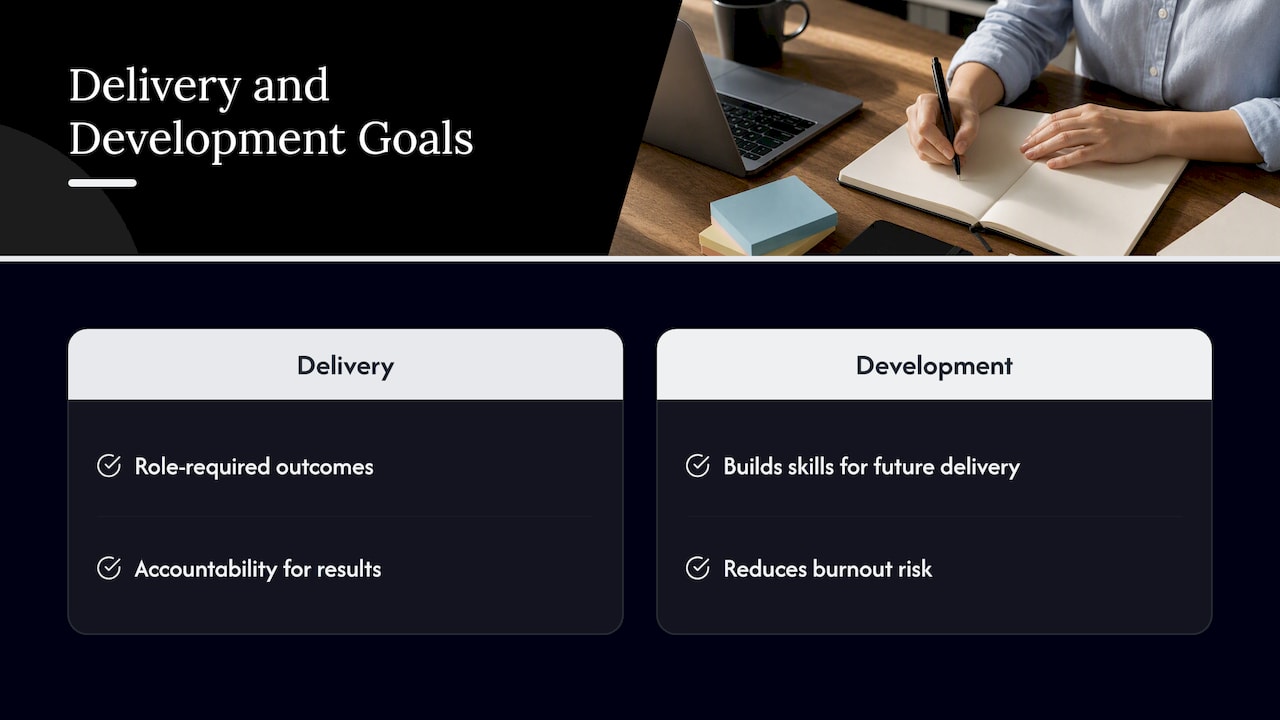
The mistake most people make is setting only one type of goal: all delivery, no development, or all ambition, no recovery. Comparisons of performance and development goals point to a better balance. Delivery goals keep you accountable to the outcomes your role requires, while development goals build the skills that make next year’s delivery easier and reduce the burnout risk that comes from chasing output alone.
How to set goals you will actually keep
Most goals fail not because the ambition was wrong, but because the process behind them was skipped. A short, repeatable sequence fixes that.
- Reflect on what is actually holding you back or what you want more of, whether that is a skill gap, a stalled project, or constant exhaustion by Friday.
- Choose your goal types across categories: one delivery, one development, and one wellbeing goal is a solid starting mix.
- Write each goal as SMART: Specific, Measurable, Achievable, Relevant, Time-bound.
- Break each goal into milestones and weekly actions so the goal has a next step attached to it at all times.
- Schedule reviews on your calendar before you need them, not after you have already drifted.
SMART turns a vague wish into something you can act on. “Get better at public speaking” becomes “Deliver two team presentations this quarter and request written feedback after each one.” The second version tells you exactly what to do, how you will know you did it, and by when.
SMART works well for individual, actionable goals, but it is not the only framework worth knowing. OKRs (Objectives and Key Results) fit better when a goal depends on cross-team impact, since an objective can carry several key results that different people contribute to. FAST goals (Frequently discussed, Ambitious, Specific, Transparent) suit situations where you want targets reviewed often and shared openly rather than set once and revisited at year-end. Use SMART for your personal goal list, reach for OKRs when a goal needs buy-in from multiple people, and use FAST when frequent visibility matters more than a fixed annual target.
Setting goals with your manager or peers, rather than alone, tends to produce better results than goals handed down without input. A classic comparison of assigned versus participative goal setting found that participative goal setting often produced more ambitious targets and stronger commitment than goals assigned without discussion. Bring a draft goal to your next one-on-one instead of announcing a finished one.
Pro Tip: Write your SMART goal in one sentence that includes a number and a date. If you cannot fit both in, the goal is not specific enough yet.
If you want a deeper walkthrough of the framework itself, our SMART goals guide for students and professionals covers the wording in more detail.
Examples you can copy for each goal category
These are ready to adapt. Swap in your own numbers and deadlines, and label each one short-term or long-term so you know which review cycle it belongs to.
Skill-building goals
- Short-term: Complete one certification course in your field within 8 weeks, starting with a single 30-minute module this week.
- Short-term: Learn one new function of a tool you already use (a spreadsheet formula, a design feature) and apply it to a real task within 2 weeks.
- Long-term: Reach conversational proficiency in a second language relevant to your industry within 18 months, starting with 15 minutes of daily practice.
- Long-term: Build a portfolio of 5 completed projects demonstrating a new skill within 12 months, starting with your first draft this month.
Performance and delivery goals
- Short-term: Reduce your average task turnaround time by a set margin this quarter, starting by tracking your current baseline this week.
- Short-term: Close out your current project backlog within 30 days, starting with the three oldest items today.
- Long-term: Own a measurable improvement in a core team metric over the next two quarters, starting with a one-page plan this week.
- Long-term: Lead one major deliverable from proposal to completion within the next year, starting by drafting the proposal this month.
Leadership goals
- Short-term: Run your first team meeting agenda end to end within the next month, starting with a draft agenda this week.
- Short-term: Give structured, specific feedback to a teammate within 2 weeks, starting with one observation you write down today.
- Long-term: Mentor one junior colleague through a defined skill over 6 months, starting with a first conversation this week.
- Long-term: Take ownership of a cross-functional initiative within the next year, starting by identifying the right stakeholders this month.
Networking goals
- Short-term: Have one genuine conversation with someone outside your immediate team each week for a month, starting today.
- Short-term: Attend one industry event or webinar this quarter, starting by registering this week.
- Long-term: Build five ongoing professional relationships outside your company within a year, starting with one outreach message this week.
- Long-term: Join and actively participate in a professional group relevant to your field within 6 months, starting by researching options this week.
Productivity and focus goals
- Short-term: Reduce time spent in unnecessary meetings by a set amount this month, starting by auditing your calendar this week.
- Short-term: Clear your inbox to zero every Friday for the next 4 weeks, starting this Friday.
- Long-term: Redesign your weekly workflow to cut repeated manual work within 3 months, starting with mapping your current process this week.
- Long-term: Consistently finish your top three priorities each day for 6 months, starting with tomorrow’s list.
Wellbeing goals
- Short-term: Take a full lunch break away from your desk 4 days a week for a month, starting tomorrow.
- Short-term: Set a hard stop time for work emails each evening for the next 2 weeks, starting tonight.
- Long-term: Reduce reported work stress through a consistent weekly habit (exercise, a short walk, a wind-down routine) over 6 months, starting this week.
- Long-term: Protect one fully offline day each month for a year, starting by blocking it on your calendar now.
How many goals to hold and how to prioritize them
Holding too many goals at once is the fastest way to finish none of them. A commonly recommended ceiling is three to five active goals at any time, because fewer goals mean sharper focus and more consistent follow-through.
- A balanced set looks like one or two delivery goals, one or two development goals, and one wellbeing goal.
- Rank candidate goals using impact and effort: a goal with high impact and low effort goes first, high impact and high effort goes next, and anything low impact gets dropped or postponed.
- Break every long-term goal into quarterly milestones, then into monthly actions, so a two-year goal always has a next step due this month.
- Swap out a goal when circumstances change enough that the original target no longer makes sense, rather than forcing progress on something that stopped mattering.
Pro Tip: When two goals compete for the same hour of your week, keep the one with the nearer deadline and push the other’s milestone back by a week rather than running both at half effort.
How to track progress without overcomplicating it
The metric should match the goal type. Delivery goals need numeric KPIs (tasks closed, turnaround time, revenue contribution). Development goals are better measured by completed actions (courses finished, projects shipped, feedback sessions held). Wellbeing goals are best tracked as behavior frequency (days you took a real lunch break, nights you logged off on time).
A simple review rhythm keeps all of it visible instead of forgotten:
- A weekly micro-check: five minutes to confirm you took the week’s planned action.
- A biweekly update during a one-on-one, so a manager or peer sees progress in real time.
- A quarterly review to confirm the goal still matters and to reset milestones if it does not.
Recording progress this way, rather than keeping it in your head, is consistent with findings that visible, recorded goals with scheduled reviews are more likely to be followed through on than goals left as unwritten intentions.
A one-line template keeps the whole system light:
| Goal | Metric | Next milestone | This week’s action | Check-in date |
|---|---|---|---|---|
| Example: cut task turnaround time | Average days per task | Hit target by end of quarter | Track this week’s baseline | Friday |
A tracking workflow that supports the goals above
Our approach centers on making progress visible instead of buried in a notebook or a forgotten spreadsheet. Tasks can be linked directly to the goal they serve, reminders can be tied to the next milestone rather than a generic to-do, and progress is surfaced so you see where a goal stands without digging for it.
The workflow itself works with or without any app: write the goal, break it into milestones, and hold a short weekly check against the nearest milestone. What changes with a visible system is how easy that check becomes, since the next action is already sitting in front of you instead of requiring you to reconstruct where you left off.
Learning goals versus hard targets: when context should change your approach
Challenging performance goals work well when your environment is stable: the task is familiar, and pushing harder on a known approach pays off. When conditions are shifting (a new role, a reorganized team, a market in flux), research on goal orientation suggests learning goals matter more than fixed targets, because they keep you exploring rather than locking in on a method that might already be outdated.
The practical habit either way is the same: review often, in small increments, so a goal can bend before it breaks. Put a 15-minute review on your calendar for this Friday and start there.
— Optiostation
How Prioritization Station helps you act on this
Everything above works with a notebook and a calendar. It works faster with a system that already connects your goals to the tasks and reminders that move them forward, which is what we built Prioritization Station to do.
Inside the app, goal tracking looks like this:
- Create a goal and attach it to a color-coded life aspect so it sits alongside your other commitments instead of in a separate list.
- Add milestones directly under the goal, each one a task you can check off.
- Set a weekly reminder tied to the next milestone instead of a generic nudge.
- Watch progress accumulate visibly as milestones close, so a quarterly review takes minutes instead of a reconstruction project.
If the goal categories and examples above convinced you that writing goals down and tracking them weekly is worth doing, start with Prioritization Station and set up your first goal today.
FAQ
What goals can I set for myself at work?
Common categories include skill-building, performance or delivery, leadership, networking, productivity, and wellbeing goals. Pick three to five across these categories, writing each as a SMART goal with a deadline, rather than setting many goals in just one category.
What are good personal goals for work?
Good personal goals combine a delivery target (something your role requires) with a development goal (a skill you are building) and a wellbeing goal (a habit that protects your energy). Writing the goal down with a specific number and date, following the SMART framework, makes it far more likely you will follow through.
How many goals should I set at once?
A commonly recommended range is three to five active goals at any time. Fewer goals mean sharper focus, while a long list tends to dilute effort across everything and finish nothing.
What is the difference between short-term and long-term work goals?
Short-term goals typically span 6 months to 1 year, while long-term career goals span 3 to 10 years. Short-term goals act as the milestones that build toward a long-term one, so most long-term goals need to be broken into quarterly or monthly steps.
How often should I review my work goals?
A weekly micro-check, a biweekly update during a one-on-one, and a quarterly full review cover most goals well. Evidence on employee performance practices supports regular, documented reviews over infrequent or informal check-ins.
