

TL;DR:
- Future plans are adaptable frameworks that define goals and specific steps to achieve them over three to five years. They rely on SMART goal setting, strategic planning, and regular reviews, emphasizing flexibility and ongoing adjustment to changing circumstances. Most young professionals fail when they confuse detailed planning with actual progress, making consistent review and evolution essential for success.
Future plans are structured, adaptable frameworks that define where you want to go and the specific steps you will take to get there. They are not wishes or vague intentions. The SMART goals framework and strategic planning principles form the backbone of any plan worth following. For ambitious college students and young professionals, knowing what are the future plans that actually work means understanding that good planning is active, specific, and built to change. This article gives you the tools to build yours.
What are the future plans, and how do you build one?
A future plan is a systematic, adaptable framework that articulates your goals and the concrete steps to reach them, typically spanning a 3–5 year horizon with reviews every 6–12 months. That time range is not arbitrary. It is long enough to set meaningful targets but short enough to stay realistic given how fast careers and industries shift.

The SMART goals framework is the most reliable starting point. SMART stands for Specific, Measurable, Achievable, Relevant, and Time-bound. A vague goal like “get a better job” becomes a SMART goal when you rewrite it as “earn a project management certification by december 2026 and apply to three mid-level roles by march 2027.” The specificity is what makes it trackable.
Strategic planning adds another layer by separating short-term budgeting (roughly one year) from long-term strategy (3–5 years). Young professionals benefit from thinking in both timeframes at once. Your one-year plan covers immediate next steps like coursework, internships, or skill certifications. Your three-year plan covers where those steps are supposed to land you.
Breaking long-term goals into smaller cycles is the practical engine of any future plan. Incremental steps aligned with a desired future state keep motivation high and progress measurable. A student targeting a data analyst role might break the goal into monthly learning sprints, a summer internship, and a capstone portfolio project, each building on the last.
- Identify your core values first. Plans built around what you actually care about survive setbacks better than plans built around what sounds impressive.
- Write SMART goals for each major area. Career, education, finances, and personal development each deserve their own goal with a deadline.
- Set a 90-day action cycle. Ninety days is short enough to stay focused and long enough to see real progress.
- Schedule a review every six months. Use it to update goals based on new information, not to judge yourself for what did not happen.
- Keep a written record. A documented plan is far more likely to be followed than one kept only in your head.
Pro Tip: Build flexibility into your plan from day one. Treat each 90-day cycle as a hypothesis you are testing, not a contract you are bound to. The goal is progress, not perfection.
What are the most common misconceptions about future planning?
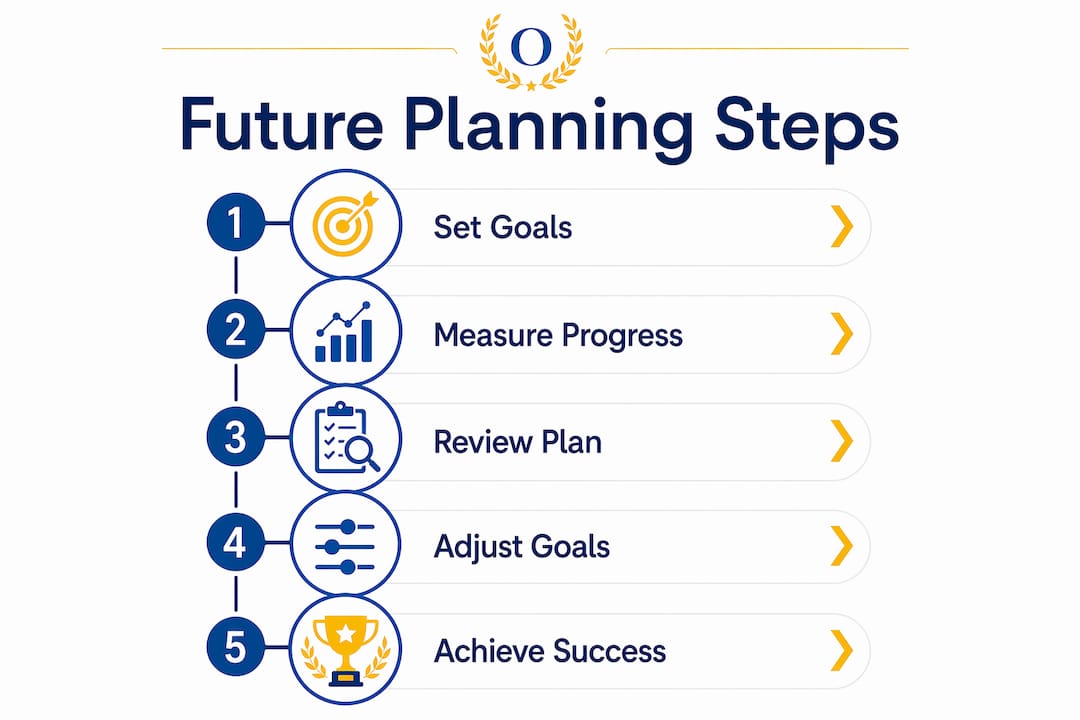
The biggest misconception about future planning is that a good plan predicts the future. It does not. Futures studies emphasize exploring plausible alternative scenarios rather than locking in a single predicted outcome. A plan is a decision-making tool, not a crystal ball.
A second misconception is that plans are fixed once written. Strategic plans are living documents, updated periodically as environments change. Students who treat their first career plan as permanent often feel like failures when circumstances shift, when the real failure is refusing to update the plan.
A third trap is over-planning. Some students spend so much time mapping every detail that they never take the first step. The planning mindset that experts recommend is about deliberate decision-making, not exhaustive documentation. A two-page plan you act on beats a twenty-page plan you admire.
Common pitfalls to avoid:
- Skipping reassessment. A plan that is never reviewed becomes outdated within months, especially in fast-moving fields like tech or healthcare.
- Confusing activity with progress. Staying busy is not the same as moving toward a goal. Each task should connect to a specific milestone.
- Waiting for certainty. Uncertainty is permanent. Agility and a planning mindset matter more than having all the answers before you start.
- Ignoring alignment. Plans that conflict with your values or lifestyle will collapse under pressure. Build plans you can actually live with.
How do you tailor your plans for career and educational growth?
Career and educational planning requires connecting your daily actions to a larger professional identity. Generic planning advice tells you to “set goals.” Career-specific planning tells you which goals actually move the needle for the role or field you are targeting.
- Map your skill gaps first. Compare the job descriptions for roles you want in two to three years against your current resume. The gap between those two lists is your development agenda.
- Integrate certifications with intention. A certification only adds value if it signals something specific to employers. Research which credentials hiring managers in your target field actually recognize before you invest time and money.
- Build networking into the plan, not around it. Treat networking as a scheduled activity with measurable outputs, such as two informational interviews per month, rather than something you do when you feel like it.
- Link educational milestones to career checkpoints. If you plan to graduate in may 2027, your internship should be secured by the fall of 2026. Work backward from the outcome.
- Use internships and volunteer work as proof of concept. These experiences let you test whether a career path fits before you commit fully. They also generate the accomplishments that make interview answers credible.
Employers assess future plans to gauge long-term commitment and alignment with organizational mission, not to evaluate whether your five-year timeline is realistic. That means your career plan should always be framed around contribution, not just personal advancement. When you can articulate how your growth serves the teams and organizations you join, you become a far more compelling candidate.
Connecting your career development goals to concrete educational milestones is what separates students who drift through their twenties from those who arrive at 30 with a clear track record. The difference is almost never talent. It is planning discipline.
What tools and techniques help you track your plans over time?
Tracking is where most plans fail. Students and young professionals build a solid plan, then lose momentum within six weeks because they have no system for staying accountable. The right tools close that gap.
Goal documentation methods:
- Written goal journals. A physical notebook dedicated to your plan creates a ritual around review. Writing by hand also improves retention compared to typing.
- Digital task managers. Apps designed for managing tasks effectively let you break goals into daily actions, assign deadlines, and track completion rates over time.
- Vision boards and visual maps. Visualization tools work because they keep your long-term goals emotionally present during short-term grind periods.
Review and feedback loops:
Periodic reviews are non-negotiable. A weekly check-in (15 minutes) covers immediate next steps. A monthly review assesses whether your 90-day cycle is on track. A biannual review asks the bigger question: is this plan still pointing in the right direction?
Technology aids goal visualization and helps maintain adherence to plans over time. The key is choosing tools that match your workflow rather than adding complexity. A student juggling coursework, a part-time job, and a job search needs a system that is fast to update, not one that requires an hour of maintenance each week.
| Technique | Best for | Review frequency |
|---|---|---|
| SMART goal journal | Long-term goal clarity | Monthly |
| Digital task manager | Daily and weekly action tracking | Weekly |
| Vision board | Motivation and emotional alignment | Quarterly |
| Biannual plan review | Strategic direction and goal updates | Every 6 months |
Pro Tip: Separate your planning tool from your to-do list. Your plan lives in a document you review monthly. Your to-do list lives in an app you check daily. Mixing the two turns both into noise.
Key Takeaways
Effective future planning combines SMART goals, regular reviews, and a flexible mindset to move you from where you are now to where you want to be.
| Point | Details |
|---|---|
| Define plans with SMART goals | Specific, Measurable, Achievable, Relevant, and Time-bound goals turn ambitions into trackable targets. |
| Use a 3–5 year horizon | Plan long-term strategy over 3–5 years and review progress every 6–12 months to stay current. |
| Treat plans as living documents | Update your plan quarterly or biannually as new information and opportunities emerge. |
| Align career plans with employer mission | Frame your professional goals around contribution, not just personal advancement, to stand out in interviews. |
| Track with the right tools | Pair a digital task manager for daily actions with a written journal for monthly strategic reviews. |
The planning trap most young professionals fall into
Most of the students and young professionals I see struggle with planning share one problem: they confuse having a plan with making progress. They write detailed goals, organize them beautifully, and then wait for the right moment to start. The plan becomes a comfort object rather than a working tool.
The uncomfortable truth is that agility matters more than accuracy in early career planning. Your first plan will be wrong in several ways. That is fine. What matters is that you build the habit of reviewing and adjusting it. The planning mindset that separates high performers from everyone else is not about predicting correctly. It is about responding well when reality diverges from the plan.
At Optiostation, we built our tools around this reality. The Centurions who get the most out of the platform are not the ones with the most detailed plans. They are the ones who check in consistently, adjust their tasks when priorities shift, and treat their plan as a conversation with their future self rather than a verdict on who they are.
Stop waiting for certainty. Start with the best information you have, review often, and update without guilt. That is what planning actually looks like in practice.
— Optiostation
How Optiostation supports your future planning
Optiostation is built for exactly the kind of planning this article describes: goal-driven, flexible, and built around real daily action.
The app gives students and young professionals a single place to manage tasks, set priorities, and track progress toward long-term goals. Whether you are mapping out a semester, preparing for a career pivot, or managing a group project, Optiostation’s task and time management features keep your plan visible and your next step clear. The best task management tools do not just organize your work. They make your goals harder to ignore. Optiostation is built to be your Optio, your second-in-command, so you can focus on leading your own future. Explore the platform and put your plan into motion.
FAQ
What is future planning, exactly?
Future planning is the process of setting specific goals and defining the steps to reach them over a defined time horizon, typically 3–5 years. It is an active, ongoing process, not a one-time document.
How often should you update your future plans?
Plans should be reviewed every 6–12 months at minimum, with lighter check-ins every 90 days to assess progress and adjust priorities.
What are your future plans in a job interview?
Interviewers ask this question to assess alignment with the organization’s mission. Frame your answer around how your growth will contribute to the team, not just your personal timeline.
How do SMART goals fit into future planning?
SMART goals translate broad ambitions into specific, measurable targets with deadlines. They are the core unit of any effective future plan.
Can future plans change?
Yes, and they should. Effective plans are living documents updated as circumstances evolve. Rigidly sticking to an outdated plan is a planning failure, not a sign of commitment.
Recommended
- SMART Goal Template for Students: 2026 Guide – Optio Station: Best Project Management App for Prioritization
- Command Log – Optio Station: Best Project Management App for Prioritization
- Future Planning Explained: Strategies and Best Practices – Optio Station: Best Project Management App for Prioritization
- Effective Goal Setting for Students: Achieve Your Dreams – Optio Station: Best Project Management App for Prioritization
