
The best sample project for a project management assignment is a small, real one with a clear end date, a handful of stakeholders and work you can split among teammates: a campus event, a process fix at a local shop, a simple app build, a home or dorm move, or a fundraiser. Below you get five examples with the deliverables each one should produce, a worked plan you can copy the structure of, and a method for fitting any example to your own brief.
TL;DR
- Pick a project that is practical, has a fixed deadline and fits skills you already have. Do not choose something so big you cannot finish it.
- Most instructors grade the same core documents: charter, scope, work breakdown structure (WBS), schedule, roles, communications plan, risk register and a closing report.
- Five strong starting points: a campus event, a local process improvement, a small app, a fundraiser and a move or renovation.
- Read your brief first, then fit the example to it: copy the structure, never the content.
- Make each teammate’s role and contribution visible. Many graders mark individual work separately.
Table of Contents
- What makes a project suitable for the assignment
- Five sample projects you can build an assignment around
- What a complete project plan contains
- A worked example: the campus career panel
- Including risks, budget and success measures
- Adapting any example to your brief, team and method
- Where Optio fits in
- Try it on your own assignment
- FAQ
- Sources
What makes a project suitable for the assignment
Before you choose, check the project against four tests. Open University’s TM470 module team, which supervises student capstone projects, advises that a project should identify a problem, be practical, include planning, evaluation and revision, and be reasonably difficult without requiring an entirely new skill set. Their tutors also suggest choosing something you are interested in so you stay motivated.
Translated into a checklist:
- A temporary effort with an end. A project has a start, a finish and a result. “Run a club” is ongoing work. “Run the club’s spring showcase” is a project.
- Enough complexity to plan. You need at least several deliverables, dependencies between tasks and a few real risks. Otherwise there is nothing to manage.
- Access to information. You must be able to get real costs, dates and stakeholder opinions, or invent defensible ones.
- A size you can finish. If your assignment asks for 15 hours of planning, do not pick a project that needs 150.
It also helps to know how much research instructors expect. In a model assignment for a UK business qualification, the first task has teams research the factors affecting a project, then set SMART objectives (specific, measurable, achievable, relevant, time-bound) and success criteria, assess feasibility and consider cost and risk implications. The task is estimated at 15 to 20 hours. Planning is real work, so budget time for it.
Five sample projects you can build an assignment around
Each example below lists a scenario, the deliverables a grader will look for and the point where teams usually go wrong.
1. A campus event
Scenario: A two-hour career panel or club fair for 100 attendees.
Deliverables: project charter, stakeholder list (venue, speakers, student affairs office, sponsors), budget, run sheet, marketing timeline, risk register and a post-event report.
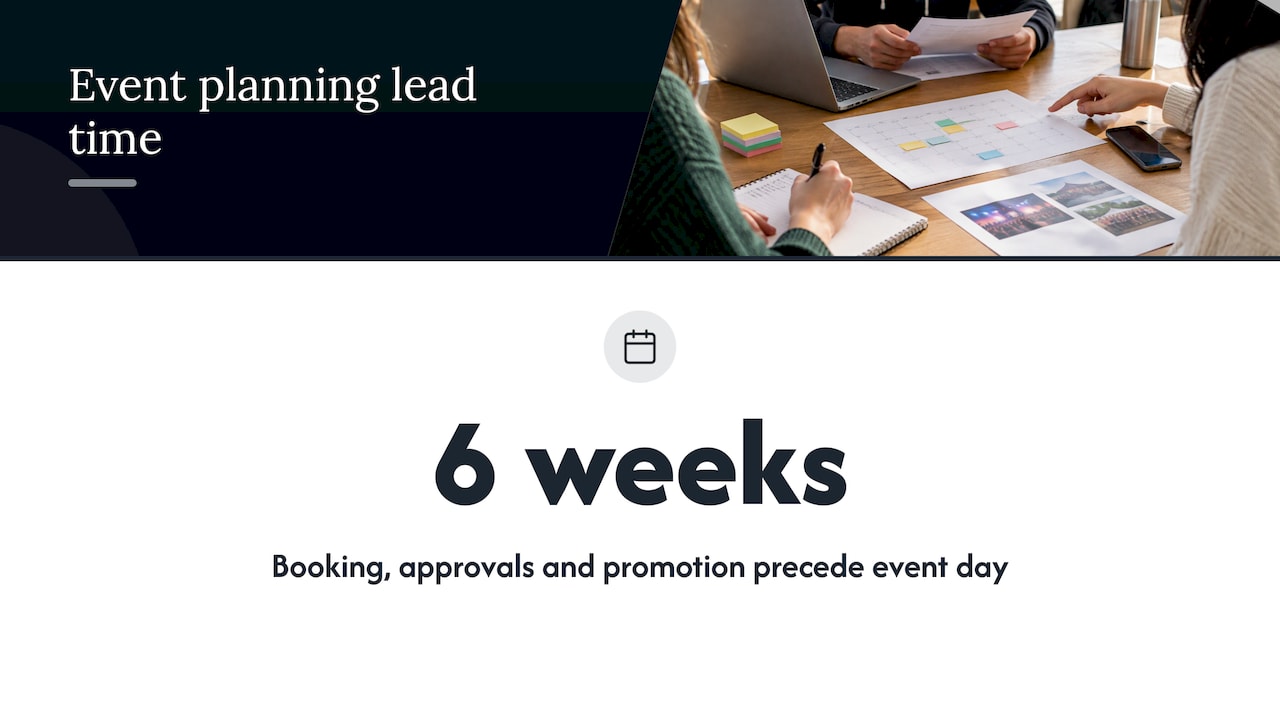
Where it goes wrong: Teams plan the day of the event in detail and forget the six weeks of booking, approvals and promotion before it. Start your WBS from the finished event and work backward.
2. A process improvement at a local business
Scenario: A coffee shop wants shorter morning lines, or a campus print shop wants fewer lost orders.
Deliverables: a current-state (AS-IS) process map, a proposed (TO-BE) map, an implementation plan, a measure of success such as average wait time, and a short results summary.
Where it goes wrong: No baseline. If you do not measure the starting point, you cannot show improvement. Collect your before numbers first.
3. A small app or website build
Scenario: A budget tracker or study-group scheduler built in short iterations.
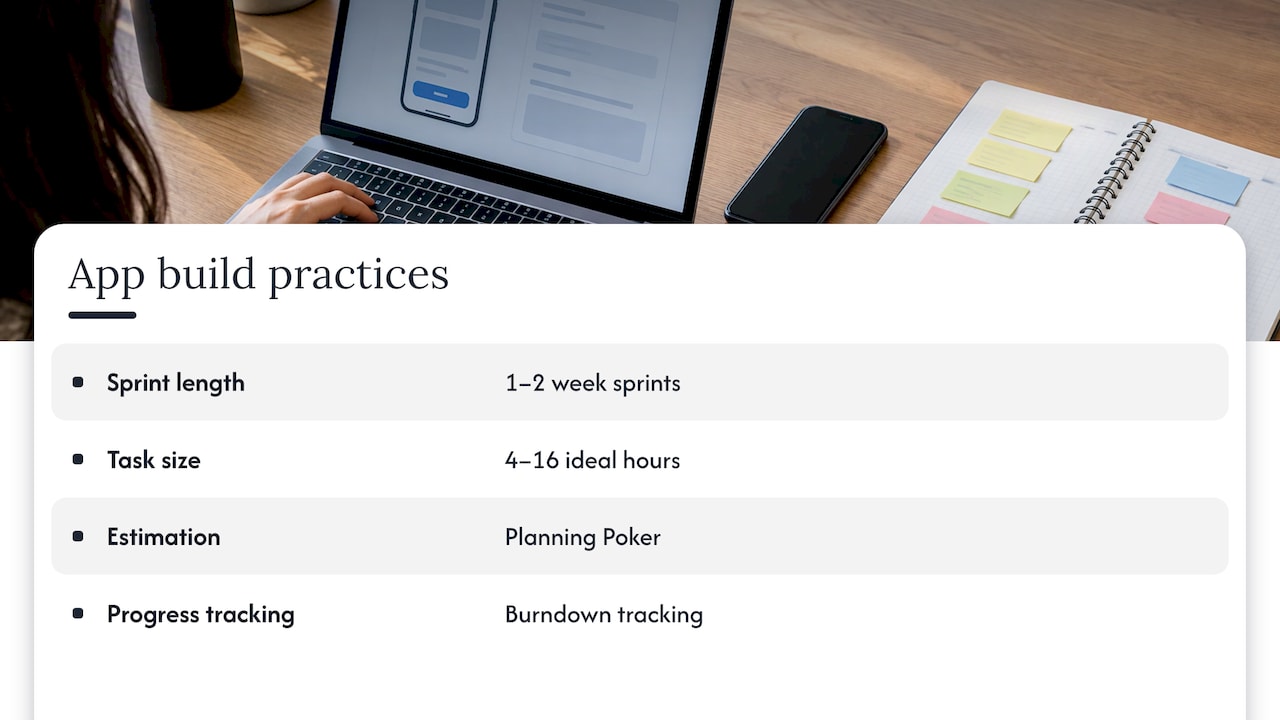
Deliverables: user stories, a prioritized backlog, wireframes, sprint plans, a test round with a few users and a retrospective. Carnegie Mellon’s software engineering course uses exactly this kind of running assignment: user stories, estimation with Planning Poker, a two-week sprint plan with tasks sized between 4 and 16 ideal hours, and burndown tracking.
Where it goes wrong: Treating Agile as no planning. You still need a backlog, estimates and a clear definition of done. Our guide to 1 to 2 week sprints for students walks through the routine.
4. A fundraiser
Scenario: A bake sale, charity run or donation drive with a dollar goal.
Deliverables: charter with the goal and deadline, volunteer roles, budget with expected costs and income, a communications plan, risk log and a closing report that compares planned and actual results.
Where it goes wrong: Budget optimism. List every cost, including permits, supplies and payment fees, then add a contingency line.
5. A move or renovation
Scenario: Moving a student household or renovating a small space.
Deliverables: scope statement, WBS, a Gantt chart with dependencies, a critical path and a cost estimate. Because tasks must happen in a strict order (you cannot paint before you repair), this is a good project for learning scheduling. For a trade-heavy version, see our sample construction project plan.
What a complete project plan contains
Instructors differ on format, but the same ingredients appear again and again. A university team-project assignment at the University of Wisconsin-Eau Claire has students complete weekly deliverables that mirror real work: a proposal memo, project charter, Gantt chart, WBS, RACI chart (who is responsible, accountable, consulted and informed), communications plan, risk register, stakeholder register and issue log. Here is what each piece does.
| Document | What it answers | Typical content |
|---|---|---|
| Project charter | Why are we doing this and who approved it? | Objectives, scope summary, budget estimate, timeline, key risks, assumptions |
| Scope statement | What is in and what is out? | Deliverables, requirements, exclusions |
| WBS | What are all the pieces of work? | Deliverables broken down into tasks small enough to assign |
| Schedule or Gantt chart | When does each piece happen? | Start and end dates, dependencies, milestones, critical path |
| RACI chart | Who does what? | One accountable person per task |
| Communications plan | Who hears what, and how often? | Audience, message, channel, frequency |
| Risk register | What could go wrong? | Risk, likelihood, impact, response, owner |
| Closing report | Did it work? | Planned vs. actual, lessons learned |
For the scope piece, a worked student version is in our project scope example. For a full plan layout, see our project management plan example.
How graders structure the paper
Some real assignment briefs show how much detail is expected:
- A Kirkwood College assignment, “Pick your Project,” asks for an objective that states what, when, where, for whom and at what cost; at least five deliverables across the lifecycle phases; at least five dated milestones; and a named customer reviewer, all in a preliminary scope statement.
- A Brunel University London group assignment asks for aims and objectives, a project plan, resource allocation, risk analysis, a work plan with contingency, critical path identification and customer analysis, with each member leading at least one main activity.
- A University of Bolton PRINCE2 assignment has groups produce a project brief, a project initiation document, highlight reports, a lessons-learned report, meeting minutes, a Gantt chart and a RACI matrix. If your course uses PRINCE2, our PRINCE2 guide explains the vocabulary.
- A Project Management Institute (PMI) sample final project grades a charter and initial scope, an initial WBS, a risk management plan with a risk register, a communications plan with stakeholder analysis and a final WBS with resources and costs, submitted in stages.
A worked example: the campus career panel
The numbers below are illustrative. Replace them with your own.
Objective (SMART): Hold a two-hour career panel with four industry speakers for 100 students in the student union on a Thursday evening in week 10, within a $600 budget, with at least 70% of attendees rating it 4 out of 5 or higher.
In scope: speaker recruitment, room booking, promotion, registration, catering, the event itself and a feedback survey. Out of scope: travel reimbursement and a recorded video.
WBS (top level):
- Initiation: charter, stakeholder list, approvals
- Planning: schedule, budget, communications plan, risk register
- Logistics: room, equipment, catering, signage
- Speakers: shortlist, invitations, confirmations, briefing
- Promotion: poster, social posts, email, registration form
- Event day: setup, run sheet, check-in, teardown
- Closing: survey, budget reconciliation, lessons learned
Sample milestones:
| Milestone | Target |
|---|---|
| Charter approved by faculty advisor | Week 2 |
| Room and date confirmed | Week 3 |
| All four speakers confirmed | Week 6 |
| Promotion begins | Week 7 |
| Event | Week 10 |
| Closing report submitted | Week 12 |
Sample risks:
| Risk | Likelihood | Impact | Response |
|---|---|---|---|
| A speaker cancels | Medium | High | Keep two backups on a reserve list |
| Low registration | Medium | Medium | Add a second promotion push in week 9 |
| Room double-booked | Low | High | Get written confirmation from the venue |
| Overspend on catering | Medium | Low | Set a hard per-head limit, hold a 10% contingency |
Notice what makes this plan gradable: every task has an owner, every milestone has a date, and success is measurable.
Including risks, budget and success measures
These three sections cost students the most marks because they are written last and written thin.
Risks. Textbook exercises ask students to name the constraints every project must manage: scope, schedule, cost, resources, quality and risks. Use those six as a prompt list. For each, ask what could push it off track, then record likelihood, impact and a response with a named owner.
Budget and resources. Include money, but also time and people. A student team’s scarcest resource is usually hours per week. Add up the available hours of each member before assigning tasks, and show that the plan fits.
Success measures. Write them as numbers you can check at the end: attendance, cost against budget, a satisfaction score, a wait time. Then your closing report can compare planned and actual figures, which is what instructors want to see.
Adapting any example to your brief, team and method
An example is a pattern, not an answer. Use this sequence.
- Read the brief for required deliverables and dates. Mark every document, page limit and submission stage. Some courses collect work in stages across the term, so your plan must match their calendar.
- Choose the approach the course teaches. Waterfall suits fixed-order work like a move or a renovation. Agile sprints suit an app or a content project. PRINCE2 or PMI language applies if your course uses it. The partner article on breaking larger projects into smaller parts shows why iterations make big work manageable.
- Divide roles on purpose. When graders mark individuals separately, each person should lead a visible piece of work with peers supporting. Our guide to group roles for projects covers who should hold which role.
- Agree on communication early. Decide the meeting day, the chat channel and how decisions get recorded. See our guide to building a communication plan.
- Trim to fit. If the example has twelve deliverables and your brief wants six, cut scope, not quality. Tutors repeatedly advise against attempting too much.
- Version your documents. Save a dated copy at every submission point so you can show how the plan evolved.
If you are juggling this assignment alongside other classes, our piece on organizing multiple projects helps you keep each one visible.
Where Optio fits in
A plan is only useful if the team follows it. The WBS and schedule you build should live somewhere your whole group checks daily, not in a document nobody reopens. Optio Station is a mobile app for task, team and time management built for students and young professionals. It lets you track tasks and projects, set goals, use smart reminders and color-code the different areas of your life, which helps when a group project competes with classes and work. It also integrates with Google Calendar. If you need ready-made structures, our project management task list templates and Gantt chart template picks are good starting points.
Our view: the plan is a team habit
We built Optio around a simple belief: students and young professionals do not fail projects for lack of templates. They fail because priorities blur, tasks drift and nobody is sure who owns what.
That is why we think a good assignment project is judged by how clearly it can be run day to day. Break the work into tasks small enough to finish in a sitting, give each one an owner and a date, and look at the list every day. Optio acts as your second-in-command for exactly that: it keeps tasks, projects, time and reminders in one place, so you, the Centurion, can lead the team.
We are an indie-built app and we build with feedback from our community, so simplicity and flexibility guide what we add. Whether your assignment is a campus event or a sprint-based app, the habit is the same: plan it, assign it, track it, close it.
Optiostation
Try it on your own assignment
Optio Station gives students and young professionals a place to turn a project plan into daily tasks, deadlines and reminders, with core features free to use. Load your WBS as a task list, assign each piece and let reminders do the nagging.
See the app at Optio Station, or read how to manage team tasks effectively first.
FAQ
How long should a project management assignment project be?
Match it to the hours in your brief, not to the size of the idea. A plan that takes 15 to 20 hours of research and objective-setting, as in one published model assignment, needs a project small enough to describe fully. When in doubt, pick the smaller project and document it deeply.
Do I need a real project or can I invent one?
Check your brief. Many assignments accept a hypothetical case as long as costs, dates and stakeholders are realistic and justified. A real project, such as a club event, gives you actual data for your closing report, which usually strengthens the paper.
Which documents should I always include?
A charter, scope statement, WBS, schedule with milestones, roles chart, communications plan and risk register cover most briefs. Add a budget and a closing or lessons-learned report if the course asks for them. Always follow the brief’s page limits and submission stages first.
Should I use Agile or Waterfall for my sample project?
Use whichever your course teaches, then match it to the work. Tasks that must happen in a fixed order, like a move, fit Waterfall. Work that evolves with feedback, like an app, fits short sprints with a backlog and a retrospective.
How do I show my individual contribution in a group project?
Take a named lead role for at least one main activity and record it in your RACI chart. Keep dated notes of your tasks and decisions. Some courses grade individual and team work separately, so visible ownership protects your mark.
Sources
- OCR Cambridge Technicals Unit 22 model assignment
- Open University TM470: Choosing a project
- Carnegie Mellon SE 17604 Scrum assignment guidelines
- University of Wisconsin-Eau Claire: team project for workplace skills
- Kirkwood: Assignment, Pick your Project
- Brunel University London assignment guideline
- University of Bolton CIS011-6 coursework
- PMI final project case alternative
- Project Management, 2nd Edition: Chapter 1 exercises
