

TL;DR:
- The role of a project management officer varies widely depending on organization size, sector, and hierarchy, from senior directors to support staff. Effective PMOs focus on overseeing multiple projects, managing budgets, developing talent, and ensuring stakeholder communication through essential soft and technical skills. Success relies more on leadership, ethical judgment, and communication than solely on certifications or technical expertise.
Most professionals who search for “project management officer” are not looking for the same thing. Some expect a senior executive overseeing a project management office. Others find a junior coordinator filing reports in a government agency. That confusion is not accidental. The project management officer title genuinely means different things depending on where you work, what sector you are in, and how large your organization is. This article cuts through that ambiguity, giving you a precise understanding of what a project management officer actually does, what skills the role demands, and how to build or evaluate a career in PMO leadership.
Table of Contents
- Key takeaways
- What a project management officer actually does
- Core responsibilities and KPIs of the role
- Skills and qualifications that separate good PMOs from great ones
- Practical strategies PMOs use to drive project success
- My take on what actually makes a PMO effective
- The right tools make the PMO job manageable
- FAQ
Key takeaways
| Point | Details |
|---|---|
| Title varies by organization | A project management officer can be a senior director or a junior coordinator depending on company size and sector. |
| KPIs drive accountability | PMOs are measured on delivery rates, budget adherence, team retention, and talent development. |
| Certifications alone are not enough | Blending PMP credentials with adaptive leadership and ethical decision-making lifts project success significantly. |
| Soft skills matter as much as technical ones | Communication, emotional intelligence, and leadership are critical alongside software proficiency and methodology knowledge. |
| Tools amplify effectiveness | The right project management software reduces reporting overhead and keeps multiple teams aligned. |
What a project management officer actually does
The title sounds straightforward. In practice, it covers a wide spectrum of seniority and responsibility. Understanding where you or a candidate falls on that spectrum requires reading the job description carefully rather than relying on the title alone.
In large corporations, the project management officer typically holds a senior director or VP-level position. This person leads the entire project management office, sets governance frameworks, and is accountable for how well the organization executes its project portfolio. They report directly to C-suite executives and oversee a team of project managers, project coordinators, and program managers. The seniority varies by organization size, however, so in smaller companies or sectors like international development, the same title can describe a mid-level support role that assists senior project managers with scheduling, documentation, and compliance tracking.
That distinction matters if you are hiring, applying, or benchmarking compensation. A senior-level project management officer in the US earns an average salary of $218,000, with a range of $170,000 to $280,000 depending on industry and company size. A junior-level PMO support officer in a nonprofit or government agency may earn a fraction of that.
Here is how the common titles break down within a project management office structure:
- PMO Director or VP of PMO sits at the top, setting strategy and owning the portfolio-level performance of all projects
- Senior Project Management Officer manages a cluster of projects and the project managers running them, often with a specialty in a particular methodology or sector
- Project Management Officer (mid-level) coordinates resources, monitors project health across multiple workstreams, and reports upward
- Project Officer or Project Coordinator provides administrative and logistical support to project managers, handling documentation, scheduling, and status updates
Knowing which level a role targets determines the qualifications, compensation, and expectations you should bring to the table.
Core responsibilities and KPIs of the role
The accountability structure of a project management officer is broader than that of a project manager. Where a project manager role focuses on delivering a specific project, the PMO role focuses on the system that makes multiple project deliveries possible at once.

PMO directors hold KPIs focused on project delivery on time and on budget, talent development within the team, and retention of high-performing staff. Those KPIs translate into daily behaviors and priorities that define the role.
Here are the core responsibilities you will find across most PMO positions at the mid-to-senior level:
- Oversight of active projects. The PMO monitors the health of multiple projects simultaneously, flagging risks before they become crises and ensuring project managers have what they need to execute.
- Budget governance. Financial stewardship means more than approving invoices. The PMO tracks budget consumption rates, reallocates resources across projects, and flags overspend early. Only 57% of projects finish within budget, which makes this one of the most critical functions the PMO performs.
- Talent cultivation. The PMO is responsible for developing the project managers beneath them. This includes coaching, structured feedback, and creating learning opportunities within live projects.
- Methodology and standards enforcement. The PMO defines and maintains the frameworks that govern how projects are run, from documentation standards to meeting cadences to escalation protocols.
- Stakeholder communication. Keeping executives, clients, and cross-functional leaders aligned is a core deliverable, not an afterthought.
Pro Tip: Track at least one leading indicator for each project, such as whether the team is meeting its weekly milestones, not just lagging indicators like budget spent. Leading indicators let you course-correct before it is too late.
Skills and qualifications that separate good PMOs from great ones
The skill set of a strong project management officer spans three dimensions: hard technical skills, soft interpersonal skills, and leadership competencies. Neglecting any one of them creates blind spots that derail even the best-laid project plans.
The certification baseline
Most PMO roles at the mid-to-senior level expect a PMP (Project Management Professional) certification as a baseline. For those earlier in their career path, the CAPM (Certified Associate in Project Management) is a recognized stepping stone. These credentials signal fluency in recognized project management frameworks, risk management, and scope control.
But certifications alone will not make you exceptional. Blending traditional credentials with adaptive leadership and ethical decision-making drives a 40% improvement in project success rates. The PMP teaches you what to do. Adaptive leadership teaches you how to respond when reality does not follow the plan.
Hard skills vs. soft skills at the PMO level
| Skill category | Examples | Why it matters at PMO level |
|---|---|---|
| Hard/technical | Budgeting, scheduling, risk analysis, software proficiency | Provides credibility and the analytical foundation for decisions |
| Soft/interpersonal | Communication, emotional intelligence, conflict resolution | Enables team alignment and stakeholder trust across multiple projects |
| Leadership | Strategic thinking, coaching, ethical decision-making | Shapes culture and long-term project office performance |
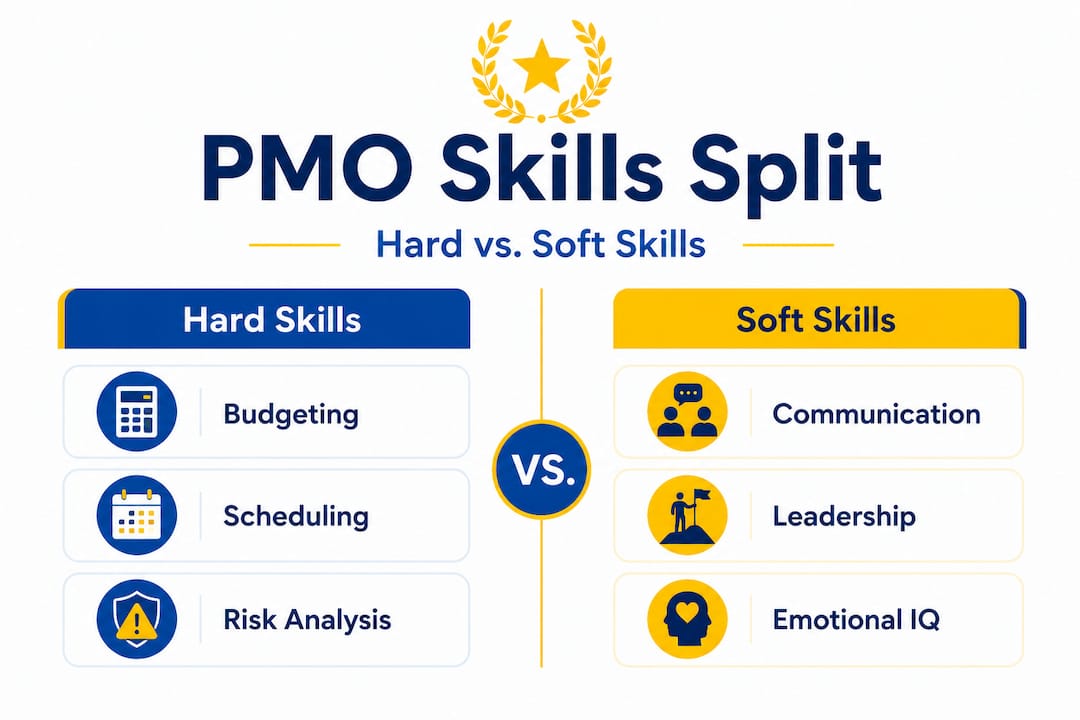
Soft skills such as communication and emotional intelligence are not secondary to technical ability. They are equally critical. A PMO who can read a Gantt chart but cannot read the room will lose the trust of their project managers quickly.
Pro Tip: When evaluating your own skill gaps, map yourself against all three columns in that table. Most professionals over-index on hard skills and underestimate how much their soft skill gaps are costing them at the leadership level.
Project managers with next-generation skills are 1.4 times more effective at achieving key project outcomes. Those next-generation skills include adaptive leadership, systems thinking, and ethical judgment, none of which appear in a standard PMP exam. For PMOs operating in public sector or international development contexts, sector-specific compliance knowledge around donor funding regulations adds another layer of technical depth that separates candidates in competitive hiring.
Understanding the full scope of project management also means recognizing when leadership skills outweigh technical knowledge in determining outcomes.
Practical strategies PMOs use to drive project success
Knowing what the role requires is one thing. Executing it across a portfolio of complex, fast-moving projects is another. The best PMOs operate with a consistent set of practices that keep their teams focused and their projects on track.
Breaking large projects into phases prevents burnout and reduces the risk of catastrophic failure. When a project is treated as one monolithic effort, a single delayed workstream can derail the entire timeline. Phasing creates natural checkpoints where the team can reassess, realign, and course-correct.
Early decision-role clarity and visible leader presence also significantly improve project outcomes. Teams surface problems faster when they know who makes the call and when they believe that leader is paying attention.
Here are the most effective practices consistent among high-performing PMOs:
- Establish a weekly communication rhythm. Brief, structured updates at the team level prevent information gaps from widening into project-level misalignments.
- Use visual progress tools. Simple dashboards or kanban boards give everyone a real-time read on project status without requiring lengthy status reports. Visual progress tools also maintain alignment across large teams.
- Create a culture of early issue reporting. The cost of surfacing a problem in week two is always lower than discovering it in week eight. PMOs who punish bearers of bad news get fewer early warnings.
- Standardize templates across the portfolio. A consistent project management plan format reduces ramp-up time when managers rotate between projects and makes portfolio-level reporting faster.
- Leverage software that fits the team’s actual workflow. The most powerful tool is the one the team actually uses. PMOs that impose complex enterprise software on small teams often see adoption collapse within six weeks.
Here is a quick reference on how common project management methodologies align with organizational needs:
| Methodology | Best suited for | PMO application |
|---|---|---|
| Waterfall | Fixed-scope, sequential projects | Construction, manufacturing, compliance-heavy sectors |
| Agile/Scrum | Iterative, evolving deliverables | Software development, product teams |
| Hybrid | Mixed scope and delivery cadence | Large organizations with diverse project types |
| PRINCE2 | Structured governance requirements | Government and public sector projects |
Mastering PMO leadership skills also means knowing which methodology to apply to which project rather than defaulting to a single approach for everything.
My take on what actually makes a PMO effective
I have seen a consistent pattern in how organizations misuse the PMO title, and it costs them. They hire a technical expert, hand them a senior title, and expect the project office to run itself. It does not. What I have learned from watching PMO offices succeed and fail is that the differentiator is almost never technical expertise. It is behavioral.
The PMOs who consistently deliver are the ones who treat communication as a core deliverable, not a soft nicety. They know that an 11% loss of investment from poor project performance is not a methodology failure. It is a leadership and visibility failure. Someone did not catch the early signals, or they caught them and did not act.
What I find underrated in this role is ethical judgment. The principles of ethical leadership shape how PMOs handle resource conflicts, competing stakeholder demands, and the uncomfortable moments when timeline pressure pushes against quality standards. The PMOs who navigate those moments well earn trust that no certification can manufacture.
My honest advice: treat your certifications as your entry ticket, not your competitive advantage. Your competitive advantage is how you lead under pressure, how honestly you communicate risk, and how well you develop the people working for you.
— Optiostation
The right tools make the PMO job manageable
Running a project management office without the right software is like managing a Roman legion with verbal orders and no maps. You need visibility, structure, and speed across everything happening at once.

Optiostation is built exactly for that kind of coordination challenge, whether you are a young professional stepping into your first PMO role or an experienced officer managing a full project portfolio. Its task, team, and time management features give you the command structure to track multiple workstreams without losing the details that matter. For an in-depth look at the software options that support PMO-level oversight and reporting, the best task management software guide on Optiostation walks you through the tools worth considering for every stage of your project career. You can also explore practical advice on tracking tasks at work when you are juggling multiple projects and deadlines simultaneously. The right tool does not just save time. It gives you the confidence to lead with clarity.
FAQ
What is a project management officer?
A project management officer is a senior or mid-level professional responsible for overseeing a project management office, governing project standards, and ensuring multiple projects are delivered on time and within budget. The seniority of the role varies significantly by organization size and sector.
How does a project management officer differ from a project manager?
A project manager leads a single project from start to finish, while a project management officer oversees the system, teams, and frameworks that govern multiple projects across an organization. The PMO role is broader in scope and typically more senior.
What certifications are recommended for a project management officer?
The PMP (Project Management Professional) is the most widely recognized certification for PMO roles. The CAPM is a common starting point for those earlier in their career. Supplementing these with skills in adaptive leadership and ethical decision-making further improves effectiveness.
What are the key KPIs for a project management officer?
PMOs are typically measured on project delivery rates, budget adherence across the portfolio, team retention, and talent development outcomes within the project office.
What is the average salary of a senior project management officer in the US?
Senior-level project management officers in the US earn an average of $218,000, with the range sitting between $170,000 and $280,000 depending on industry and company size.
Recommended
- Understanding the Role of Project Management in Success – Optio Station: Best Project Management App for Prioritization
- Master project manager tasks to boost team success – Optio Station: Best Project Management App for Prioritization
- Understanding Project Management Tips for Success – Optio Station: Best Project Management App for Prioritization
- Project Management Plan Checklist: Powering Team Productivity – Optio Station: Best Project Management App for Prioritization
