

The best product prioritization technique is the one that matches the evidence you have. Use RICE when you have a large backlog and real reach data, ICE when you need fast scores for experiments, MoSCoW when a release date is fixed, value vs. effort when you want a quick visual, and weighted scoring when stakeholders disagree on what matters. This guide explains how each works, how to build a prioritization matrix, and how to avoid the mistakes that make scores misleading.
TL;DR
- Prioritization is deciding which features, improvements or initiatives to tackle first so the most value reaches users and the business.
- RICE, ICE, MoSCoW, Kano, value vs. effort and weighted scoring answer different questions. Pick by backlog size, data and deadline, not by popularity.
- A prioritization matrix is just items in rows, criteria in columns, and a score per cell. The 2×2 effort-impact grid is the fastest version.
- Scores are only as good as the evidence behind them. Gather customer signal first, then score.
- Small backlogs and early discovery often need no formal framework at all.
Table of Contents
- What product prioritization is and why it matters
- The main product prioritization techniques
- How the techniques compare
- How to build a product prioritization matrix
- How to choose the right technique
- Mistakes that undermine prioritization
- Using these techniques outside a product team
- Our perspective
- Put your priorities where you work
- FAQ
- Sources
What product prioritization is and why it matters
Product prioritization is the process of deciding which features, improvements or initiatives should be tackled first to deliver the most value to users and the business. Every team has more ideas than time. A technique gives you a shared, explicit way to say “this first, that later, and that not now.”
It is also hard. In a 2022 industry survey, 22% of product managers named prioritization their biggest hurdle, more than any other part of the job. The reason is simple: every request feels urgent to the person who made it.
A framework does not make the decision for you. It makes your reasoning visible, so teammates can challenge the inputs instead of arguing about opinions. One product leader quoted in a roadmap prioritization collection put it well: people want to know why they are doing a body of work. Frameworks help you rank work inside a strategy you have already chosen. They do not choose the strategy for you.
The main product prioritization techniques
There are dozens of named methods, but a handful cover most real situations. The NN/g overview of prioritization methods lists the impact-effort matrix, the feasibility-desirability-viability scorecard, RICE, MoSCoW and Kano as common choices. Here is how each one works in practice.
RICE: Reach, Impact, Confidence, Effort
RICE was developed at Intercom. You multiply Reach, Impact and Confidence, then divide by Effort to get one score per item.
- Reach: how many people the item touches in a set period.
- Impact: how much it moves the goal for each of them.
- Confidence: how sure you are of your own estimates, as a percentage.
- Effort: the work required, usually in person-weeks.
The confidence factor is what makes RICE honest. A shiny idea with weak evidence gets pulled down automatically. RICE shines on large backlogs where you have usage numbers. For a full walkthrough, see our RICE prioritization method guide, or try the one-week RICE pilot on five backlog items.
ICE: Impact, Confidence, Ease
ICE is RICE’s lighter cousin. It ranks impact, confidence and ease and multiplies the three values into a score. Teams choose it for its simplicity. With no reach figure to estimate, you can score twenty ideas in a single meeting, which makes ICE a good fit for growth experiments and quick tests.
The trade-off is that ease and impact are judgment calls. Score as a group and write down why, so the numbers do not drift.
MoSCoW: Must, Should, Could, Won’t
MoSCoW sorts release scope into Must, Should, Could and Won’t Have categories. It does not produce a ranked list. It produces an agreement: what must ship for the release to make sense, and what is explicitly out. That makes it the right tool when the date is fixed and the scope is negotiable. Our practical guide to the MoSCoW method shows how to run the sorting session.
Kano model: delight versus basics
The Kano model was developed in the 1980s by Professor Noriaki Kano at Tokyo University of Science. It classifies features by how customers perceive their presence or absence and the satisfaction that follows. Some features are basics people only notice when missing. Others are performance features where more is better. A few are delighters nobody expected.
Kano needs customer survey data, so it suits teams that can ask users directly. It is less about ranking and more about understanding what kind of value each feature creates.
Value vs. effort
This framework scores features on value to the customer and organizational effort. Lean teams that want a lightweight approach often choose it. You plot each item on a grid. High value, low effort items go first. Low value, high effort items go to the bottom. It is the fastest route to a visual conversation.
Weighted scoring
Weighted scoring lets you define your own criteria, such as strategic fit, revenue potential or risk, and give each a weight. As airfocus describes it, this makes it a highly customizable model for complex decisions with several stakeholders. It is the technique behind most prioritization matrices, covered next.
How the techniques compare
| Technique | Best for | Inputs needed | Output |
|---|---|---|---|
| RICE | Large backlogs with usage data | Reach, impact, confidence, effort | Ranked numeric list |
| ICE | Experiments, fast triage | Impact, confidence, ease | Ranked numeric list |
| MoSCoW | Fixed-date releases | Team and stakeholder agreement | Four scope buckets |
| Kano | Understanding customer satisfaction | Survey responses | Feature categories |
| Value vs. effort | Quick visual sorting | Rough value and effort estimates | 2×2 grid |
| Weighted scoring | Stakeholders disagree on criteria | Custom criteria and weights | Ranked numeric list |
How to build a product prioritization matrix
A prioritization matrix gives you visual insight into which tasks to complete first. The most common type is a 2×2 framework with axes such as effort and impact, where items are plotted to show their relative ranking. A weighted matrix goes a step further, and you can build either in an hour.
The 2×2 version
- List every candidate item on its own card or line.
- Agree on what “impact” and “effort” mean for this round. Impact might mean retention. Effort might mean engineer-weeks.
- Place each item on the grid as a team, not alone.
- Start with the high-impact, low-effort quadrant. Plan the high-impact, high-effort items as larger bets. Question everything else.
The weighted version
You list items as rows and criteria as columns, assign weights to the criteria, and score each item. Multiply each score by its weight and sum the results to compare ideas.
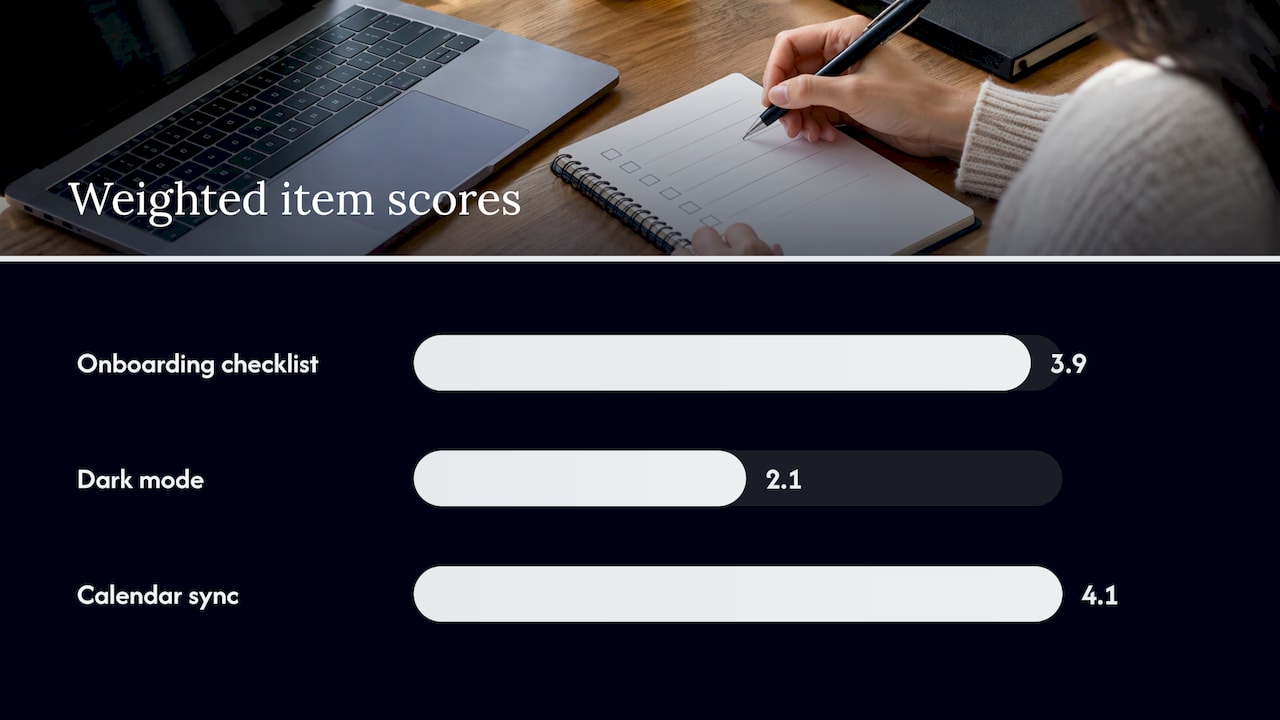
A worked example with three criteria, weighted 50% user value, 30% strategic fit, 20% ease, each scored 1 to 5:
| Item | User value (50%) | Strategic fit (30%) | Ease (20%) | Weighted score |
|---|---|---|---|---|
| Onboarding checklist | 4 | 3 | 5 | 3.9 |
| Dark mode | 2 | 1 | 4 | 2.1 |
| Calendar sync | 5 | 4 | 2 | 4.1 |
The math: calendar sync is (5 x 0.5) + (4 x 0.3) + (2 x 0.2) = 4.1. The checklist is (4 x 0.5) + (3 x 0.3) + (5 x 0.2) = 3.9. Dark mode lands at 2.1. The numbers are close at the top, which is a useful signal: discuss those two items instead of treating 4.1 against 3.9 as a verdict.
For more variations on this format, read our feature prioritization matrix guide.
How to choose the right technique
Start from your situation, not from the framework. A comparison of frameworks suggests ICE for experiments, RICE for backlogs of 15 or more items with quantitative reach data, and MoSCoW for scope negotiation within a release or sprint.
A second practitioner guide adds two more rules of thumb: use weighted scoring when stakeholders disagree on criteria, and use no framework for small backlogs under 8 items with good alignment, or during discovery when you have no data yet.
A quick decision path:
- Fewer than 8 items and the team agrees? Just order them and move on.
- A fixed release date? Run MoSCoW to agree on scope.
- Testing many small ideas fast? Use ICE.
- Big backlog with usage data? Use RICE.
- Arguments over what “important” means? Build a weighted matrix so the criteria are visible.
- Unsure what customers value? Run a Kano survey first.
You can also combine them. A common pattern is MoSCoW to set the release boundary, then RICE or ICE to rank items inside the Should and Could buckets. For more on ordering a live backlog, see our guide to product backlog prioritization techniques.
Mistakes that undermine prioritization
A tidy spreadsheet can hide weak thinking. Watch for these.
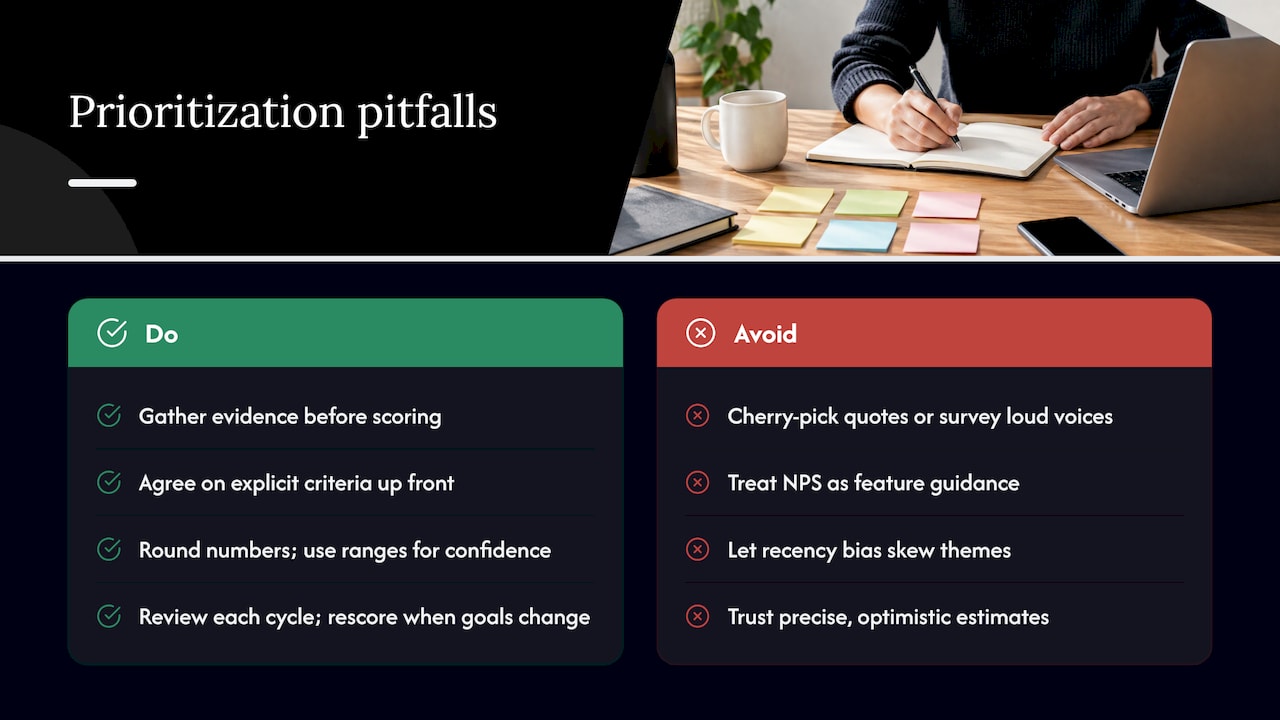
Scoring before gathering evidence. Research on feature prioritization recommends an evidence layer before scoring: customer interviews, support tickets and sales calls collected in one place, so the inputs reflect real signal instead of memory.
Listening only to the loudest voices. The same source warns about cherry-picking supportive quotes, surveying only the loudest customers, treating NPS as feature guidance and letting recency bias skew themes. Agree on explicit criteria up front to reduce that bias.
False precision. A RICE score of 47.3 looks scientific, but its inputs are estimates. Round your numbers, use ranges for confidence, and treat near-ties as ties.
Underestimating effort. The planning fallacy, first described by Kahneman and Tversky in 1979, is the tendency to underestimate how long a task will take. One write-up on setting priorities notes that even experienced leaders who pad estimates may see projects run two to three times longer than planned. If your effort numbers are always optimistic, your scores will be too.
Never revisiting the list. Priorities should be re-evaluated as new user feedback comes in, competitors launch updates or internal goals shift. A practical rhythm: review the top of the list at every planning cycle, and rescore fully when a goal changes.
Using these techniques outside a product team
The same logic works for personal and student projects. A group assignment, a side project or a first job all have more tasks than hours. An effort-impact grid sorts a to-do list as well as it sorts a roadmap, and MoSCoW is a clean way to decide what a project group must hand in by the deadline.
If that is your situation, these guides adapt the methods to everyday workloads:
- Prioritization techniques in agile for student productivity
- The agile prioritization matrix for students
- A college student’s guide to better tasks
Our perspective
We built Optio around a simple idea: a prioritization method only works if you actually use it on a Tuesday afternoon with a full inbox. Most people do not need a thirty-factor model. They need a place where tasks, deadlines and goals sit together, so ranking them takes a minute instead of an hour.
That is why we think of the app as your second-in-command. You are the Centurion. You set the strategy, and Optio keeps the list in order: color-coded life aspects keep school, work and personal tasks visible side by side, smart reminders surface what is due, and Google Calendar integration puts the plan next to your real schedule.
We are an indie-built app and we shape it with feedback from our community. When a technique like MoSCoW or an effort-impact grid helps you decide, we want your task list to be the place where you act on that decision. We think simple, flexible tools beat complicated ones that nobody opens.
Optiostation
Put your priorities where you work
A ranking that lives in a spreadsheet tends to go stale. Optio is a mobile app for task, team and time management built for college students and young professionals. It combines task management, team collaboration, time tracking, goal setting, project organization, color-coded life aspects, smart reminders, hashtag-based search and Google Calendar integration. Core features are free to use.
Try sorting your next week with an effort-impact grid, then keep the result in the app. You can start from the Optio Station home page or read how task management software fits into a daily routine.
FAQ
What is the easiest product prioritization technique to start with?
Value vs. effort is the easiest. You only need two rough estimates per item and a simple grid, and the result is visual enough to discuss with a team in one sitting. Once you want a ranked list, move to ICE, which adds a confidence score.
What is the difference between RICE and ICE?
RICE multiplies Reach, Impact and Confidence and divides by Effort. ICE multiplies Impact, Confidence and Ease, with no reach figure. RICE suits large backlogs where you have usage data, while ICE is quicker and better for experiments.
How is a prioritization matrix different from a framework like RICE?
A matrix is the format: items against criteria, or a 2×2 grid. A framework like RICE is a fixed set of criteria and a formula you can place in that format. A weighted matrix lets you choose your own criteria, while RICE gives you four set ones.
Do small teams need a formal framework?
Often not. Practitioner guidance suggests skipping a formal framework when the backlog has fewer than 8 items and the team is aligned, or during early discovery when there is no data. Order the list by judgment and add structure when the backlog grows or opinions split.
How often should priorities be reviewed?
Review the top of the list every planning cycle, and rescore when something material changes, such as new user feedback, a competitor launch or a shift in goals. A list that is never revisited drifts away from reality.
Sources
- 9 Prioritization Frameworks & Which to Use, Product School
- Prioritization glossary entry, ProductPlan
- 5 Prioritization Methods in UX Roadmapping, NN/g
- Kano Model: Feature Prioritization for Customer Satisfaction
- Product Prioritization Frameworks: 12 Common Models, Aha!
- Weighted decision matrix, airfocus
- How to use a prioritization matrix, LogRocket
- Product Prioritization Frameworks Compared, Fygurs
- Feature prioritization, PM Read
- Roadmap Prioritization, Lenny’s Wiki
- How to Prioritize Product Features, Dovetail
- The art and science of setting priorities, MPB Tech
