

Over 70% of team projects fail due to unclear task delegation and poor communication. Whether you’re leading a student group assignment or coordinating your first workplace project, mastering core project manager tasks can transform chaos into smooth collaboration. This guide breaks down the essential tasks that prevent confusion, boost efficiency, and help your team deliver results on time.
Table of Contents
- Introduction To Project Manager Tasks
- Core Project Manager Tasks Explained
- How Project Manager Tasks Improve Team Collaboration
- Common Misconceptions In Project Management Tasks
- Frameworks And Models For Project Manager Tasks
- Practical Implementation For Students And Young Professionals
- Conclusion: Bringing It All Together
- Upgrade Your Project Management Skills With Optio Station
Key takeaways
| Point | Details |
|---|---|
| Core PM tasks drive success | Planning, communication, delegation, and risk management form the foundation of effective project leadership. |
| Clear delegation prevents failure | Proper task assignment eliminates 70% of project failures caused by role confusion. |
| Multitasking kills productivity | Switching between tasks reduces efficiency by 40%, making focused work essential. |
| Frameworks organize complexity | Agile and Scrum structures help teams adapt quickly and maintain 30% better task responsiveness. |
| Digital tools boost delivery | Task management apps increase on-time completion rates by over 20% through better coordination. |
Introduction to project manager tasks
Project manager tasks are the core activities that shape how teams work together and deliver results. For students juggling group assignments and young professionals navigating their first team projects, understanding these tasks means the difference between stressed chaos and confident execution.
These tasks matter because most team environments lack natural coordination. Without someone actively managing the workflow, projects drift off course. Core project manager tasks create structure that keeps everyone aligned and productive.
The four fundamental categories every project leader should master include:
- Planning: Setting clear goals, timelines, and resource allocation before work begins
- Communication: Establishing information flow so everyone knows what’s happening and why
- Delegation: Assigning specific responsibilities to team members based on skills and capacity
- Risk management: Identifying potential problems early and creating backup plans
Each task builds on the others. Strong planning makes delegation easier. Clear delegation improves communication. Better communication reveals risks before they become crises. Together, these activities form a system that helps teams work smarter, not harder.
For college students managing group projects or young professionals leading their first initiatives, mastering these basics provides a competitive edge. You’ll stand out as someone who brings order to confusion and helps teams achieve what they set out to accomplish.
Core project manager tasks explained
Successful project leadership depends on how well you execute specific, measurable tasks. Understanding what each task involves and why it matters helps you prioritize your time and energy effectively.
Planning consumes focus upfront. Project managers typically invest 10-20% of their time defining objectives, mapping schedules, and outlining deliverables. This front-loaded effort prevents confusion later. For a student group project, planning means deciding who researches what sections, when drafts are due, and how you’ll combine individual work into a cohesive final product.
Delegation prevents most failures. Research shows that proper task assignment prevents 70% of project failures linked to unclear roles. When everyone knows exactly what they’re responsible for, accountability becomes automatic. Young professionals leading workplace initiatives should document assignments clearly using effective task delegation steps to avoid the “I thought you were handling that” scenario.

Risk management anticipates problems. Identifying potential issues early reduces failure rates by 30-40%. This doesn’t mean endless worry, it means asking “what could go wrong?” and having backup plans. If your team member might miss a deadline, knowing this possibility lets you build in buffer time or redistribute work proactively.
Pro Tip: Create a simple task assignment document at project kickoff listing every deliverable, its owner, and due date. Share it where everyone can access and update it, this single action eliminates most coordination confusion.
Real examples bring these concepts to life. Check out diverse project management examples showing how these core tasks apply across different scenarios. The principles stay consistent whether you’re organizing a campus event or launching a marketing campaign.
How project manager tasks improve team collaboration
When you execute project manager tasks well, the entire team dynamic shifts. People work together more smoothly, produce higher quality results, and actually enjoy the collaboration process instead of dreading it.
Clear communication channels eliminate guesswork. Effective communication boosts productivity by up to 25% because team members spend less time clarifying expectations and more time doing actual work. Setting up regular check-ins, shared documents, and explicit update protocols means everyone stays aligned without constant interruptions.
Organized task management builds trust. When team members see that responsibilities are distributed fairly and progress is tracked transparently, they feel more invested in outcomes. Structured task management increases collaboration quality by about 50% because people know their contributions matter and connect to the bigger picture.
Focused work beats scattered effort. Many students and young professionals believe juggling multiple tasks simultaneously shows productivity. The opposite is true. Giving team members single, clear priorities lets them deliver better results faster. This focused approach also reduces the stress that comes from constantly switching mental gears.
The collaboration improvements extend beyond immediate project success. Teams that experience well-managed projects develop stronger working relationships, making future collaborations even smoother. You build a reputation as someone who makes teamwork work, a valuable asset in both academic and professional settings. Explore more strategies in this comprehensive team collaboration guide to deepen your coordination skills.
Common misconceptions in project management tasks
Several widespread myths about project management actually sabotage team effectiveness. Recognizing and rejecting these misconceptions helps you lead more successfully.
Myth: Multitasking improves productivity. The data tells a different story. Multitasking reduces efficiency by approximately 40% because your brain needs time to refocus each time you switch tasks. What feels like productive busyness is actually cognitive friction that slows everything down.
“The brain is not designed to do two things at once. When you think you’re multitasking, you’re actually switching between tasks very rapidly, and every switch costs you time and accuracy.”
For project managers, this means assigning team members focused blocks of work rather than spreading them thin across multiple simultaneous demands. You’ll get better results by letting people concentrate.
Myth: Project management equals micromanagement. Many students and young professionals avoid taking on project leadership because they worry about becoming controlling or annoying. Real project management is the opposite of micromanagement. It’s about clear delegation, trust, and coordination, not hovering over every detail. You set expectations, provide resources, and check progress at reasonable intervals.
Myth: Delegation is optional for small projects. Even tiny team efforts benefit from explicit task ownership. The “we’ll figure it out as we go” approach leads to duplicated effort, missed deadlines, and resentment when one person ends up doing most of the work. Taking five minutes to divide responsibilities saves hours of confusion later.
These misconceptions persist because they feel intuitive or match what we see in rushed, poorly managed projects. Breaking free from them requires conscious effort but pays immediate dividends in smoother collaboration and better outcomes.
Frameworks and models for project manager tasks
Structured frameworks give you ready-made systems for organizing project manager tasks. Two approaches dominate modern project management, each with distinct strengths suited to different situations.
Agile emphasizes adaptability. This framework breaks projects into short cycles where you plan, execute, review, and adjust. Agile increases task responsiveness by about 30% because teams can pivot when priorities shift or new information emerges. For student projects where requirements often evolve as you learn more, Agile’s flexibility prevents wasted effort on obsolete plans.
Scrum defines clear roles and rhythms. This framework assigns specific responsibilities like Scrum Master who removes obstacles and Product Owner who prioritizes work. Teams work in fixed sprints, typically one to four weeks, with daily brief check-ins. Scrum excels when you need tight coordination and regular deliverables, making it ideal for professional projects with hard deadlines.
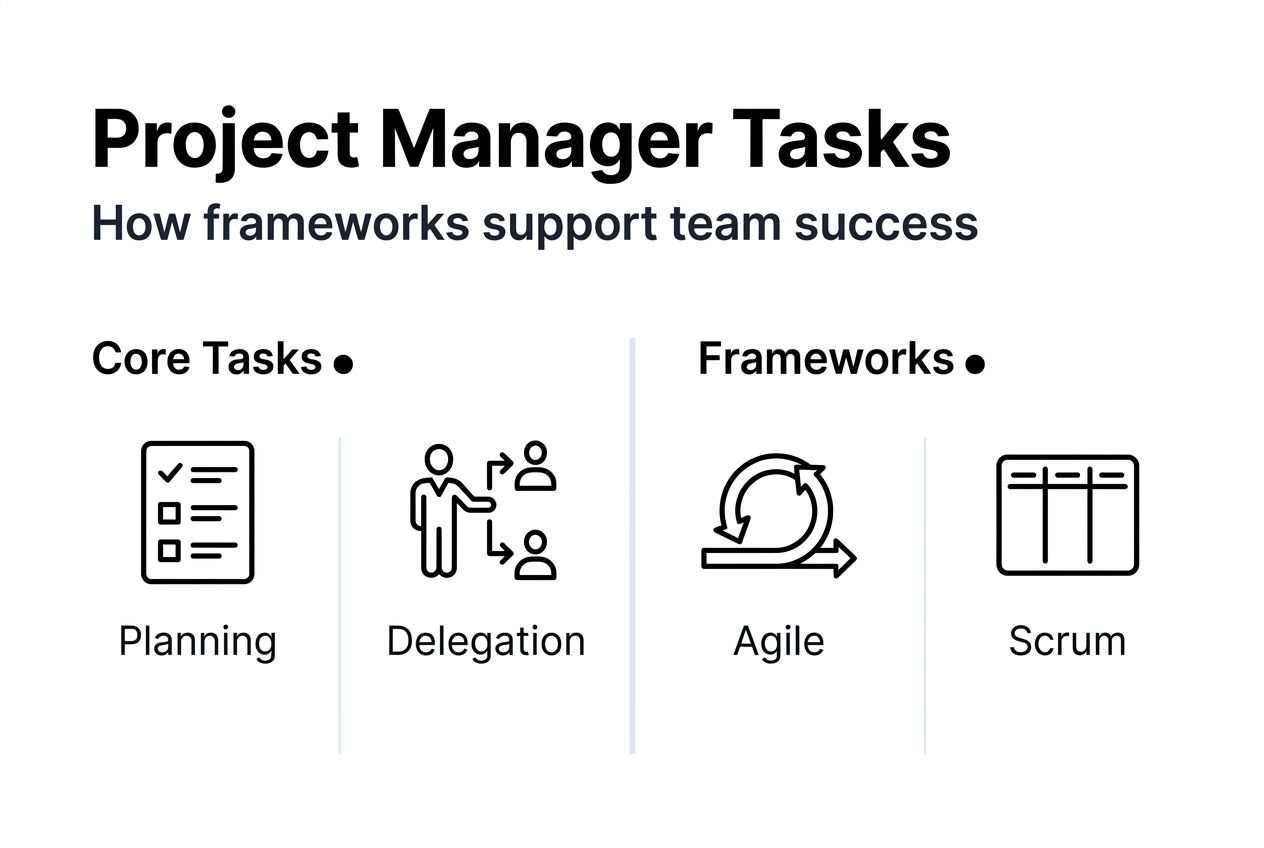
| Framework | Best For | Key Strength | Typical Cycle |
|---|---|---|---|
| Agile | Evolving requirements, creative work | Flexibility to change direction | 2-4 week iterations |
| Scrum | Defined deliverables, team coordination | Clear roles and daily alignment | 1-4 week sprints |
Prioritization prevents delays. Regardless of framework, identifying which tasks matter most reduces project delays by about 35%. Use tools like an Agile prioritization matrix to classify work by urgency and impact. This clarity helps teams focus energy where it counts most.
Choosing between frameworks depends on your context. Student projects with unclear requirements benefit from Agile’s adaptability. Workplace initiatives with specific deliverables and stakeholders work better with Scrum’s structure. Learn strategies to prioritize multiple projects when you’re juggling several initiatives simultaneously.
Practical implementation for students and young professionals
Theory matters less than execution. Here’s how to apply project manager tasks in real academic and professional settings, starting today.
Step-by-step implementation process:
- Define clear objectives: Write down exactly what success looks like. “Complete the group presentation” is vague. “Create a 15-slide deck covering three case studies, due March 20” is actionable.
- Create a realistic timeline: Work backwards from your deadline, building in buffer time for reviews and unexpected issues. Assume tasks take 20% longer than your first estimate.
- Delegate based on strengths: Match tasks to team members’ skills and interests when possible. Someone who hates public speaking shouldn’t present, even if it’s “fair” rotation.
- Set up progress tracking: Use shared documents, project boards, or simple spreadsheets where everyone updates their status. Visibility prevents surprises.
- Schedule regular check-ins: Brief weekly meetings keep everyone aligned without eating excessive time. A 15-minute sync beats three hours of confusion later.
- Address problems immediately: When issues surface, tackle them fast. Ignored problems compound into crises.
Pro Tip: Hold your first team meeting focused entirely on clarifying expectations and documenting task assignments. This single session prevents 80% of later confusion and resentment.
Digital tools amplify effectiveness. Using task delegation steps with supporting software increases on-time completion by over 20%. Consider these approaches for managing team tasks efficiently:
- Time management apps help individuals track their commitments and deadlines
- Project planning apps provide visual boards showing who’s doing what and when
- Team management software integrates communication, file sharing, and progress tracking in one place
- Scheduling tools coordinate meetings without endless back-and-forth emails
Start simple. You don’t need expensive enterprise software for most student or entry-level professional projects. A shared spreadsheet and weekly video call can work wonders when paired with clear task assignments and consistent follow-through.
Conclusion: bringing it all together
Mastering project manager tasks transforms how teams collaborate and deliver results. Planning sets clear direction. Communication keeps everyone aligned. Delegation ensures fair workload distribution and accountability. Risk management prevents small problems from becoming project killers.
These tasks aren’t bureaucratic overhead, they’re practical tools that reduce stress and improve outcomes. Students who apply them stand out in group settings and build leadership skills employers value. Young professionals who execute them well earn reputations as reliable coordinators who make projects succeed.
Start with one project. Define objectives clearly, delegate explicitly, and track progress transparently. You’ll notice the difference immediately, less confusion, fewer last-minute scrambles, better final deliverables. Build these skills deliberately and you’ll become the person everyone wants on their team.
Upgrade your project management skills with Optio Station
Ready to put these project manager tasks into action? Optio Station gives students and young professionals powerful yet simple tools designed specifically for team coordination and task management.
Our platform helps you prioritize work, delegate clearly, and track progress without overwhelming complexity. Whether you’re organizing a campus project or coordinating your first professional initiative, Optio Station provides the structure that turns good intentions into completed deliverables.
Explore proven strategies to manage tasks effectively with our comprehensive task management software guide. Join other Centurions using Optio as their second-in-command for project success. Check out our team collaboration guide to transform how your team works together.
FAQ
What are the most important tasks of a project manager?
Planning, communication, delegation, and risk management form the core. Planning establishes objectives and timelines. Communication keeps information flowing. Delegation assigns clear responsibilities. Risk management anticipates and addresses potential problems before they derail progress.
How can students improve team collaboration using project manager tasks?
Start by clearly assigning specific roles and responsibilities to each team member at project kickoff. Maintain open communication through regular check-ins and shared progress tracking. Use the strategies in this team collaboration guide to coordinate effectively without micromanaging.
Why is multitasking harmful in project management?
Switching between tasks forces your brain to refocus repeatedly, reducing efficiency by 40% while increasing errors. Focused work on single priorities produces better results faster. Assign team members concentrated blocks of work rather than spreading them across simultaneous demands.
What project management frameworks are best for student projects?
Scrum works well when you need clear roles, regular deliverables, and tight deadlines. Agile suits projects where requirements might evolve as you learn more. Use an Agile prioritization matrix to identify critical tasks, and apply prioritization techniques when juggling multiple commitments.
Recommended
- How to Manage Team Tasks Effectively for Success – Optio Station: Best Project Management App for Prioritization
- How to Organize Multiple Projects for Maximum Productivity – Optio Station: Best Project Management App for Prioritization
- Command Log – Optio Station: Best Project Management App for Prioritization
- Task Delegation Steps for Effective Team Management – Optio Station: Best Project Management App for Prioritization
- Master Team Scheduling Best Practices for Success – WhenNOT Blog
- Project Management | Outsprinter
