

Making better decisions comes down to three moves: clarify what you actually value, run a short structured process instead of winging it, and check for at least one common bias before you commit. You can get started by naming your top decision criterion, picking a framework below, and running a quick bias check. This guide covers fast frameworks, a structured process, debiasing evidence, and small practice habits you can use.
TL;DR:
- Use a fast rule for routine, low stakes choices, a weighted matrix for complex tradeoffs, and a default plus check for recurring decisions.
- For medium stakes, cap information gathering at 10 to 20 minutes, weigh each option’s likely consequences, set an action deadline, and review the choice afterward.
- Field research found one debiasing session with feedback reduced confirmation bias by around 29%, with effects lasting at least two months.
- Before committing to a project, use silent writing before group discussion in a pre mortem, then assign each major risk an owner and mitigation.
Table of Contents
- Three Decision Frameworks for Different Stakes
- A Seven-Step Process for Medium-Stakes Choices
- Daily Habits That Reduce Decision Fatigue
- What Research Says About Reducing Bias
- How to Run a 30-Minute Pre-Mortem
- A Copy-Ready Decision Checklist
- Practicing Decision Skills Without Overrating Outcomes
- Why Process Beats Outcome, Every Time
- Turning These Habits Into a Routine With Optiostation
- FAQ
- Sources
- Recommended Reading
Three Decision Frameworks for Different Stakes
Not every choice deserves the same amount of thought. Matching the framework to the stakes saves time on small calls and protects you from rushing the big ones.
- The fast rule: Use a simple if-then heuristic (“if it seems affordable and I’ll use it regularly, buy it”) for low-stakes, repeatable choices like daily purchases or routine scheduling.
- The weighted matrix: List your options as rows and your criteria (cost, time, risk, alignment with goals) as columns, score each cell, and total the weights for decisions like choosing a job offer or an apartment.
- Default plus check: Pick your usual choice, then ask one sanity question (“has anything changed that would make this wrong?”) for recurring decisions like weekly meal planning or routine vendor choices.
A work example: a team lead facing a vendor renewal might run the weighted matrix because the stakes and number of criteria justify it. A personal example: deciding what to eat for lunch is a fast-rule decision, not a spreadsheet exercise.
The trade-off is speed versus thoroughness. The fast rule takes seconds but can miss nuance; the weighted matrix takes longer but surfaces trade-offs you’d otherwise ignore. Default plus check sits in between, useful when a decision repeats often enough that full analysis every time would waste effort.
A Seven-Step Process for Medium-Stakes Choices
When a decision is too important for a fast rule but doesn’t need a full project plan, a compact process keeps you moving without skipping the parts that matter.
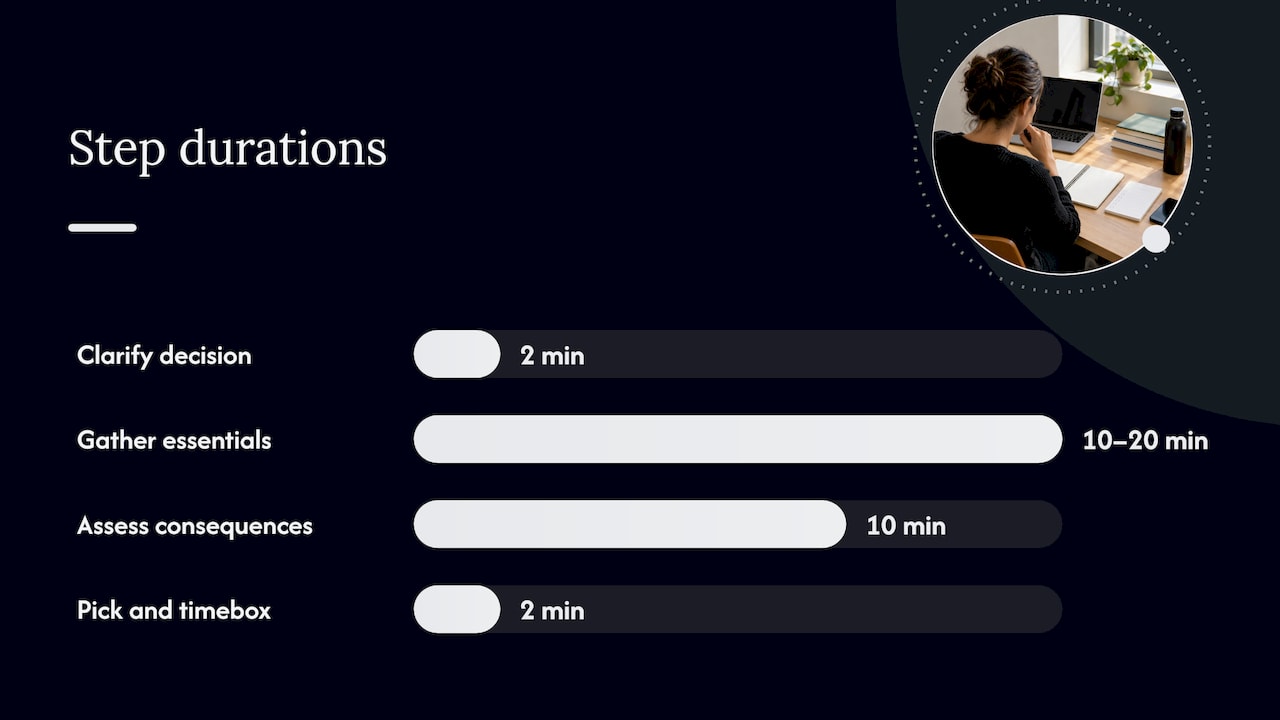
- Clarify the decision: Write the actual question in one sentence (2 minutes).
- Gather essentials: Collect only the information you need to decide, not everything available (10 to 20 minutes).
- Set constraints and criteria: Name your must-haves and your nice-to-haves.
- Generate alternatives: List several options, even if one seems obviously best.
- Assess consequences: Estimate the realistic upside and downside of each option (10 minutes).
- Pick and timebox: Choose, and set a hard deadline for acting on it (2 minutes).
- Review after implementation: Revisit the decision later and note what you’d change.
A practical example: choosing between internship offers might take some time using this sequence, mostly spent gathering information and assessing consequences.
Pro Tip: Set an explicit deadline for each step, not just the final choice. Parkinson’s Law means a decision will expand to fill whatever time you give it, so a 10 minute cap on “gather essentials” keeps you from endless research that never changes the outcome.
This structure echoes guidance in Decision Making at Work: A Practical Guide for 2026, which breaks the same steps down for workplace scenarios.
Daily Habits That Reduce Decision Fatigue
Decision fatigue builds when you make too many small choices in a row, and your judgment quality drops as the day goes on. Routines protect your mental bandwidth for the decisions that actually need it.
- Morning journaling: Spend a little time naming your top priority before checking email or messages.
- Decision batching: Group similar choices (what to wear, what to eat, which emails to answer) into set times instead of deciding them one by one all day.
- Energy-aligned scheduling: Put your hardest decisions in your highest-energy hours, whatever those are for you.
- Small rituals: Use a fixed checklist or routine for recurring low-stakes choices so you don’t relitigate them daily.
Start with habit stacking: attach a new habit to one you already do, like journaling right after your coffee. Track success simply, by counting how many days you followed the routine, not by judging the outcome of every decision it produced.
What Research Says About Reducing Bias
Short, well-designed training can meaningfully reduce certain decision errors, and the effect isn’t limited to the lab. Single-session, feedback-rich debiasing training reduced hypothesis-confirming biases by around 29% in field settings, according to research from Wharton, with effects that persisted for at least two months. Related work summarized by Insights@Questrom found that abstract-level, game-based training can transfer to real decision making by reducing confirmatory hypothesis testing, the tendency to only look for evidence that supports what you already believe.
A separate problem is outcome bias: judging a decision’s quality by how it turned out rather than how it was made. Replication research on this effect found it holds even among people who explicitly say outcomes shouldn’t matter, which is why separating process from result matters when you review past choices.
- Practice with abstract-level bias lessons rather than one-off tips.
- Vary your practice scenarios instead of repeating the same case.
- Schedule periodic refreshers to revisit the skills.
- Bring a short debiasing exercise into team meetings before high-stakes calls.
How to Run a 30-Minute Pre-Mortem
A pre-mortem asks you to imagine a decision has already failed, then work backward to find out why, before you commit. Practitioner research shows the technique reliably surfaces specific, actionable risks and reduces overconfidence, and the exercise can be completed in a focused session.
- Stipulate failure: State that the project has failed, then work backward to identify possible causes.
- Silent writing: Everyone writes down possible reasons for the failure alone, with no talking.
- Round-robin sharing: Go around the group reading one reason at a time, no discussion yet.
- Cluster items: Group similar reasons together on a board or shared doc.
- Pick the most important: Vote or discuss to narrow down the most likely failure causes.
- Assign mitigations: Give each important risk an owner and a concrete next step.
The most common mistakes are letting a senior person speak first, which anchors everyone else’s answers, and skipping silent writing, which lets louder voices dominate. Use a pre-mortem before project launches, hiring decisions, or any commitment you can’t easily reverse.
Pro Tip: Run the pre-mortem before you’ve emotionally committed to the plan. It works best when the group can still imagine being wrong.
A Copy-Ready Decision Checklist
A full process isn’t always necessary. For most daily and weekly choices, a short pause does the job.
A generic weighted-criteria template works for bigger calls: list your options, list the criteria that matter to you, score each option on each criterion, and total the scores.
For quicker moments, run this brief pause before committing:
- Does this align with my stated values or goals?
- Do I have an obvious information gap I’m ignoring?
- Have I checked for at least one likely bias?
- Is there a real deadline, or am I inventing urgency?
- What’s my fallback if this doesn’t work?
- Who owns the next action?
Use the checklist for quick decisions; use the fuller process from the structured-process section above for anything with lasting consequences. Readers who want more templates can see essential decision making tools for better life choices.
Practicing Decision Skills Without Overrating Outcomes
Weekly micro-practice builds the skill faster than waiting for real high-stakes decisions to teach you. Try mini-cases (quick hypothetical scenarios), journaling your process notes right after a real decision, and asking a peer to review your reasoning, not just your result.
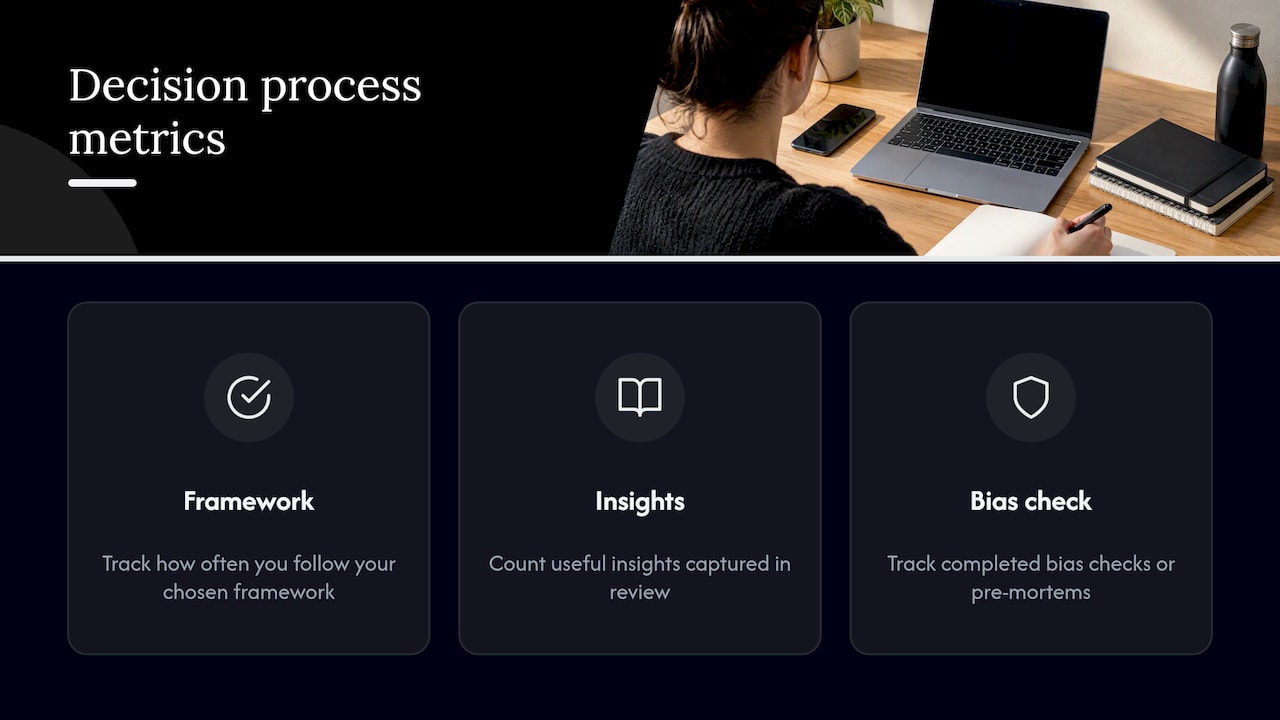
Track process metrics instead of just outcomes: how often you actually followed your chosen framework, how many useful insights you captured in review, and how often you ran a bias check or pre-mortem before committing.
Pro Tip: Block a recurring slot for this practice. A one-page checklist from Bocconi Test prep practice offers a useful model for structuring short, repeatable decision drills.
Why Process Beats Outcome, Every Time
A good decision made with a bad result is still a good decision. Our editorial work on decision processes keeps pointing back to the same truth: tracking your reasoning, not just your wins, can help you learn from decisions. Try a process-based practice this week and see what changes.
— Optiostation
Turning These Habits Into a Routine With Optiostation
We built our app around the habits this guide covers: task batching and deadline tracking that can help turn a one-time framework into a daily routine. If you want to put the seven-step process or the weekly practice habit into an actual schedule, explore our app or check out Prioritization Station.
FAQ
How do I train myself to make better decisions?
Short, repeated practice works better than occasional big efforts. Use mini-cases, journal your reasoning after real decisions, and run periodic debiasing refreshers, since research on debiasing training suggests that practice can help reinforce these skills.
How to make better decisions?
Clarify your values first, then match the decision to a framework: a fast rule for low-stakes choices, a weighted matrix for complex ones, or a seven-step timeboxed process for anything in between. Add one bias check, such as a pre-mortem, before committing to anything hard to reverse.
What are the 4 R’s of decision-making?
There’s no single, widely agreed-upon “4 R’s” framework in the decision-making literature, and definitions vary by source. If you’ve seen this term elsewhere, it likely refers to a specific program or author’s model rather than a standard concept.
What are the 5 important steps when making good decisions?
Common step-based models include clarifying the decision, gathering relevant information, identifying alternatives, weighing consequences, and choosing while setting a review point. This guide’s seven-step process expands on that same structure with explicit timeboxing.
Sources
- Marketing
- Outcomes Affect Evaluations of Decision Quality: Replication and Extensions of Baron and Hershey’s (1988) Outcome Bias Experiment 1 | International Review of Social Psychology
- Leadingrounds
- Training to reduce cognitive bias may improve decision making after all | Insights@Questrom
Recommended Reading
For deeper research on debiasing and outcome bias, see the Wharton field study and the pre-mortem practitioner writeup. For team-level framing, see Leaderly’s take on decision making versus problem solving.
