

When you need to decide at work, the fastest reliable method is a 5–10 minute checklist paired with one analytic frame. SIOP’s 2024 evidence-based strategies confirm this approach works even under pressure, Bain’s RAPID framework handles the team side, and Optiostation lets you save the templates so the routine actually sticks.
Start here — four moves you can make right now:
-
Timebox it. Set a short, explicit timer before you start thinking to prevent decisions from expanding to fill excessive time. Decisions expand to fill available time.
-
Generate two alternatives. Research shows most decisions consider only a single option. Force at least one more.
-
Score quickly. Rate each option on three criteria (1–5 scale). The highest total wins unless a hard constraint kills it.
-
Commit and log it. Write one sentence on what you decided and why. That sentence becomes your post-decision reference.
Table of Contents
- What does a good decision-making process look like at work?
- How does RAPID help small teams stop debating and start deciding?
- Which analytic tool fits your decision right now?
- How do cognitive biases hurt your decisions and what stops them?
- When should you escalate, slow down, or move fast?
- How do you run a post-decision review that actually improves future choices?
- How do you fold decision routines into your daily workflow?
- Key Takeaways
- Building decision confidence takes repetition, not talent
- Optiostation keeps your decision routines from slipping
- Sources and further reading
What does a good decision-making process look like at work?
The SIOP white paper recommends a short pre-decision checklist that can be completed quickly for low-to-medium stakes choices. Here is the sequence:
- Define the outcome. One sentence: “I need to choose X so that Y happens by Z date.”
- List at least two alternatives. If you only have one option, you do not have a decision — you have a default.
- Pick three criteria. Cost, time, and quality cover most workplace choices. Add a fourth only if it genuinely changes the ranking.
- Score each option using a simple rating scale per criterion. Multiply by a weight if one criterion matters more than the others.
- Write the main disadvantage of your top scorer. This single step catches overconfidence before you commit.
- Decide and record. One sentence. Done.
Mini scoring example — choosing a project tool:
| Option | Cost (×2) | Ease (×1) | Integration (×2) | Total |
|---|---|---|---|---|
| Option A | — | 4 | 6 | — |
| Option B | 6 | 5 | — | — |
| Option C | 4 | 3 | 4 | 11 |
Option B wins. But before committing, write its main disadvantage: “Requires a two-week setup.” If that kills the timeline, revisit Option A.
Pro Tip: If you can only think of one alternative, set a two-minute timer and brainstorm three more — even bad ones. The act of generating options forces your brain out of default mode and often surfaces a better path.
When to use this checklist vs. a longer process: use it for decisions you can reverse within a week and that affect only your own work or a small team. Anything with budget authority, legal implications, or cross-department impact needs more structure.
How does RAPID help small teams stop debating and start deciding?
Ambiguity about who decides is the most common reason team decisions stall. Bain’s RAPID framework fixes that by assigning five roles before the conversation starts.
RAPID roles in one line each:
- Recommend ®: Gathers information and proposes the decision with supporting rationale.
- Agree (A): Must formally sign off — their veto can block the decision.
- Perform (P): Executes once the decision is made; should be consulted early on feasibility.
- Input (I): Provides relevant data or perspective but does not have veto power.
- Decide (D): Makes the final call and owns the outcome.
Mini-case: A student project team of five needs to pick a research methodology by Friday. The team lead is R, the faculty advisor is A, the two researchers are I, the presenter is P, and the project manager is D. With roles assigned Monday, the team stops looping the same debate and the decision lands Wednesday.
Meeting or ticket checklist — paste this into any task:
- Decision title and due date
- Who is R / A / P / I / D (one name per role)
- Information the R needs before recommending
- Acceptance criteria (what “done” looks like)
- Escalation path if A and D disagree
Harvard Business Publishing’s 2022 research confirms that clarity about decision rights improves both timeliness and quality — the RAPID ticket above takes three minutes to fill out and eliminates most of the back-and-forth.
Which analytic tool fits your decision right now?
Pick the method by complexity and available time. The table below maps each to its best use case.
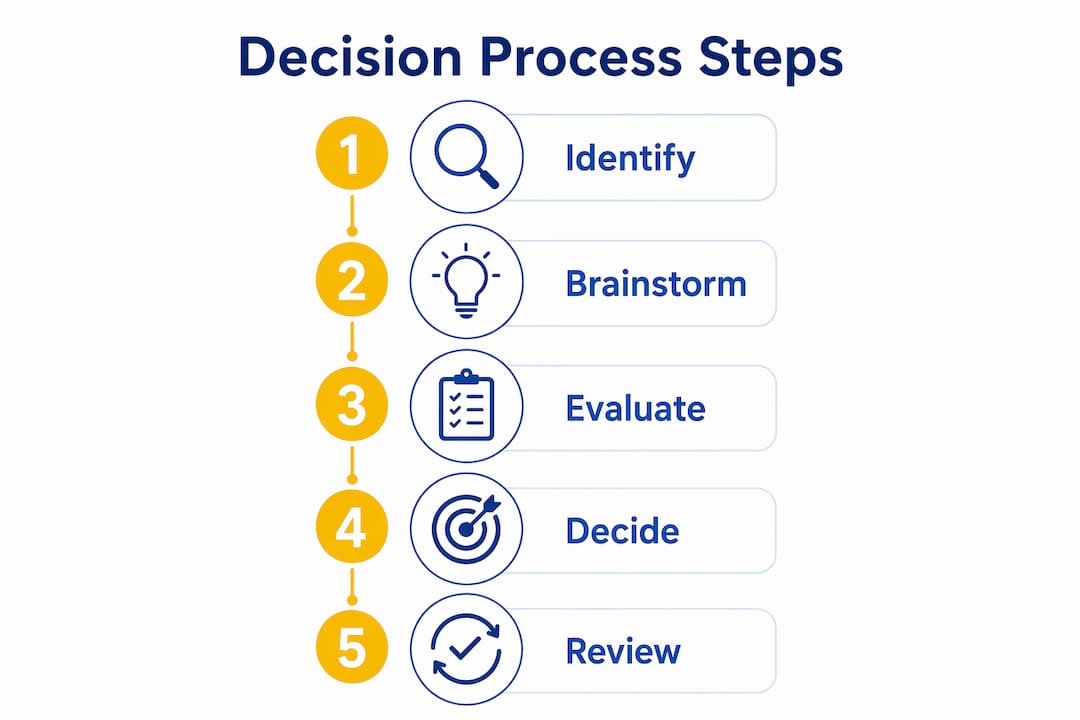
| Method | Best use case | Time to run |
|---|---|---|
| Weighted decision matrix | Multiple options with competing priorities | 10 minutes |
| Additive Feature Model | Scoring many features across options | 15 minutes |
| Elimination by Aspects (Tversky) | Quickly filtering out options that fail a hard threshold | 5 minutes |
Weighted decision matrix template (copy and fill):
- List your options as column headers.
- List your criteria as row headers.
- Assign each criterion a weight (weights must sum to 10).
- Score each option per criterion (1–5).
- Multiply score × weight; sum each column. Highest total wins.
Elimination by Aspects checklist:
- Name your single most important criterion (e.g., “must cost under $50/month”).
- Eliminate every option that fails it.
- Move to the next most important criterion. Repeat until one option remains.
Worked example: You are choosing a note-taking app. Hard constraint: free tier available. Three options fail immediately. Of the two remaining, you weight collaboration (4), offline access (3), and search quality (3). Score and multiply. The winner takes under eight minutes to identify.
IMD Business School’s 2025 technical notes recommend weighted matrices specifically to activate System 2 thinking and counter bias under pressure.
How do cognitive biases hurt your decisions and what stops them?
Under pressure, your brain defaults to System 1: fast, pattern-based, and prone to shortcuts. The IMD research frames balancing System 1 intuition with System 2 analysis as a core challenge for anyone making workplace decisions.
Five biases that hit early-career professionals hardest:
- Confirmation bias: You search for evidence that supports what you already want to do.
- Anchoring: The first number or option you see pulls all subsequent judgments toward it.
- Availability bias: You overweight recent or memorable events when estimating likelihood.
- Overconfidence: You underestimate how long tasks take and how often plans fail.
- Status-quo bias: Doing nothing feels safer than choosing, even when inaction has real costs.
Mitigation checklist:
- Write down the main disadvantage of your preferred option before committing.
- Force at least one dissenting scenario to challenge assumptions.
- Build a reference class: find six similar past decisions and check their outcomes before assuming yours will be different.
- Take an outside view: ask someone not involved in the decision what they would do.
Pro Tip: Run a 10-minute pre-mortem before any decision that will take more than a week to reverse. Write “It’s six months from now and this decision failed completely — what went wrong?” Fill one page. The exercise surfaces risks your optimism was hiding.
When should you escalate, slow down, or move fast?

A 2017 Journal of Psychology study found that exhaustion and excessive demands directly reduce decision quality. That is the research case for knowing when to stop deciding and ask for help.
| Stakes / time pressure | Suggested process | Expected turnaround |
|---|---|---|
| Low stakes, reversible | Solo checklist (5–10 min) | Same day |
| Medium stakes, affects team | Analytic frame + one peer review | 1–3 days |
| High stakes, cross-functional | RAPID roles + formal sign-off | 1–2 weeks |
| Legal, financial, or irreversible | Escalate immediately | Per policy |
Escalation script (one template): “I need a decision on [topic] by [date]. The options are [A] and [B]. My recommendation is [A] because [reason]. I need your input on [specific question] to proceed.”
Rules of thumb:
- If the decision costs more than your monthly budget authority, escalate.
- If you have been thinking about it for more than twice your original timebox, slow down and get a second opinion.
- If it cannot be undone within 30 days, treat it as high stakes regardless of dollar amount.
How do you run a post-decision review that actually improves future choices?
Run the review shortly after implementation while the details are still fresh. A structured review closes the learning loop and builds the reference class you will need for future outside-view checks.
Post-decision checklist:
- What outcome did you expect vs. what actually happened?
- Which assumption was most wrong?
- Who executed well, and where did execution break down?
- What would you do differently at the decision stage?
- What would you do differently at the execution stage?
One-line scorecard template:
| Metric | Target | Actual | Variance |
|---|---|---|---|
| Primary outcome | [goal] | [result] | [+/−] |
| Time to complete | [days] | [days] | [+/−] |
| Resource used | [budget] | [actual] | [+/−] |
Store the completed scorecard in a “decisions” note or board. Over time, six or more of these entries become your personal reference class — the outside-view data that makes your next estimate far more accurate than gut feel alone.
How do you fold decision routines into your daily workflow?
Pick one routine and schedule it as a 10-minute habit tied to something already on your calendar. The habit only sticks when it has a trigger.
Habit checklist:
- Calendar block: Add a recurring 10-minute “decision log” slot at the end of each workday or study session.
- Template saved: Keep your weighted matrix and elimination checklist in a pinned note, task comment, or Optiostation template so you never start from scratch.
- Weekly review: Once a week, scan your open decisions. Anything older than your original timebox needs a new deadline or an escalation.
- Quick post-decision capture: Within 24 hours of any medium-stakes decision, write the one-sentence record (what, why, expected outcome).
For low-friction setup, paste your RAPID ticket template into your team’s task tool as a reusable ticket type. Optiostation’s template and task management features let you save decision checklists alongside your tasks so the routine lives where your work already happens. Pair this with the academic productivity workflow approach if you are managing coursework and work commitments simultaneously.
Key Takeaways
Structured decision routines — a short checklist, one analytic frame, and clear team roles — consistently produce better workplace decisions than unguided deliberation, regardless of experience level.
| Point | Details |
|---|---|
| Use a 5–10 minute checklist | SIOP research supports a short pre-decision checklist; always generate at least two alternatives. |
| Match the tool to complexity | Use Elimination by Aspects to filter fast; use a weighted matrix when multiple criteria compete. |
| Assign RAPID roles for teams | Name R, A, P, I, and D before any group discussion to prevent ownership gaps and stalled decisions. |
| Escalate by stakes, not anxiety | Escalate when a decision exceeds your budget authority or cannot be reversed within 30 days. |
| Optiostation saves the routine | Store decision templates and checklists in Optiostation so the habit runs in the flow of your work. |
Building decision confidence takes repetition, not talent
Confidence in workplace decisions grows from repeated, structured practice — not from some innate ability you either have or do not. The research from the 2017 Journal of Psychology study makes this concrete: job resources and clear processes improve decision competency more than raw ability alone.
Try this experiment: run the 5–10 minute checklist for three decisions this week and write a one-sentence record for each. At the end of the week, read them back. You will notice your framing gets sharper by the third one. And if one of those decisions turns out to be wrong, that is not a failure — it is the data point that makes your next outside-view check more accurate. Changing course after new information arrives is not weakness; it is exactly what the process is designed to allow.
Optiostation keeps your decision routines from slipping
Most decision frameworks fail not because they are wrong but because they never get used twice. Optiostation is built for exactly that gap: it lets you save your weighted matrix, RAPID ticket, and post-decision scorecard as reusable templates inside the same app where you manage your tasks and calendar.
Templates plus calendar reminders equal consistent habit formation — that is the honest mechanic behind why the routines in this guide actually stick when you use Optiostation. The app’s guides, including Optiostation’s Decision Making in Project Management: A 2026 Guide and Personal Work Goals 2026, give you the frameworks; the app gives you the place to run them daily. Students and young professionals can explore Optiostation’s task management features and set up their first decision template in under 10 minutes.
Sources and further reading
The sources below represent the strongest evidence base for the frameworks and tactics in this guide — peer-reviewed research, practitioner white papers, and primary institutional guidance.
- SIOP / SHRM white paper (2024) — Evidence-based decision strategies including the pre-decision checklist and the finding that most decisions consider only a single alternative.
- Bain & Company — RAPID framework (2023) — Primary source for role definitions and guidance on applying RAPID to high-value decisions.
- Harvard Business Publishing (2022) — Insight on how decision-making competence is spreading across organizational levels and why clear decision rights matter.
- IMD Business School technical notes (2025) — System 1 / System 2 balance and the case for weighted matrices under pressure.
- Journal of Psychology / PMC (2017) — Peer-reviewed evidence that exhaustion and job demands reduce decision competency; supports short routines and escalation rules.
- Verywell Mind — decision-making strategies — Accessible summary of the Additive Feature Model and Elimination by Aspects (Amos Tversky).
- Optiostation guides — Decision Making in Project Management: A 2026 Guide and Personal Work Goals 2026 provide applied templates that extend the frameworks above into daily task workflows.
Statistic callout: The SIOP white paper notes that many decisions are made considering only a single alternative — a finding backed by Lovallo and Sibony’s research on strategic decision quality. Forcing even one additional option is one of the highest-leverage improvements any decision maker can make.
Recommended
- Essential decision making tools for better life choices – Optio Station: Best Project Management App for Prioritization
- Decision Making in Project Management: A 2026 Guide – Optio Station: Best Project Management App for Prioritization
- Work‑Life Balance: Complete Guide for Students & Young Pros – Optio Station: Best Project Management App for Prioritization
- 7 Essential Organization Tips for Busy Professionals – Optio Station: Best Project Management App for Prioritization
