

TL;DR:
- Effective project decision making involves selecting the best action to meet objectives while clearly defining roles and frameworks. Using structured methods like MoSCoW, Weighted Scoring, and decision logs improves consistency, accountability, and outcomes. Clear authority assignment and context-aware strategies prevent delays and build team trust.
Decision making in project management is the deliberate process of selecting the best course of action to achieve project objectives effectively and efficiently. Every project, from a student capstone to a corporate product launch, runs on a chain of choices. The quality of those choices determines whether a project finishes on time, within budget, and with a team that still trusts each other. This guide covers the key decision types, proven frameworks like MoSCoW and Weighted Scoring, the standard five-step process, and practical strategies for cutting through ambiguity so your team moves forward with confidence.
What are the key types of decision making in project management?
Three types of decisions drive project success: Strategic, Tactical, and Operational. Each type operates at a different level of the project, and confusing them is one of the fastest ways to create bottlenecks.
Understanding which type of decision you face tells you who should make it and how quickly it needs to happen. A project manager who escalates every operational call to the sponsor wastes everyone’s time. One who makes strategic calls alone risks misaligning the entire project.
- Strategic decisions set the long-term direction. Examples include choosing a project methodology, selecting a vendor, or deciding whether to proceed after a major scope change. These belong to sponsors, steering committees, or senior leadership.
- Tactical decisions translate strategy into action. Choosing which features to build in the next sprint or how to redistribute work after a team member leaves falls here. Project managers typically own these.
- Operational decisions manage daily activities. Assigning tasks for the week, resolving a scheduling conflict, or approving a minor budget reallocation are operational. Team leads and individual contributors handle most of these.
Classifying decision tiers immediately prevents paralysis and improper escalation. When a team member knows their operational call does not need director approval, the project keeps moving. Build a simple decision authority matrix at the start of every project and share it with the full team. That single document eliminates a surprising number of delays.
How to apply structured decision-making frameworks to improve project outcomes
The most effective project managers do not rely on gut instinct alone. They use frameworks to structure their thinking, then apply judgment to the result. The four frameworks below cover the majority of decisions you will face.
MoSCoW prioritization
MoSCoW sorts requirements or options into four buckets: Must Have, Should Have, Could Have, and Won’t Have. It works best for feature prioritization and scope decisions. The method forces the team to agree on what is truly non-negotiable before the project starts, which prevents scope creep later.
Weighted Scoring
Weighted Scoring assigns numerical weights to evaluation criteria, then scores each option against those criteria. A vendor selection decision, for example, might weight cost at 40%, technical fit at 35%, and support quality at 25%. The option with the highest total score wins. This method makes the reasoning visible and defensible to stakeholders.
Decision Tree Analysis
A Decision Tree maps out possible choices, their outcomes, and the probability of each outcome. Decision Tree Analysis showed a better expected monetary value of +$336,000 for a delayed launch versus +$279,000 for an immediate one when integrated with MoSCoW and Weighted Scoring. That $57,000 difference would have been invisible without the tree. Combining multiple frameworks produces results that no single method can match.
Cost-Benefit Analysis
Cost-Benefit Analysis compares the total expected costs of an option against its total expected benefits. It is the right tool when a decision carries significant financial risk or when you need to justify a choice to finance teams or executives.
| Framework | Best used for | Key output |
|---|---|---|
| MoSCoW | Scope and feature prioritization | Ranked requirement list |
| Weighted Scoring | Vendor or option selection | Numeric comparison score |
| Decision Tree | Risk and financial decisions | Expected monetary value |
| Cost-Benefit Analysis | Budget justification | Net benefit figure |
Pro Tip: Balance quantitative scores with qualitative judgment. A vendor that scores highest on paper may have a poor track record with teams like yours. Use the numbers to narrow the field, then apply experience to make the final call.
What steps compose the standard decision-making process in project management?
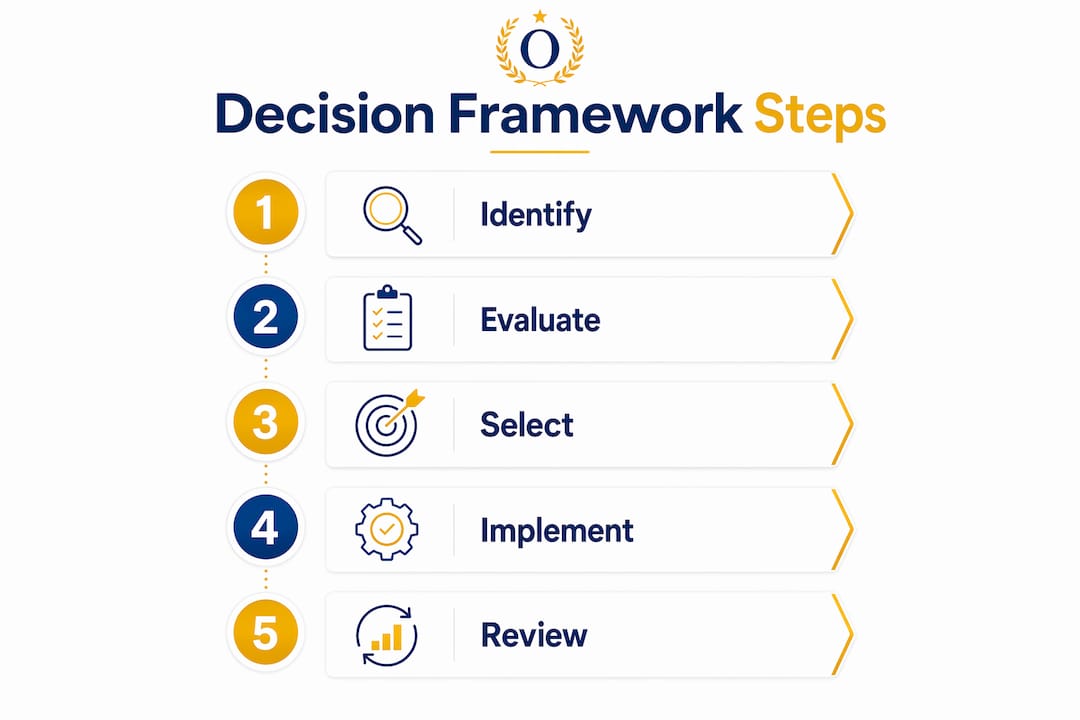
The standard decision-making process involves five steps that build accountability into every choice. Skipping steps is the most common reason decisions get revisited weeks later.
- Identify the decision. Name the specific choice that needs to be made and confirm who is responsible for making it. Vague problem statements produce vague decisions.
- Gather information. Collect data, consult subject matter experts, and review relevant project history. Validate that your sources are current and reliable before moving forward.
- Evaluate alternatives. Apply one or more frameworks from the previous section. Score each option against predefined criteria so the evaluation is consistent and repeatable.
- Implement the chosen option. Assign clear ownership, set a deadline, and communicate the decision to everyone it affects. A decision that is not communicated is not yet a decision.
- Monitor and adjust. Track the outcome against what you expected. If results diverge, adjust early rather than waiting for a formal review cycle.
Maintaining a Key Decision Log that includes rejected options reduces re-deliberation and builds stakeholder confidence. When a stakeholder asks why Option B was not chosen, you have a documented answer. That transparency saves hours of rework and prevents the team from relitigating closed questions. Log every significant decision, the alternatives considered, the criteria used, and the rationale for the final choice.
How can project managers overcome common decision-making challenges?

Ambiguity in decision authority causes decision paralysis, and it is the most common complaint project managers raise about their organizations. When no one is sure who owns a call, everyone waits. The RACI matrix solves this directly.
RACI stands for Responsible, Accountable, Consulted, and Informed. Assigning each role to a specific person for each major decision type at the start of a project eliminates the confusion that stalls teams. Addressing ambiguity through RACI assignment at project start is the most effective way to avoid paralysis. The matrix does not need to be complex. A simple spreadsheet with decision categories and names is enough.
- Responsible: The person who does the work to reach the decision.
- Accountable: The single owner who approves the final call. Only one person per decision.
- Consulted: Subject matter experts whose input is needed before the decision is made.
- Informed: Stakeholders who need to know the outcome but do not influence it.
Beyond authority clarity, avoiding a decision purposefully is sometimes the right call. Decision avoidance is valid when actionable information is lacking or when the risk of acting prematurely outweighs the cost of waiting. The key distinction is intentionality. Purposeful avoidance requires setting a review date and monitoring conditions. Passive indecision has no plan and no trigger for action.
Pro Tip: When a decision feels stuck, ask one question: “What information would make this obvious?” If that information is obtainable within 48 hours, get it. If it is not, set a deadline and decide with what you have.
Involving the right team members in decisions also speeds resolution. Teams that feel consulted commit more fully to implementation. Limit your consultation group to people with direct expertise or direct impact. Large consensus groups slow decisions without improving them.
How to adapt decision strategies for complex project environments
Not every project environment responds to the same decision approach. Diagnosing the problem context via the Cynefin framework is the necessary first step before selecting any decision method. Applying a structured analytical framework to a chaotic situation produces false confidence, not better decisions.
The Cynefin framework identifies three relevant contexts for project managers.
| Context | Characteristics | Recommended approach |
|---|---|---|
| Ordered | Clear cause and effect, predictable outcomes | Apply best practices and standard frameworks |
| Complex | Multiple interacting variables, emergent outcomes | Run small experiments, review results, adapt |
| Chaotic | No clear cause and effect, high urgency | Act to stabilize first, then analyze |
Ordered, Complex, and Chaotic systems each require tailored approaches to avoid ineffective decisions. A project manager who treats a complex environment as ordered will over-plan and under-adapt. One who treats an ordered environment as chaotic will act impulsively when a structured process would have worked.
Modern VUCA environments benefit from conditional decision language. Phrases like “No, But If” and “Yes, And” replace binary approvals with adaptive commitments. “Yes, we proceed, and we reassess at the 30-day mark” is more useful than a flat yes when conditions are shifting. Build iterative review points into your project plan so decisions can evolve as the environment changes.
Key takeaways
Effective project decisions require matching the right framework to the right context, assigning clear authority before work begins, and documenting every significant choice with its rationale.
| Point | Details |
|---|---|
| Match decision type to authority | Strategic, Tactical, and Operational decisions each require a different decision owner. |
| Use multiple frameworks | Combining MoSCoW, Weighted Scoring, and Decision Trees produces better outcomes than any single method. |
| Follow the five-step process | Identify, gather, evaluate, implement, and monitor every significant decision without skipping steps. |
| Assign RACI at project start | Clarifying who is Accountable for each decision type eliminates the paralysis that stalls teams. |
| Diagnose before deciding | Apply the Cynefin framework to identify whether your environment is Ordered, Complex, or Chaotic before choosing a method. |
The uncomfortable truth about project decisions
Most project managers I have worked with treat decision-making as a skill they already have. They do not. They have opinions and experience, which is not the same thing. The difference shows up when a project hits genuine ambiguity and the team freezes because no one documented who owns the call or what criteria matter.
The habit that changed everything for me was writing down the “why” behind every significant decision, not just the “what.” When a stakeholder questions a choice three months later, the log answers them in 30 seconds. Without it, the team re-analyzes the same problem from scratch. Neglecting to document decision criteria leads to inefficient re-analysis when decisions are questioned, and that cost compounds across a project’s lifetime.
Speed matters too, but not the way most people think. The goal is not to decide fast. The goal is to decide at the right moment with enough information. Purposeful avoidance, a clear RACI, and a defined review date give you permission to wait without losing momentum. That combination of structure and flexibility is what separates project leaders who build trust from those who just manage tasks.
The teams I have seen thrive are not the ones with the most process. They are the ones where every member knows exactly which decisions they own and feels safe making them. Build that clarity first. The frameworks and logs support it, but they cannot replace it.
— Optiostation
Optiostation: built for project managers who decide with clarity
Keeping decisions, tasks, and team communication in separate places is one of the most common reasons projects stall. Optiostation is a mobile app built for students and young professionals who need one place to track priorities, assign ownership, and move work forward without losing context.

As your Optio, your second-in-command, the app helps you log decisions, organize tasks by priority, and keep your team aligned across every phase of a project. Centurions who use Optiostation report spending less time in status meetings and more time on work that matters. If you are ready to put structure behind your choices, start with the best task management tools guide to find the right setup for your team.
FAQ
What is decision making in project management?
Decision making in project management is the structured process of identifying, evaluating, and selecting the best course of action to meet project objectives. It spans the full project lifecycle, from scope definition to post-delivery review.
What are the three main types of project decisions?
Strategic, Tactical, and Operational decisions are the three core types. Strategic decisions set direction, Tactical decisions implement strategy, and Operational decisions manage daily work.
How does the RACI matrix help with managerial decision making?
The RACI matrix assigns Responsible, Accountable, Consulted, and Informed roles to each decision type. Assigning RACI at project start eliminates authority ambiguity and prevents the paralysis that delays teams.
When is it acceptable to avoid making a decision?
Avoiding a decision is valid when actionable information is lacking or when acting prematurely carries high risk. Purposeful avoidance requires a set review date and clear conditions that would trigger action.
What is a Key Decision Log and why does it matter?
A Key Decision Log records each significant decision, the alternatives considered, and the rationale for the final choice. It reduces re-deliberation, builds stakeholder confidence, and prevents teams from re-analyzing closed questions.
Recommended
- Engineering project manager guide: frameworks and strategies – Optio Station: Best Project Management App for Prioritization
- 7 Key Examples of Project Management You Can Learn From – Optio Station: Best Project Management App for Prioritization
- Head of Project Management: Skills to Succeed in 2026 – Optio Station: Best Project Management App for Prioritization
- How to Organize Multiple Projects for Maximum Productivity – Optio Station: Best Project Management App for Prioritization
