

Effective leadership for project managers means one thing above all: creating the conditions for your team to do their best work, then getting out of the way. A meta-analytic review synthesizing 41 studies confirmed that transformational leadership correlates more strongly with project success than transactional approaches. Optiostation’s EE-AAT framework puts that finding to work inside a task app you can open right now.
Three actions you can take in the next hour:
- Create a project kickoff card in your app and assign every task an owner before the first meeting.
- Add a “Blockers” label and commit to clearing at least one blocker by end of day.
- Write a two-sentence project goal at the top of your project card so every teammate knows the “why,” not just the “what.”
Pro Tip: Set a recurring weekly sync in your app calendar on day one. Teams that schedule their check-ins at kickoff tend to maintain better meeting discipline.
Table of Contents
- What is the difference between leadership and management in projects?
- Which leadership style works best for project teams?
- What project management leadership skills matter most?
- Repeatable routines that keep small projects on track
- How do you lead a project inside your task app?
- Short exercises to build leadership skills on your next project
- Common pitfalls that quietly kill small-project leadership
- How do you keep your team motivated throughout a project?
- How should project leaders manage time and prioritization?
- How do you set clear goals and expectations for your team?
- Key Takeaways
- What actually matters in small-project leadership
- Optiostation puts these routines in your pocket
- Useful sources and further reading
What is the difference between leadership and management in projects?
Leadership and management are both required for a project to succeed, but they pull in different directions. Management keeps the train on the tracks. Leadership decides where the train is going and convinces everyone to care about the destination.
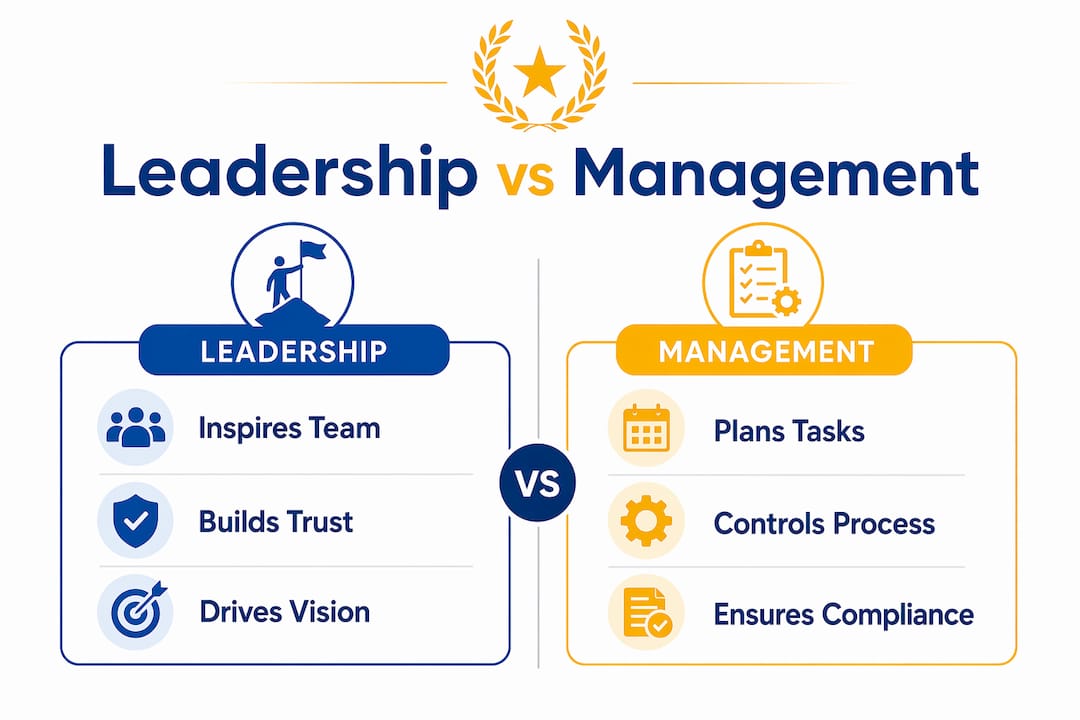
| Leadership does | Management does |
|---|---|
| Sets vision and motivates the team | Plans tasks, schedules, and budgets |
| Builds trust and psychological safety | Tracks progress and controls scope |
| Influences without formal authority | Enforces process and escalates risks |
Knowing when to switch modes is the real skill. A rough guide:
- Lead when the team is confused about purpose, morale is low, or a decision requires buy-in.
- Manage when deadlines are tight, scope is drifting, or a deliverable needs a clear owner.
- Both at once during kickoff: set the vision (leadership) and assign every task an owner (management).
For deeper context on stakeholder management and influence, the two roles overlap most visibly when you are negotiating priorities with people outside your team.
Which leadership style works best for project teams?
Start with situational leadership as your default, and layer in transformational behaviors. No single style fits every phase of a project, and capable PMs adapt by context rather than defaulting to one approach.
The meta-analytic finding above backs this up: transformational behaviors (inspiring, coaching, connecting work to meaning) produce stronger outcomes than purely transactional ones (rewards, penalties, compliance). But a team in crisis needs clear direction first, not a motivational speech.
| Style | When to use it | Sample phrase for your app |
|---|---|---|
| Directive | Crisis, new team, unclear roles | “Here’s exactly what we need by Friday: [task + owner + deadline].” |
| Coaching | Mid-project, growing team members | “You’ve got this. What’s one thing I can remove so you can move faster?” |
| Transformational | Low motivation, big milestone ahead | “This deliverable matters because it directly affects [end user]. Let’s make it count.” |
| Transactional | Governance, compliance, final delivery | “Checklist complete = we ship. Let’s walk through it together.” |
Pro Tip: Post your current project phase in the app description field (“Phase: Delivery — directive mode this week”). It signals to teammates what kind of communication to expect from you.
What project management leadership skills matter most?
The top five, ranked by impact on small-team projects:
- Communication clarity. Translating complex delivery into honest, audience-specific actions is the single most impactful skill a PM can develop. In practice: write every update in two parts — what happened, what’s next.
- Blocker removal. A PM who quickly clears blockers earns significant trust. Tag blockers in your app the moment they surface; don’t let them age.
- Emotional consistency. Unpredictable emotional swings force teammates to manage you instead of the work. Keep your tone steady in written updates and meetings alike.
- Decision-making speed. Indecision stalls small teams faster than bad decisions. Make the call, document it, and move on.
- Power skills. Darrel Hubbard’s analysis in the PM World Journal frames empathy, systems thinking, and creativity as the skills that separate project managers from project leaders in volatile conditions.
One micro-practice per skill this week:
- Clarity: Rewrite your last project update so it fits in three bullet points.
- Blocker removal: Pick one open blocker and close it before tomorrow morning.
- Emotional consistency: Before your next meeting, write one sentence describing the tone you want to set.
- Decision-making: Use a 60-second rule: if a decision affects only your team and is reversible, make it on the spot.
- Power skills: Read one article on technical project manager training and identify one new skill to practice this month.
Repeatable routines that keep small projects on track
Four core routines cover most of what a small project needs:
- Kickoff (60 min): Align on goals, assign owners, set communication norms.
- Weekly sync (20 min): Review progress, surface blockers, confirm priorities.
- Blocker blitz (10 min, as needed): Clear one blocker per person before the week ends.
- Retrospective (30 min, end of project or sprint): What worked, what didn’t, one change next time.
Kickoff agenda (copy into your app):
- Project goal in one sentence
- Roles and owners (who decides what)
- Communication channel and update cadence
- Definition of done for the first milestone
Weekly sync agenda:
- Status: green / yellow / red per workstream
- Top blocker per person (30 seconds each)
- One decision to make before next week
Retro template (three columns): What went well | What slowed us down | One change we commit to
Psychological safety is the reason retros work. When teammates feel safe raising problems, issues surface early enough to fix. Record retro outcomes in your app so patterns become visible across projects.
How do you lead a project inside your task app?
The simplest workflow: one project card per initiative, three label types (Priority, Blocker, Decision), and a weekly update pinned to the top.

Three copyable templates:
Kickoff card:
Project: [Name] | Goal: [One sentence] | Owner: [Name] | Deadline: [Date] | Status: Active
Blocker card:
Blocker: [Description] | Raised by: [Name] | Date raised: [Date] | Owner to resolve: [Name] | Target clear date: [Date]
Weekly update format:
Week of [Date] | Done: [2–3 items] | In progress: [2–3 items] | Blocked: [item + owner] | Decision needed: [yes/no]
Step-by-step walkthrough inside Optiostation:
- Create a project and add the kickoff card as the first task.
- Tag every task with an owner using the assign feature.
- Add a “Blockers” label to any task that is stuck; review this label every morning.
- Pin the weekly update card to the top of the project board.
- Use the Command Log to record every decision with a date and rationale.
Pro Tip: Never let a blocker card sit for more than 48 hours without an update. If it’s aging, escalate it in the weekly sync, not in a private message.
Short exercises to build leadership skills on your next project
Six drills, each under 60 minutes:
- Communication clarity drill (15 min): Write a project update for three audiences: your teammate, your professor or manager, and a newcomer. Compare the three versions and identify what changed.
- Decision sprint (10 min): List five open decisions on your project. Make a call on each one in under two minutes. Document the rationale in one sentence.
- Blocker-clearing challenge (20 min): Pick the oldest open blocker. Map every dependency blocking it and identify one action you can take unilaterally to move it forward.
- Situational style switch (30 min): Run your next team meeting in coaching mode: ask questions instead of giving answers. Note which teammates responded differently.
- Feedback loop drill (15 min): After your next deliverable, ask one teammate: “What’s one thing I could have communicated more clearly?” Record the answer in your app.
- Conflict resolution simulation (45 min): With a partner, role-play a disagreement over task priority. Practice the three-step flow: listen fully, restate their position, then propose a compromise.
Pro Tip: Log your drill results in your app after each exercise. Patterns across three or four sessions will show you exactly which skill to prioritize next.
For students looking to translate these exercises into resume language, NueCareer’s skills tool helps convert leadership experiences into concrete job application language.
Common pitfalls that quietly kill small-project leadership
The single most damaging pattern is ignoring blockers until they become crises. By the time a blocker surfaces in a status meeting, it has usually been sitting unresolved for days.
Red flags to watch for in your app and meetings:
- Tasks with no owner assigned (accountability gap)
- Blocker cards older than 48 hours with no update
- Teammates who stop commenting or updating their tasks
- Decisions that keep getting deferred to “next week”
- Meeting notes that never get posted to the app
Five quick fixes when trust or momentum has slipped:
- Clear one visible blocker publicly and announce it to the team.
- Reassign any ownerless task within 24 hours.
- Run an unscheduled 10-minute check-in and ask each person one question: “What’s in your way?”
- Post a transparent status update, even if the news is bad. Honesty rebuilds credibility faster than silence.
- Acknowledge the slip in the next retro and name one specific change.
How do you keep your team motivated throughout a project?
Motivation on small teams is less about grand gestures and more about consistent, specific recognition. Name what someone did well, not just that they did well. “You caught that scope gap before it cost us a week” lands differently than “great job.”
Connect every task to the project’s purpose. When teammates understand why their piece matters, they bring more to it. Keep the project goal visible at the top of your app board so it stays front of mind, not buried in a document nobody opens.
Build relationship capital before you need it. Consistent investment in teammates during calm periods means you have goodwill to draw on when things get hard. Leaders who only show up during crises find the well dry exactly when they need it most.
How should project leaders manage time and prioritization?
The most useful frame for time management in project leadership is separating your time into two buckets: work on the project and work on the team. Both matter, and both compete for the same hours.
A practical approach is to dedicate a portion of your weekly project time to team-facing work (check-ins, blocker clearing, feedback). The rest goes to delivery. When delivery pressure spikes, that 20% is the first thing leaders cut, and it is usually the reason the next crisis happens.
Prioritize by impact and reversibility. High-impact, irreversible decisions get your full attention. Low-impact, reversible ones get the 60-second rule from the skills section above. Most project decisions fall into the second category.
How do you set clear goals and expectations for your team?
Vague goals produce vague results. Write every project goal as a specific outcome: not “improve the presentation” but “deliver a 10-slide deck reviewed by all three teammates by Thursday at noon.” The PMI’s 12 project management principles list effective leadership as a driver of positive project outcomes, and specific goal-setting is where that leadership shows up first.
Set expectations on three things at kickoff: what done looks like, who decides when it’s done, and what the team does when something blocks progress. Those three answers prevent most of the conflicts that derail small projects.
Review goals at every weekly sync. Not to police progress, but to catch drift early. A goal that no longer reflects reality should be updated, not ignored.
Key Takeaways
Strong leadership for project managers involves consistently communicating clearly, removing blockers promptly, and building trust proactively.
| Point | Details |
|---|---|
| Communication clarity is #1 | Write every update as: what happened, what’s next — two parts, every time. |
| Transformational beats transactional | A meta-analytic review of 41 studies found transformational leadership correlates more strongly with project success. |
| Situational style wins | Adapt between directive, coaching, and transformational modes by project phase and team experience. |
| Blockers kill momentum | Clear at least one blocker per day; never let a blocker card age past 48 hours without an update. |
| Optiostation in practice | Use Optiostation’s kickoff card, blocker label, and Command Log to run every routine in this guide from one app. |
What actually matters in small-project leadership
Most advice on project leadership focuses on frameworks and certifications. The PMP credential is worth pursuing, and Darrel Hubbard’s work on the project manager/leader hybrid is genuinely useful reading. But the gap between knowing the frameworks and actually leading a team well is almost always a behavioral one, not a knowledge one.
The leaders who earn their team’s trust fastest are not the ones with the best plans. They are the ones who do what they said they would do, clear the thing that was in everyone’s way, and stay calm when the project hits a rough patch. Emotional consistency is underrated as a leadership skill precisely because it is invisible when it is working.
For students and young professionals, the real opportunity is this: small projects are low-stakes practice grounds for high-stakes habits. The communication discipline, the blocker-clearing reflex, the habit of writing decisions down — these compound. A student who runs three group projects with genuine leadership intentionality arrives at their first job with more practical leadership experience than most people accumulate in years of formal work.
Optiostation puts these routines in your pocket
Optiostation is built specifically for students and young professionals who want to lead small projects without the overhead of enterprise tools. The app’s Roman-themed structure positions you as the Centurion: the one who sets direction, assigns the work, and keeps the mission moving.
Three steps to get started:
- Create your project and paste the kickoff card template from Section 6 into your first task.
- Add the blocker label and assign it to any task that is stuck before your first sync.
- Run your first blocker blitz using the task tracking workflow to surface and clear your first obstacle as a team.
Every routine in this guide maps directly to a feature inside Optiostation. The best task management software is the one your team actually uses. Start with one project, one template, and one weekly sync.
Useful sources and further reading
Short annotations on the key sources behind this guide:
- Transformational vs. transactional leadership meta-analysis — 41 studies, 64 effect sizes. The strongest academic backing for prioritizing transformational behaviors in project work.
- APM: Project team management and leadership — Covers team ethos, psychological safety, and why a culture of trust and openness is widely reported as critical for project success. Authoritative UK-based professional body; principles apply globally.
- Project Management Formula: Essential Leadership — Practitioner-level guidance on communication clarity and influence without authority. Directly applicable to small teams.
- Darrel Hubbard, PM World Journal — The project manager/leader hybrid argument and the case for power skills. Useful for students thinking about long-term career development.
- PMI: Essential Leadership Skills for Project Managers — Covers the five differences between managing and leading, plus the core competencies (motivating, communicating, influencing, team building). The foundational reference for this topic.
- PMI: 12 Project Management Principles — The official PMI standard. Leadership is listed as a core principle, with specific guidance on adapting style to team needs.
- Optiostation: Build a communication plan — Practical templates for formatting updates for different audiences; pairs directly with the communication clarity skill in Section 4.
- Project management portfolio templates — Useful for students who want to document their leadership experience across multiple projects.
- Project manager salary trends — For readers motivated by long-term career context: median salary data and six-year trend for project manager roles in the US.
Recommended
- How to Manage Team Tasks Effectively for Success – Optio Station: Best Project Management App for Prioritization
- How to Organize Multiple Projects for Maximum Productivity – Optio Station: Best Project Management App for Prioritization
- 7 Steps Project Planning Checklist for Students and Professionals – Optio Station: Best Project Management App for Prioritization
- Head of Project Management: Skills to Succeed in 2026 – Optio Station: Best Project Management App for Prioritization
