

Imagining a goal activates the same neural pathways as actually doing it. That single fact changes everything about how you should approach your productivity routine. Goal visualization involves mentally rehearsing success by creating vivid, multisensory mental images of achieving your goals, and most students and young professionals skip it entirely. That’s a mistake. This article breaks down the science, the methods, the pitfalls, and the daily routines that make visualization a real productivity weapon, not just a motivational poster cliché.
Table of Contents
- What is goal visualization and why does it work?
- Process vs. outcome visualization: what’s the difference?
- Pitfalls and best practices: visualization for ongoing goals
- Rituals and routines: daily visualization for lasting productivity
- Combining visualization with modern task management
- Next steps: take your productivity to the next level
- Frequently asked questions
Key Takeaways
| Point | Details |
|---|---|
| Visualization activates brain pathways | Mentally imaging your goals stimulates similar neural regions as real experience, boosting focus and confidence. |
| Process > outcome visualization | Visualizing the steps and obstacles to reach your goals works far better than imagining the outcome alone. |
| Pair visualization with action | Successful productivity requires linking visualization to concrete actions, routines, and task management tools. |
| Avoid common pitfalls | Exclusive outcome-focused visualization can reduce motivation; use WOOP or SMART strategies to avoid traps. |
| Rituals sustain progress | Daily five-minute visualization rituals combined with tracking and real tasks drive meaningful improvement. |
What is goal visualization and why does it work?
Goal visualization is the practice of creating detailed mental images of yourself succeeding at a specific goal. Not daydreaming. Not wishful thinking. Deliberate, structured mental rehearsal. When you do it correctly, your brain treats the imagined experience as nearly real, firing the same neural circuits it would during the actual event.
The neuroscience here is striking. Brain activation during visualization mirrors real experience, which improves performance, confidence, motivation, and focus. A neural strengthening study confirms that repeated mental rehearsal physically strengthens the brain pathways tied to a skill or behavior. This is why elite athletes have used visualization for decades, and why it translates directly to academic and professional performance.
For students, this means better study goal performance and stronger self-efficacy before exams. For young professionals, it means walking into presentations or negotiations with a mental edge. Here’s what consistent visualization delivers:
- Sharper focus on what actually matters
- Higher confidence before high-stakes moments
- Stronger motivation to follow through on tasks
- Faster skill development through mental repetition
- Reduced anxiety around performance situations
These aren’t soft benefits. They’re measurable outcomes backed by research, and they apply directly to the practical work goal examples you’re already chasing.
Process vs. outcome visualization: what’s the difference?
Not all visualization is equal. There are two main types, and choosing the wrong one can actually hurt your progress.

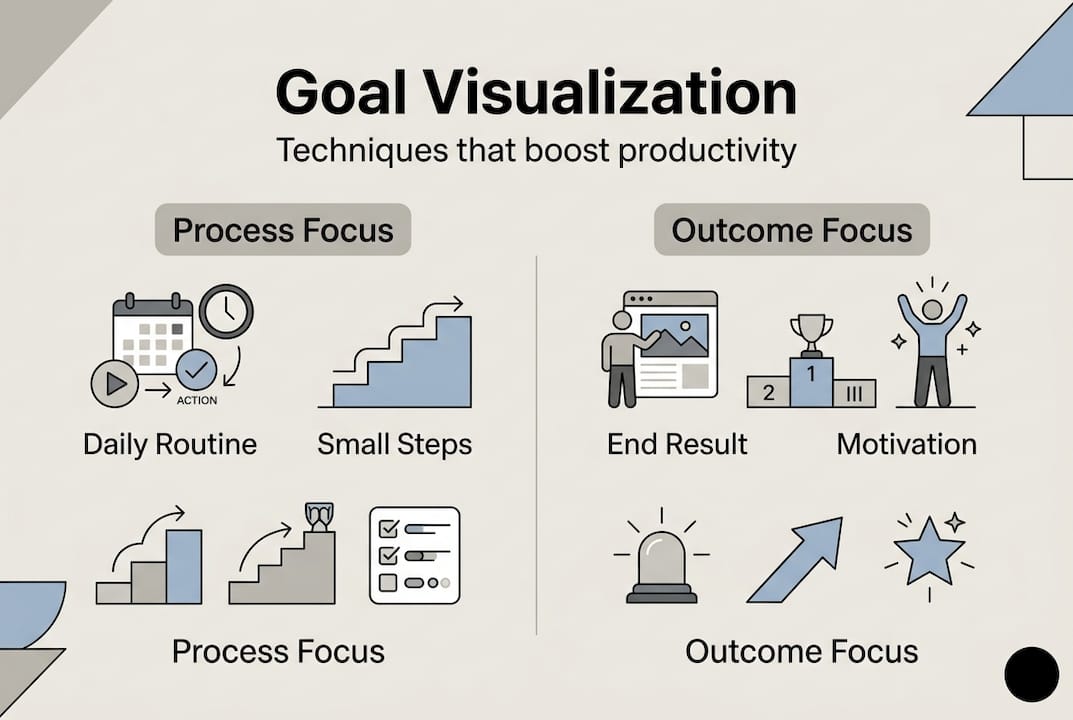
Outcome visualization means picturing the end result. You imagine holding the diploma, landing the job, or finishing the project. It feels great. It’s also the less effective approach when used alone.
Process visualization means mentally rehearsing every step required to reach that outcome. You picture yourself sitting down to study, working through difficult problems, recovering from a setback, and pushing through to completion. You include sensory details, obstacles, and your own responses to those obstacles.
The data is clear. Process visualization outperforms outcome visualization by a wide margin, with effect sizes of d=1.36 versus d=0.09 in a sports meta-analysis. That’s not a small gap. That’s the difference between a technique that works and one that barely moves the needle.
“Visualize the how, not just the what. The steps, the struggle, and the recovery are where real mental preparation happens.”
Here’s a quick comparison to make this concrete:
| Feature | Outcome visualization | Process visualization |
|---|---|---|
| Focus | End result | Steps and actions |
| Emotional tone | Excitement, relief | Effort, problem-solving |
| Effect size (d) | 0.09 | 1.36 |
| Best for | Short-term motivation | Sustained performance |
| Risk | Complacency | Minimal |
To apply this, follow these steps before any major task or goal:
- Identify the specific goal you want to achieve
- Break it into 3 to 5 concrete action steps
- Visualize each step in sequence, including sensory details
- Picture a realistic obstacle and how you handle it
- End with the successful completion of the final step
Pair this with a solid [daily planning routine](https://optiostation.com/daily-planning routine how to boost productivity) and you’ll notice the difference within a week. You can also stack this with productivity hacks for students to build a complete system.
Pitfalls and best practices: visualization for ongoing goals
Visualization has a dark side that nobody talks about enough. Used incorrectly, it can actually reduce your drive to act.
The biggest trap is pure outcome visualization for ongoing goals. Research shows that outcome-only visualization can backfire for long-term goals like fitness or career growth because it creates a false sense of accomplishment. Your brain partially satisfies the goal just by imagining it, which reduces the urgency to actually do the work.
Another common mistake is using third-person visualization, where you watch yourself from the outside like a movie. This limits your connection to the goal and weakens the motivational effect for anything beyond simple motor tasks.
The fantasy trap is real too. Visualizing only perfect outcomes with zero obstacles sets you up for discouragement the moment reality pushes back. And it will push back.
Here’s what actually works:
- Use WOOP (Wish, Outcome, Obstacle, Plan): a structured method that doubles activity rates compared to outcome-only approaches
- Practice mental contrasting: pair your positive vision with a realistic obstacle, then plan your response
- Stay first-person: visualize from inside your own perspective, not as an observer
- Include friction: picture the hard moments and your recovery, not just the highlight reel
- Follow a visualization ritual example to build consistency
Pro Tip: Every visualization session should end with one specific action you’ll take within 24 hours. This bridges the mental rehearsal to real behavior and prevents the fantasy trap entirely. Pair it with organization tips for professionals to keep your workflow tight.
Rituals and routines: daily visualization for lasting productivity
Knowing the theory is one thing. Building a daily habit is where most people stall. Here’s a simple, proven structure that fits into any student or professional schedule.
Morning and bedtime sessions of just 5 minutes, paired with a written action step and weekly progress tracking, are enough to sustain motivation over time. You don’t need an hour. You need consistency.
Here’s a sample weekly visualization schedule:
| Day | Session time | Focus area | Action step |
|---|---|---|---|
| Monday | Morning, 5 min | Weekly top goal | Write 1 task to complete today |
| Wednesday | Evening, 5 min | Obstacle rehearsal | Identify 1 likely challenge |
| Friday | Morning, 5 min | Progress review | Note 1 win from the week |
| Sunday | Evening, 5 min | Next week preview | Set 3 priorities for Monday |
Follow this sequence for each session:
- Take 3 slow, deep breaths to settle your focus
- Close your eyes and picture your goal in vivid sensory detail
- Walk through the process steps, including one obstacle and your response
- Open your eyes and write one specific action you’ll take today
- Review your weekly planning checklist to align your tasks
Practiced 3 to 10 minutes daily and paired with SMART goals, visualization can substantially boost performance across academic and professional settings. The key is pairing the mental work with a tracking system. Use your command log to record what you visualized and what action you committed to. Reviewing this weekly shows you exactly where your focus is going and where it isn’t.
Pro Tip: Start with just one goal and one 5-minute session per day. Scale up only after the habit feels automatic. Trying to visualize five goals at once is a fast path to doing none of them well.
Combining visualization with modern task management
Visualization without action is just imagination. Task management without direction is just busywork. Together, they form a system that actually moves you forward.
Integrating process visualization with SMART goals and task management tools boosts productivity for both students and professionals in measurable ways. The mental rehearsal primes your brain for the work. The task manager holds you accountable to the steps.
Here’s how to connect the two:
- Set a SMART goal first: specific, measurable, achievable, relevant, and time-bound
- Visualize the process using the steps from the previous section
- Break the goal into tasks inside your digital planner or checklist app
- Use Pomodoro sessions to work through each task with focused sprints
- Track your completion rate weekly and adjust your visualization focus accordingly
Time management and goal-setting interventions directly correlate with improved efficiency and GPA, with a correlation of r=0.37 in recent research. That’s a meaningful relationship, not a coincidence. Students who combine structured planning with mental rehearsal consistently outperform those who rely on effort alone.
For professionals, the same logic applies to project deadlines, client presentations, and skill development. Check out organization tips for busy professionals to see how this fits into a broader productivity system. You can also look at study routine improvement as a model for how deliberate practice and mental rehearsal compound over time.
Next steps: take your productivity to the next level
You now have the science, the structure, and the daily routines to make goal visualization work for you. The next move is putting it all into a system that holds together under real pressure.

Optio is built exactly for this. As your second-in-command, Optio gives you the task management tools, team coordination features, and time tracking systems that Centurions need to execute on their goals, not just visualize them. From your task management software guide to learning how to manage tasks effectively, Optio Station has the resources to bridge your mental game with real results. If you’re still asking why manage tasks at all, that’s the perfect place to start.
Frequently asked questions
How often should I practice goal visualization for best results?
Practicing visualization for 3 to 10 minutes daily, paired with a concrete action step, delivers the most consistent productivity gains over time. Shorter sessions done daily beat longer sessions done occasionally.
What’s the difference between process and outcome visualization?
Process visualization focuses on each step required to reach the goal, while outcome visualization only imagines the end result. Process visualization is far more effective, with an effect size of d=1.36 compared to d=0.09 for outcome-only approaches.
Can visualization replace real action?
No. Visualization enhances motivation and mental preparation, but it must always be paired with specific actions. WOOP doubles activity rates precisely because it forces you to plan concrete steps alongside the mental rehearsal.
How does visualization impact academic achievement?
Vivid future-oriented visualization predicts higher academic self-efficacy, stronger GPA, and greater persistence in college students. The mental clarity it creates helps you prioritize and follow through on what actually matters for your grades.
What is the WOOP method and why is it effective?
WOOP stands for Wish, Outcome, Obstacle, Plan. It works because it combines positive visualization with realistic obstacle planning, and WOOP doubles activity rates compared to outcome-only visualization by forcing you to prepare for resistance before it arrives.
Recommended
- 7 Powerful Productivity Hacks for Students to Excel Fast – Optio Station: Best Project Management App for Prioritization
- 7 Goal Setting Strategies 2025 for Students and Professionals – Optio Station: Best Project Management App for Prioritization
- Personal Work Goals 2026: 72% Higher Achievement Rates – Optio Station: Best Project Management App for Prioritization
- Why Reflect on Goals: Unlocking Productivity Growth – Optio Station: Best Project Management App for Prioritization
- Top Student Time Management Strategies to Succeed – Luxury Apartments for Rent in Boca Raton | Premium Boca Raton Apartments | Aapartments Boca Raton
