

TL;DR:
- Daily planning significantly improves academic performance, reduces stress, and boosts productivity.
- Flexible methods like time-blocking, Eisenhower Matrix, and energy-based scheduling optimize daily routines.
- Using supportive digital apps with built-in flexibility helps sustain effective planning habits.
Most college students and young professionals assume that planning is something only hyper-organized people do. That assumption is costing them. Study engagement and academic performance correlate positively with daily planning behaviors, meaning even small, consistent habits move the needle on grades, output, and stress. This article breaks down the science, the best frameworks, and the right mobile tools to help you build a daily planning routine that actually sticks. No rigid checklists. No overwhelming systems. Just practical strategies designed for the way you actually live and work.
Table of Contents
- Why daily planning matters: Evidence-backed benefits
- Core daily planning methodologies: What works in real life
- Digital tools for daily planning: Choosing and using mobile apps
- The science of flexible planning: Avoiding rigidity and burnout
- What most productivity guides miss about daily planning
- Transform your planning routine with expert tools
- Frequently asked questions
Key Takeaways
| Point | Details |
|---|---|
| Proven productivity boost | Daily planning measurably increases engagement and task completion for students and young professionals. |
| Planning frameworks matter | Using time-blocking, prioritization, and energy-based scheduling leads to more sustainable routines. |
| Flexibility prevents burnout | The most effective planners leave room for interruptions and avoid rigid schedules. |
| Mobile apps enable progress | Task management apps help structure routines, track progress, and personalize planning. |
Why daily planning matters: Evidence-backed benefits
Let’s kill a common myth first. Daily planning is not just for the student who color-codes their entire semester before classes begin. The research shows it benefits nearly everyone, including people who think they work better without structure.
A positive correlation between planning and performance (r=0.38, β=0.194) has been found in student populations, which means the more intentional your planning, the stronger your academic results. That is not a small effect. For context, an r value of 0.38 is considered a moderate-to-strong relationship in behavioral research.
The benefits do not stop at grades. Planning behaviors reduce stress (r=-0.16 to -0.43), boost wellbeing, and increase productivity in workplace environments. The negative correlation means more planning equals less stress. That is a direct trade-off worth paying attention to.
Here is a snapshot of the core benefits backed by research:
- Improved focus: Planning forces you to decide what matters before the day starts, so you spend less mental energy deciding in the moment.
- Clearer priorities: Written goals reduce the mental noise of competing tasks.
- Better grades and work output: Structured daily habits create consistent momentum.
- Lower stress: Knowing what is coming reduces anxiety and reactive decision-making.
- Stronger self-regulation: Planning builds the habit of checking in with your own progress.
| Benefit | Research finding |
|---|---|
| Academic performance | r=0.38 correlation with planning behavior |
| Stress reduction | r=-0.16 to -0.43 (planning reduces stress) |
| Workplace productivity | Significant positive association |
| Wellbeing | Improved across student and professional groups |
“Planning is not about predicting the future. It is about creating a structure that lets you respond to the unexpected without losing your direction.”
If you want to go deeper on how to rank your tasks before you even open your planner, check out these prioritization techniques that pair well with any daily planning system. You can also explore student organization tools designed specifically for academic environments.
With the groundwork established, let’s explore how these benefits translate into practical daily practices.
Core daily planning methodologies: What works in real life
Knowing that planning works is one thing. Knowing how to plan is where most people get stuck. There are three frameworks that consistently deliver results for students and young professionals.
Time-blocking is the practice of assigning specific tasks to fixed time slots in your day. Instead of a vague to-do list, you schedule 90-minute focused work blocks with intentional breaks in between. Research into time-blocking and energy scheduling shows these methods deliver consistently positive outcomes for productivity and sustainability. A key rule: add 20% extra time to every estimate. If you think a task takes an hour, block 72 minutes. This buffer alone prevents the cascade of delays that derails most daily plans.

The Eisenhower Matrix sorts tasks into four boxes based on urgency and importance. Urgent and important tasks get done first. Important but not urgent tasks get scheduled. Urgent but not important tasks get delegated. Everything else gets cut. For digital planning, this translates beautifully into labeled task categories inside a mobile app.
Energy-based scheduling is the most underused method. Your brain does not perform at the same level all day. Matching your hardest cognitive tasks to your personal peak hours (usually mid-morning for most people) and saving admin or low-effort tasks for your energy dips makes a measurable difference in output quality.
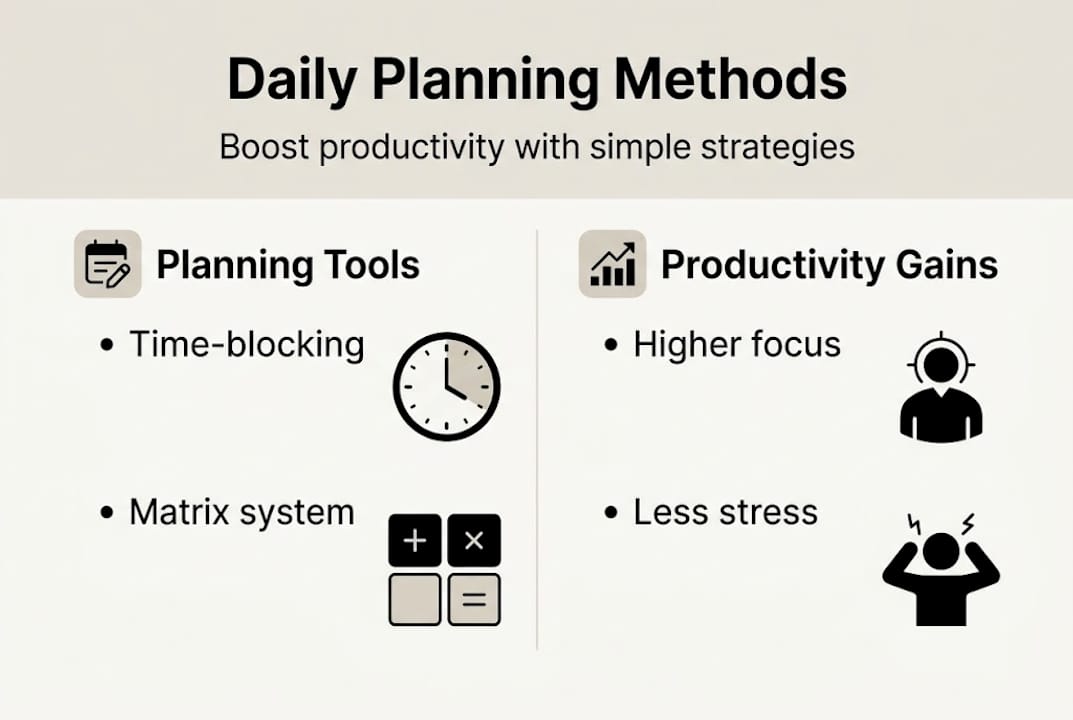
| Framework | Best for | Key mechanic | Outcome |
|---|---|---|---|
| Time-blocking | Deep work sessions | 90-min blocks + 20% buffer | Focus and output |
| Eisenhower Matrix | Priority sorting | 4-box urgency/importance grid | Clarity and decisiveness |
| Energy scheduling | Cognitive performance | Match tasks to peak energy | Sustained productivity |
Here is how to set up any of these frameworks inside a mobile app:
- Open your task management app and list every task for the day.
- Estimate the time each task requires, then add 20%.
- Sort tasks using the Eisenhower Matrix labels.
- Assign time blocks to your top three priorities.
- Schedule low-effort tasks during your known energy dips.
- Set reminders for each block and review at day’s end.
Pro Tip: Limit yourself to three daily priorities. More than three and your focus fractures. Three is enough to create real momentum without overwhelming your schedule.
For a more tactical breakdown, explore agile prioritization for students and what productivity app benefits look like in practice.
Now that you know the evidence, let’s unpack the tools that help turn theory into daily practice.
Digital tools for daily planning: Choosing and using mobile apps
Frameworks give you the structure. Mobile apps give you the execution layer. The right app turns your planning system from a good idea into a daily habit that runs on autopilot.
When choosing a mobile task management tool, look for these core features:
- Flexible scheduling: The app should let you move tasks without friction when your day shifts.
- Visual boards or lists: Seeing your day laid out visually reduces cognitive load.
- Reminders and alerts: Timely nudges keep you on track without requiring constant manual check-ins.
- Goal-setting features: Apps that connect daily tasks to bigger goals help you stay motivated.
- Simple interface: Complexity kills consistency. If setup takes more than five minutes, most people quit.
Apps like Todoist and Routinery help structure routines, especially for busy minds or those managing ADHD, and digital tools support flexibility while reducing overplanning. Google Tasks is a solid free option that integrates with Google Calendar, making it easy to visualize time blocks alongside your existing schedule.
Todoist stands out for its natural language input (type “submit report every Friday” and it auto-schedules), while Routinery excels at habit-based morning and evening planning sequences. Each app has a different strength, so your choice depends on whether you need task management, habit building, or both.
Pro Tip: Plan only 70 to 80 percent of your day inside your app. Leave the remaining 20 to 30 percent as unscheduled buffer. This is not wasted time. It is the margin that keeps your plan from collapsing when reality intervenes.
Digital task logging also gives you data. After two weeks of tracking, you can see which tasks consistently take longer than expected, which time slots are your most productive, and where your energy drops. That insight lets you refine your routine with real evidence instead of guesswork.
For more curated options, browse these organization tools for students, compare the top time management apps, and explore different to-do list types to find the format that fits your brain.
Frameworks make planning possible. Now, let’s see how flexibility keeps it sustainable.
The science of flexible planning: Avoiding rigidity and burnout
Here is the uncomfortable truth about daily planning: doing too much of it is just as harmful as doing none at all. Overplanning creates analysis paralysis, the state where you spend so much time organizing your tasks that you never actually start them.
Planning with 70 to 80 percent capacity and leaving flex time for interruptions and energy variance is a science-backed guideline that prevents decision fatigue. Decision fatigue is real. Every choice you make drains a finite cognitive resource, and if your plan requires constant micro-decisions to maintain, it will collapse by noon.
Rigid and excessive planning is less effective due to real-life interruptions, and not everyone benefits equally since generational and gender differences in planning effectiveness do exist. This matters for you as a student or young professional because your day is likely filled with unplanned demands: a professor who runs long, a Slack message that needs an immediate response, an unexpected errand.
Here are practical tactics for keeping your planning flexible:
- Allow task swapping: If your energy does not match the scheduled task, swap it with something lower intensity rather than forcing through.
- Build buffer blocks: Schedule 15 to 20 minute gaps between major tasks to absorb overruns.
- Review nightly: Spend five minutes each evening moving incomplete tasks and adjusting tomorrow’s plan. This prevents the guilt spiral of a failed day.
- Set a planning time limit: Give yourself a fixed window (15 to 20 minutes max) to plan. When the timer ends, you execute.
- Protect one unplanned hour: Keep at least one hour per day completely open for reactive needs.
“Better strategies compensate for less study time. The goal is not to fill every hour but to protect the hours that matter most.”
For a ready-to-use structure, check out this schedule management template that builds flexibility directly into your daily layout.
Digital tools can empower you, but it is the science of flexibility that keeps daily planning sustainable and truly beneficial.
What most productivity guides miss about daily planning
Most productivity content treats daily planning like a performance. The idea is that if your system looks organized enough, results will follow. That is backwards.
Real productivity comes from iteration, not perfection. The students and young professionals who consistently outperform their peers are not the ones with the most elaborate systems. They are the ones who plan loosely, act quickly, and adjust constantly. They treat their daily plan as a working draft, not a contract.
Conventional wisdom still pushes rigid checklists and full-day schedules. But the research and real-world experience both point to the same conclusion: flexible, app-supported planning with room for error outperforms rigid systems every time. The reason is simple. Life does not follow your calendar.
Digital apps make this iterative approach practical. You can drag tasks, reschedule blocks, and log what actually happened in seconds. That feedback loop is what builds genuine self-awareness about how you work.
Spend 20 minutes planning, then act and iterate. That single habit, supported by the right tool, is more powerful than any elaborate system. If you are curious about what drives people to use these tools in the first place, this breakdown of why use productivity apps is worth reading.
Transform your planning routine with expert tools
You now have the science, the frameworks, and the flexibility principles to build a daily planning habit that actually works. The next step is putting it all together with the right tools.
Optio is built for Centurions like you: students and young professionals who need a second-in-command that keeps their tasks, teams, and time in formation. From curated guides on best task management software to deep dives on productivity apps for success, Optio Station gives you everything you need to move from planning theory to daily execution. Explore the full list of essential time management apps and find the tools that match how you actually work.
Frequently asked questions
How does daily planning improve academic or work performance?
Daily planning correlates positively with student engagement and academic performance, helping you set goals, prioritize tasks, and build the consistent habits that drive measurable results in both school and work.
What’s the best daily planning method for busy students or professionals?
Time-blocking, the Eisenhower Matrix, and energy-based scheduling are all scientifically supported methods that pair well with mobile task management apps, giving you structure without locking you into a rigid routine.
How can I avoid overplanning or burnout when planning my day?
Plan only 70 to 80 percent of your day and leave buffer time for interruptions. Flexible planning with iterative review prevents decision fatigue and keeps your system sustainable over weeks and months.
Which mobile apps support effective daily planning?
Apps like Todoist and Routinery offer flexible scheduling, reminders, and structured routines that work well for busy students and professionals, including those managing ADHD or high-interruption environments.
Recommended
- Daily Planning Routine How To Boost Productivity Easily – Optio Station: Best Project Management App for Prioritization
- Command Log – Optio Station: Best Project Management App for Prioritization
- 7 Essential Organization Tips for Busy Professionals – Optio Station: Best Project Management App for Prioritization
- 7 Essential Types of Schedules for Students and Professionals – Optio Station: Best Project Management App for Prioritization
