
Here’s a copyable sample: Goal (finish a 10-page research paper in 3 weeks), Milestones (research → outline → draft → revise), Week 1 schedule (Mon: 60 min library search, Wed: 90 min source notes, Fri: 30 min accountability check-in with a study partner). The method behind it, from Stanford’s Center for Teaching and Learning: define the milestone, break it into 20 to 90 minute verifiable tasks, estimate person-hours plus buffer time, time-block it, then set a checkpoint. Copy these five things first:
- The goal, stated as one sentence with a deadline
- Milestone names (3 to 5, phase by phase)
- Two or three sample tasks under the first milestone, each sized 20 to 90 minutes
- One accountability checkpoint per milestone (a date, a person, a question to answer)
Productivity research from Inc. backs this up directly: habits like visible milestones and defined work beat any app or planning tool on their own. An app like Optio just makes the habit easier to keep.
Key Takeaways
A sample project schedule works when milestones break into 20 to 90 minute verifiable tasks, person-hour estimates include buffer time, and every milestone carries a named accountability checkpoint.
| Point | Details |
|---|---|
| Define before scheduling | Write the goal and deliverable as one sentence before touching a calendar. |
| Size tasks to 20–90 minutes | Smaller tasks with clear “done” criteria get finished; vague ones get skipped. |
| Build in buffer time | Add slack inside each milestone, not at the end, since first estimates usually run short. |
| Re-plan instead of restarting | When a milestone slips, triage for 15 to 30 minutes and reset the next checkpoint. |
| Run it on Optio | Optio’s color-coded phases and task-card fields match the sample plan’s structure for mobile use. |
Table of Contents
- Building a Construction Project Planning and Scheduling Sample You Can Actually Use
- How Do You Build a Project Plan From Scratch?
- Which Visual Layout Fits a Student Project Best?
- What to Do When Your Schedule Falls Behind
- Copyable Templates and a Quick Plan Checklist
- Run This Plan Faster With Optio
- Frequently Asked Questions
- Sources
Building a Construction Project Planning and Scheduling Sample You Can Actually Use
A sample schedule only earns its keep if you can lift it straight into your calendar. Take a small team prototype project lasting a few weeks with a handful of people, due by the end of the term. It breaks into four milestones: requirements, build, test, and presentation. Each one gets tasks small enough to finish in a single sitting and clear enough that nobody argues about whether they’re “done.”
Requirements week includes interview potential users, write a one-page problem statement, and get sign-off from the team lead, with tasks lasting reasonable short durations. “Done” means the one-pager exists as a file everyone can see, not a mental note in someone’s head. That distinction is what Stanford’s project-planning guidance means by verifiable tasks: a task is finished when its output is visible to someone other than the person who did it.
Here’s the two-week snippet mapped to real dates and hours, using a fictional start of Monday, March 2, 2026:
| Milestone | Sample tasks | Task length | Date window |
|---|---|---|---|
| Requirements | User interviews, problem statement draft | 20–90 min | March 2–March 5 |
| Build (part 1) | Wireframe, core feature build | 60–90 min | March 9–March 12 |
| Buffer | Catch-up on slipped tasks | 60 min | March 12 |
| Checkpoint | Team review call | 20 min | March 12 |
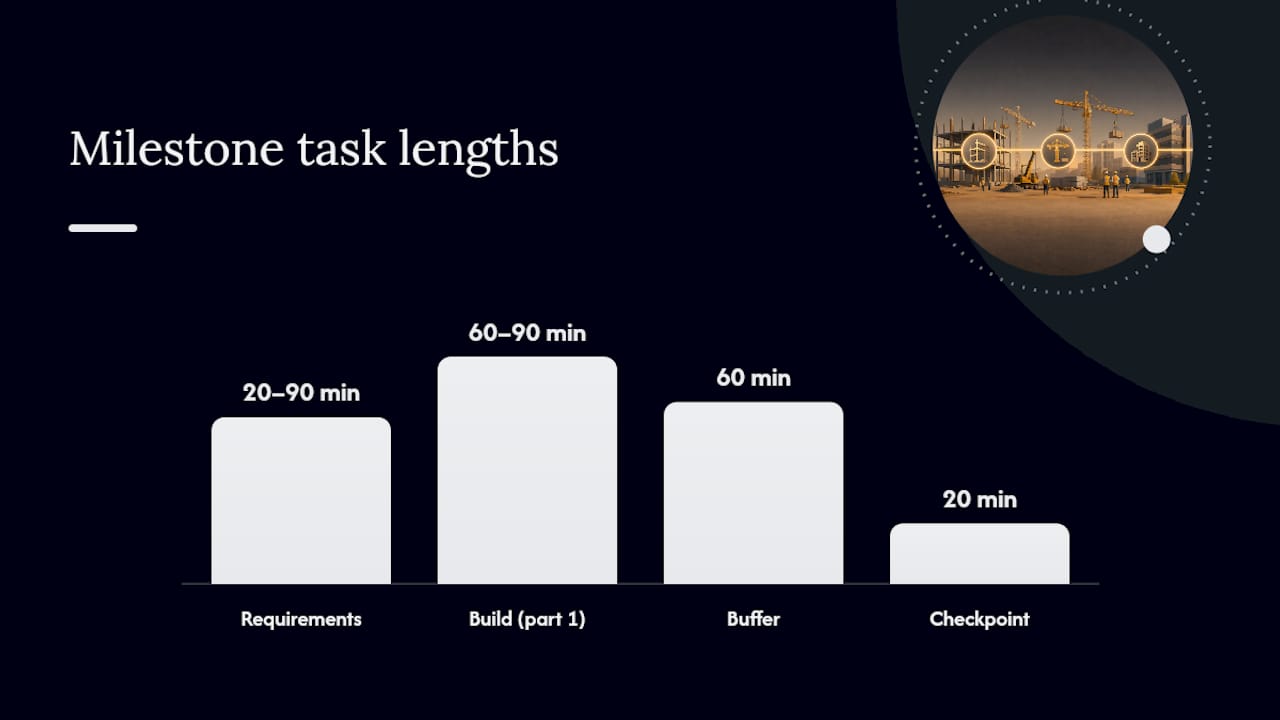
Notice the buffer sitting inside the second week, not tacked on at the end. That’s deliberate. The NUS project planning guide recommends running a quick time audit and blocking “do” dates before you commit to a full calendar, because tasks almost always run long the first time you estimate them. Build the slack in now, not after you’re already behind.
How Do You Build a Project Plan From Scratch?
Start with the goal, not the calendar. A vague goal like “make progress on the project” can’t be scheduled because nobody can tell when it’s finished. A usable goal names the deliverable and the date: “Submit a 10-page draft by March 20.” That’s a small SMART framing but it’s the difference between a plan and a wish.
- Define the project. Write the goal, list what’s in scope, and name the final deliverable in one sentence.
- Set milestones. Pick 3 to 5 phases. For most student and small-team work, one-week iterations work best, according to the NUS guide to project iterations, because a week is long enough to finish something real and short enough to catch problems early.
- Break milestones into tasks. Each task should run 20 to 90 minutes and have a “done” test: a file, a message sent, a checkbox that someone besides you could verify.
- Estimate and audit. Guess the person-hours per task, then track your first few honestly. Most people underestimate by 30 to 50 percent the first time.
- Schedule and time-block. Put each task on a specific date with a specific time window, not just a day. “Sometime Tuesday” gets skipped. “Tuesday, 4:00 to 5:00 PM” gets done.
Pro Tip: Estimate in person-hours, not days. A “one-day task” hides how much actual work is inside it, while “3 person-hours” tells you exactly what to block on the calendar.
Pro Tip: Protect one focus block per day where no meetings, no notifications, and no last-minute requests are allowed. Even 45 minutes of uninterrupted work beats two hours of fragmented attention.

Which Visual Layout Fits a Student Project Best?
Different visuals solve different problems. A Kanban board (To Do, Doing, Done) is best when your bottleneck is flow, too many things half-started. A simple Gantt snippet, even three rows in a spreadsheet, is best when tasks depend on each other and order matters. A weekly time-block grid is best when the real problem is energy and focus, not sequencing.
Color-coding phases the way you’d sort Lego bricks by build stage measurably reduces the mental load of tracking a project, according to research on modular visualization for student teams. Give “Research” blue, “Build” yellow, “Test” red. On a phone screen, a task card should show just four things: task name, person-hours, deadline, and a done checkbox. Anything more gets lost in the scroll.
Combining Agile-style dual-layer planning, macro milestones for the term paired with weekly micro sprints, with a customized Kanban board improved coordination in student technical teams, according to research on flexible project management for student teams.
Pro Tip: Set a work-in-progress limit of two active tasks per person. More than that on a small team almost always means something is stalled, not multitasked.
What to Do When Your Schedule Falls Behind
Falling behind isn’t a planning failure, it’s normal. Treat the plan as something you update, not something you defend. When a milestone slips, don’t rebuild the whole schedule. Re-estimate what’s left and restart at the next honest milestone.
- Run a 15 to 30 minute triage: which tasks got delayed, and why.
- For each delayed task, decide: keep it as-is, shift the date, or cut it if it’s no longer critical.
- Reset the accountability checkpoint to reflect the new reality, not the old plan.
- Identify which tasks sit on the critical path (block other work) and protect those first.
The NUS iteration guide frames this well: update the schedule after each iteration rather than trying to predict three weeks out on day one.
Pro Tip: Keep iterations at one week and run a five-minute retrospective after each recovery: what caused the slip, and what would prevent it next time.
Copyable Templates and a Quick Plan Checklist
Three templates, ready to paste anywhere:
- Milestone row: Name | Start date | End date | Owner | Checkpoint date
- Task card: Task | Person-hours estimate | Deadline | Done criteria | Assigned to
- Weekly grid: Seven columns (days), four to six rows (time blocks), color-coded by project phase
Paste the milestone row into your calendar’s event description, the task card into an Optio task card or similar app entry, and the weekly grid into a shared document or your app’s calendar view.
Before you run the plan, check it against five things:
- Every task has a visible “done” state.
- Person-hour estimates come from a real audit, not a guess.
- Dependencies between tasks are marked (which task blocks which).
- Buffer time exists somewhere in every milestone.
- Every milestone has a named accountability checkpoint.
Author note: start small and iterate
Do it now. Plans improve with practice, not with more planning time upfront. A one-week iteration you actually run beats a perfect term-long schedule that never gets used. Write down what worked after each project. Future you, or your next teammate, will reuse it.
Run This Plan Faster With Optio
Optio maps directly onto the plan you just built, leveraging decision intelligence for design teams to connect color-coded phases and modular workflows for smoother execution. Color-coded life aspects handle the phase coding (research, build, test) without extra setup. Task cards carry fields for person-hours and done criteria side by side, so the estimate and the finish line live in the same place. Calendar integration pushes your time-blocked tasks straight into Google Calendar, and smart reminders cover the accountability checkpoints so nobody has to remember to check in manually.
Say you finish the requirements milestone above. Open Optio, create a task card labeled “Build: core feature,” set the person-hours estimate, tag it to your “Build” color, and drop a comment tagging your teammate for the Friday checkpoint. That’s the whole setup, done in under two minutes on a phone.
The plan works with a notebook and a wall calendar too. Optio just removes the friction of running it on the device you already carry. Check the project plan templates built for this exact workflow, or go straight to the Optio landing page and set up your first milestone today.
Frequently Asked Questions
What is a good construction project planning and scheduling sample for a student project?
A good sample names the goal, lists 3 to 5 milestones, and breaks the first milestone into two or three tasks sized 20 to 90 minutes, each with a clear done state and one accountability checkpoint per milestone.
How many hours should I estimate per task?
Start with your gut estimate, then track your first week honestly. Most students underestimate by roughly a third, so pad your early guesses and adjust after one real iteration, as the NUS planning FAQ recommends.
Do I need special software to plan a small project?
No. A spreadsheet or simple table often works fine, per NUS’s iteration guidance, which explicitly favors simple documentation over complex charts for student-scale work. A task app like Optio speeds up execution but isn’t required to build the plan.
How do I handle team members with different availability?
Assign tasks by person-hours available that week, not by headcount, and use a shared weekly grid so overloaded teammates are visible before the deadline, not after.
What if my schedule falls apart halfway through?
Run a short triage, decide which delayed tasks to keep, shift, or cut, and reset your next checkpoint. Treat it as a normal iteration reset, not a failure of the plan.
Sources
For deeper method reading, Stanford’s Center for Teaching and Learning covers milestone breakdown and task verification in more detail. The NUS project iteration guide explains one-week iteration sizing for student teams. The Lego block visualization framework is worth reading if color-coding your phases sounds useful but you want the reasoning behind it. And Micro offers a lightweight weekly routine built specifically for teams of one to seven people.
- Project planning in college | Center for Teaching and Learning
- Flexible project management for student teams (MDPI paper)
- Lego block analogy framework for student projects (Springer chapter)
- 12 common productivity myths that are holding you back | Inc.
For ready-made files, Optiostation’s project management checklist template and Excel schedule templates are built to paste straight into a spreadsheet or app.
Recommended
- Project Management Plan Example: Success Blueprint For Students – Optio Station: Best Project Management App for Prioritization
- Top 5 Excel project management schedule templates for 2026 – Optio Station: Best Project Management App for Prioritization
- Project management plan example PDFs: templates for students – Optio Station: Best Project Management App for Prioritization
- Why Plan Schedules: Key to Student Success – Optio Station: Best Project Management App for Prioritization
