
The best goal-goal tip today is one you can check yourself. A goal-goal (GG) tip says both teams will score at least once in a soccer match. A tip is only as good as the reasoning behind it: how often each side scores and concedes, who is actually playing, and whether the price is fair. No tip can guarantee a result, so this guide shows you how to judge any tip you see and how to keep the whole thing under control.
TL;DR
- GG, or BTTS (both teams to score), wins when each team scores at least once in 90 minutes plus stoppage time. The winner does not matter.
- Good predictions come from scoring and conceding rates, recent form, home and away splits, and confirmed lineups, not from a hunch or a streak.
- Convert any decimal odds into a break-even probability (1 divided by the odds) before you decide a tip has value.
- Even a 62% estimate fails roughly four times in ten, so judge tips over many matches, never one result.
- Set a budget and limits first. Betting is gambling, and analysis does not remove the risk.
Table of Contents
- What a goal-goal tip actually means
- How today’s goal-goal predictions are made
- A pre-match checklist for any goal-goal tip
- Reading the odds: when a likely GG is still a poor bet
- Why no tip is a guarantee
- A simple daily routine for reading tips
- Our perspective
- Build the habit with Optio
- FAQ
- Sources
What a goal-goal tip actually means
A goal-goal, GG or BTTS “Yes” tip means that both teams will score at least once during the match’s 90 minutes plus stoppage time. Livescore’s betting guide gives the clearest picture: 1-1 and 3-2 both win, while 0-0, 1-0 and 4-0 all lose. Extra time and shootout goals do not count.
That makes GG different from picking a winner. A heavy favorite can win 4-0 and your tip loses. A weak side can lose 2-1 and your tip wins. What matters is whether both attacks can break through and both defenses can be breached.
The opposite market is usually called NG (no goal) or BTTS “No”. Everything below applies to both, because the same reasoning decides whether a match leans toward goals at both ends or a clean sheet.
If you are in the US, you will mostly see this market called “both teams to score” rather than goal-goal. The terms are the same bet.
How today’s goal-goal predictions are made
Most daily tip pages you will find are not guesses. They are model outputs, and knowing what goes into them helps you decide how far to trust any single line.
Scoring rates and the Poisson grid
The common approach estimates how many goals each team is expected to score in this specific match, then turns those two numbers into a grid of scoreline probabilities. One published example, Elofoot’s method, starts from a team’s average expected goals (xG), adjusts for points per game, recent form and home advantage, then uses a Poisson distribution to read off both teams to score and over/under lines.
KickoffHour’s methodology describes the same basic idea: scoring rates come from team results, opponent strength and home advantage. It also notes that a model’s expected goals for a future match are not the same measure as the shot-based xG recorded in a played match.
Dixon-Coles and recent form
Some models add refinements. VARStats explains that its goal-goal predictions come from a Dixon-Coles model: each team has an attacking and a defensive rating, home advantage is estimated separately, older matches count for less, and a low-score correction fixes the tendency of simple models to overstate draws. Because every market comes from the same score distribution, the result, totals and BTTS probabilities always agree with each other.
What data goes in
FootyMetrics lists the inputs it uses for every fixture: recent form, season averages for goals scored and conceded, clean sheet rate and BTTS frequency, match statistics such as shots and possession, goal timing, corners, head to head, lineups and injuries, and league context. It then compares its probability with the one implied by bookmaker odds, and treats the gap as the edge.
What models often miss
Models vary in what they know. StatsBench states that its model does not know lineups or injuries and tells readers to check each match page before betting. That is honest, and it points to the biggest job left for you: the news that arrives after a model has run.
A pre-match checklist for any goal-goal tip
Use the same list every time. The point is consistency: when you check the same things on every match, you can see which of your reasons actually held up.
1. Confirm the fixture, the time zone and the market
Basic, but it causes errors. Tipsters.net advises checking the fixture and kickoff time zone, the current odds for the named market, recent results with opponent quality, and confirmed absences versus possible lineup changes. Separate what is confirmed from what you are assuming, and write down what would change your mind.
2. Look at scoring and conceding by venue
Overall averages hide a lot. A team may score freely at home and struggle away. Socapredict’s checklist recommends checking venue-specific scoring and conceding frequency for both teams, not just season totals.
Sample size matters too. Elofoot suggests looking at home and away goals separately over a meaningful sample, ideally 10 matches or more.
3. Check chance quality, not only goals
A team can score twice from two shots and look dangerous. Expected goals (xG) measure the quality of chances created and conceded. According to Tipsters.net, xG estimates chance quality rather than guaranteeing future scoring, and comparisons work best when you stick to one source and one measurement method.
A quick screen from PerformanceOdds asks whether both teams create decent xG in recent matches (around or above 1.3 per game), whether they allow chances at the other end, whether they take enough shots on target, and whether their games often finish with both sides scoring.
4. Check who is actually playing
A missing striker or goalkeeper can flip a GG lean. Look at confirmed or likely lineups and injuries to attackers, defenders and keepers, then recheck your shortlist when lineups appear. Tipsters.net makes the same point: confirmed information and assumptions are different things.
5. Ask whether both sides have a reason to attack
Stakes shape matches. A side that only needs a draw may sit deep. A cup tie, a relegation fight or a team chasing a title can open up. PerformanceOdds asks the same thing: is this a match where both teams have a reason to attack? Elofoot adds fixture congestion, fatigue, weather and neutral venues as context.
6. Do not over-read a streak
A winning run is a starting point, not an explanation. Narrow wins over weak opponents say something different from convincing wins over strong ones, and red cards, penalties and late goals distort how much a result tells you. Soccer Expert Advisor warns that small samples and recent-scoreline bias can mislead, and recommends larger samples and underlying xG over reacting to a few matches.
The checklist at a glance
| Check | What to look for | Why it matters |
|---|---|---|
| Fixture and market | Right match, kickoff time zone, GG market | Avoids simple errors |
| Venue splits | Home scoring and conceding, away scoring and conceding | Averages hide big gaps |
| Sample size | Around 10 or more matches | Small samples mislead |
| Chance quality | xG created and conceded, shots on target | Goals alone can be lucky |
| Availability | Confirmed lineups, key absences | Models often lack this |
| Motivation | Stakes, congestion, competition | Decides how open a match is |
| Price | Break-even probability vs. your estimate | A likely outcome can still be poor value |
Reading the odds: when a likely GG is still a poor bet
A tip says what might happen. The odds say what it costs to back it. Those are separate questions.
Convert decimal odds to a break-even probability by dividing 1 by the odds. Odds.guru gives these examples: odds of 1.80 require 55.6%, odds of 2.00 require 50.0%, and odds of 2.50 require 40.0%, before considering margin and risk.
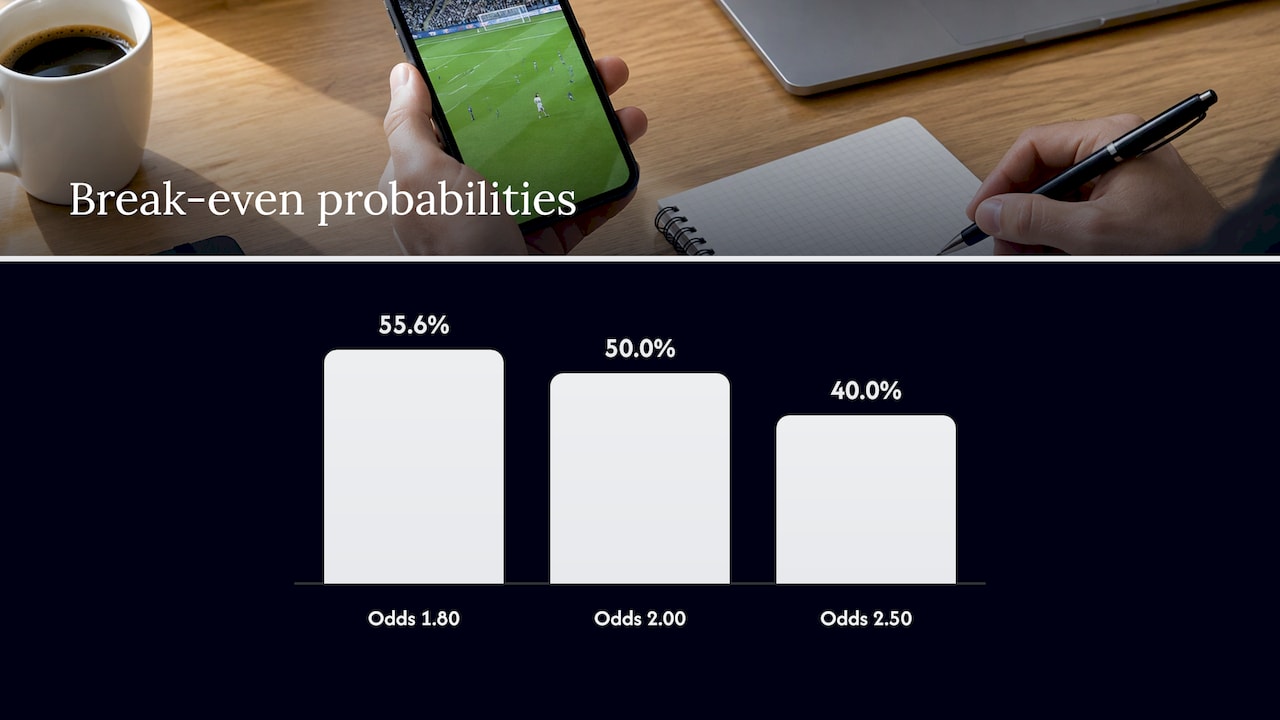
So if you think a GG outcome is 55% likely and the price is 1.80, you are below break-even. If the same estimate comes with odds of 2.00, you are above it. Same tip, different decision. PerformanceOdds makes this point about Over 2.5 at 1.75 versus 1.95: they are two different worlds in long-term profit even when the bet looks the same.
Bookmaker prices also include a margin. SmartMatchPick’s example uses 1.80 for Yes and 2.10 for No: the raw probabilities of 55.6% and 47.6% add to 103.2%, and removing the margin gives a Yes probability of 53.9%. The extra 3.2% is the bookmaker’s cushion, and it is why a fair-looking tip can still be a losing price.
The lesson from Tipsters.net is the same: a strong favorite can look likely to win without being an attractive wager, so the price matters as much as the statistics.
Why no tip is a guarantee
Probabilities are ranges. FootballPredictions.bet notes that a 62% probability should be expected to fail roughly four times in ten. That means a sensible tip will lose often, and a single result tells you very little about whether the reasoning was good. Judge a method across many matches, not one night.
The Responsible Gambling Council is direct about this. Sports betting is gambling, sports bettors show higher problem-gambling rates than the general gambling population, and live-action betting is an independent risk factor. It also warns about the illusion of control: believing skill or analysis can control complex or random outcomes.
That does not make analysis pointless. It makes it a way to understand a match, not a way to remove risk.
Keeping it safe
- Bet only where it is legal and you meet the minimum age. Rules differ by country and, in the US, by state.
- Decide your budget before you look at any tips, and treat it as the cost of entertainment, not income.
- Prognosist recommends per-bet, daily and weekly limits, record-keeping and breaks, and avoiding betting when angry, stressed, tired or under the influence of alcohol or drugs.
- The same guide lists warning signs that call for a pause and possible support: borrowing to bet, hiding gambling, raising stakes to recover losses, and money, work, sleep or relationship problems linked to gambling. If any of that sounds familiar, stop and talk to a licensed counselor or a problem-gambling helpline in your area.
A simple daily routine for reading tips
This routine turns the checklist into something you can finish in ten or fifteen minutes.
- Shortlist early. Pick two or three fixtures, not twenty. Fewer matches means better checks.
- Pull the same numbers every time. Venue-based scoring and conceding, xG for and against, and BTTS rate over the last 10 or more matches.
- Write your own probability. Do this before you look at the odds, so the price does not anchor you.
- Compare with break-even. Divide 1 by the decimal odds. If your number is not clearly above it, skip.
- Recheck at lineup time. Confirmed absences can change the whole picture. If it changes, update or drop the match.
- Log the result and the reason. After a few weeks you will see which checks actually predicted something.
Notice that skipping is a valid outcome. Most days, the disciplined answer to “which tip should I take?” is a smaller number of matches than you started with.
Our perspective
Most people who search for tips want a shortcut. What they need is a repeatable habit. The checklist above works because it is the same every time, and habits like that fail for ordinary reasons: the notes are scattered, the limits are forgotten, and the review never happens.
At Optiostation we build around that gap. Optio is a mobile app made for task, team and time management, and it plays the second-in-command to its users, whom we call Centurions. Our approach is to keep goals, tasks and time visible in one place, with color-coded life aspects so that a hobby never quietly crowds out study or work.
We think a good routine beats a good hunch, whether the subject is a lecture schedule, a project deadline or how you spend your free time. Set the goal, break it into small tasks, give each a slot in your calendar, and review it honestly. That is the idea behind Optio, and it is why we are indie-built and open to feedback from our community.
Optiostation
Build the habit with Optio
If you follow soccer as a hobby, the hard part is rarely the stats. It is keeping a routine that stays small, scheduled and separate from the rest of your life. Optio is designed to help college students and young professionals organize tasks, track time and set goals, so a pastime stays in its lane next to classes, work and sleep.
You could, for example, set a goal for your week, turn your review steps into a short task list, add reminders, and use color-coded life aspects to see at a glance how your time is split. Optio also works with Google Calendar. You can explore Optio’s Prioritization Station to see how it fits your routine, or read our guides on time management skills for school and work and how to keep track of tasks effectively.
FAQ
What does GG mean in football tips?
GG means “goal-goal”: both teams score at least once in the match. It is the same bet as BTTS (both teams to score) and covers 90 minutes plus stoppage time. Extra time and penalty shootout goals do not count.
Are there sure goal-goal tips?
No. Every prediction is a probability, and even a high estimate fails often. A 62% chance, for example, should be expected to miss roughly four times in ten. Be cautious of any page that promises certain wins, and remember that analysis cannot control a random outcome.
What stats matter most for a GG tip?
Start with venue-specific scoring and conceding rates over a meaningful sample, then add xG for and against, shots on target, and how often each team’s matches end with both sides scoring. Finish with confirmed lineups and the stakes of the match.
How do I know if the odds are worth it?
Divide 1 by the decimal odds to get the break-even probability. At 2.00 that is 50%, and at 1.80 it is 55.6%. If your own estimate is not clearly higher than that figure, the price is not giving you value, however likely the outcome looks.
How can I keep betting under control?
Set a budget and per-bet, daily and weekly limits before you start, keep records, and take breaks. Do not bet when you are stressed, tired or drinking, and never chase losses. If gambling is causing money, work or relationship problems, pause and contact a licensed counselor or a problem-gambling helpline.
Sources
- Both Teams to Score (GG/NG): How BTTS Betting Works, Livescore
- How AI football predictions work: Elofoot’s method
- How to predict a correct score: a step-by-step method, Elofoot
- How our football predictions are calculated, VARStats
- How our AI works, FootyMetrics
- Football Analysis & Prediction Methodology, KickoffHour
- Both Teams to Score Predictions, StatsBench
- How to Analyze Football Predictions, Tipsters.net
- Both Teams to Score Checklist: 7 Checks Before a GG Tip, Socapredict
- Match Stats Tips Today, PerformanceOdds
- Both Teams to Score Bets: Common Mistakes and GG/NG Betting Tips, Soccer Expert Advisor
- Both Teams to Score Betting Strategy, odds.guru
- How to predict BTTS using odds, SmartMatchPick
- Football Predictions Today, FootballPredictions.bet
- Sports and Gambling, Responsible Gambling Council
- Responsible Gambling, Prognosist
