
Program manager training teaches you to run a group of related projects toward one business goal: governance, benefits, stakeholders and risk, not just deadlines. If you are a student or early in your career, the smartest path is to learn the basics through a short course, then practice the role on real work while you build the experience that senior certifications require. Below you will find what the training covers, how to compare formats, when a certification matters and how to start before you hold the title.
TL;DR
- Program managers coordinate several linked projects to deliver a strategic benefit. Training covers governance, stakeholder engagement, benefits management and risk.
- Beginners can start with a short, self-paced course. The advanced PgMP certification requires years of project and program experience, so it is a later step.
- Federal program and project management jobs in the 0340 series do not require a degree or certification to enter, and experience counts most.
- You can act like a program manager now: manage your projects with company strategy in mind, mentor others and make your results visible.
- Optio Station gives you a place to practice the daily habits behind the role: prioritizing, tracking time and organizing projects.
Table of Contents
- What a program manager actually does
- What program manager training covers
- The skills that matter most
- How to compare training options
- When certification becomes relevant
- Act like a program manager before you have the title
- Where daily habits meet program thinking
- Practice the habits with Optio Station
- FAQ
- Sources
What a program manager actually does
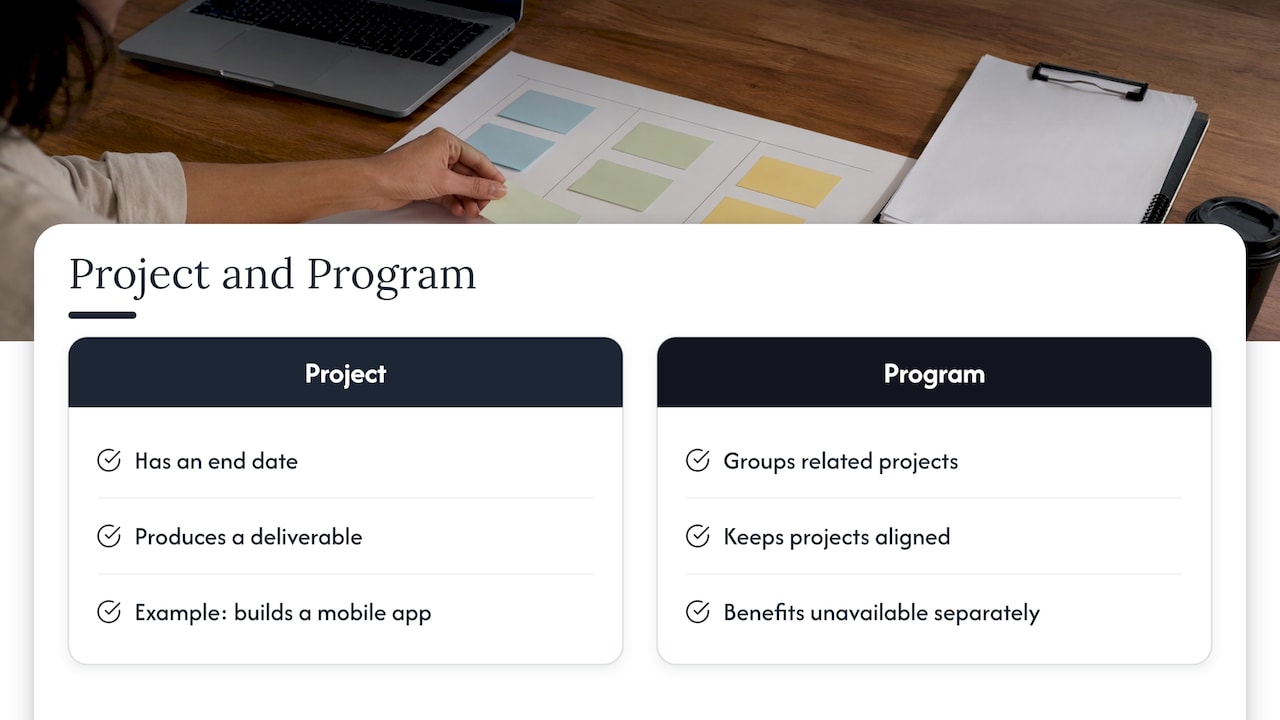
A project has an end date and a deliverable. A program is a group of related projects managed together so the organization gets benefits it would not get from running them separately. One project might build a mobile app, another train customer support, a third launch marketing. The program manager keeps them aligned.
Capgemini’s training material describes program management as giving structure, coherence and focus to organizations running multiple linked projects, and notes that governance (the framework for decisions, resource coordination and responsibilities) is a key component. Korn Ferry frames benefits management as the program manager’s primary responsibility.
For you, the practical takeaway is this: project managers ask “is this task done on time?” Program managers ask “are these projects still the right ones, and are they producing the result we wanted?”
What program manager training covers
Courses differ in length, but the content is fairly consistent. Three examples show the range.
A short PMI on-demand course. The PMI-authorized course on its learning platform runs 3.32 hours with 365-day access. It covers the Program Manager and Program Sponsor roles, the three stages of the program lifecycle, eight program management principles, six performance domains (Strategic Alignment, Benefits Management, Stakeholder Engagement, Governance Framework, Collaboration and Life Cycle Management) and ten program management domains, including change, communications, financial, risk and schedule management.
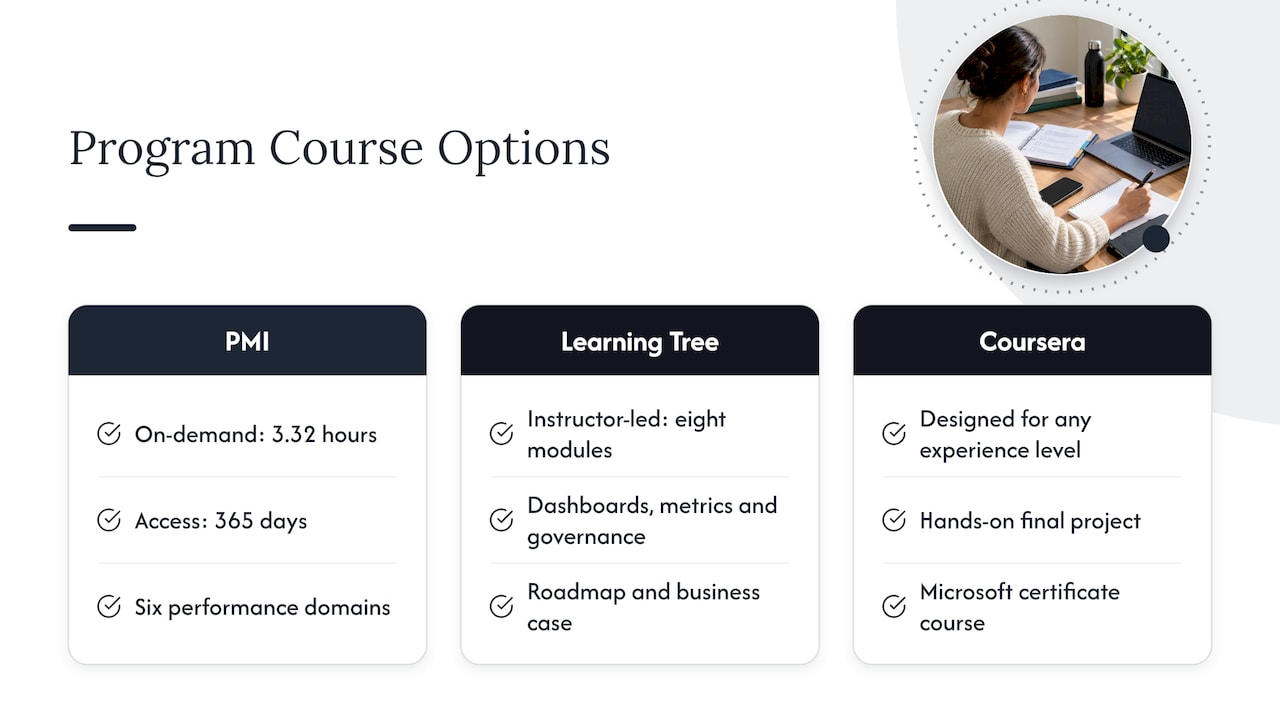
An instructor-led corporate course. Learning Tree’s program management training is organized into eight modules. Topics include distinguishing projects from programs, setting up a project management office, aligning programs with strategy, building a business case, creating a roadmap and work breakdown structure, governance, monitoring with dashboards and metrics, and leading the program through vision-setting and resource negotiation.
A beginner-friendly online course. Program Management Fundamentals on Coursera is designed for anyone regardless of experience. It covers project, program and portfolio management, core frameworks, planning, execution and control, benefits realization and a hands-on final project. It is part of the Microsoft Program Management Professional Certificate.
Notice what repeats: business case, governance, stakeholders, benefits, roadmap. If a course description mentions none of these, it is probably project management training under a different name.
The skills that matter most
PMI’s PgMP exam content outline lists the skills required across all domains. The list is long, but several items are things you can start building in a dorm group project or a first job:
- Prioritizing and time management
- Negotiating, persuading and influencing
- Stakeholder analysis and engagement
- Problem-solving and systems thinking
- Facilitation and active listening
- Managing virtual, multicultural and remote teams
The people side counts as much as the frameworks. University of Washington instructor Grierson makes the point in a UW Professional & Continuing Education article: every program changes how people engage with the organization, so communication, negotiation, integrity, empathy and compassion matter. The same article notes the field can suit people from a variety of backgrounds, not only those who started in project management.
How to compare training options
When you shop for a course, compare five things.
| What to check | Why it matters |
|---|---|
| Format | Self-paced, instructor-led, hybrid or in person. Your schedule decides this. |
| Length and access | A 3-hour primer and a multi-week certificate are different commitments. |
| Prerequisites | Some courses assume project experience; others start from zero. |
| Certification alignment | Does the course count toward PgMP education hours or earn PDUs (professional development units used to maintain a certification)? |
| Hands-on work | Deliverables such as a program charter teach more than slides. |
PMI itself offers self-paced exam prep courses, Study Hall subscriptions with practice exams, instructor-led courses from Authorized Training Partners, on-demand eLearning and webinars. On-demand eLearning, PMI training and webinars can earn PDUs.
A university certificate is a deeper option. UW Professional & Continuing Education offers a two-course Certificate in Program Management aligned with the PgMP exam. It covers program benefits, governance, stakeholder engagement and synchronizing related projects across roles, organizations, regions and cultures. Hands-on deliverables include a SWOT analysis, program proposal, charter and objectives. PMI approved UW PCE to issue contact hours and PDUs for courses that count toward the PgMP education requirements.
If you are also weighing project-level credentials first, a guide to PMP certification requirements helps you see how that step compares with training options.
When certification becomes relevant
The top-ranked credential for this keyword is PMI’s Program Management Professional, or PgMP. It is not an entry-level credential. According to PMI’s PgMP page, there are two eligibility paths:
- Set A: a high school or secondary diploma, plus 48 months of project management experience (or a PMP) and 84 months of program management experience within the past 15 years.
- Set B: a four-year degree, plus 48 months of project management experience and 48 months of program management experience within the past 15 years.
PMI also reports that nearly half of surveyed PgMP holders saw more responsibility and larger programs after certifying. So it pays off, but later in a career.
For students that timeline is good news. You do not need to decide on a certification now. The U.S. Office of Personnel Management’s guide says program and project management positions in the 0340 series do not require a degree or certification for entry, and that experts emphasize experience over credentials. It still lists PMP, CAPM, Lean Six Sigma and degrees from an MBA to a Master’s in Public Administration as recommended credentials.
A sensible sequence looks like this:
- Take a short program management fundamentals course to learn the vocabulary.
- Manage real projects, in a student organization, internship or first job.
- Add a project-level credential when employers in your field ask for it.
- Consider a program-level certificate or the PgMP once you manage related projects.
If you are heading toward a PMP first, our guide to writing PMP application project descriptions shows how to document the experience you already have.
Act like a program manager before you have the title
PMI’s career paper, Becoming a program manager, says the move comes from delivering consistent project results, upgrading your education, delegating effectively, mentoring other project managers, promoting your successes and showing leadership. Its most useful advice is to act the role now. Here is how that translates for a student or early-career professional.
Manage with strategy in mind
Before starting any project, write one sentence on how it supports the goal of your team, club or employer. If you cannot, ask. Program managers live in this question.
Run related work as a set
If you are juggling a capstone, an internship project and a student group event, treat them as a small portfolio. Which one carries the most benefit? Which risks overlap? Our guide to prioritization techniques helps you rank competing work.
Structure work for others
PMI suggests giving junior colleagues pieces of work as subprojects that run like standalone projects with status reports. In a group assignment, that means giving each teammate an owner, a due date and a short weekly update.
Mentor and document
Share your templates, write down what worked and buddy a new teammate. PMI recommends this, and it makes you easy to promote because someone can take your place.
Make results visible
Busy managers do not see everything. Keep a short log of outcomes (what changed, by how much) so you can cite them when applying for a program role. If you are preparing application materials, a guide on writing a project manager resume shows how to frame results as outcomes.
Where daily habits meet program thinking
Program management sounds abstract, but it is built from habits: deciding what matters most, tracking where time goes, keeping every project visible and keeping teammates in sync. Those habits are testable on a small scale well before you manage a budget. Our guides on keeping track of tasks at work and time management skills for school and work cover them.
If you want to see where the role leads, read about the project management officer and the PMO manager, the functions that often sit around programs.
Our view: training sticks when you practice it daily
Optio Station is a mobile app built for students and young professionals who manage tasks, teams and time. We are indie-built and we shape the app with feedback from our community of Centurions, our name for users.
We think program management is learned the same way anyone learns to lead: by making many small decisions well. Which task comes first? Which project gets this hour? Who is waiting on you? A course gives you the vocabulary. A daily system gives you reps.
That is why we focus on simplicity and flexibility. Optio helps you organize projects, color-code the different parts of your life, set goals, track time and plan with smart reminders and Google Calendar integration. Each of those is a small version of what a program manager does at scale.
If you want to be a program manager someday, start running your own work like a program today.
Optiostation
Practice the habits with Optio Station
Optio is a mobile app for task management, team collaboration, time tracking, goal setting and project organization. You can color-code the aspects of your life, use hashtag-based search to find related work fast and sync with Google Calendar. Core features are free, and advanced capabilities are planned for a paid subscription. Our Prioritization Station is a good place to begin: explore Optio Station.
If you are comparing tools, our overview of task management software explains what to look for.
FAQ
How can I become a program manager?
The usual route is to deliver consistent project results, build leadership and mentoring experience, add education such as a program management course or a PMP, MBA or MPM, and then step into related-project oversight. PMI’s career paper recommends acting the role early by managing projects with company strategy in mind.
Do I need a certification to work as a program manager?
Not always. Federal program and project management roles in the 0340 series do not require a degree or certification for entry, and experience is emphasized. Certifications such as the PgMP help signal advanced knowledge, but PMI’s PgMP eligibility rules require years of experience first.
How long does program manager training take?
It ranges from a few hours to several months. PMI’s on-demand course runs 3.32 hours with 365-day access, while a two-course university certificate is a longer commitment. Check the course page for current length and format.
Which skills should I focus on first as a student?
Start with prioritizing, time management, communication, negotiation and stakeholder engagement. They appear in PMI’s list of core program management skills and you can practice them in group projects, clubs and internships.
Sources
- Becoming a program manager: moving your career to the next level (PMI)
- How to Become a Program Manager (UW Professional & Continuing Education)
- Certificate in Program Management (UW Professional & Continuing Education)
- PMI on-demand program management course
- PgMP exam content outline (PMI)
- Learning at PMI
- Program Management Professional (PgMP) certification (PMI)
- Career Paths for Federal Program and Project Management: Credentials and Certifications (OPM)
- Program Management (Korn Ferry)
- Program management training (Capgemini Academy)
- Program Management Training (Learning Tree)
- Program Management Fundamentals (Coursera)
