

Organizational decision making is the structured process of moving a group from a problem to a committed action using a repeatable cycle. The fastest way to start: run your next team meeting through the 7-step decision cycle (identify the decision, gather info, identify alternatives, weigh evidence, choose, act, review) and assign one person the final call before the meeting ends. Harvard Business School warns that treating a decision as a single event rather than a process is the most common reason teams fall back on gut instinct and skip diverse input. INFORMS contingency research adds a second lever: the right decision structure (delegation, voting, or averaging) depends on your team’s knowledge breadth and how stable your environment is.
- Run a one-meeting 7-step scan before committing to any path.
- Assign a DACI-lite role (Driver, Approver, Contributor, Informed) for every decision above low stakes.
- Check knowledge breadth and environmental stability before choosing delegation vs. voting.
Pro Tip: Write the decision question in one sentence before the meeting starts. Teams that can’t state the decision clearly in one sentence almost always skip step one and jump straight to debating solutions.
Table of Contents
- How does the 7-step decision cycle work for small teams?
- Which decision structure fits your team: delegation, voting, or averaging?
- How do you map Roman military roles to a modern peer team?
- What templates and app features should you use today?
- How do you run high-uncertainty decisions as experiments?
- How long do decisions actually take, and what do they cost?
- Key Takeaways
- The case for slowing down to decide faster
- Optiostation puts the Roman playbook in your pocket
- Cited sources and further reading
How does the 7-step decision cycle work for small teams?
The 7-step cycle is the industry standard for both personal and team-based organizational management. Here is what each step looks like when your “team” is four classmates or a five-person startup crew.
- Identify the decision. Write one sentence: “We need to decide X by Y date.” No sentence, no meeting.
- Gather information. Collect only what changes the outcome: survey data, a quick poll, one relevant case study, or a 10-minute desk review.
- Identify alternatives. Name at least three options. Two options is a false binary; more than six creates analysis paralysis.
- Weigh evidence. Score each option against pre-set criteria (cost, time, risk). Use a simple 1–5 scale.
- Choose among alternatives. One person makes the call or the group votes. Document the choice and the reason.
- Take action. Assign tasks with owners and deadlines before the meeting ends.
- Review outcomes. Schedule a 15-minute debrief after the action plays out.
| Step | Artifact to collect | Time budget (small team) |
|---|---|---|
| Identify decision | One-sentence decision statement | 5 min |
| Gather info | Notes, poll results, one source | 15 min |
| Identify alternatives | Shortlist of 3–5 options | 10 min |
| Weigh evidence | Scored criteria matrix | 15 min |
| Choose | Documented choice + rationale | 5 min |
| Act | Task list with owners | 5 min |
| Review | Debrief notes | 15 min |
Common pitfalls at each stage: confirmation bias during info gathering, groupthink during the weigh step, and skipping the review entirely. Time-boxing each step kills all three.

Which decision structure fits your team: delegation, voting, or averaging?
INFORMS contingency research gives a clean rule: the best structure depends on two variables — how broad your team’s knowledge is and how stable your environment is.
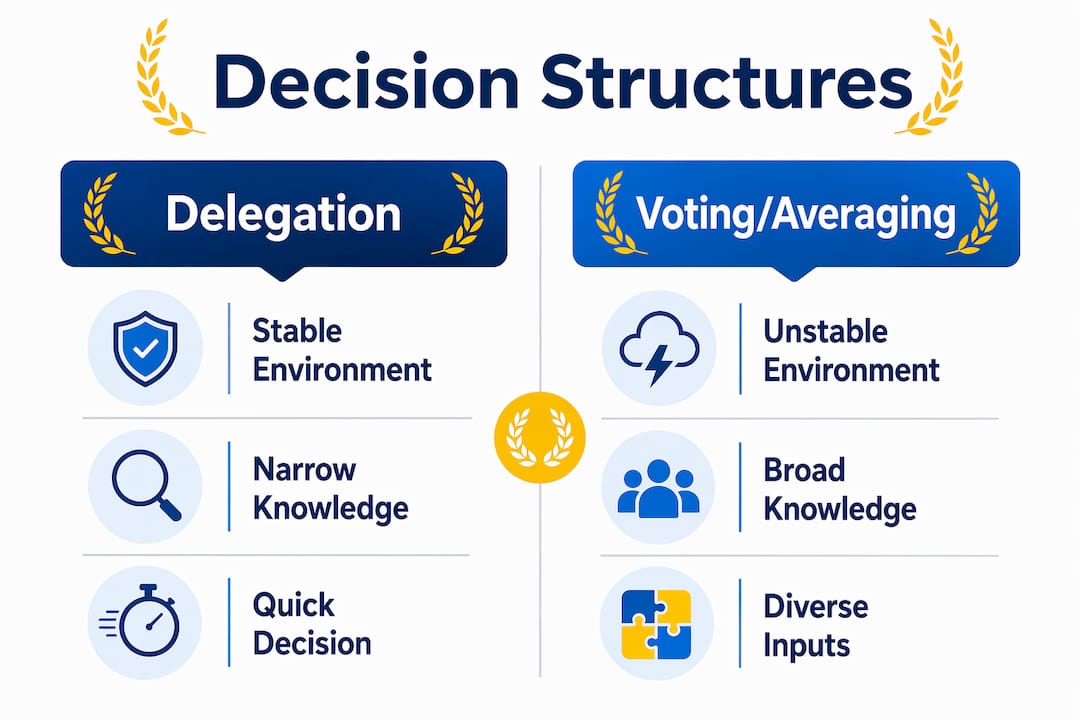
| Environment stability | Narrow knowledge breadth | Broad knowledge breadth |
|---|---|---|
| Stable | Delegate to the expert | Average independent estimates |
| Unstable / fast-changing | Majority vote (speed matters) | Delegate to the best-matched expert |
Delegation wins when one person’s expertise clearly outpaces the group’s. Voting wins when speed matters more than precision and no single expert exists. Averaging works best when multiple people have independent, roughly equal knowledge and the environment is predictable enough to let you aggregate calmly.
Red flags that tell you to escalate rather than decide locally:
- The decision affects people outside your team.
- No one on the team has direct experience with the outcome type.
- The stakes are high enough that a wrong call can’t be reversed in a week.
Pro Tip: Before a group vote, have each person write their preference privately and submit it before discussion. This one move cuts availability bias — the tendency to anchor on whoever spoke first — almost entirely.
The Mediating Assessments Protocol (MAP) from MIT Sloan takes this further: separate information sharing from final judgment in two distinct meeting phases so early opinions don’t contaminate the evidence review.
How do you map Roman military roles to a modern peer team?
The Roman legion ran on clear decision rights. The Centurion commanded; the Optio (second-in-command) executed and relayed; scouts gathered field intelligence; scribes recorded everything. That structure maps cleanly onto a four-person student or startup team.
- Commander (Centurion): Holds final decision authority. Accountable for the outcome. One person per decision, not per team.
- Optio (Driver): Runs the meeting, keeps the 7-step cycle on track, and owns the action list.
- Scouts (Contributors): Gather data, surface alternatives, and flag risks before the weigh step.
- Scribe (Informed): Documents the choice, the rationale, and the review date.
RACI-lite template (copy into any task card):
- Decision: [one sentence]
- Responsible (Optio): [name]
- Accountable (Centurion): [name]
- Consulted (Scouts): [names]
- Informed (Scribe): [name]
- Deadline: [date]
- Review date: [date]
“Clarifying decision rights — explicitly separating who has authority from who has input — is the single most effective lever for preventing decision paralysis in teams.” — Harvard Business Perspective
Three rituals that keep the Roman playbook fast without sacrificing safety:
- Morning briefing (5 min): Centurion states the day’s top decision and assigns roles.
- Rapid council (15 min): Scouts present evidence; Optio facilitates; Centurion decides.
- After-action review (15 min): Scribe reads back the decision and outcome; team notes what to change.
Psychological safety matters here. Frontline empowerment only works when scouts feel safe surfacing bad news. Make it a norm: the Centurion thanks the scout who brings the uncomfortable data point, not just the one who confirms the plan.
What templates and app features should you use today?
Three plug-and-play templates for your first week:
- One-page decision brief: Decision statement / three alternatives / scoring criteria / chosen option / owner / review date.
- 15-minute meeting script: 2 min framing → 5 min evidence → 3 min alternatives → 3 min vote or delegate → 2 min action list.
- Experiment run sheet: Hypothesis / metric / sample size / decision gate / learning note.
Software features worth prioritizing for team collaboration in small teams:
- Lightweight DACI role tags per task or decision card.
- Threaded decision comments so context doesn’t live in someone’s inbox.
- Timeline tracking that shows when a decision was made and by whom.
- Outcome review logs with a scheduled reminder.
Optiostation maps directly to this playbook. Its Roman-themed role structure (you are the Centurion; the app is your Optio) mirrors the DACI-lite template above. Use it to assign decision roles, log the chosen option, set a review date, and track the action list through to completion. The decision-making tools guide on the Optiostation site walks through how to set up each template inside the app.
Pro Tip: Log the reason for every decision, not just the outcome. Six weeks later, when the outcome looks bad, the reason tells you whether the process was flawed or just unlucky.
How do you run high-uncertainty decisions as experiments?
When past data is thin or the problem is genuinely new, theory-driven decision making beats immediate commitment. The logic: start by selecting the best theory about why something will work, then test it cheaply before going all in.
- Write a hypothesis. “If we do X, then Y will happen because Z.” One sentence.
- Design a small test. Limit scope: one week, one channel, one cohort.
- Set a decision gate. Define in advance what result confirms or kills the theory.
- Collect data. Track one or two leading indicators, not a dozen.
- Run the learning loop. At the gate, decide: commit, pivot, or test a different theory.
Experimenting with more “surprising” and less plausible theories often yields greater learning — precisely because the results are less predictable and force sharper reasoning.
Two biases that wreck this process: excessive coherence (forcing new evidence to fit the original theory) and availability bias (over-weighting the most recent data point). The MAP protocol from MIT Sloan counters both by requiring independent evidence assessment before any group discussion.
Pro Tip: Set your decision gate before you see any results. Teams that set gates after early data almost always move the goalposts.
AI-supported study tools, like those covered in BoardMaster’s guide to efficient studying, show the same principle at work in learning contexts: structured hypothesis testing outperforms passive review when the problem space is unfamiliar.
How long do decisions actually take, and what do they cost?
Time is the real cost for students and small teams. Here is a realistic budget:
Decisions vary in preparation, meeting, and follow-up times depending on their complexity and stakes, with simpler decisions requiring shorter total durations and strategic experiments taking longer setups with ongoing follow-ups.
Simple prioritization rule: spend decision time proportional to impact × uncertainty. A low-impact, low-uncertainty call (which font for the slide deck) deserves two minutes, not a committee meeting.
Three practices that cut overhead without cutting quality:
- Time-box every step. Set a visible timer. When it goes off, move on.
- Collect data asynchronously. Scouts submit findings in a shared doc before the meeting; the meeting is for weighing, not gathering.
- Use a standing agenda. A pre-written meeting script (see the 15-minute template above) eliminates the five minutes teams spend figuring out how to start.
Tracking time spent on decisions is the fastest way to spot where your process leaks. Most teams discover they spend a large portion of their meeting time on information gathering that could have happened before the room convened.
Key Takeaways
Effective organizational decision making requires a repeatable 7-step cycle, a contingency-matched decision structure, and clear role separation — all three together, not any one alone.
| Point | Details |
|---|---|
| Use the 7-step cycle | Run every team decision through all seven steps; skipping the review step breaks the learning loop. |
| Match structure to context | Use the knowledge breadth × environmental stability rule to choose delegation, voting, or averaging. |
| Assign roles before the meeting | A DACI-lite role card (Centurion, Optio, Scouts, Scribe) prevents paralysis and speeds execution. |
| Test before committing | Frame high-uncertainty decisions as experiments with a written hypothesis and a pre-set decision gate. |
| Optiostation as your Optio | Use Optiostation’s role tags, decision logs, and review reminders to run the Roman playbook in one app. |
The case for slowing down to decide faster
Most teams rush decisions because they confuse speed with efficiency. They skip the evidence step, skip role assignment, and skip the review. Then they relitigate the same decision three weeks later because nothing was documented and no one remembers why they chose what they chose.
The Roman military did not win because its commanders were smarter. It won because the structure was clear enough that every level of the hierarchy could act without waiting for orders from above. That is exactly what the DACI-lite template and the 7-step cycle give a student team: enough structure to move fast without losing the thread.
The contingency rule from INFORMS is the piece most guides skip. Knowing when to delegate versus when to vote is not obvious, and getting it wrong costs more time than the decision itself. A team that votes on a technical question no one is qualified to answer is not being democratic. It is being slow and wrong simultaneously.
One more thing: psychological safety is not a soft skill. It is the mechanism that gets scouts to surface bad news before the Centurion commits. Without it, the whole playbook collapses into a performance of decision making rather than the real thing.
Optiostation puts the Roman playbook in your pocket
Optiostation was built for exactly this: the student or young professional who needs a second-in-command to keep decisions organized, roles clear, and reviews scheduled. You are the Centurion. The app is your Optio.
Four features that map directly to the templates in this guide:
- Role tags for DACI-lite assignments on every task or decision card.
- Decision logs that capture the choice, the rationale, and the owner in one place.
- Outcome review reminders so the learning loop actually closes.
- Timeline tracking that shows the full decision history at a glance.
Start with the task management guide to set up your first Roman-playbook decision in the app, or go straight to managing tasks effectively for a student-specific walkthrough. Your first structured decision is one meeting away.
Cited sources and further reading
The research and frameworks behind this guide:
- 7-step decision-making cycle — Southern New Hampshire University
- Decision-making as process — Harvard Business School Online
- INFORMS contingency research on decision structures (2024)
- Mediating Assessments Protocol (MAP) — MIT Sloan Management Review
- Harvard Business Perspective on decision quality (Nov 2022)
- DACI and RACI-lite frameworks — Atlassian teamwork blog
- Decision-making pitfalls and remedies — Asana resources
- Theory-driven strategic decisions under uncertainty — INFORMS Strategy Science
- Organizational decision making: information aggregation view — Management Science
For templates and app setup, the Optiostation decision-making guide covers how to configure role tags, decision logs, and review reminders inside the app.
Recommended
- Essential decision making tools for better life choices – Optio Station: Best Project Management App for Prioritization
- Decision Making in Project Management: A 2026 Guide – Optio Station: Best Project Management App for Prioritization
- How to Handle Multiple Tasks Efficiently as a Centurion – Optio Station: Best Project Management App for Prioritization
- How to Improve Teamwork for Success in College and Work – Optio Station: Best Project Management App for Prioritization
