

TL;DR:
- Goals are specific, time-bound outcomes that guide effort toward achievement. Using all three types—outcome, process, and task goals—creates systems that boost motivation and consistency. Effective goal setting relies on the SMART framework, obstacle planning, and regular progress reviews to sustain effort and adapt goals over time.
A goal is a consciously envisioned future outcome that a person or group commits to achieving within a specific timeframe. That definition is the foundation of every productivity system, academic framework, and personal development method worth following. Goals give your effort a direction and your time a purpose. Without a clear goal, you are working hard without knowing what “done” looks like. This guide explains what defines a goal, why goals matter, the different types, how to set them using science-backed methods, and how to stay on track when motivation fades.
Why does defining a goal matter for success?
Clear goals do more than point you in a direction. Goal-setting mechanisms boost performance by increasing intrinsic motivation and self-efficacy. Self-efficacy is your belief that you can actually complete what you set out to do. When that belief is strong, you persist longer and recover faster from setbacks.
Goals also create a measurable roadmap. Without one, progress is invisible. When you can see progress, you feel it. Positive emotions from tracking milestones drive sustained effort more effectively than stress from failure. That is a critical insight: the reward system that keeps you going is built on wins, not fear.
The distinction between intrinsic and extrinsic motivation matters here. Intrinsic goals come from genuine personal interest or values. Extrinsic goals come from outside pressure, such as what others expect of you. Extrinsic goals collapse faster because the fuel source is unreliable. A goal you truly want to achieve outlasts one you feel you “should” pursue.
- Intrinsic goals connect to personal values, curiosity, or growth
- Extrinsic goals are driven by rewards, approval, or social pressure
- Intrinsically motivated goals produce higher task completion and longer commitment
- Extrinsic pressure often leads to early motivation collapse when the external reward disappears
Pro Tip: Use the “Why Test” before committing to any goal. Ask yourself “why” five times in a row. If your final answer connects to a personal value, the goal is intrinsically motivated. If it connects to someone else’s expectation, reconsider whether this goal is truly yours.
What are the different types of goals?
A goal can be classified into three types: outcome goals, process goals, and task goals. Each type serves a different function. Using only one type creates blind spots in your approach.

| Goal type | What it focuses on | Example |
|---|---|---|
| Outcome goal | The final result you want to achieve | Score an A on the final exam |
| Process goal | The daily behaviors that lead to the result | Study for 45 minutes every evening |
| Task goal | The specific learning or execution structure | Complete one practice problem set per session |
Outcome goals give you a destination. They answer the question “what do I want?” Process goals give you control. They answer “what do I do today?” Task goals give you structure. They answer “how exactly do I do it?”
Most people only set outcome goals. That is a mistake. Outcome goals are entirely dependent on results you cannot always control. A student who sets “get an A” as their only goal has no plan for what to do each day. A student who adds “study 45 minutes nightly” and “complete one practice set per session” has a system. Systems survive bad days. Pure outcome goals often do not.
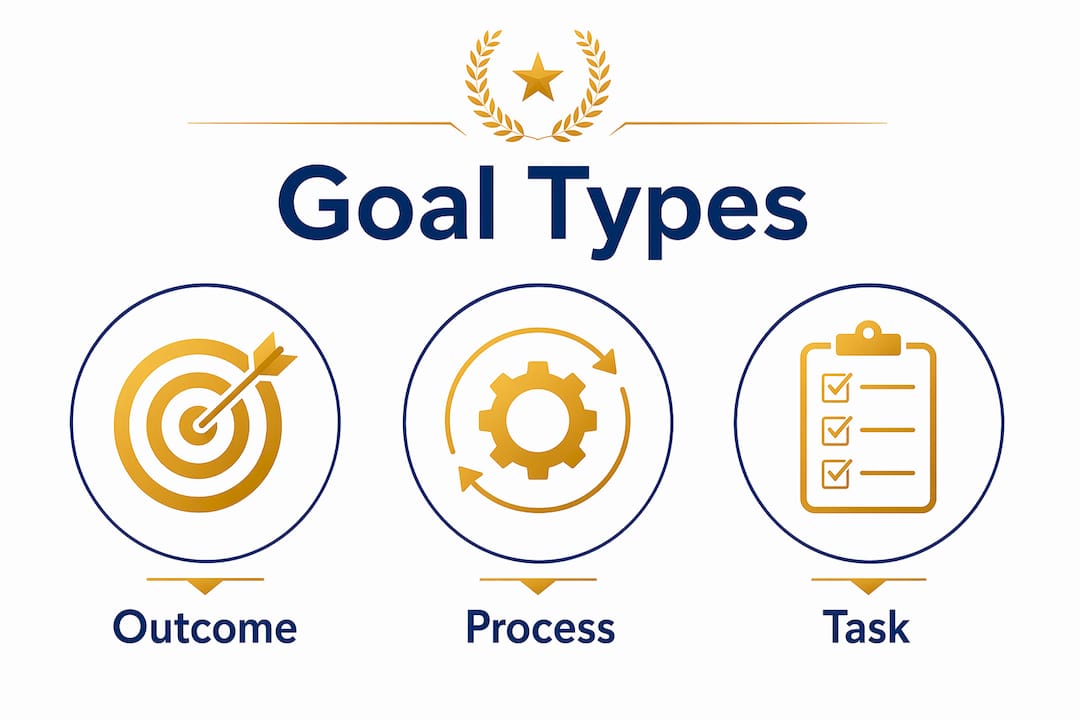
Balancing all three types produces the most consistent motivation. You stay connected to the big picture while maintaining daily control over your behavior.
How to set effective goals using proven strategies
The SMART framework is the most widely used standard for writing effective goals. SMART stands for Specific, Measurable, Achievable, Relevant, and Time-bound. Each element removes ambiguity and makes your goal trackable.
- Write one clear sentence. State what you want to achieve, by how much, and by when. “I will read 10 pages of my textbook every day for the next 30 days” is a SMART goal. “I want to read more” is not.
- Limit yourself to 2–3 goals at once. Focusing on fewer than 4 goals preserves the mental bandwidth needed to make daily progress on each one. More goals mean more competing demands on your attention.
- Use if-then planning. Write a specific response for each likely obstacle. “If I miss my study session after dinner, then I will complete it before breakfast the next morning.” This technique is called an implementation intention.
- Test your motivation. Apply the Why Test before you commit. A goal that fails the test will likely fail in practice.
- Schedule a 12-week review. Successful goal achievement requires regular recalibration every 12 weeks. Life changes. Your goals should adapt with it.
If-then planning achieves a medium-to-large effect size (d=0.65) across 94 studies involving over 8,000 participants. That effect size means the technique produces a meaningful, reliable improvement in goal attainment. It is not a motivational trick. It is a behavioral mechanism that creates automatic responses to obstacles.
Pro Tip: Write your goal in one sentence using this formula: “I will [specific action] by [measurable amount] by [exact date].” Pin it somewhere you see every morning. Visibility is a simple but underused commitment device.
Common goal-setting mistakes and how to avoid them
Most goal failures are predictable. Recognizing the pattern before it happens is the fastest way to avoid it.
- Setting too many goals. Multiple goals create conflicting demands on your attention and self-regulation. When everything is a priority, nothing is. Cap your active goals at three.
- Only setting outcome goals. Without process goals, you have a destination but no route. Add at least one process goal for every outcome goal you set.
- Pursuing externally pressured goals. Goals driven by what others want for you lose their fuel quickly. The Why Test exists precisely to catch this mistake before you invest weeks of effort.
- Having no obstacle plan. Most people plan for success and ignore failure scenarios. When the first obstacle hits, they quit. Implementation intentions fix this by pre-loading your response.
- All-or-nothing thinking. Missing one day does not erase your progress. Treating a single slip as total failure is the most common reason people abandon goals after minor setbacks. One missed session is not a failed goal. It is a data point.
The fix for most of these mistakes is the same: slow down before you start. Spend 20 minutes writing a clear goal sentence, listing your top two obstacles, and writing an if-then response for each. That 20-minute investment prevents weeks of wasted effort.
How do you stay on track and measure progress?
Tracking progress is not optional. Satisfaction from milestone completion drives sustained effort better than stress signals. You need to see your wins to keep going.
Practical tracking methods include a simple daily checklist, a habit tracker app, a journal entry at the end of each day, or a visual progress bar drawn on paper. The format matters less than the consistency. Pick one method and use it every day.
The “never miss twice” rule is one of the most useful consistency tools available. Missing once is an accident. Missing twice is the start of a new habit. The rule gives you permission to be human while protecting your momentum.
Pro Tip: Set a weekly 10-minute check-in with yourself every Sunday. Review what you completed, what you missed, and what obstacle caused the miss. Then write your if-then plan for the coming week. This single habit closes the gap between intention and execution.
Accountability also accelerates progress. Sharing your goal with one trusted person, scheduling a weekly check-in, or using a progress tracking system increases your commitment. The social element adds a layer of external accountability that reinforces your internal motivation. Understanding why setting study goals matters can also sharpen your focus before you even begin.
Key Takeaways
A goal is a time-bound, consciously envisioned outcome that directs effort, and achieving it requires the right type, a clear structure, and consistent tracking.
| Point | Details |
|---|---|
| Goal definition | A goal is a specific, time-bound outcome that directs intentional effort toward a desired result. |
| Three goal types | Outcome, process, and task goals each serve a distinct role. Use all three together for best results. |
| SMART framework | Write every goal as one sentence stating what, by how much, and by when. |
| Limit active goals | Cap your goals at 2–3 at once to preserve focus and avoid cognitive overload. |
| Track and adapt | Review progress every 12 weeks and apply the “never miss twice” rule to maintain momentum. |
Goals are a system, not a wish list
Optiostation has worked with students and young professionals long enough to see one pattern repeat itself: the people who struggle most with goals treat them as declarations rather than systems. They write “I want to get fit” or “I want to finish my degree” and then wonder why nothing changes after two weeks.
The research is clear, but the real lesson is behavioral. A goal without a process goal attached to it is just a wish. A goal without an obstacle plan is fragile. A goal that fails the Why Test is borrowed ambition, not your own. The most effective goal-setters we have seen are not the most disciplined people in the room. They are the ones who spent time designing their system before they started running it.
The other thing worth saying plainly: goals are allowed to change. Treating a goal as permanent creates rigidity that kills motivation. A 12-week review is not a sign of failure. It is a sign that you are paying attention. The goal you set in january may not be the right goal by april, and that is fine. Revise it. Keep moving.
The Centurion mindset is not about grinding harder. It is about commanding your effort with intention. Set fewer goals. Make them specific. Plan for obstacles. Track your wins. That is the system.
— Optiostation
Put your goals into action with Optiostation
Setting a clear goal is step one. Executing it day after day is where most people need support.

Optiostation is built for exactly that gap. As your second-in-command, it helps you break goals into daily tasks, track your progress, and manage your time without losing sight of the bigger picture. Whether you are a student managing coursework or a young professional juggling projects, the right task management tools turn your goals from intentions into completed work. Optiostation also covers the practical side of execution, from managing tasks effectively to keeping your team aligned. Your goals deserve a system built to support them.
FAQ
What is the standard definition of a goal?
A goal is a consciously envisioned future outcome that a person or group commits to achieving within a specific timeframe. It functions as an endpoint toward which effort is intentionally directed.
What are the three types of goals?
The three types are outcome goals, process goals, and task goals. Outcome goals focus on results, process goals focus on daily behaviors, and task goals focus on the specific structure of learning or execution.
How many goals should you set at once?
Experts advise limiting active goals to 2–3 at a time. Pursuing more than three goals simultaneously creates competing demands on attention and reduces the likelihood of completing any of them.
What is if-then planning and why does it work?
If-then planning is a technique where you write a specific response to a likely obstacle, such as “if I miss my session, then I will complete it the next morning.” Research shows it produces a meaningful effect size (d=0.65) in goal attainment across large-scale studies.
How do you stay motivated when pursuing long-term goals?
Track progress consistently and apply the “never miss twice” rule after setbacks. Positive emotions from seeing milestone progress drive sustained effort more effectively than stress from failure.
Recommended
- Define your goals: proven strategies for motivation and success – Optio Station: Best Project Management App for Prioritization
- 7 Effective Goal-Setting Tips for Students and Professionals – Optio Station: Best Project Management App for Prioritization
- Understanding Why Use Goal Trackers for Success – Optio Station: Best Project Management App for Prioritization
- SMART goals: a step-by-step guide to real results – Optio Station: Best Project Management App for Prioritization
