

TL;DR:
- Work-life balance involves managing professional responsibilities and personal well-being without letting either dominate. It is a dynamic practice of setting boundaries and adjusting priorities based on life stages and individual circumstances. Maintaining awareness and consistency in routines directly impacts productivity, mental health, and long-term career sustainability.
Work-life balance in the workplace is the deliberate practice of managing professional responsibilities alongside personal well-being so that neither consistently destroys the other. For college students and young professionals entering the workforce, this concept is not abstract. WorldatWork 2025 research identifies work-life balance as a top stressor driving talent decisions, and the stakes are real from day one of your career. Dr. Kendra Thomas of Southern New Hampshire University frames it simply: balance is about honoring your health and setting boundaries, not achieving a perfect split between work and personal time. If you start your career understanding that, you are already ahead of most people in the room.
What is work life balance in the workplace, really?
Work-life balance is defined as the ongoing effort to distribute your time, energy, and attention between work and personal life in a way that sustains both. The word “balance” misleads people into thinking it means 50/50. It does not. Psychology Today describes it as a dilemma to manage, not a problem to solve. That distinction matters because it removes the pressure of achieving some fixed, perfect state.
For young professionals, the concept is especially fluid. A college student juggling a part-time job, coursework, and internship applications faces a completely different version of “balance” than a full-time employee managing a team. What counts as a good work-life balance shifts with your life stage, your role, and your personal values. The goal is not to find the right ratio. The goal is to stay aware of when the ratio is hurting you and to adjust before the damage compounds.
The term “work-life harmony” is sometimes used as an alternative definition, and it captures something the word “balance” misses. Harmony suggests that work and life do not have to be in opposition. They can coexist and even reinforce each other when managed well.
Why work-life balance matters for your productivity and mental health
Poor work-life balance does not just make you tired. It produces measurable, costly outcomes for both individuals and organizations. More than 50% of workers have left employers primarily because of poor work-life balance. That statistic means organizations that ignore this issue lose their best people first, because high performers have options.
The mental health consequences are equally serious. The WHO projects that depression will be a leading health condition by 2030, and chronic workplace stress is a direct contributor. Burnout, which is the clinical endpoint of sustained imbalance, produces increased errors, absenteeism, and a near-total collapse of motivation. You do not have to be burned out to feel the effects. Even moderate, persistent imbalance degrades your focus and decision-making over time.
Pro Tip: Track your energy levels for one week, not just your hours. If you consistently feel drained before noon or cannot mentally disconnect after work, that is a signal worth taking seriously before it becomes a health issue.
| Point | Details |
|---|---|
| Strong balance: higher retention | Workers with good balance stay longer and perform more consistently. |
| Strong balance: better focus | Adequate rest and personal time restore cognitive capacity for complex tasks. |
| Poor balance: burnout risk | Chronic overwork leads to emotional exhaustion, errors, and absenteeism. |
| Poor balance: turnover cost | Replacing an employee costs organizations significantly more than retaining one. |
| Poor balance: mental health decline | Sustained stress increases risk of anxiety, depression, and physical illness. |
Is work-life balance the same for everyone?
Work-life balance is not a universal formula. SNHU’s Dr. Kendra Thomas argues that balance means honoring your well-being, which looks different for every person depending on their circumstances, values, and season of life. A 22-year-old in their first job has different needs than a 28-year-old managing a side project and a relationship. Both deserve balance. Neither should use the same template to find it.
Several factors shape what balance looks like for you specifically:
- Life stage and responsibilities. A student with a part-time job needs different boundaries than a full-time professional with a family. Your current obligations define your baseline.
- Career stage. Early careers often demand more learning time and longer hours. That is not inherently wrong, but it requires conscious management so it does not become permanent.
- Personality and energy type. Introverts typically need more recovery time after social or collaborative work. Extroverts may recharge through interaction. Neither is wrong, but ignoring your type leads to chronic fatigue.
- Organizational culture. A workplace that rewards 60-hour weeks signals that overwork is the norm. Recognizing that culture early helps you decide whether to adapt, push back, or leave.
- Personal values. What you prioritize outside of work, whether that is fitness, relationships, creative projects, or rest, defines what “personal life” actually means to you.
Rainer Strack of Boston Consulting Group makes a point that most people resist: time is a limited resource and individuals bear ultimate responsibility for managing their own energy and priorities. Waiting for your employer to fix your balance is a losing strategy. You have to own it.
Psychology Today reinforces this with a practical framing: balance is a continual negotiation, not a destination. You re-evaluate it as your circumstances evolve. That means checking in with yourself regularly and being willing to change what is not working, even when change feels inconvenient.
Common challenges to work-life balance in modern workplaces
Remote and hybrid work changed the rules. Before 2020, the physical act of leaving an office created a natural boundary between work and personal life. That boundary is now gone for millions of workers. Remote and hybrid employees show higher burnout rates due to difficulty unplugging, with a 2022 post-pandemic study linking blurred work-home boundaries to increased emotional exhaustion. For young professionals who started their careers during or after the pandemic, this blurred state can feel normal. It is not.
The challenges young workers face most often include:
- Always-on technology. Slack, email, and project management notifications do not stop at 5 PM. The expectation of constant availability is one of the most corrosive forces in modern work culture.
- Unclear boundaries in remote settings. When your bedroom is also your office, the psychological separation between work and rest collapses. This makes mental recovery nearly impossible.
- Workplace culture pressure. Some organizations implicitly reward overwork. When your manager sends emails at 11 PM and praises people who “go above and beyond,” the message is clear, even if no one says it out loud.
- Unrealistic workloads. Entry-level roles often carry more responsibility than their titles suggest. Young professionals frequently absorb excess work because they want to prove themselves, which is understandable but unsustainable.
- Lack of organizational support. Not every employer offers flexible schedules, mental health resources, or clear policies on after-hours communication. Without structural support, individual effort only goes so far.
Organizations that promote flexible schedules and mental health support help employees sustain balance more effectively than those that rely on individual willpower alone. If your current workplace does not offer these, that is worth factoring into your long-term career decisions. For remote work productivity, setting clear daily boundaries is the single most effective starting point.
How to achieve work-life balance as a student or young professional
Healthy work-life balance does not require a complete overhaul of your life. It requires a set of consistent, deliberate practices that compound over time. Here is what actually works for students and young professionals:

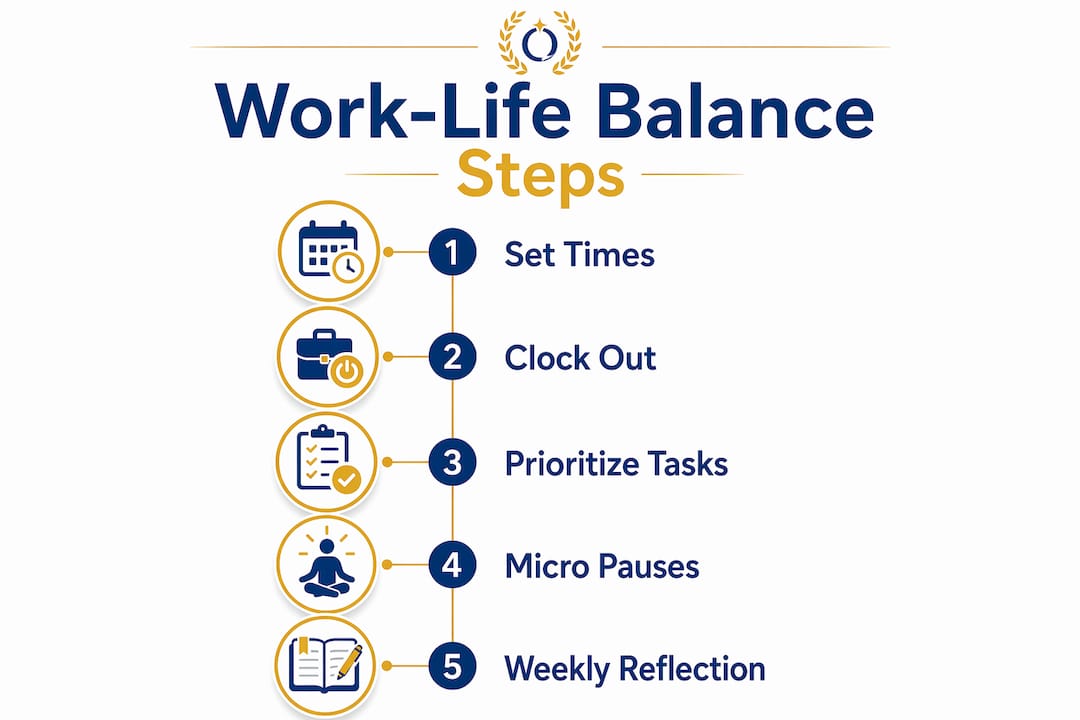
Set firm start and end times. Decide when your workday begins and ends, and treat those times as non-negotiable. Disable work notifications outside those hours. This is not laziness. It is the foundation of sustainable performance.
Create a “clocking out” ritual. Mindfulness and end-of-day rituals improve well-being, especially for remote workers. A short walk, a workout, or even changing out of work clothes signals to your brain that the workday is over. The ritual does not need to be elaborate. It needs to be consistent.
Use task management tools to prioritize ruthlessly. Effective task management reduces stress and supports better balance by improving focus and time allocation. Tools that help you organize your workload, set deadlines, and timebox your day prevent the mental sprawl that makes work feel endless. Optiostation’s task management features are built specifically for students and young professionals who need to manage competing demands without burning out.
Practice micro-pauses during the day. A five-minute break every 90 minutes is not a luxury. Research on cognitive performance consistently shows that short breaks maintain focus better than grinding through without stopping. Set a timer if you have to.
Leverage available resources. Universities offer counseling, wellness programs, and academic advisors. Many employers provide employee assistance programs, mental health days, and flexible scheduling. Most young professionals underuse these resources because they do not know they exist or feel uncomfortable asking. Use them.
Reflect weekly on your satisfaction. Ask yourself two questions every Sunday: What drained me this week? What restored me? The answers tell you where your balance is slipping before it becomes a crisis. Pair this with a step-by-step balance review tailored to students and young professionals for a structured approach.
Pro Tip: Try timeboxing your most demanding tasks into 90-minute focused blocks. Optiostation’s timeboxing approach gives you a practical framework for protecting both your productive hours and your personal time.
Key takeaways
Work-life balance in the workplace is not a fixed achievement. It is a continuous, personalized practice of managing energy, boundaries, and priorities to sustain both performance and well-being.
| Point | Details |
|---|---|
| Balance is dynamic, not static | Adjust your approach as your life stage, role, and responsibilities evolve. |
| Poor balance has real costs | Over 50% of workers have left jobs due to imbalance; burnout degrades performance measurably. |
| Individual ownership is non-negotiable | You bear primary responsibility for your energy and priorities, regardless of employer support. |
| Rituals and boundaries are the tools | End-of-day rituals and firm work hours are the most practical defenses against burnout. |
| Task management reduces mental load | Organizing your workload with dedicated tools frees cognitive space for personal recovery. |
The honest truth about balance that most articles skip
Most advice on work-life balance treats it like a checklist. Set boundaries. Take breaks. Use an app. Done. That framing misses the harder truth: balance is a mindset before it is a method.
At Optiostation, we work with students and young professionals every day who are trying to manage coursework, jobs, internships, and personal lives simultaneously. The ones who struggle most are not the ones with the heaviest workloads. They are the ones who believe that rest is something you earn after you finish everything. You never finish everything. That is the trap.
What actually works is treating your personal time as a non-negotiable input to your performance, not a reward for it. Sleep, social connection, physical activity, and genuine downtime are not indulgences. They are the conditions under which good work becomes possible. When you protect them, your output improves. When you sacrifice them consistently, your output degrades, and so does your health.
The other thing worth saying directly: your first job or internship will not define your career, but your habits in that first role will follow you for years. If you normalize 60-hour weeks and constant availability at 22, you will find it very difficult to reclaim boundaries at 30. Start as you mean to go on.
Balance is not something you achieve once and maintain effortlessly. It is something you choose, lose, and rechoose, repeatedly, throughout your career. The goal is not perfection. The goal is awareness and the willingness to correct course before the cost becomes too high.
— Optiostation
Take control of your workload with Optiostation
Managing work-life balance starts with managing your tasks. Optiostation is built for students and young professionals who need to organize competing demands without losing their minds or their personal time.
With Optiostation, you can prioritize tasks by urgency and importance, set reminders that respect your off-hours, and build daily routines that protect both your productivity and your well-being. The app’s Roman-themed structure puts you in command as the Centurion, with Optio as your second-in-command handling the organizational load. Explore the best task management tools for students and young professionals, or go straight to managing tasks effectively with a guide built for your exact situation.
FAQ
What is work-life balance in the workplace?
Work-life balance in the workplace is the practice of managing professional duties alongside personal well-being so that neither consistently undermines the other. It involves setting boundaries, prioritizing tasks, and protecting time for rest and personal life.
What is a healthy work-life balance?
A healthy work-life balance means you can meet your work responsibilities without sacrificing your physical health, mental well-being, or personal relationships. According to SNHU’s Dr. Kendra Thomas, it centers on honoring your health needs and setting firm boundaries, not achieving equal time splits.
Why is work-life balance important for young professionals?
Poor work-life balance drives burnout, increased errors, and turnover. WorldatWork research shows more than 50% of workers have left jobs due to imbalance, making it a career-defining issue from the start.
How do remote workers maintain work-life balance?
Remote workers maintain balance by creating firm end-of-day rituals, disabling work notifications after hours, and using task management tools to contain their workload. Blurred work-home boundaries are the primary driver of remote burnout, so artificial separation routines are not optional.
What is the difference between work-life balance and work-life harmony?
Work-life balance implies an equal or managed division between work and personal time. Work-life harmony suggests that work and personal life can coexist and reinforce each other when managed intentionally, rather than existing in constant competition.
Recommended
- Work‑Life Balance: Complete Guide for Students & Young Pros – Optio Station: Best Project Management App for Prioritization
- Understanding Time Management for Young Professionals – Optio Station: Best Project Management App for Prioritization
- Work-Life Balance Checklist: Achieve Optimal Balance Fast – Optio Station: Best Project Management App for Prioritization
- Step-by-step guide to work-life balance for students – Optio Station: Best Project Management App for Prioritization
