

Most American students and professionals are surprised to learn that habits are mental shortcuts, not just automatic routines. This matters because the way you track and change habits can shape how productive and adaptable you become in competitive tech and business environments. By exposing the biggest myths and revealing proven strategies, you will discover smarter techniques for habit tracking that support real growth and lasting results.
Table of Contents
- Defining Habit Tracking And Common Myths
- Types Of Habits And Tracking Methods
- How Habit Tracking Drives Productivity
- Personal Growth Through Consistency And Reflection
- Risks, Common Pitfalls, And How To Avoid Them
Key Takeaways
| Point | Details |
|---|---|
| Habit Tracking Requires Active Management | Simply recording habits is not enough; individuals must actively engage with and reflect on their behaviors for successful change. |
| Common Myths Oversimplify Habit Formation | Many believe habits form in a fixed timeframe, but actual formation varies greatly by individual and context. |
| Effective Tracking Methods Integrate Technology and Reflection | Combining digital tools with reflective practices enhances understanding and promotes lasting behavior change. |
| Balance is Key to Avoid Pitfalls | Focus on a few meaningful habits and allow flexibility to mitigate stress and encourage personal growth. |
Defining Habit Tracking and Common Myths
Habit tracking represents a strategic approach to understanding and modifying personal behaviors through systematic observation and documentation. At its core, habit tracking involves recording specific actions, patterns, and progress to gain insights into your daily routines and performance. Psychological research suggests that habits are more complex mental connections between cues and actions rather than simple, stable behaviors.
Contrary to popular belief, habit formation is not a straightforward, guaranteed process. Researchers argue that habit impulses constantly compete with other mental urges, meaning tracking alone does not automatically ensure success. Habit tracking requires active management and understanding of the psychological mechanisms driving behavior change. These mental links between triggers and actions can be influenced by various factors such as environment, motivation, and personal context.
Common myths about habit tracking often oversimplify the process of behavioral change. Many people believe that creating a habit takes exactly 21 or 66 days, but scientific research reveals that habit formation is a nuanced process dependent on individual differences. Habits are computationally efficient mental shortcuts, but they can also lead to inflexible behavior if not carefully monitored and adjusted. Understanding these complexities helps individuals develop more realistic expectations and strategies for personal development.
Pro tip: Start your habit tracking journey by selecting 1-2 specific, measurable behaviors and tracking them consistently for at least two months to build realistic insights into your personal patterns.
Here’s a summary of common myths versus scientific realities in habit tracking:
| Myth | Scientific Reality | Practical Implication |
|---|---|---|
| Habits take exactly 21 or 66 days to form | Habit formation duration varies widely | Set realistic, flexible timelines |
| Tracking guarantees habit success | Tracking only supports—but does not ensure—success | Combine tracking with active reflection |
| Habits are stable, automatic behaviors | Habits compete with other mental urges | Adjust strategies as needed for context |
| All habits are equally easy to develop | Individual differences impact habit formation | Personalize your approach for better results |
Types of Habits and Tracking Methods
Habit types span multiple domains of personal and professional development, ranging from health-related behaviors to productivity and skill acquisition. Digital behavior change interventions demonstrate that habits can be systematically tracked and modified through strategic monitoring techniques. These interventions typically focus on key areas such as physical activity, nutrition, sleep patterns, learning practices, and professional performance.
Traditional and digital tracking methods have evolved to provide nuanced insights into habit formation. Health-related habit research reveals multiple approaches for systematic habit observation, including self-report indices, automaticity questionnaires, and digital monitoring tools. Modern tracking methods leverage technology like wearable devices, smartphone applications, and interactive platforms that offer real-time feedback, personalized goal setting, and virtual reward systems to enhance motivation and behavioral consistency.
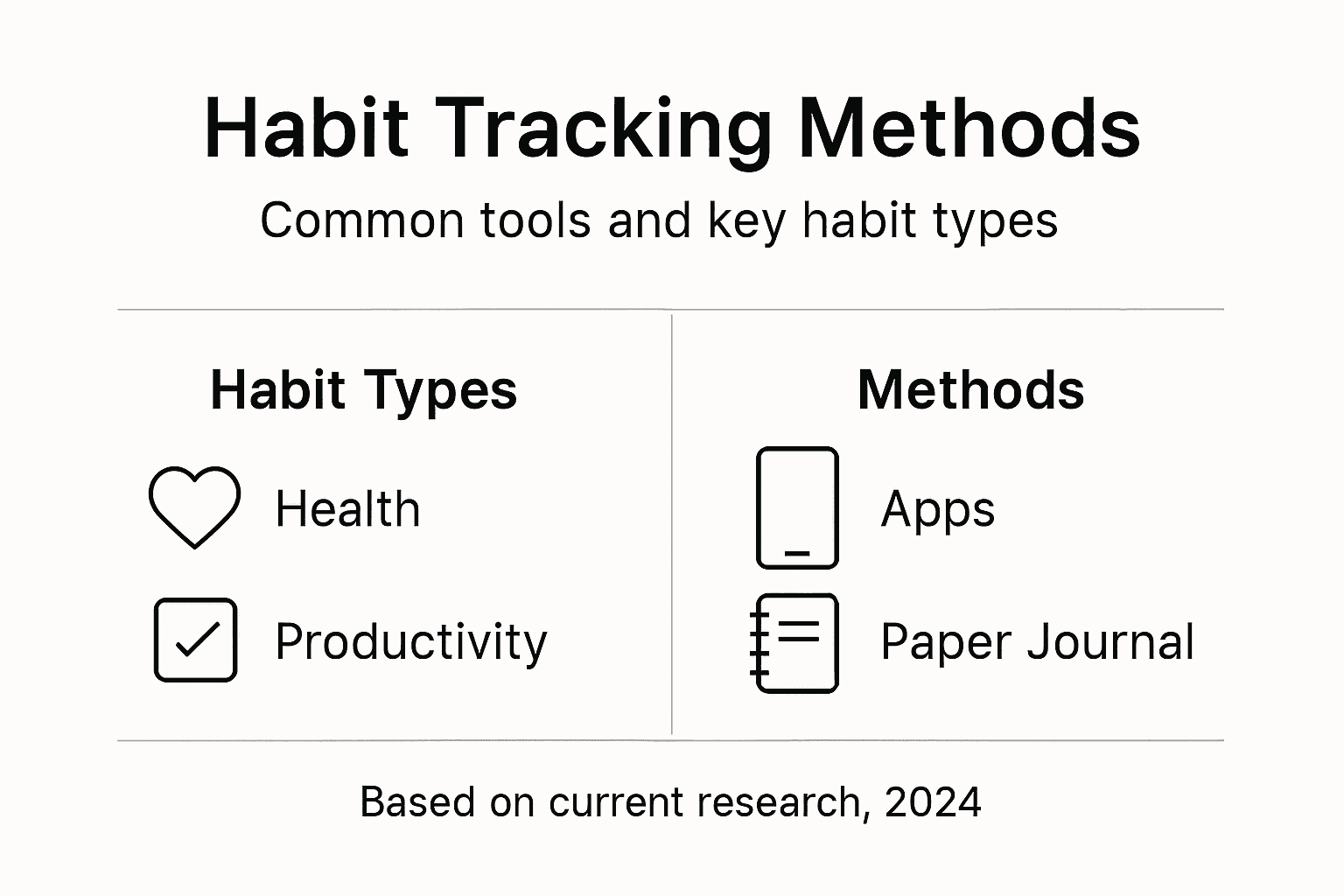
The most effective habit tracking methods combine multiple techniques to provide comprehensive insights. These approaches typically incorporate elements like frequency logging, environmental context analysis, emotional state tracking, and performance metrics. Digital tools now integrate advanced features such as automatic monitoring, descriptive feedback mechanisms, and personalized behavior modification recommendations. By understanding individual variations in habit formation, these methods can help users develop more targeted and sustainable behavior change strategies.
Pro tip: Choose a habit tracking method that offers both quantitative metrics and qualitative reflection to ensure comprehensive personal development and sustained behavioral insights.
Here is a comparison of key habit tracking methods and their unique benefits:
| Tracking Method | Unique Feature | Best Use Case | Limitation |
|---|---|---|---|
| Pen and paper journals | Simple and flexible | Self-reflection and customization | Can lack reminders and analytics |
| Wearable devices | Automatic data capture | Health or fitness habits | May not capture emotions or context |
| Smartphone apps | Real-time feedback and reminders | Productivity and daily routines | Risk of over-reliance on technology |
| Online spreadsheets | Structured records and sharing | Collaboration or long-term tracking | Manual entry required |
How Habit Tracking Drives Productivity
Habit tracking serves as a powerful mechanism for enhancing personal and professional productivity by transforming abstract goals into measurable, actionable behaviors. Habit tracking apps help users create accountability through interactive tools that function like digital coaches, providing visual reminders and insights into behavioral patterns. These systems enable individuals to systematically identify unproductive habits and strategically replace them with more efficient routines.
The psychological foundation of habit tracking lies in its ability to reinforce the cue-craving-response-reward cycle fundamental to behavior modification. Research indicates that consistent tracking typically requires 59-66 days to establish an automatic behavior, highlighting the importance of persistent and structured monitoring. By breaking down complex productivity goals into trackable daily actions, individuals can create incremental progress that compounds over time, transforming sporadic efforts into sustainable performance improvements.
Digital tracking methods leverage technology to provide multifaceted productivity insights. Modern habit tracking approaches integrate advanced features like performance metrics, contextual analysis, and personalized feedback mechanisms. These tools not only record behaviors but also help users understand the underlying triggers and environmental factors that influence their productivity. By offering real-time data visualization and progress tracking, these systems transform abstract intentions into concrete, measurable outcomes that motivate continued personal development.
Pro tip: Select habit tracking methods that offer both quantitative metrics and qualitative reflection to create a comprehensive understanding of your productivity patterns.
Personal Growth Through Consistency and Reflection
Consistency and reflection are fundamental pillars of personal development, working together to transform individual experiences into meaningful growth. Professional resilience and self-reflection demonstrate how intentional practices can significantly enhance motivation and personal commitment. By systematically examining past actions, individuals can identify patterns, understand their strengths and limitations, and develop more strategic approaches to personal and professional challenges.

Reflective practices serve as a powerful mechanism for introspection and behavioral modification. Through consistent self-evaluation, individuals can deconstruct complex experiences, extract valuable insights, and create actionable strategies for improvement. This process involves embracing discomfort and recognizing setbacks as essential components of meaningful transformation. By maintaining a structured approach to reflection, people can prune distracting behaviors and redirect their energy toward more purposeful goals, supporting both mental and emotional well-being.
The intersection of consistency and reflection creates a dynamic framework for continuous personal growth. Regular, honest self-assessment allows individuals to track progress, adjust strategies, and maintain momentum toward their objectives. This approach transforms personal development from a sporadic effort into a systematic, intentional journey of improvement. By developing a habit of consistent reflection, individuals can create a feedback loop that continuously refines their understanding, enhances their skills, and supports long-term personal and professional advancement.
Pro tip: Dedicate 15 minutes each week to structured reflection, documenting your progress, challenges, and insights to create a comprehensive growth journal.
Risks, Common Pitfalls, and How to Avoid Them
Habit tracking technologies present both opportunities and potential challenges for personal development. Mobile apps have mixed effectiveness in supporting long-term behavior change, with significant risks emerging from over-reliance on technological solutions without addressing underlying motivational factors. Successful habit tracking requires a nuanced approach that goes beyond simply recording data and focuses on meaningful behavioral insights.
One of the most significant risks in habit tracking is the potential for obsessive monitoring and counterproductive behaviors. Users often fall into traps such as tracking too many habits simultaneously, becoming overly rigid in their approach, or failing to reflect meaningfully on the data collected. These pitfalls can transform habit tracking from a supportive tool into a source of stress and potential demotivation. The key is to maintain a balanced, flexible approach that allows for natural variation in personal performance and acknowledges the complex contextual factors that influence behavior.
To mitigate the risks associated with habit tracking, individuals should develop a strategic and mindful approach. This involves setting realistic expectations, focusing on a limited number of meaningful habits, and creating space for reflection and adaptation. Successful habit tracking requires understanding that data is a tool for insight, not a rigid scorecard of personal worth. By remaining adaptable, compassionate with oneself, and focused on long-term growth rather than short-term perfection, individuals can transform habit tracking from a potential source of stress into a powerful mechanism for personal development.
Pro tip: Limit your habit tracking to 3-4 key behaviors and schedule monthly reviews to assess progress and adjust your approach based on real-world insights.
Take Control of Your Habits with Optio Station
Struggling to track your habits consistently or feeling overwhelmed by the complexity of behavior change The article highlights key challenges like setting realistic timelines and combining habit tracking with meaningful reflection. Optio Station stands ready as your digital Optio, the second-in-command for managing your tasks, time, and team with a Roman-inspired strategy designed for students and young professionals aiming to boost productivity and personal growth.

Experience the power of focused habit tracking combined with task management by exploring our Uncategorized – Optio Station: Best Project Management App for Prioritization category. Join thousands of Centurions who rely on our app to personalize their growth journeys. Don’t wait Be the leader of your productivity now at Optio Station and transform abstract goals into measurable success.
Frequently Asked Questions
What is habit tracking and how can it improve my life?
Habit tracking involves systematically observing and documenting specific behaviors to understand and modify personal routines. It can enhance personal growth and productivity by turning abstract goals into measurable actions.
How long does it take to establish a new habit through tracking?
Scientific research shows that habit formation varies by individual but typically requires about 59-66 days of consistent tracking to establish new behaviors effectively.
What are the best methods for habit tracking?
Effective habit tracking methods include digital tools like smartphone apps, wearable devices for automated data collection, and traditional pen and paper journals for flexibility. Combining techniques can provide comprehensive insights into your habits.
What common pitfalls should I avoid when tracking habits?
Common pitfalls include tracking too many habits at once, being overly rigid in your approach, and failing to reflect meaningfully on the data. To avoid these, focus on a few key habits and allow for flexibility and personal adaptation.
Recommended
- 7 Essential Habit Tracking Tips for Success – Optio Station: Best Project Management App for Prioritization
- Understanding the Role of Growth Tracking in Success – Optio Station: Best Project Management App for Prioritization
- Understanding Why Track Achievements Matters for You – Optio Station: Best Project Management App for Prioritization
- Why Track Time? Understanding Its Importance and Benefits – Optio Station: Best Project Management App for Prioritization
- Why Multitasking is Hurting Your Productivity – Human Design Insights
- Healthy Daily Habits: Complete Guide for Busy Homes – BLUSHBEES USA
- Effective Time Management Tips for 2025 Success | Colossus Systems
