

Students who set specific, challenging study goals perform over 250% better than those who rely on vague intentions like “study more.” That gap is not a small edge. It is the difference between scraping by and genuinely mastering your material. Yet most students still sit down without a clear target, hoping effort alone will carry them through. This guide breaks down what study goals actually are, why the research behind them is so compelling, and how you can build a goal-setting habit that turns every study session into a real win.
Table of Contents
- What does it mean to set study goals?
- How study goals boost learning and performance
- Why clarity and challenge matter in goal setting
- Practical steps for setting better study goals
- Goal setting in real life: scenarios, edge cases, and expert perspectives
- Connect your goals to better time management tools
- Frequently asked questions
Key Takeaways
| Point | Details |
|---|---|
| Specific goals empower learning | Setting clear and challenging goals boosts motivation, focus, and academic achievement. |
| SMART criteria drive results | Using SMART goals leads to better outcomes and easier progress tracking during study sessions. |
| Clarity avoids common pitfalls | Vague or overly challenging goals create frustration—clarity and feedback support consistent success. |
| Tools enhance consistency | Combining strong goals with the right time management tools increases the odds of long-term success. |
What does it mean to set study goals?
A study goal is not a wish. It is a clear, actionable target tied to a specific outcome and a defined timeframe. The difference between a goal and a vague intention is the difference between “I want to get better at chemistry” and “I will complete Chapter 5 notes and solve 10 practice problems by Thursday at 6 PM.”
That second version gives you something to aim at, something to measure, and a deadline that creates urgency. SMART goals enhance study session productivity precisely because they remove ambiguity. When you know exactly what done looks like, you stop wasting time deciding what to do next.
Study goals generally fall into a few categories:
- Assignment completion goals: Finish a specific reading, problem set, or draft by a set date.
- Skill mastery goals: Practice a technique, like essay structuring or calculus integration, until you can do it without notes.
- Knowledge retention goals: Review and recall key concepts from a unit before a quiz.
- Exam result goals: Target a specific score and work backward to build the study plan that gets you there.
If you want a deeper look at how to structure these for your semester, the goal setting guide for students at Optio Station walks through the full framework. Start with one category and build from there.
How study goals boost learning and performance
Goals do not just make you feel organized. They change how your brain allocates attention and effort during a session. When you have a clear target, your mind filters out distractions and focuses resources on what actually matters.

Research backs this up hard. A 2024 meta-analysis found that goal-setting interventions improved self-regulated learning behavior with a standardized coefficient of β=0.42. That is a meaningful, consistent effect across diverse student populations. It means students with structured goals are not just slightly better. They learn differently.
Locke and Latham’s foundational goal-setting theory identifies four mechanisms that explain why:
- Direction: Goals point your attention toward relevant tasks and away from distractions.
- Effort: Specific goals trigger higher effort than open-ended ones.
- Persistence: When you have a target, you push through difficulty instead of quitting early.
- Strategy adoption: Goals motivate you to find smarter methods, not just work harder.
Here is how the outcomes compare when students use specific goals versus no goals at all:
| Outcome | With specific goals | Without specific goals |
|---|---|---|
| Task completion rate | High | Inconsistent |
| Study session focus | Sustained | Fragmented |
| Performance on assessments | Significantly higher | Average or below |
| Motivation over time | Maintained | Declines quickly |
| Strategy use | Active and adaptive | Passive |
“Goals that are specific and challenging consistently outperform vague or easy goals across academic and professional settings. The effect is not marginal. It is transformational.” — Locke & Latham, Goal-Setting Theory
If you want to go further, the effective goal setting strategies resource at Optio Station connects these mechanisms to real student workflows.
Why clarity and challenge matter in goal setting
Not all goals are created equal. A goal that is too vague gives your brain nothing to lock onto. A goal that is too easy does not trigger the effort response. The sweet spot is a goal that is clear enough to track and hard enough to stretch you.
Specific and challenging goals produced 250% higher performance compared to easy or vague goals in Locke and Latham’s research. That is not a rounding error. Clarity and challenge are the two levers that make goal setting actually work.
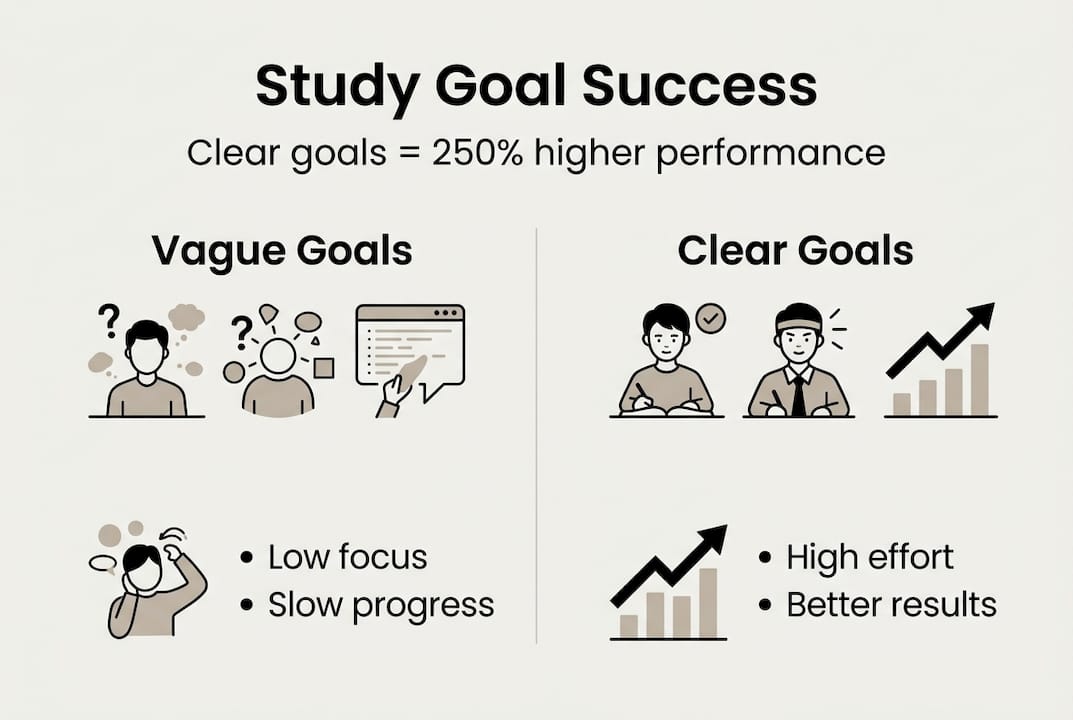
The SMART framework is the most practical way to build both qualities into every goal you set. Here is how SMART goals stack up against vague ones:
| SMART criterion | Vague goal example | SMART goal example |
|---|---|---|
| Specific | Study biology | Review cell division notes for the midterm |
| Measurable | Do some practice | Complete 20 practice questions |
| Achievable | Learn everything | Master one chapter per study session |
| Relevant | Study hard | Focus on topics weighted most on the exam |
| Time-bound | Finish soon | Done by Sunday at 5 PM |
SMART goals for study outcomes show effect sizes of η2=0.33 to 0.42, which means they explain a significant portion of the variation in student achievement. That is a strong signal that the framework is worth using consistently.
Pro Tip: The challenge level of your goal matters as much as its clarity. If you hit every goal with zero struggle, raise the bar. If you miss consistently, scale back slightly and rebuild momentum before pushing again.
For ready-to-use examples, check out SMART goals examples and time management SMART goals at Optio Station. Both resources give you templates you can adapt immediately.
Practical steps for setting better study goals
Knowing the theory is one thing. Putting it into your actual study routine is another. Here is a five-step process that works whether you are prepping for finals or building a long-term skill.
- Identify your outcome. What do you need to know or be able to do by the end of this study period? Be specific about the result, not just the activity.
- Break it into tasks. Large goals feel overwhelming. Split them into smaller actions you can complete in one sitting.
- Apply the SMART test. Run your goal through each SMART criterion before you commit. If it fails any one of them, revise it.
- Set a timeline. Assign a date and time to each task. Deadlines create accountability even when no one else is watching.
- Track your progress. Check off completed tasks and review your goals weekly. Adjust based on what is working.
SMART goals outperform general goals in both productivity and retention, which means the tracking step is not optional. It is what closes the feedback loop.
Pro Tip: If you miss a goal three sessions in a row, that is data. Either the goal is too ambitious, your timeline is unrealistic, or something in your environment is pulling focus. Diagnose before you reset.
Watch out for these common pitfalls:
- Overly broad goals: “Study for the exam” is not a goal. It is a category.
- No deadlines: Without a time constraint, tasks expand to fill whatever time you give them.
- No measurement: If you cannot tell whether you hit the goal, you cannot improve your process.
- Too many goals at once: Three focused goals beat ten scattered ones every time.
For more structure, the goal-setting tips and weekly planning checklist at Optio Station give you a repeatable system to organize your week around your goals.
Goal setting in real life: scenarios, edge cases, and expert perspectives
Goal setting sounds clean in theory. In practice, it gets messy. Students self-set goals that drift easier over time, assigned goals sometimes outperform self-set ones because they introduce appropriate challenge, and students may set easier goals when left without guidance or accountability structures.
“Learning goals outperform performance goals when students are developing new skills. Feedback and commitment to the goal are essential ingredients. Without them, even well-formed goals lose their effect.” — Goal-Setting Research, Frontiers in Education
Here is what the research and real student experience tell us about edge cases:
- When guidance is lacking: Students without mentors or structured feedback tend to set goals that feel safe rather than goals that stretch them. The result is slow progress that feels like effort.
- When goals are too hard: Frustration builds fast. Students disengage or start avoiding the subject altogether. The goal stops being motivating and starts feeling like a threat.
- When group or mentor input is involved: Shared accountability and external perspective consistently improve goal quality and follow-through.
The online learning context makes this even more important. Goal clarity in online learning improves both perceived effectiveness and actual engagement, especially when students are studying independently without a professor or classmates to keep them on track.
If you are studying solo, whether for an online course or self-directed skill building, goal clarity and self-study research shows that community and structured goals together outperform either one alone. The productivity hacks for students at Optio Station cover how to build that structure even when you are working on your own.
Connect your goals to better time management tools
Setting great study goals is only half the battle. The other half is building the systems that keep you consistent when motivation dips and deadlines pile up.

Optio Station is built for exactly this. As your second-in-command, Optio helps you as a Centurion organize tasks, manage your time, and track your goals inside one focused platform. Explore the time management apps list to find tools that fit your workflow, use the SMART time management goals guide to connect your study targets to a real schedule, and check out the productivity system for students to build a repeatable routine that compounds over time. Your goals deserve a system strong enough to support them.
Frequently asked questions
Why are study goals important for students?
Study goals give your sessions structure and direction, which leads to stronger focus and measurably better academic outcomes. Students with goals perform significantly better than those without them.
What makes a study goal effective?
Effective goals are specific, measurable, challenging, and time-bound. SMART goals outperform general goals in both retention and productivity because they make progress visible and keep motivation high.
Can setting goals be harmful if they’re too difficult?
Yes. Goals that are too ambitious can trigger frustration and disengagement. Feedback and adjustment are critical to keeping goals in the motivating range rather than the overwhelming one.
How do study goals support online learning?
Goal clarity in online learning directly improves engagement and perceived effectiveness, especially for self-directed students who lack the natural accountability of a classroom setting.
Recommended
- Examples of SMART goals to boost academic success – Optio Station: Best Project Management App for Prioritization
- Effective Goal Setting for Students: Achieve Your Dreams – Optio Station: Best Project Management App for Prioritization
- Complete Guide to Goal Setting for Students – Optio Station: Best Project Management App for Prioritization
- SMART goals for work: practical tips to boost productivity – Optio Station: Best Project Management App for Prioritization
- Why Self Study Falls Short
