

Glancing at a massive assignment or career milestone is enough to make any college student or young professional freeze. The overwhelm builds and procrastination sets in. Micro-goals offer a way out by transforming intimidating projects into small, actionable steps that directly contribute to your bigger objectives. This approach helps you build momentum and see visible progress, making ambitious targets feel manageable instead of paralyzing.
Table of Contents
- Micro-Goals Explained And Common Misconceptions
- Types Of Micro-Goals For Daily Success
- How Micro-Goals Combat Procrastination
- Practical Strategies For Setting Micro-Goals
- Mistakes To Avoid When Using Micro-Goals
Key Takeaways
| Point | Details |
|---|---|
| Micro-Goals Simplify Tasks | Micro-goals break large objectives into specific, actionable steps, making projects feel more manageable. |
| Build Momentum with Small Wins | Achieving micro-goals delivers psychological wins that enhance motivation and reduce procrastination. |
| Different Types Enhance Productivity | Combine habit-building, task-focused, and outcome-oriented micro-goals for balanced progress and consistency. |
| Set Specific and Measurable Goals | Ensure micro-goals are precise and time-bound to facilitate tracking and prevent overwhelm. |
Micro-Goals Explained and Common Misconceptions
Micro-goals are small, actionable steps that directly contribute to your bigger objectives. They transform overwhelming projects into manageable bite-sized tasks you can actually complete.
Think of it this way: instead of “finish my thesis,” a micro-goal is “write the introduction section by Wednesday.” The difference feels small but changes everything about your ability to start.
Research shows that micro goals help build momentum and focus by making larger goals more approachable. You’re not just breaking tasks into pieces; you’re creating psychological wins that fuel motivation.
What Makes Micro-Goals Different From Regular Tasks
Most students confuse micro-goals with simple to-do items. That’s the first misconception. A regular task is passive: “do my laundry.” A micro-goal is active and outcome-focused: “complete and fold laundry by 7 PM so I have clean clothes for interviews.”
Micro-goals connect directly to larger ambitions:
Here’s how micro-goals differ from regular tasks:
| Aspect | Micro-Goals | Regular Tasks |
|---|---|---|
| Focus | Linked to larger ambitions | Standalone actions |
| Measurability | Clearly defined outcome | Vague or general result |
| Motivation | Builds momentum through wins | Offers little long-term drive |
| Progress Tracking | Easily visible and trackable | Progress often unclear |
| Typical Example | Submit chapter draft by Friday | Do my laundry |
- Regular tasks = what you do
- Micro-goals = measurable steps toward mastery
- Each micro-goal builds confidence for the next one
- Progress becomes visible and celebratable
The Biggest Misconceptions About Micro-Goals
Students often underestimate how powerful small wins actually are. You might think, “If I only achieve a tiny goal, how does that move me forward?” The answer: momentum compounds.
Another common misconception is that micro-goals replace the need for bigger goals. They don’t. Instead, micro goals complement larger ambitions by making them achievable. You still need the destination; micro-goals are just the map.
Here are the myths that hold students back:
- Micro-goals are for people who lack discipline
- They slow you down by focusing on small things
- Real achievers skip the small steps
- They’re only useful for major projects
None of these are true. Micro-goals are actually how high performers work consistently without burning out.
Why Micro-Goals Counter Overwhelm
When you’re staring at a semester-long project or a career milestone, your brain goes into shutdown mode. Paralysis sets in. Micro-goals prevent this by letting you win regularly.
Each small achievement triggers dopamine release. Your brain registers progress. Motivation increases naturally instead of relying on willpower alone.
Micro-goals transform vague ambitions into concrete actions you can complete today, breaking the procrastination cycle before it starts.
This is why they’re so effective for college students and young professionals juggling multiple priorities. You’re not trying to do everything at once; you’re nailing one specific, achievable target.
Pro tip: Write your micro-goals in action-verb format (“complete,” “finish,” “submit”) with a specific deadline, then track them in a task management system to visualize momentum building.
Types of Micro-Goals for Daily Success
Not all micro-goals work the same way. Different types serve different purposes in your day, and knowing which one to use makes the difference between progress and spinning your wheels.
The three main categories are habit-building goals, task-focused goals, and outcome-oriented goals. Each one tackles a different part of your productivity puzzle.
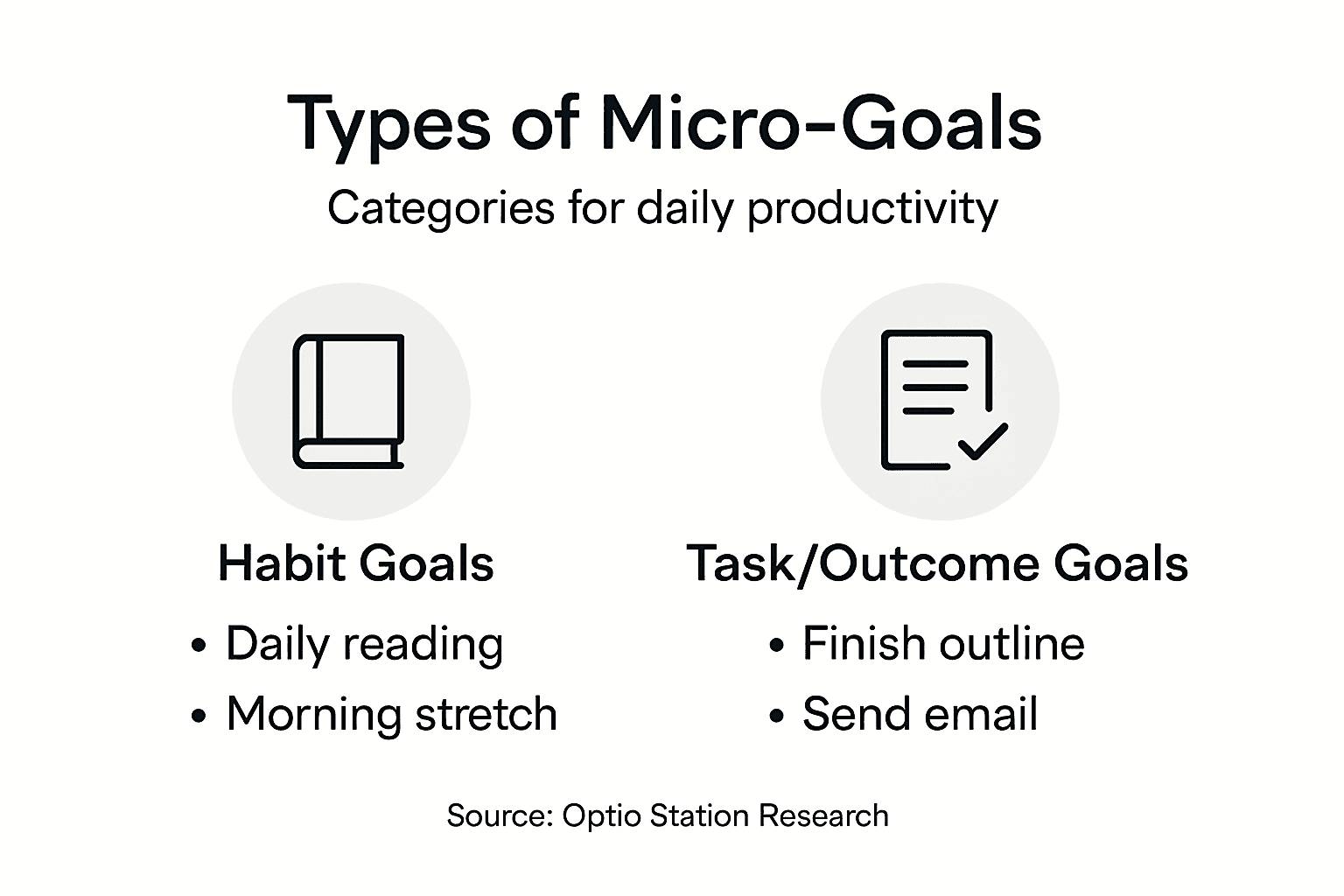
Compare the three main micro-goal types and their optimal use:
| Goal Type | Main Purpose | Ideal Use Case | Example |
|---|---|---|---|
| Habit-Building | Build daily consistency | Establish routines | Study 20 minutes every day |
| Task-Focused | Complete project steps | Progress on assignments | Finish three slides today |
| Outcome-Oriented | Hit a measurable milestone | Track long-term targets | Raise GPA this semester |
Habit-Building Micro-Goals
These focus on developing consistent, repeatable behaviors that compound over time. The goal isn’t to finish something; it’s to build a pattern.
Examples for students and young professionals:
- Study for 25 minutes every morning before class
- Write 500 words on your research paper by lunch
- Review one set of flashcards during your commute
- Practice coding exercises for 15 minutes daily
Habit-building micro-goals work because they’re about frequency, not perfection. You’re training your brain to show up consistently, even when motivation dips.
Task-Focused Micro-Goals
These break larger projects into specific daily actions you can complete and check off. They’re concrete and measurable.
Instead of “finish my presentation” (vague), you’d set: “create slide deck with 10 slides by Thursday” or “research three credible sources for my essay by Tuesday.”
Task-focused goals help you track progress on bigger deliverables. Each completed task is visible proof you’re moving forward. This visibility kills procrastination because you see momentum building.
Outcome-Oriented Micro-Goals
These track small progress milestones toward a larger achievement. They measure incremental improvement.
Examples include:
- Improve your GPA from 3.2 to 3.4 this semester
- Build a professional network of 50 LinkedIn connections
- Save $500 toward your internship housing fund
- Complete one chapter of a skill-building course
The best daily success strategy uses all three types together, creating a system where habits build consistency, tasks create daily wins, and outcomes keep you focused on what matters most.
How to Mix Them for Maximum Results
Your ideal week probably includes different goal categories working together. Maybe Monday and Wednesday focus on habit-building (consistency), Tuesday and Thursday tackle task-focused goals (completion), and weekends review outcome-oriented progress (big picture).
This mixed approach prevents burnout. You’re not grinding on one type of goal all the time. Instead, you’re rotating between building habits, completing work, and tracking meaningful progress.
Pro tip: Assign one micro-goal type to each day of your week—habit Monday, tasks Tuesday, outcome review Friday—so you stay balanced and maintain momentum without exhaustion.
How Micro-Goals Combat Procrastination
Procrastination isn’t laziness. It’s a failure in goal management and self-control where negative emotions attached to tasks get temporarily relieved by avoidance. You delay to feel better now, but suffer later.
Micro-goals flip this dynamic. They disrupt the procrastination cycle by making tasks less emotionally overwhelming and more immediately actionable.
Breaking the Anxiety Cycle
When you stare at a massive project, your brain detects a threat. The anxiety builds, so you escape into social media or busy work. That escape becomes habit.
Micro-goals reduce anxiety by transforming intimidating tasks into digestible chunks. Instead of “write 20-page thesis,” you focus on “write introduction section in 90 minutes.” Suddenly the task feels doable.

This shift is psychological. Your brain stops triggering the avoidance reflex because the demand feels reasonable.
Creating Immediate Win Momentum
Procrastination thrives on delay. Each day you avoid a task, the emotional weight grows heavier. But micro-goals create regular small wins that rebuild confidence.
When you complete a micro-goal, your brain releases dopamine. You feel progress. Tomorrow’s micro-goal feels easier because you proved you could do yesterday’s. Momentum builds naturally.
Here’s how this breaks procrastination:
- First micro-goal completed = proof you can start
- Second completion = evidence of progress
- Third completion = confidence for harder steps
- Pattern emerges = procrastination loses grip
Improving Emotional Regulation
Procrastination happens because you’re managing emotions poorly. The discomfort of a task makes you seek relief elsewhere.
Micro-goals help you manage emotional regulation by keeping the task manageable. When demands feel proportional to your energy, you don’t need to escape. You engage naturally.
This is why students who set micro-goals tend to start assignments earlier. The emotional barrier drops significantly.
Reducing Task Aversion
Task aversion is the resistance you feel before starting. Micro-goals shrink this resistance by lowering the perceived difficulty.
Micro-goals combat procrastination not by willpower, but by making the task so small and specific that your brain stops seeing it as a threat.
You’re not fighting your emotions. You’re redesigning the task so emotions don’t get triggered in the first place.
Pro tip: Set your first micro-goal for tomorrow to be absurdly small—write 250 words, not 2,000—so you break the avoidance pattern and build momentum before tackling bigger steps.
Practical Strategies for Setting Micro-Goals
Knowing micro-goals exist is one thing. Actually setting them so they stick is another. The difference between vague micro-goals and effective ones comes down to how specifically you define them.
Here’s what separates the goals that work from the ones that fail.
Start With Crystal Clear Outcomes
Vague micro-goals die fast. “Study harder” or “work on my project” feel good when you write them, but they’re useless for actually driving action.
Effective micro-goals require specific outcomes. Instead of “study,” your goal is “complete practice problems 1-15 in calculus chapter 3.” Instead of “work on project,” it’s “design wireframes for mobile app homepage.”
Specificity removes ambiguity. Your brain knows exactly what success looks like.
Break Goals Into the Smallest Next Step
Most students still set micro-goals that are too big. A “micro” goal should take 15-90 minutes, not multiple hours.
Here’s how to find the right size:
- Identify your larger goal (finish research proposal)
- Break it into major phases (research, outline, draft, edit)
- Break each phase into daily actions (find three academic sources)
- Make sure each action is completable in one focused session
The smallest next step is the one you could start right now without preparation or fear.
Make Goals Repeatable, Not Perfect
Perfectionism kills micro-goal momentum. You don’t need flawless work; you need consistent action.
Focus on regular progression over sporadic bursts. A 500-word writing goal every day beats a 5,000-word marathon once a month. Your brain builds momentum through repetition, not perfection.
When setting micro-goals, ask: “Can I repeat this weekly without exhaustion?”
Use Time Blocks and Word Counts
Time-bound objectives help with accountability. Instead of “work on assignment,” set “spend 45 minutes on research between 2-3 PM Tuesday.”
For writing-specific work, set daily word count targets. Researchers find that 300-500 words per session creates sustainable momentum without burnout.
The best micro-goals are specific enough to measure, small enough to complete today, and repeatable enough to build into weekly rhythms.
Combine these elements: outcome (what), quantity (how much), and timing (when).
Pro tip: Write your three biggest micro-goals for next week using this format: “[Action verb] [specific deliverable] in [timeframe]” (e.g., “Complete 3 research sources in 60 minutes by Wednesday 3 PM”), then add them to a task tracker for visual momentum.
Mistakes to Avoid When Using Micro-Goals
Micro-goals are powerful, but they’re easy to mess up. Most students fail not because the concept doesn’t work, but because they make predictable mistakes when setting them up.
Knowing what to avoid saves you months of wasted effort.
Setting Goals Without Clear Purpose
A micro-goal needs a reason. “Complete 10 math problems” sounds fine, but why? If it’s not connected to something you care about, your motivation evaporates after day two.
Goals need clear purpose and control to sustain commitment. Your micro-goal should align with something intrinsically meaningful. “Complete 10 math problems to master derivatives before the midterm exam” works because you understand the bigger picture.
Always ask: “Why does this micro-goal matter?”
Failing to Define Success Criteria
Vague success kills momentum. “Get better at writing” provides zero guidance. Your brain doesn’t know what counts as success, so it never feels accomplished.
Success criteria must be measurable and specific. Instead of “improve my essay,” set “revise three paragraphs and fix grammar errors using the Hemingway Editor.” Now you know exactly when you’re done.
Without success criteria, you’ll never feel the dopamine hit from completion.
Setting Goals That Are Too Broad
The biggest mistake is making micro-goals too big. They’re supposed to be small enough to complete in one focused session.
Here’s what to avoid:
- Goals spanning multiple days (break them into daily pieces)
- Goals requiring multiple decisions (make them decision-light)
- Goals without a clear stopping point (define the finish line)
- Goals that feel overwhelming (if it does, shrink it further)
If your micro-goal makes you procrastinate, it’s too big.
Chasing Perfection Instead of Consistency
Perfectionism destroys micro-goal systems. You set a goal, it’s not perfect, you quit. Then you wait weeks before trying again.
Focus on consistency over perfection. A 300-word rough draft beats a 500-word perfect one you never write. Repetition beats occasional brilliance.
Ask yourself: “Can I do a slightly-imperfect version of this regularly?”
Refusing to Adjust When Life Changes
Your schedule shifts. New priorities emerge. Sticking rigidly to micro-goals that no longer fit wastes energy.
The best micro-goal systems stay flexible, adjusting goals to maintain momentum rather than abandoning them entirely.
Review your micro-goals weekly. If something isn’t working, modify it. Flexibility keeps you engaged when circumstances change.
Pro tip: Review your micro-goals every Sunday and adjust any that feel too vague, too big, or misaligned with your actual priorities that week.
Take Command Over Procrastination With Optio Station
The article highlights how setting micro-goals can break down overwhelming tasks and stop procrastination from taking over your workflow. If you face the constant challenge of starting projects or staying motivated by turning your big ambitions into clear, actionable steps then you are exactly the Centurion Optio Station is built for. With Optio Station, your dedicated second-in-command, you gain powerful tools to organize tasks, build momentum, and track your progress through bite-sized goals inspired by Roman discipline and precision.

Empower yourself today by turning micro-goal theory into daily victories. Discover how Optio Station’s mobile app tailored for students and young professionals can improve your time management, team collaboration, and task focus immediately. Don’t wait until overwhelm shuts you down. Become the Centurion of your own success and start conquering procrastination now at Optio Station.
Explore the benefits of consistent micro-goals with task and time management solutions. Your mission starts here.
Frequently Asked Questions
What are micro-goals and how do they help with procrastination?
Micro-goals are small, actionable steps that contribute to larger objectives. They help combat procrastination by breaking overwhelming tasks into manageable parts, allowing for regular wins that build momentum and motivation.
How can I effectively set micro-goals?
To set effective micro-goals, start with clear outcomes, break down the goals into the smallest next steps, and ensure they are repeatable rather than perfect. Use time blocks and measurable criteria to keep them specific and achievable.
What are the different types of micro-goals?
There are three main types of micro-goals: habit-building goals (focused on consistency), task-focused goals (specific daily actions related to projects), and outcome-oriented goals (tracking progress toward a measurable milestone). Each type serves a unique purpose in enhancing productivity.
How do micro-goals improve emotional regulation and reduce anxiety?
Micro-goals improve emotional regulation by making tasks feel manageable, thus reducing anxiety associated with larger projects. This approach helps you engage with the task at hand rather than avoiding it, as the smaller steps do not trigger the same emotional threats as larger tasks.
Recommended
- 7 Goal Setting Strategies 2025 for Students and Professionals – Optio Station: Best Project Management App for Prioritization
- 7 Powerful Productivity Hacks for Students to Excel Fast – Optio Station: Best Project Management App for Prioritization
- 7 Key Goal Setting Techniques for Centurions – Optio Station: Best Project Management App for Prioritization
- 7 Effective Goal-Setting Tips for Students and Professionals – Optio Station: Best Project Management App for Prioritization
