

Most students and young professionals overestimate time spent on tasks by nearly 45%, creating a false sense of productivity that sabotages real progress. Weekly progress reviews cut through this bias with objective data, reducing mental fatigue by 41% and error rates by 58%. This article explains why reviewing your weekly progress is essential for academic and work success, how apps correct common time-on-task misperceptions, and practical steps to build a sustainable review habit that transforms your productivity.
Table of Contents
- Key takeaways
- The science behind weekly progress reviews
- Why students and young professionals overestimate their productivity
- How weekly progress reviews enhance collaboration and psychological safety in teams
- Practical steps to implement effective weekly progress reviews using time management apps
- See how Optio Station makes weekly progress reviews seamless
- Frequently asked questions
Key Takeaways
| Point | Details |
|---|---|
| Weekly progress reviews | Weekly progress reviews reduce error rates by 58% and mental fatigue by 41% through objective data and reflection. |
| Objective time data | Objective app data corrects overestimation of time spent on tasks. |
| Elaborated feedback gains | Elaborated feedback from weekly reviews improves assignment and test scores by eight to ten percent. |
| Identify procrastination triggers | Regular reviews help quickly identify procrastination triggers before they derail the week. |
| Time perception reality check | Regular reviews provide a reality check on actual versus perceived time investment. |
The science behind weekly progress reviews
Empirical research proves that weekly progress reviews deliver measurable improvements in academic performance, mental health, and task accuracy. College students who use weekly review lists reduce error rates by 58% and mental fatigue by 41% compared to peers who skip structured reflection. These aren’t marginal gains. They represent the difference between consistently meeting deadlines with clarity versus scrambling through assignments in a fog of stress.
The mechanism behind these benefits centers on elaborated feedback. When you review your weekly progress, you’re not just checking boxes. You’re processing what worked, what didn’t, and why. Studies show elaborated feedback improves assignment and test scores by 8-10%, a boost that compounds over semesters. This type of reflection forces your brain to consolidate learning, identify patterns, and adjust strategies before small issues become major setbacks.
Relative performance feedback adds another layer of impact. Research demonstrates that performance feedback improves grades and accelerates graduation by approximately 0.12 standard deviations. Understanding why track progress matters transforms abstract goals into concrete milestones you can measure and adjust weekly.
Here’s what weekly reviews deliver:
- Sharper focus on high-priority tasks by eliminating low-value activities
- Faster identification of procrastination triggers before they derail entire weeks
- Clearer understanding of actual versus perceived time investment
- Reduced anxiety from knowing exactly where you stand on commitments
- Improved decision-making through pattern recognition across multiple weeks
“Weekly reviews create a feedback loop that turns vague intentions into measurable outcomes. You stop guessing and start knowing.”
The science is clear. Regular weekly reflection isn’t optional for high performers. It’s the foundation that separates students who coast from those who consistently excel.
Why students and young professionals overestimate their productivity
Your brain lies to you about time. The median student overestimates time on task by 45%, reporting 1.45 hours for every actual hour worked. This isn’t laziness or dishonesty. It’s a cognitive bias rooted in how memory encodes effort versus duration. You remember the struggle of a difficult problem set, not the 20-minute Instagram break that interrupted it.

Notification overload makes this worse. When you receive more than 12 notifications per day, retention drops by 37%, fragmenting your attention and distorting your sense of productive time. Each ping feels like a brief interruption, but the cumulative cognitive cost is massive. Your brain counts the recovery time as work time, inflating your perceived productivity while actual output stagnates.
Objective app-tracked data corrects these distortions. Understanding what is time tracking and implementing tools like those in our TickTick time tracking guide provides the reality check your memory can’t deliver. Apps don’t care about your intentions or how hard something felt. They record what actually happened.
Five factors drive productivity overestimation:
- Effort conflation: You remember difficulty, not duration, leading to inflated time estimates for challenging tasks
- Interruption blindness: Brief distractions feel negligible but compound into hours of lost focus weekly
- Intention credit: Planning to work counts as working in your mental accounting
- Selective memory: You recall productive bursts while forgetting idle periods between them
- Social comparison bias: Seeing peers’ highlight reels makes your own fragmented work feel more substantial
Pro Tip: Schedule a 15-minute weekly review session every Sunday evening. Pull your app’s auto-generated time report, compare it to your memory of the week, and note the gaps. This simple habit trains your brain to estimate more accurately over time, improving your planning and reducing overcommitment.
The gap between perceived and actual productivity isn’t a character flaw. It’s a predictable cognitive bias that objective weekly reviews systematically eliminate.
How weekly progress reviews enhance collaboration and psychological safety in teams
Weekly reflections transform team dynamics by creating structured space for honest feedback and shared learning. Research shows regular reflections improve collaboration and psychological safety in 75% of student teams, fostering environments where members feel safe admitting mistakes and asking for help. This matters because psychological safety is the foundation of high-performing teams, whether you’re working on a group project or coordinating a startup launch.
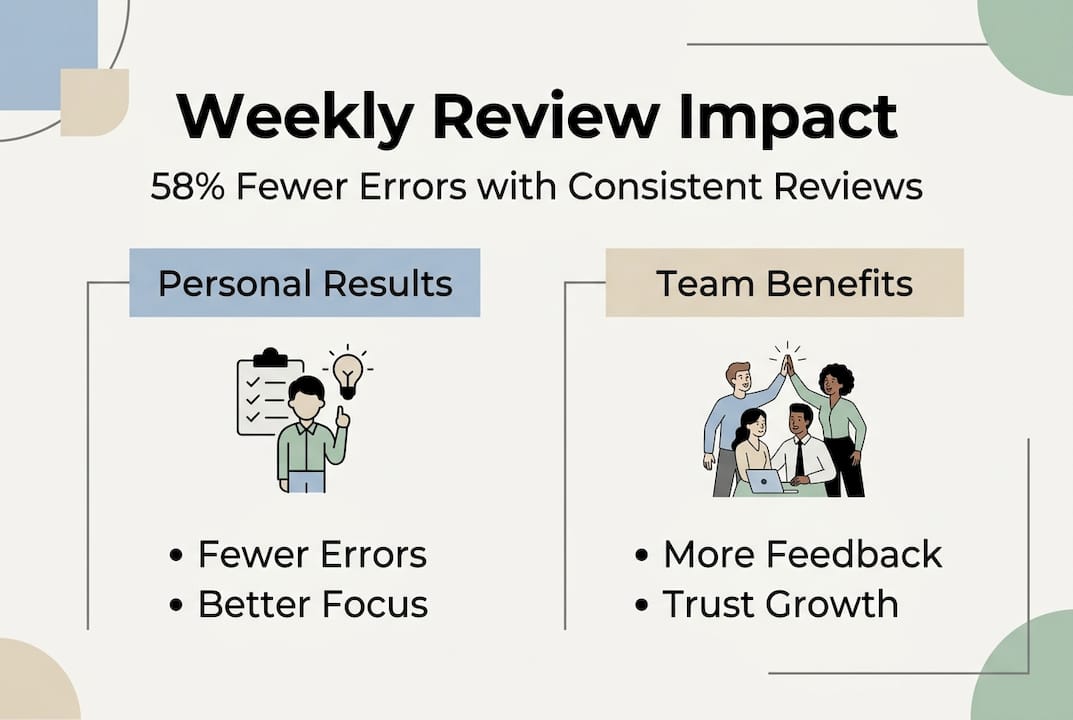
The mechanism is straightforward. When teams review progress weekly, they normalize discussing what went wrong alongside what went right. This routine removes the stigma from failure, reframing setbacks as data points rather than personal shortcomings. Over time, this builds trust. Team members stop hiding problems until they become crises and start surfacing issues early when they’re still manageable.
However, weekly reviews aren’t universally embraced. Some high-performing teams undervalue structured reflection because their existing workflows already produce strong results. They view reviews as bureaucratic overhead rather than optimization opportunities. The key is keeping reviews brief and action-oriented. A 10-minute check-in that identifies one concrete improvement beats a 60-minute discussion that generates no changes.
Effective team reviews balance three elements:
- Brevity: 10-15 minutes maximum to maintain engagement and prevent fatigue
- Consistency: Same day and time weekly to build habit and expectation
- Action orientation: Every review ends with specific commitments, not vague intentions
Overcoming resistance requires demonstrating value quickly. Start with a four-week trial where the team commits to brief weekly reviews and tracks one metric like missed deadlines or communication delays. When they see measurable improvement, buy-in follows naturally. Understanding team collaboration principles and implementing a clear workflow for progress tracking makes this transition smoother.
Pro Tip: Use a rotating facilitator model where a different team member leads each weekly review. This distributes ownership, prevents one person from dominating discussion, and ensures everyone develops facilitation skills. It also makes reviews feel less like status reports to a manager and more like peer learning sessions.
The social benefits of weekly reviews extend beyond immediate productivity gains. They create a culture of continuous improvement where feedback becomes normal rather than threatening, setting the foundation for long-term team effectiveness.
Practical steps to implement effective weekly progress reviews using time management apps
Setting up a sustainable weekly review system requires intentional design and the right tools. Follow these steps to build a review habit that sticks:
- Choose your review day and time: Sunday evening or Friday afternoon work best for most people, creating natural bookends to the work week
- Select a time management app with auto-reporting: Look for tools that generate weekly summaries automatically, eliminating manual data collection
- Define your review questions: What did I accomplish? Where did I spend unexpected time? What should I prioritize next week? What obstacles need addressing?
- Set a 15-minute timer: Strict time limits prevent reviews from expanding into unproductive rumination
- Document one key insight and one action item: Writing forces clarity and creates a record you can reference in future reviews
- Schedule next week’s top three priorities immediately: Turn reflection into action before you close the review session
Review cadence matters more than most people realize. Daily reviews generate too much noise, making it hard to distinguish signal from random variation. Monthly reviews happen too infrequently to catch problems while they’re still small. Brief, consistent weekly reviews hit the sweet spot, providing enough data to identify patterns without overwhelming you with detail.
| Review Cadence | Pros | Cons | Best For |
|---|---|---|---|
| Daily | Catches issues immediately, maintains momentum | Too granular, hard to see patterns, time-intensive | Short-term sprints, crisis management |
| Weekly | Balances pattern recognition with timely feedback | Requires discipline to maintain | Most students and professionals, ongoing projects |
| Monthly | Big-picture perspective, less time commitment | Slow feedback loop, problems compound before detection | Long-term strategic planning, stable workflows |
Sustaining your review habit requires addressing common obstacles proactively. Schedule reviews as non-negotiable calendar blocks, not optional tasks you’ll do “when you have time.” Use accountability by sharing your weekly insights with a friend or study group. Minimize distractions by closing all apps except your task manager during review sessions.
Pro Tip: Use your app’s auto-generated reports as the foundation, but layer in three reflection questions: What surprised me this week? What pattern am I noticing across multiple weeks? What small change would have the biggest impact next week? This combination of objective data and subjective insight maximizes learning from each review.
Learning how to manage tasks effectively and choosing the right time management software sets the technical foundation. But the real power comes from consistently using these tools to reflect on goals and productivity in a structured weekly cadence.
The difference between people who occasionally review their progress and those who do it weekly is the difference between hoping for improvement and systematically creating it.
See how Optio Station makes weekly progress reviews seamless
Implementing everything you’ve learned becomes effortless when you have the right platform. Optio Station combines intuitive task management with powerful weekly review features designed specifically for students and young professionals who refuse to settle for guesswork.
Our automated progress tracking eliminates manual data collection, generating insightful weekly summaries that show exactly where your time went and how it aligned with your priorities. The priority matrix helps you visualize high-impact tasks versus time-wasters, while collaboration tools make team reviews smooth and productive. Every feature is built to reduce mental fatigue and improve time awareness, the two factors that research proves matter most for sustained productivity.
Key features that support effective weekly reviews:
- Automated weekly reports showing time spent by project, task type, and priority level
- Visual progress dashboards that make patterns obvious at a glance
- Integrated reflection prompts that guide deeper insight without adding complexity
- Team collaboration spaces where groups can conduct structured weekly reviews together
- Historical data tracking that reveals long-term trends across months and semesters
Optio Station encourages consistent reflection and feedback by making reviews feel less like administrative work and more like gaining superpowers. When you see objective data about your week, you stop wondering if you’re productive and start knowing exactly how to improve. Explore our guides on how to manage tasks effectively, best task management software, and how to keep track of tasks at work to discover how Optio Station transforms weekly reviews from a chore into your competitive advantage.
Frequently asked questions
What is the ideal frequency for reviewing weekly progress?
Weekly reviews balance consistency with meaningful feedback better than daily or monthly alternatives. Daily reviews create too much noise, making it difficult to distinguish genuine patterns from random daily variation. Monthly reviews happen too infrequently, allowing small problems to compound into major setbacks before you detect them. Brief, regular weekly sessions prevent information overload while maintaining the momentum needed for continuous improvement.
How can time management apps improve accuracy in weekly progress reviews?
Apps track actual time spent versus perceived time, systematically reducing the common overestimation bias where students report 1.45 hours for every actual hour worked. They generate objective reports that reveal productivity patterns, distraction sources, and time allocation mismatches your memory can’t reliably capture. Understanding what is time tracking and implementing app-based systems transforms weekly reviews from subjective reflection into data-driven optimization.
Why do some high-performing teams skip weekly reflections?
High performers often undervalue reviews because their existing workflows already produce strong results, making structured reflection feel like unnecessary overhead. They’ve developed informal feedback mechanisms that work well enough, so adding formal reviews seems bureaucratic. However, introducing brief, targeted reflections can still uncover hidden improvement areas and prevent complacency. Even the best teams benefit from systematic review when it’s kept focused and action-oriented. Explore our team collaboration guide for strategies that work with high-performing groups.
What are the key obstacles to maintaining regular weekly reviews?
Weekly reviews get skipped when people are busy or fatigued, making habit formation fragile under time pressure. The irony is that reviews get abandoned precisely when they’re most valuable during high-stress periods. Maintaining brief, consistent sessions dramatically increases success rates because 10 minutes feels manageable even during overwhelming weeks. Scheduling reviews as non-negotiable calendar blocks rather than optional tasks transforms them from something you’ll do “when you have time” into a reliable habit that compounds benefits over months and years.
Recommended
- Goal Reviews Boost Productivity by 20% for Students – Optio Station: Best Project Management App for Prioritization
- How to Plan Weekly Goals for Max Productivity with Optio – Optio Station: Best Project Management App for Prioritization
- 7 Steps to a Powerful Weekly Planning Checklist for Success – Optio Station: Best Project Management App for Prioritization
- Understanding Workflow for Progress Tracking in Detail – Optio Station: Best Project Management App for Prioritization
