

Every busy week can blur your real achievements, leaving you wondering where your effort actually goes. For college students and young professionals aiming to take control of their goals, understanding the difference between casual notes and systematic journal progress can reshape how you measure success. When you track tasks with intention and reflect on your input versus output, productivity becomes specific, actionable, and visible—opening the path to smarter work and genuine growth.
Table of Contents
- Defining Journal Progress And Productivity
- Types Of Journaling For Task Tracking
- How Journaling Accelerates Achievement
- Role Of Journaling In Time Management
- Common Pitfalls In Progress Journaling
Key Takeaways
| Point | Details |
|---|---|
| Journal Progress Enhances Productivity | Systematic journaling provides concrete evidence of accomplishments, helping to measure and optimize productivity effectively. |
| Choose Your Journaling Method Wisely | Select a journaling approach that suits your thought process, whether it’s bullet, reflective, or goal-setting journaling. |
| Consistent Journaling Is Key | Regular updates, even brief ones, are essential for gaining insights; missing days should not deter your journaling practice. |
| Reflect for Growth | Weekly reflections on your entries can reveal patterns and insights that drive personal development and productivity improvement. |
Defining Journal Progress and Productivity
When you hear “journal progress,” you might picture a diary filled with personal reflections. That’s not what we’re talking about here. In the context of productivity, journal progress means systematically recording what you accomplish, what you learn, and how your efforts translate into measurable results. Think of it as creating a documented trail of your work that you can revisit, analyze, and learn from. This differs entirely from casual note-taking. Journal progress captures specifics: completed tasks, obstacles encountered, time spent, and outcomes achieved. It’s concrete evidence of movement toward your goals, not just a collection of thoughts.
Productivity, meanwhile, gets defined differently depending on who you ask. At its core, productivity is output relative to input, meaning the results you generate compared to the time and resources you invest. In academic contexts, this might be grades earned per study hours invested. For early-career professionals, it could be projects completed per week or value delivered per client engagement. The key insight is that productivity isn’t just about doing more. It’s about doing work that matters and tracking whether your effort correlates with meaningful progress. When you journal your work consistently, you create visibility into that relationship between input and output. Suddenly, productivity becomes measurable rather than theoretical.
Here’s where journal progress becomes powerful: sustained tracking of your achievements reveals patterns you’d otherwise miss. You might notice that certain times of day produce better work. You could discover that breaking projects into smaller milestones dramatically increases your output. You might recognize which tasks actually move you forward and which ones drain your energy without generating real results. Students often realize they study hardest when they journal about what they’ve learned rather than just cramming. Young professionals notice that documenting their contributions helps them recognize growth they couldn’t see in the moment. Without this record, productivity remains abstract. With it, you hold concrete evidence of progress.
Pro tip: Start with one specific metric this week, such as tracking daily task completion rate or hours spent on high-priority work, then review your journal entry after five days to identify one clear pattern that emerges.
Types of Journaling for Task Tracking
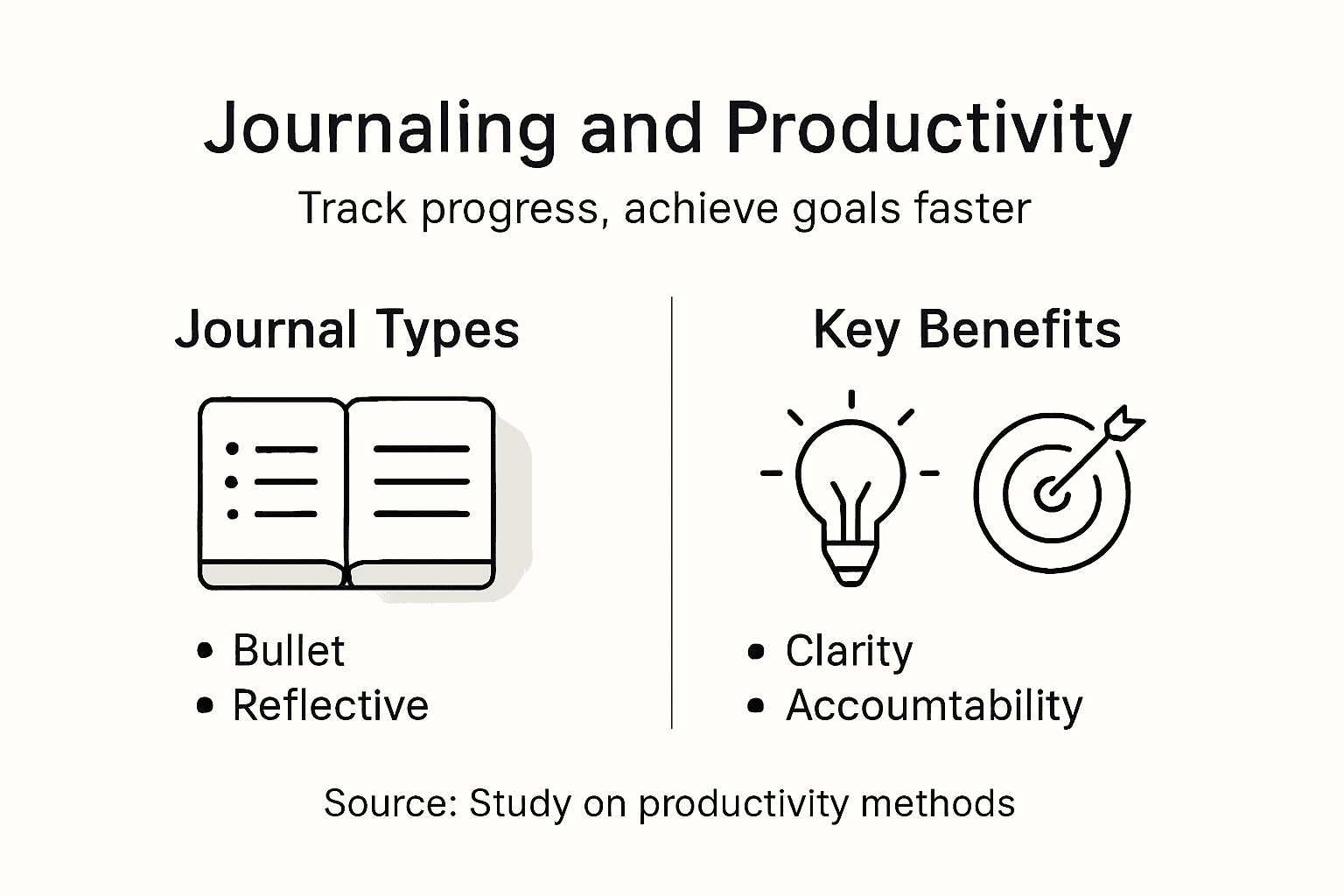
Not all journaling approaches work the same way. Some students thrive with visual systems, while others prefer narrative reflection. The method you choose should match how your brain processes information and what you’re trying to achieve. The most common approaches break down into distinct categories, each offering unique advantages for tracking tasks and recognizing patterns.
Bullet journaling remains the most popular option for task management. This approach uses symbols and tags to organize tasks, allowing you to quickly scan entries and prioritize what matters most. You might use a checkmark for completed work, a dash for notes, or a greater-than symbol for tasks to migrate to the next day. This visual shorthand reduces the time you spend writing while maximizing clarity. Early-career professionals often love bullet journaling because it combines planning with progress tracking. You can see at a glance which projects are advancing and which ones stalled.
Reflective journaling takes a different angle. Instead of just listing tasks, you record what you learned, what obstacles emerged, and how you solved problems. This style works particularly well when you’re tackling complex projects or unfamiliar challenges. You might write about why a meeting went poorly, what you’d do differently next time, or how you broke through a mental block. This type of journaling creates patterns that support self-awareness and problem-solving, helping you avoid repeating the same mistakes. For students working through difficult material, reflective journaling transforms homework from a checkbox exercise into actual learning.
Goal-setting and milestone journaling focuses on the bigger picture. You document your objectives, break them into smaller checkpoints, and record progress toward each one. This approach helps you track whether your daily work actually moves you closer to what matters. You might journal about reaching a specific GPA, landing an internship, or completing a certification. You write the deadline, track weekly progress, and note obstacles. This method answers the question that often paralyzes young professionals: am I actually getting somewhere, or just staying busy?
The key is matching the approach to your needs. Combine approaches if necessary. Some people use bullet journaling for task organization and reflective journaling once per week for deeper analysis. Others keep a goal-setting journal separate from their daily task list. Experiment for two weeks with one method, then assess whether it actually helps you see progress and adjust your approach.
Pro tip: Choose one journaling method this week and commit to it for at least 10 entries before deciding if it works for you; most people give up too early before the system becomes automatic.
Here’s a comparison of journaling methods for task tracking:
| Journaling Method | Main Focus | Ideal For | Unique Advantage |
|---|---|---|---|
| Bullet Journaling | Task organization | Busy professionals | Fast visual tracking |
| Reflective Journaling | Learning & reflection | Students, creatives | Deep self-analysis |
| Goal/Milestone Journaling | Long-term objectives | Goal-oriented workers | Progress toward big goals |
How Journaling Accelerates Achievement
Journaling creates a feedback loop that traditional studying skips entirely. When you write about what you accomplished, what confused you, and how you solved problems, something shifts in your brain. You stop passively consuming information and start actively analyzing it. Reflective journaling transforms feedback into actionable insights, helping you identify patterns in your habits that you’d otherwise miss. A student might realize they retain information better after group discussions than solo reading. A young professional might notice they produce better work when they break projects into two-hour focused blocks rather than attempting eight-hour marathons. These patterns exist in your work life right now, but without writing them down, they remain invisible.
Here’s the mechanism: when you journal regularly, you develop metacognition, which is simply thinking about your thinking. You analyze not just what you learned, but how you learned it. You examine failures and ask why they happened. You celebrate wins and understand what made them possible. This constant reflection builds personalized strategies that actually work for your brain, not some generic productivity system designed for everyone. Over weeks and months, these strategies compound. Each reflection teaches you something about yourself. Each pattern you identify lets you optimize further. The student who journals about study sessions discovers they need background music and shorter breaks. They adjust. The next study session works better. They journal again. They notice even more. Achievement accelerates because you’re no longer guessing about what works.
Beyond academic performance, journaling addresses the mental obstacles that derail achievement. Journaling reduces anxiety by focusing on progress rather than fear, which builds confidence over time. When you document what you’ve accomplished, you have concrete evidence of movement forward. During tough weeks when progress feels invisible, you can flip back through your journal and see real results. This shifts your mindset from “I’m stuck” to “I’ve already overcome harder things.” Early-career professionals often struggle with imposter syndrome. Reviewing a journal of completed projects, learned skills, and solved problems provides undeniable proof of competence. You stop relying on feeling confident and start building it through evidence.

The acceleration compounds because journaling creates accountability without judgment. You write truthfully about what happened. You see patterns. You adjust. You try again. You journal again. Each cycle gets tighter. What took you three months to figure out in your first semester takes three weeks by your third semester because you’ve journaled your way to understanding how you work best. Achievement accelerates not from working harder but from working smarter, and journaling is how you learn what smart means for you specifically.
Pro tip: After completing any significant task or project, spend five minutes writing what worked, what didn’t, and one thing you’d change next time, then review these entries monthly to spot trends that reveal your personal productivity formula.
Below is a summary of how journaling drives achievement:
| Benefit | Academic Impact | Professional Impact |
|---|---|---|
| Metacognition | Improves learning strategies | Tailors work habits |
| Confidence Growth | Eases exam anxiety | Counters imposter syndrome |
| Pattern Recognition | Boosts retention rate | Reveals strengths & gaps |
Role of Journaling in Time Management
Time management fails for most people because they treat it like a single decision made once, then forgotten. You plan your week on Sunday night and expect that plan to survive contact with reality. But reality is messy. Classes get canceled, projects expand, emergencies emerge, and suddenly your carefully organized schedule feels useless. Journaling transforms time management from a static plan into a dynamic system that adapts. When you journal about how you actually spent your time, you create accountability and awareness that pure planning cannot deliver. You write down what you intended to do, what you actually did, and why the difference exists. This gap between intention and reality becomes your most valuable data.
Time-blocking works better when combined with journaling. You designate specific hours for specific tasks, which sounds simple until you try it without tracking what happened. Using journaling as a time-blocking and planning tool improves focus and reduces procrastination because you’re not just planning blocks of time, you’re monitoring whether they actually worked. A student might journal that their planned two-hour study block got interrupted five times by phone notifications, destroying their focus. They adjust. Next time, they silence their phone during that block. They journal again. They notice the difference immediately. Over weeks, journaling reveals which time blocks produce actual output and which ones are fool’s gold.
Journaling also prevents burnout by making workload visible. Early-career professionals often work without clear boundaries, pushing through fatigue because they cannot see how much they’re actually doing. When you journal daily tasks, weekly summaries reveal the truth. You wrote that you worked until 9 PM three nights last week. You documented skipping lunch twice. You recorded back-to-back meetings leaving no focus time. Journaling integrates with time management strategies by providing a method to document plans and monitor time usage, which helps you spot patterns of overwork before they become crises. You see the data. You adjust your calendar. You protect focus time. You enforce boundaries. None of this happens without writing it down.
The most powerful aspect of journaling for time management is the feedback loop. You plan. You execute. You journal about what happened. You analyze the journal. You adjust your plan. You execute differently. You journal again. Each cycle teaches you about your actual capacity, not your imagined capacity. You learn how long tasks really take. You discover which times of day your brain works best. You identify which types of work drain you fastest. This knowledge compounds. By your second semester or second year, you’re not guessing about time anymore. You’re working from months of documented evidence about how you actually operate.
Pro tip: Schedule five minutes every evening to journal three things: one task you completed, one task that took longer than expected, and one thing you’ll protect time for tomorrow; review these entries weekly to identify patterns that reveal your true time costs.
Common Pitfalls in Progress Journaling
Good intentions fail when systems crumble under inconsistency. You start journaling with enthusiasm, writing detailed entries for two weeks. Then life gets busy. You skip a day. Then two. You tell yourself you’ll catch up later. You never do. This pattern derails more journaling attempts than any other single factor. Consistent writing and regular updates are essential for effective journaling, but consistency doesn’t mean perfection. Many people quit because they think missing one day means they’ve failed, so they abandon the entire system. The reality is simpler: even brief entries are better than none. A one-sentence journal entry beats a three-week gap. You’re building a habit, not writing literature.
Another common trap is being too vague in your entries. You write “worked on project” or “studied for exam” without capturing what actually happened. This feels efficient in the moment, but it defeats the purpose. You can’t identify patterns from meaningless summaries. Effective progress journaling requires specific details: what task you tackled, how long it took, what obstacles appeared, and what you learned. Instead of “studied chemistry,” write “studied organic chemistry mechanisms for 90 minutes, got confused on substitution reactions, finally understood it through Khan Academy videos.” That second version gives you actionable data. The first one gives you nothing.
Perfectionism is the third assassin of journaling systems. You imagine your journal as a perfectly formatted, beautifully written record of your achievements. Reality strikes when you’re exhausted after a long day and cannot compose eloquent sentences. You think, “I’ll write it later when I have more time.” Later never comes. Your journal gathers dust. The antidote is accepting that your journal exists to serve you, not impress anyone. Messy bullet points work. Abbreviations are fine. You don’t need complete sentences. A student might write “3 hrs math study, understood limits finally, brain fried by 11 PM.” It’s not Shakespeare, but it’s data you can use.
A final pitfall is treating journaling as task-tracking without reflection. You document what you did but never ask why or what it means. Maintaining detailed, reflective journals that support personal development and critical evaluation requires you to occasionally step back and analyze patterns. Once per week, spend ten minutes reading your entries and asking: What’s working? Where am I stuck? What surprised me? What should I change? Without this reflection layer, journaling becomes busywork instead of a tool that drives growth.
Pro tip: Set a phone reminder for the same time each evening, keep your journal entry to five sentences maximum, and write one thing you learned each day regardless of whether you accomplished anything else.
Boost Your Productivity by Journaling with Optio Station
Struggling to turn your journal progress into real measurable productivity You are not alone Many students and young professionals find it challenging to track their tasks clearly while extracting meaningful insights from their daily work This article highlights key pain points like inconsistent journaling, lack of reflection, and difficulty connecting effort to outcomes Optio Station, your trusted second-in-command, is built to solve exactly these issues by blending task management with insightful tracking to help Centurions like you conquer distractions and time mismanagement

Explore the power of disciplined progress journaling enhanced by Optio Station’s Roman-themed app featuring intuitive task organization and smart time tracking Dive deeper into mastering your productivity habits with our ProductivityThoughts insights and discover how to sustain momentum through consistent journaling on Uncategorized – Optio Station Get started today at optio station and experience how your journey from planning to performance becomes clearer smarter and faster
Frequently Asked Questions
What is journal progress?
Journal progress refers to systematically recording your accomplishments, learnings, and measurable results over time, creating a documented trail of your work that can be analyzed for patterns and insights.
How can journaling improve my productivity?
Journaling helps identify patterns in your work habits, allowing you to see which tasks enhance your productivity and which ones drain it. This visibility transforms productivity from a theoretical concept into a measurable outcome.
What are the different types of journaling methods for task tracking?
Common types include bullet journaling for task organization, reflective journaling for learning and analysis, and goal-milestone journaling to track long-term objectives. Each method suits different styles and goals.
How do I avoid common pitfalls in journaling?
To avoid pitfalls, maintain consistency by journaling regularly, be specific in your entries, accept imperfection in your writing, and incorporate reflection to analyze patterns and adjust your strategies accordingly.
Recommended
- Understanding Workflow for Progress Tracking in Detail – Optio Station: Best Project Management App for Prioritization
- Understanding Why Track Progress Matters for Success – Optio Station: Best Project Management App for Prioritization
- Understanding Why Use Productivity Apps for Success – Optio Station: Best Project Management App for Prioritization
- 7 Essential Productivity Hacks for Students and Professionals – Optio Station: Best Project Management App for Prioritization
- Conversion Design Case Studies: Outfit7
