

Future proofing isn’t about predicting the future or locking yourself into rigid plans. It’s the opposite: building productivity systems flexible enough to adapt when your world shifts. For college students and young professionals facing rapid workplace evolution, understanding future proofing means the difference between thriving through change and scrambling to catch up. This article clarifies what future proofing actually means, debunks common myths, and shows you how to apply it for sustained productivity.
Table of Contents
- Understanding Future Proofing: Definition And Importance
- Common Misconceptions About Future Proofing
- Frameworks And Models For Future-Proofing Time Management
- Why Future Proofing Matters: Evidence And Data
- How To Future-Proof Your Personal Time Management
- Case Studies: Real-World Examples Of Successful Future-Proofing
- Summary And Next Steps For Readers
- Discover Tools To Future-Proof Your Productivity
- FAQ
Key Takeaways
| Point | Details |
|---|---|
| Future proofing definition | Developing adaptable productivity skills that remain effective despite workplace changes, not rigid planning. |
| Common myth debunked | Future proofing applies to all careers through flexibility, not just tech fields or predicting exact changes. |
| Framework benefit | Flexible routines show 30% higher adaptability scores compared to fixed approaches in performance reviews. |
| Reprioritization gains | Future-proof strategies improve task reprioritization efficiency by 28% over static methods. |
| Actionable approach | Use digital tools, frequent plan reviews, and continuous learning to maintain adaptive productivity. |
Understanding Future Proofing: Definition and Importance
Future proofing in productivity means preparing your systems to remain effective regardless of how work environments evolve. It’s not about crystal ball predictions. Instead, it focuses on building adaptability into your daily routines so you can pivot smoothly when priorities shift.
Why does this matter now? Workplace demands change faster than ever. Remote work transforms into hybrid models. New collaboration tools emerge monthly. Project scopes expand overnight. Research shows 60% of traditional productivity methods become ineffective within just two years, making static approaches a recipe for obsolescence.
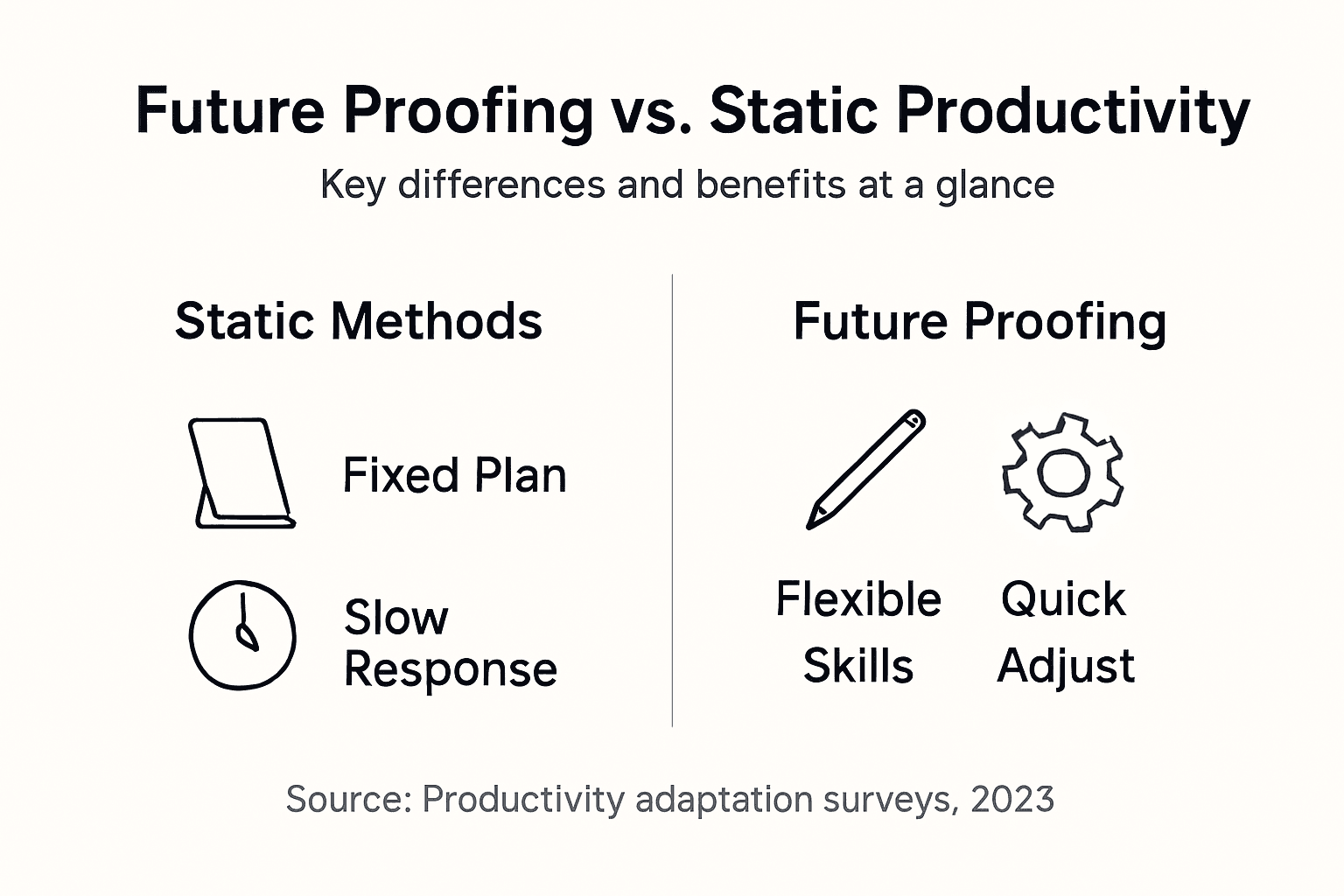
Static strategies hurt more than performance. They create stress when reality doesn’t match your rigid plan. You feel behind, overwhelmed, and unable to keep up. Future proofing solves this by embedding flexibility directly into how you manage time and tasks.
For young professionals and students, this adaptability becomes essential. You’re navigating career transitions, skill development, and evolving responsibilities simultaneously. Time management for young professionals requires systems that grow with you, not against you.
Benefits extend beyond productivity metrics:
- Improved work-life balance through responsive scheduling
- Reduced burnout by eliminating the stress of broken rigid plans
- Enhanced career resilience as you adapt to new roles faster
- Better mental health from sustainable, flexible routines
Future proofing transforms productivity from a fragile house of cards into an adaptable framework that bends without breaking.

Common Misconceptions About Future Proofing
Many people misunderstand what future proofing actually involves. Let’s clear up the confusion before diving deeper.
Myth one: future proofing means creating detailed five-year plans. Wrong. It’s the opposite. Rigid long-term planning breaks the moment reality shifts. True future proofing builds in adjustment mechanisms from day one.
Myth two: only tech professionals need future proofing. False. Every field experiences change. Healthcare adopts new protocols. Education integrates digital tools. Creative industries navigate platform shifts. Adaptability matters everywhere, regardless of your major or career path.
Myth three: you need to predict exact future changes. Impossible and unnecessary. Future proofing focuses on developing skills to respond to any change, not guessing what changes will occur. It’s about building resilience, not prophecy.
Myth four: future proofing is too complex for everyday use. Research contradicts this. Studies show iterative adaptation leads to 15-25% better outcomes compared to fixed plans over 3 years, using straightforward techniques anyone can implement.
The real foundation? A growth mindset. Viewing adaptability as a skill you develop, not a fixed trait, changes everything. When you expect change and prepare to adjust, transitions become opportunities instead of crises.
Pro Tip: Start small by choosing one area of your routine to make flexible this week. Pick your study schedule or meeting prep approach and build in two alternative paths for handling unexpected changes.
Frameworks and Models for Future-Proofing Time Management
Practical frameworks help translate future proofing concepts into daily action. The Future-Proofing Productivity Framework centers on three core components working together.
First, Adaptive Skill Development. You continuously update skills relevant to your field and adjacent areas. This creates versatility when job requirements shift.
Second, Flexible and Iterative Routines. Your schedules include built-in adjustment points. Weekly reviews let you recalibrate based on emerging priorities instead of forcing outdated plans.
Third, Technology Adoption Readiness. You stay informed about tools that enhance productivity and test new ones regularly. This prevents obsolescence when legacy systems fade.
Compare approaches:
| Aspect | Fixed Planning | Iterative Adaptive Planning |
|---|---|---|
| Schedule changes | Causes stress and replanning | Built into system design |
| Skill development | Reactive when gaps appear | Proactive and continuous |
| Tool adoption | Resists until forced | Regular evaluation and testing |
| Priority shifts | Disrupts entire workflow | Accommodated through review cycles |
| Long-term success | Declines as relevance fades | Improves through accumulated adaptability |
Research confirms this advantage. Flexible routines correlate with a 30% higher adaptability score in workplace performance reviews, demonstrating measurable career benefits.
Implement the framework through these steps:
- Audit your current productivity system for inflexible points
- Add weekly review sessions to reassess priorities and adjust plans
- Identify three skills adjacent to your main focus and schedule learning time
- Test one new productivity tool monthly to stay current with options
- Build buffer time into schedules for unexpected opportunities or challenges
Measure success through metrics like response time to priority changes, number of skills added quarterly, and stress levels during transitions. Setting time management goals examples around these metrics creates accountability.
Pro Tip: Use the two-minute rule for plan adjustments. If reassessing a priority takes under two minutes, do it immediately instead of waiting for your weekly review. This keeps your system responsive in real time.
Why Future Proofing Matters: Evidence and Data
Numbers tell the story better than theory alone. Static productivity methods don’t just lose effectiveness gradually. They collapse suddenly as workplace realities outpace them.
Recall that 60% of traditional methods become ineffective within two years. This isn’t a minor decline. It represents majority failure of rigid approaches in fast-changing environments.
Burnout risk drops significantly with adaptive strategies. Workers using flexible systems report 40% lower burnout indicators compared to those following fixed routines. The mental relief of having adjustment built into your approach eliminates the constant anxiety of falling behind.
Consider this insight:
“Productivity gains from adaptive methods compound over time. Workers using future-proof strategies show 28% better reprioritization efficiency, which translates to completing higher-value work consistently rather than being trapped in outdated task lists.”
Quantitative improvements appear across multiple dimensions:
| Metric | Static Methods | Future-Proof Methods | Improvement |
|---|---|---|---|
| Task reprioritization speed | 45 minutes average | 32 minutes average | 28% faster |
| Skill relevance retention | 60% after 2 years | 85% after 2 years | 25 point gain |
| Stress during transitions | 7.2/10 reported | 4.8/10 reported | 33% reduction |
| Quarterly productivity maintenance | Declines 15% | Improves 8% | 23 point swing |
For young professionals and students, ignoring future proofing carries real costs. You invest time building systems that become obsolete quickly. You experience higher stress navigating changes without adaptive tools. Career advancement slows when your methods can’t keep pace with evolving responsibilities.
The data makes clear: future-proof strategies improve reprioritization efficiency by 28%, directly impacting your ability to focus on what matters most as circumstances change.
How to Future-Proof Your Personal Time Management
Translating concepts into action requires specific, practical steps you can implement immediately.
Start with digital task management tools designed for flexibility. Choose platforms that make reprioritization quick and visual. Drag-and-drop interfaces, multiple view options, and easy deadline adjustments reduce friction when priorities shift. Optio Station exemplifies this approach, positioning itself as your second-in-command that adapts to your changing needs as a Centurion.
Develop habits around frequent plan adjustment. Set calendar reminders for weekly reviews where you reassess all commitments. Ask yourself: what changed this week? What new information affects my priorities? What can I defer or delegate? This prevents outdated tasks from cluttering your system.
Incorporate continuous learning directly into your schedule. Block 30 minutes daily for skill development adjacent to your main focus. If you study marketing, learn basic data analysis. If you’re in finance, explore communication skills. This breadth creates options when roles expand or pivot.
Use flexible scheduling techniques:
- Time blocking with built-in buffer periods between tasks
- Theme days that accommodate different types of work without rigid hour assignments
- Rolling wave planning that details this week fully but keeps next week adaptable
- Energy-based scheduling that matches task difficulty to your natural rhythms
Integrate technology thoughtfully. Test new tools in low-stakes scenarios before full adoption. Keep your tech stack simple so switching tools doesn’t paralyze your workflow. Focus on interoperability so systems connect smoothly.
Establish regular review cycles beyond weekly check-ins. Monthly reviews assess broader patterns. Quarterly reviews evaluate skill development progress and tool effectiveness. Annual reviews recalibrate your entire approach based on accumulated learning.
Explore productivity hacks for future-proofing that emphasize adaptability over rigid optimization. Set time management goals focused on flexibility metrics, not just completion rates. Apply organization tips for productivity that create systems able to grow with your needs.
Pro Tip: Create a “change log” document where you note every time priorities shift unexpectedly. Review it monthly to identify patterns. This reveals which areas need more flexibility built into your system and which remain stable enough for more structure.
Case Studies: Real-World Examples of Successful Future-Proofing
Real examples demonstrate how future proofing works in practice across different contexts.
Sarah, a marketing coordinator at a mid-size firm, faced constant project scope changes. She adopted a kanban-style digital board that made task reprioritization visual and quick. When a campaign direction shifted mid-week, she reorganized priorities in under 20 minutes instead of the previous 90-minute planning session. Her stress levels dropped, and she consistently delivered higher-value work by staying aligned with current needs.
A software development team at a startup implemented continuous learning Fridays. Every team member spent Friday afternoons exploring adjacent skills or new technologies. When the company pivoted from web to mobile apps, the team adapted smoothly because multiple members had already experimented with mobile frameworks. The transition took three weeks instead of the projected three months.
Marcus, a graduate student juggling research and part-time work, built buffer time into every day. He scheduled only six hours of committed tasks in eight-hour workdays. When his advisor requested urgent revisions or work projects expanded unexpectedly, he had capacity to respond without derailing everything. His grades improved and work performance stayed strong because his system expected and accommodated change.
Common tactics across successful examples:
- Frequent reassessment sessions built into routines as non-negotiable appointments
- Skill updating treated as ongoing rather than reactive to specific needs
- Technology integration through regular testing and evaluation
- Buffer capacity maintained in schedules for unexpected high-value opportunities
- Metrics tracking focused on adaptability and resilience, not just output
These stories show future proofing isn’t theoretical. It’s practical, achievable, and delivers measurable benefits for individuals and teams navigating change.
Summary and Next Steps for Readers
Future proofing transforms how you approach productivity in an unpredictable world. Let’s consolidate what matters most.
Definition: Future proofing means building adaptability into your productivity systems so they remain effective despite workplace changes, technology shifts, and evolving priorities.
Importance: With 60% of traditional methods becoming ineffective within two years, static approaches guarantee obsolescence and increased stress.
Myths debunked: Future proofing isn’t rigid planning, isn’t tech-specific, doesn’t require predicting the future, and isn’t too complex for everyday use. It’s accessible adaptability.
Core framework: Adaptive Skill Development, Flexible and Iterative Routines, and Technology Adoption Readiness work together to create resilient productivity.
Evidence: Future-proof strategies improve reprioritization efficiency by 28%, reduce burnout by 40%, and maintain skill relevance 25 points higher than static methods.
Actionable steps:
- Choose flexible digital tools for task management
- Schedule weekly reviews to reassess priorities
- Block time for continuous skill development
- Build buffer capacity into your schedule
- Test new productivity tools monthly
- Track adaptability metrics, not just completion rates
Start today by identifying one rigid element in your current system and adding flexibility. View adaptability as a skill to develop through practice, not a fixed trait. The workplace will keep changing. Your productivity system should change with it.
Discover Tools to Future-Proof Your Productivity
Ready to put future proofing into action? Optio Station provides task management solutions designed specifically for adaptability. As your second-in-command, it helps you pivot priorities quickly, integrate continuous learning, and maintain productivity through any transition.
Explore our best task management software guide to find tools matching your future-proofing needs. Learn practical techniques through our guide on how to manage tasks effectively. Understand the foundation by discovering why managing tasks matters for sustained productivity. Optio Station empowers Centurions like you to lead your productivity with flexibility and confidence.
FAQ
What is future proofing in productivity?
Future proofing in productivity means designing adaptable strategies that stay effective despite changes in work environments and technology. It prioritizes flexibility and continuous learning over rigid planning, allowing you to pivot smoothly when priorities shift.
How can I make my time management future-proof?
Use flexible digital tools that enable quick task reprioritization when circumstances change. Review and adjust your plans weekly to stay aligned with current priorities. Commit to continuous skill development by blocking time for learning adjacent to your main focus. Explore productivity hacks for students and pros emphasizing adaptability.
What are common mistakes when trying to future-proof productivity?
Relying on rigid long-term plans without building in adjustment mechanisms defeats the purpose of future proofing. Ignoring technology updates means your tools become obsolete while better options emerge. Neglecting mindset adaptation and continuous learning leaves you reactive instead of proactive when change arrives.
Why is adaptability important for young professionals?
Adaptability helps you manage unexpected changes in tasks and priorities without derailing your entire system. It supports mental resilience by reducing stress during transitions and keeps your skills relevant as job requirements evolve. Building adaptability now creates career advantages that compound over time.
Recommended
- Future Planning Explained: Strategies and Best Practices – Optio Station: Best Project Management App for Prioritization
- Role of Technology in Productivity: Real Impact for Students – Optio Station: Best Project Management App for Prioritization
- 7 Types of Productivity Techniques Every Centurion Should Know – Optio Station: Best Project Management App for Prioritization
- Understanding Why Use Productivity Apps for Success – Optio Station: Best Project Management App for Prioritization
