

Balancing classes, deadlines, and work projects leaves many students and young professionals feeling stretched thin. Trying to keep every commitment in your head leads to stress and missed details, especially with multiple priorities at once. A to-do list is more than a memory aid—it clears mental space so you can focus, work smarter, and tackle challenges with greater confidence. This guide unpacks what makes a to-do list truly effective and corrects common misunderstandings that can slow your progress.
Table of Contents
- Defining A To-Do List And Common Myths
- Main Types Of To-Do Lists Explained
- How To-Do Lists Boost Productivity
- Common Pitfalls And Best Practices
Key Takeaways
| Point | Details |
|---|---|
| To-Do Lists Offload Mental Burden | Writing tasks down helps individuals remember their commitments and focus on execution. This approach is particularly beneficial for students and professionals managing multiple responsibilities. |
| Effective Lists Share Key Characteristics | To-do lists should contain specific, actionable tasks, realistic scopes, clear deadlines, and broken down projects to enhance productivity. |
| Dispelling Common Myths | A to-do list does not ensure task completion on its own; motivation and commitment are still needed. Additionally, the “perfect” system is often less effective than a simple, usable list. |
| Regular Review Enhances Effectiveness | Consistently reviewing and updating your list helps maintain clarity, keeps priorities clear, and fosters a sense of accomplishment through visible progress. |
Defining a To-Do List and Common Myths
A to-do list is fundamentally a roadmap for action. It’s a written compilation of tasks you need to complete, organized in a way that helps you stay focused and track progress toward your goals.
The core purpose goes beyond simple record-keeping. To-do lists help offload the mental burden of remembering tasks, freeing your brain to concentrate on actually doing the work instead of constantly wondering what you forgot.
For college students and young professionals juggling multiple projects, deadlines, and responsibilities, this distinction matters. Your brain has limited working memory. Writing things down removes the stress of trying to keep everything mentally organized.
What Makes a To-Do List Actually Work
Effective to-do lists share specific characteristics that separate productive ones from lists that sit unused:
- Specific, actionable tasks rather than vague goals (“Complete marketing proposal” not “marketing stuff”)
- Realistic scope that doesn’t overwhelm you with 47 items
- Clear deadlines when applicable
- Breakdown of large projects into smaller, manageable steps
Breaking down large tasks into smaller steps increases your likelihood of actually finishing them. When you see “Design website” instead of “Rebuild entire online presence,” you’re more likely to start.
Busting the Myths
Here’s where many people get frustrated with to-do lists. They expect something to-do lists can’t actually deliver.
Myth 1: A to-do list guarantees task completion. Wrong. A list is awareness, not execution. Having something written down doesn’t magically get it done—you still need the motivation, time, and commitment to actually complete it. The list removes the memory burden, but the work still falls on you.
Myth 2: You need the “perfect” system. People waste weeks researching apps and formats instead of just writing things down. The simplest list beats the most elegant system you never use.
Myth 3: Everything belongs on your to-do list. Vague items like “get better at studying” or “be more organized” clutter your list. Replace them with concrete actions: “Review Chapter 5 notes Tuesday evening” or “Sort project files by deadline.”
Myth 4: Longer lists are more productive. Cramming 30 items into one day demoralizes you. A focused list of 5-7 realistic tasks beats an ambitious list of 25 that leaves you feeling defeated.
The real power of a to-do list isn’t in the list itself—it’s in the clarity and focus it creates.
Pro tip: Start with just today’s three most important tasks rather than overwhelming yourself with a massive list. Build the habit first, then expand.
Main Types of To-Do Lists Explained
Not all to-do lists work the same way. Different list types serve different purposes, and the best approach often combines multiple formats based on your situation and workload.
Understanding these categories helps you choose the right structure for your specific needs. Whether you’re managing a semester project or juggling client work, the type of list you use directly impacts your success.
Time-Based Lists
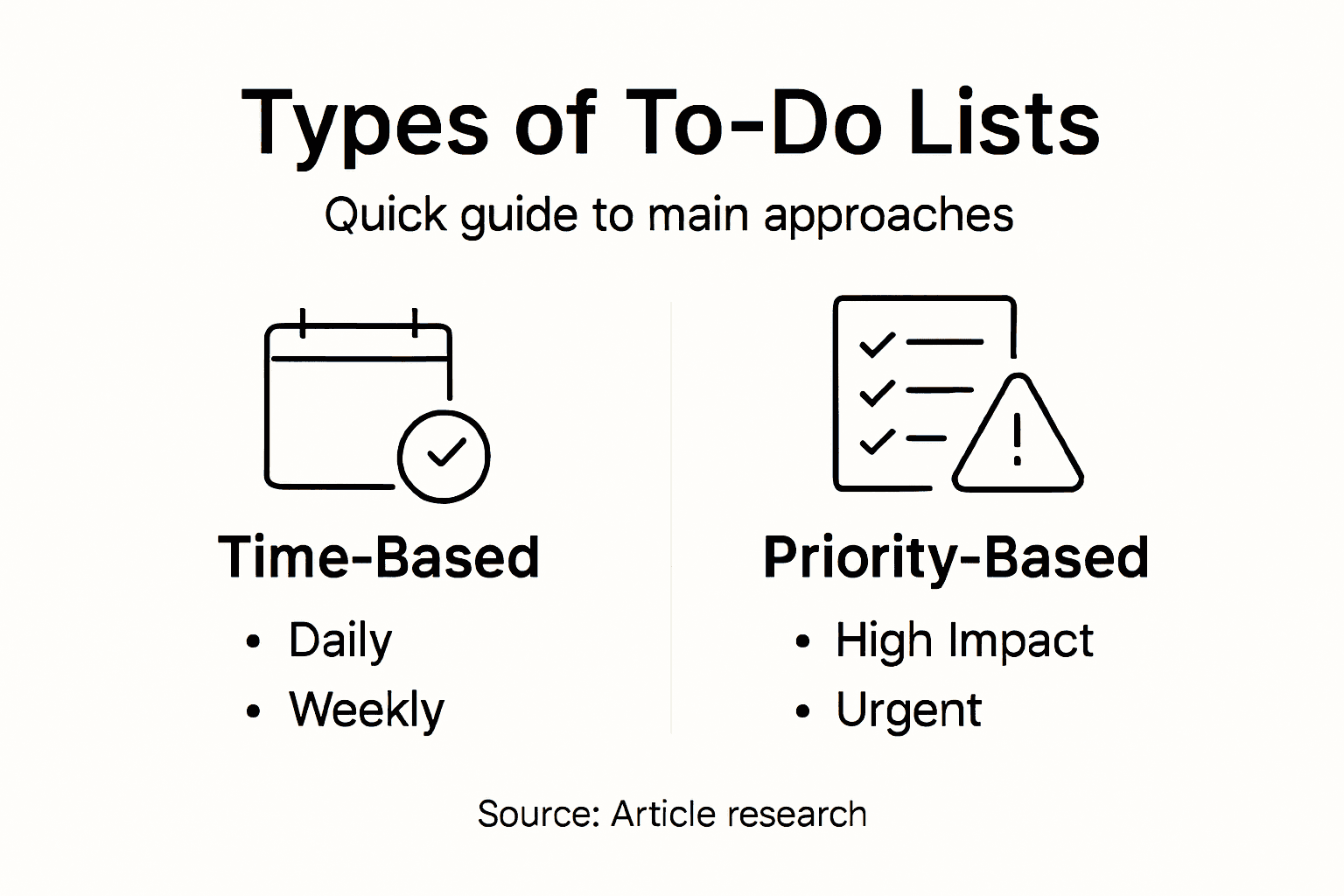
The most common approach divides tasks by timeframe:
- Daily lists capture what needs doing today (typically 5-10 focused items)
- Weekly lists show your bigger picture and priorities for the next seven days
- Monthly or semester lists track major deadlines and long-term projects
Daily lists keep you grounded in immediate action. Weekly lists help you plan ahead and avoid last-minute panic. Many students use both simultaneously—a weekly overview for context and a daily list for execution.
Task Category Lists
Instead of organizing by time, you can organize by type. Categorizing tasks into different types helps you manage priorities and match work to your mental energy:
- Deep work requires intense focus (writing papers, coding, strategic thinking)
- Shallow work includes emails, admin tasks, and routine items
- Chores are household or organizational maintenance
- Self-care blocks protect your health and wellbeing
This approach is powerful because it matches tasks to your energy levels. You tackle deep work when your brain is sharpest, leaving shallow tasks for when you’re tired.
Priority-Based Lists
Some lists use urgency and importance matrices. To-do lists can include prioritization and deadlines to clarify what truly matters:
- Urgent and important tasks go first (due tomorrow, affects your grade)
- Important but not urgent tasks prevent crises (studying for a test two weeks away)
- Urgent but not important tasks often feel demanding but aren’t truly critical
- Neither urgent nor important tasks can often be skipped or delegated
This framework prevents you from confusing noise with necessity.
Collaborative Lists
For group projects, shared lists keep everyone aligned. These lists track who owns what, progress status, and shared deadlines—essential for team-based coursework or professional work.
The right list type depends on your context, not on what works for others.
Pro tip: Start with a simple daily list this week, then add a weekly view next week once the habit sticks. Build gradually rather than overhauling your system all at once.
Here’s how the main types of to-do lists compare:
| List Type | Best For | Key Advantage | Typical Limitation |
|---|---|---|---|
| Time-Based | Daily and weekly planning | Maintains consistent focus | May not show task priority |
| Task Category | Managing energy | Matches work to brainpower | Can overlook deadlines |
| Priority-Based | Urgent vs. important work | Clarifies what matters most | Requires active prioritizing |
| Collaborative | Team projects | Improves group accountability | Needs regular updates |
How To-Do Lists Boost Productivity
To-do lists aren’t just organizational tools—they’re productivity multipliers. When used correctly, they transform how you work, think, and manage your time.
The productivity gains come from several interconnected benefits that compound when you stick with the system.
Breaking Projects Into Actionable Chunks
Breaking projects into manageable chunks is one of the most powerful productivity moves. A vague goal like “finish the marketing campaign” feels overwhelming. Breaking it into “research competitor strategies,” “draft messaging,” and “create visuals” suddenly becomes doable.

When tasks feel small, you start them more easily. You finish them faster. Momentum builds naturally.
Creating Accountability Through Writing
There’s something powerful about writing something down. It transforms a passing thought into a commitment. When you see your task written clearly, you’re more likely to follow through.
This accountability effect is psychological but real. Your brain takes written commitments seriously in ways mental reminders don’t.
Eliminating Mental Clutter
Effective time management with to-do lists reduces stress by clarifying exactly what needs to be done. You stop spending mental energy wondering what you’re forgetting.
Your brain can focus on the work itself rather than trying to remember everything. This shift alone boosts productivity significantly.
Enabling Strategic Prioritization
Not all tasks matter equally. A good to-do list forces you to decide what actually drives results:
- Urgent items get done today
- Important items get scheduled and protected
- Lower-priority items get deferred or delegated
- Non-essential items get removed entirely
Without a list, you default to reacting. With a list, you choose where your effort goes.
Preventing Procrastination and Burnout
A list aligned with your goals keeps you moving forward consistently. You see progress accumulating. You avoid the all-nighter panic spiral that kills quality work.
Balancing focused effort with breaks prevents burnout. You accomplish more by working deliberately rather than frantically.
This summary shows how to-do lists improve productivity at different stages:
| Productivity Benefit | How the List Helps | Resulting Impact |
|---|---|---|
| Actionable Steps | Breaks goals into clear actions | Easier task initiation |
| Written Accountability | Turns intentions into commitments | Higher follow-through |
| Mental Clarity | Frees cognitive resources | Less stress, more focus |
| Strategic Prioritization | Highlights essential tasks | Better time allocation |
A to-do list transforms scattered effort into concentrated progress.
Pro tip: Review your list each morning for five minutes and update it each evening for two minutes. This 7-minute daily ritual keeps your system accurate and your priorities clear.
Common Pitfalls and Best Practices
To-do lists fail when people treat them like dumps for every thought that crosses their mind. The system breaks under its own weight. Understanding what goes wrong helps you build a list that actually works.
The Overwhelm Trap
Overwhelm from to-do lists often comes from lack of prioritization and unrealistic task volumes. When your list contains 50 items, none feel urgent. Your brain shuts down instead of engaging.
You end up ignoring the list entirely. It becomes a source of guilt rather than productivity.
Common Pitfalls to Avoid
Recognize these mistakes before they derail your system:
- Adding everything without filtering what actually matters
- Vague task descriptions that don’t tell you where to start
- Never reviewing your list, so items pile up indefinitely
- Ignoring completed tasks, which prevents you from seeing progress
- Forcing one list type for all situations when different contexts need different approaches
- Setting unrealistic daily goals that guarantee failure
Each of these patterns kills momentum and erodes trust in your system.
Best Practices That Work
These strategies transform your list from burden to asset:
1. Prioritize ruthlessly. Not everything is equally important. Identify the three tasks that matter most each day. The rest can wait.
2. Break tasks into smaller steps. “Write proposal” overwhelms. “Outline main sections” feels achievable. “Draft introduction” becomes a single focused session.
3. Maintain flexibility. Life changes. Deadlines shift. Unexpected urgent work appears. Your list must adapt without falling apart. This reduces anxiety and keeps the system realistic.
4. Review regularly. Spend five minutes each morning reading your list. Spend two minutes each evening updating it. This keeps everything accurate and aligned.
5. Celebrate completion. Check off finished tasks visibly. See that progress accumulating. This psychological reward sustains motivation for the next items.
Matching Your List to Your Context
A semester list looks different from a daily list. A deep work project looks different from administrative tasks. Your best system often combines multiple list types working together.
The best to-do list is one you’ll actually use consistently.
Pro tip: Limit your daily list to 5-7 tasks maximum. On days when you complete everything, you feel accomplished and motivated. On days when life intervenes, you still make meaningful progress.
Take Command of Your Tasks with Optio Station
The challenge of managing overwhelming to-do lists and breaking projects into clear, actionable steps can feel like standing alone on a battlefield. This article highlights the need for focused prioritization and mental clarity, which are exactly the struggles many students and young professionals face every day. If you find yourself burdened by vague goals, procrastination, or mental clutter, it is time to enlist a reliable second-in-command to help you win your daily battles.
Optio Station was designed with you in mind—a mobile app inspired by Roman leadership that supports you, the Centurion, in mastering your task, team, and time management. By offering a structured system to capture priorities, break tasks into manageable steps, and maintain clarity, Optio Station turns overwhelming to-do lists into powerful productivity tools. Don’t let your goals stay stalled or your lists become a source of stress. Visit Optio Station today and start commanding your day with confidence. Take the first step to transform your daily actions by exploring how our app can help you create clear, focused to-do lists and keep your projects on track with ease.
Frequently Asked Questions
What is a to-do list?
A to-do list is a written compilation of tasks you need to complete, organized to help you focus and track your progress toward specific goals.
How can a to-do list boost my productivity?
To-do lists boost productivity by breaking projects into manageable chunks, creating accountability through written tasks, eliminating mental clutter, enabling strategic prioritization, and preventing procrastination and burnout.
What are the key characteristics of an effective to-do list?
An effective to-do list includes specific, actionable tasks, a realistic scope, clear deadlines, and a breakdown of large projects into smaller, manageable steps.
Why do people often struggle with to-do lists?
People may struggle with to-do lists due to overwhelm from unrealistic task volumes, vague task descriptions, lack of regular review, and not prioritizing tasks properly.
Recommended
- To‑Do List Apps: Everything You Need to Know – Optio Station: Best Project Management App for Prioritization
- What Is the Best To Do List App? Complete Guide – Optio Station: Best Project Management App for Prioritization
- Understanding Why Use Task Lists for Better Productivity – Optio Station: Best Project Management App for Prioritization
- 7 Types of To-Do Lists Every Student Should Use – Optio Station: Best Project Management App for Prioritization
- 7 étapes clés de la checklist vidéo pour le marketing efficace
