

TL;DR:
- A good work life balance involves managing work and personal demands without draining energy or well-being.
- It requires continuous adjustment and flexible integration, not a fixed 50/50 split or permanence.
A good work life balance is the ability to meet your work and personal demands without either side consistently draining your energy or well-being. Defining work life balance this way matters because it shifts the focus from clock hours to sustainable control. 77% of workers have experienced burnout, and that number tells you this is not a personal failure. It is a systemic problem that hits college students and young professionals especially hard. Techniques like the Pomodoro Technique and tools like Optiostation exist precisely to close that gap between what you need to do and what you can actually sustain.
What is a good work life balance, really?

A healthy work life balance is not a perfect 50/50 split between work and personal time. Balance is better understood as integration for sustainability and well-being, meaning you have enough autonomy and flexibility to shift your energy where it is needed most at any given time. Some weeks, a deadline demands more. Other weeks, a family event or your own mental health takes priority. Neither situation means you have failed.
The traditional model treated work and personal life as two separate containers. The modern understanding treats them as overlapping zones you move between intentionally. That shift matters because rigid separation is often impossible for students juggling part-time jobs, internships, and coursework simultaneously.
“Work-life balance is a fluid construct requiring ongoing priority adjustments, not a fixed formula.” — Psychology Today
Common myths that keep you stuck
Three misconceptions block most people from achieving real balance:
- The 50/50 myth. Equal time in each area is not the goal. Sustainable energy is. A student pulling a 60-hour week before finals is not failing at balance if they recover properly afterward.
- Balance is permanent. Balance shifts with life seasons, demanding continuous re-evaluation. What works in your sophomore year will not work in your first full-time role.
- Productivity equals worth. Filling every hour does not mean you are performing well. Rest is part of the output, not a reward for it.
Understanding these myths is the first step. Acting on them requires concrete strategies.
What practical strategies help achieve a healthy work life balance?
The most effective strategies for young professionals and students combine structured focus, deliberate recovery, and firm boundaries. These are not abstract concepts. They are specific behaviors you can start today.
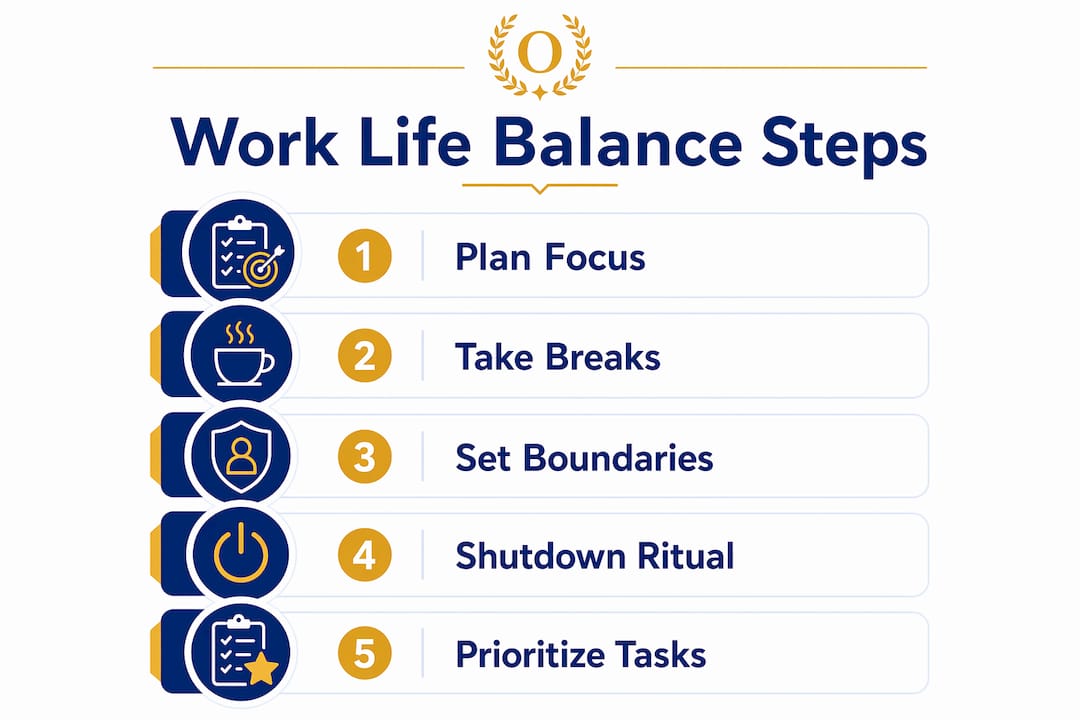
1. Use the Pomodoro Technique for focused work
The Pomodoro Technique structures work into 25-minute blocks followed by 5-minute breaks. That rhythm prevents the mental fatigue that comes from grinding for two hours straight. After four cycles, you take a longer break of 15–30 minutes. For a student writing a research paper or a junior analyst building a report, this structure turns an overwhelming task into a series of manageable sprints.
2. Schedule real breaks, not scroll sessions
Taking 10–30 minute breaks away from screens sustains energy and motivation across a full day. A break that involves checking social media does not count. A walk, a meal without a screen, or a short workout resets your nervous system in a way that passive scrolling cannot. Build these into your calendar the same way you schedule class or meetings.
Pro Tip: Block your break times in your calendar before you block your work sessions. Breaks that are not scheduled are the first things that disappear under pressure.
3. Set fixed work hours and protect them
Boundaries are not just for managers. As a student or entry-level professional, you need to decide when your workday ends and actually stop. Checking emails at 11 p.m. trains your brain to stay in work mode around the clock. Scheduling emails during work hours rather than sending them at night is one of the most effective ways to protect your personal time, and it models good behavior for anyone you work with.
4. Create a physical shutdown ritual
Physical shutdown rituals like closing your laptop, changing clothes, or taking a short walk after your last task help your brain switch out of work mode. Mental effort alone rarely works. Your brain responds to physical cues. A student who closes their textbooks, puts them in a bag, and makes tea signals to their nervous system that the study session is over. That transition is not trivial. It is neurologically meaningful.
5. Prioritize tasks by impact, not urgency
Not every task deserves equal attention. Use a priority framework to separate what moves the needle from what just feels urgent. The time management skills you build now will compound over your entire career. Spending 30 minutes on a low-stakes email while a major project sits untouched is a balance problem disguised as a productivity problem.
How does work life balance impact mental health and performance?
The importance of work life balance becomes clear when you look at what poor balance actually costs. Chronic stress from poor balance doubles heart attack risk and weakens immune function. That is not a distant risk for overworked executives. It is a real risk for a 22-year-old running on four hours of sleep and three deadlines.
On the positive side, balanced workers are more productive, report better job satisfaction, and take fewer sick days. The benefits of work life balance are not just personal. They show up in your output, your relationships, and your long-term career trajectory.
| Area of life | Effect of poor balance | Effect of good balance |
|---|---|---|
| Mental health | Anxiety, burnout, low motivation | Clarity, resilience, sustained focus |
| Physical health | Doubled heart attack risk, weakened immunity | Better sleep, stronger immune response |
| Work performance | Lower output, more errors, absenteeism | Higher productivity, fewer sick days |
| Relationships | Withdrawal, conflict, isolation | More presence, stronger connections |
The table above is not theoretical. Each row reflects documented outcomes from research on how balance affects real people in real jobs and classrooms. Burnout does not arrive suddenly. It accumulates through weeks of ignoring these signals.
How can students and young professionals tailor balance to their lives?
College students and young professionals face a specific set of pressures that generic advice does not address. You are often managing coursework, a part-time job, an internship, a social life, and your own finances at the same time. That is not a standard 9-to-5 problem. It requires a different approach.
Here is what actually works for this stage of life:
- Audit your commitments honestly. Write down every recurring obligation and estimate how long each takes per week. Most students underestimate by 30–40%. Seeing the real number forces better decisions.
- Use technology intentionally. Apps built for task and time management reduce the mental load of tracking everything in your head. When your system holds the details, your brain can focus on execution.
- Set semester-length goals, not just weekly ones. Short-term thinking creates reactive schedules. Knowing your major deadlines three months out lets you distribute effort instead of cramming.
- Recognize when a path is hurting you. A major, job, or relationship that consistently destroys your well-being is not a balance problem you can schedule your way out of. Sometimes the right move is a structural change, not a better morning routine.
- Protect social time as seriously as study time. Relationships are not a reward for finishing work. They are a recovery mechanism. Students who maintain strong social connections avoid burnout more effectively than those who isolate during high-pressure periods.
Pro Tip: Build a weekly review into your Sunday routine. Spend 15 minutes checking what is due, what drained you last week, and what you need to protect. That single habit replaces hours of reactive scrambling.
The step-by-step guide to work life balance for students from Optiostation breaks this process down further for anyone who wants a structured starting point.
Key takeaways
A good work life balance requires sustainable integration, not equal time, and it must be actively redesigned as your life changes.
| Point | Details |
|---|---|
| Balance means integration | Sustainable energy management matters more than splitting time equally between work and life. |
| Burnout is systemic | 77% of workers experience burnout, making proactive strategies necessary, not optional. |
| Structured focus works | The Pomodoro Technique and scheduled breaks prevent fatigue and protect recovery time. |
| Shutdown rituals matter | Physical cues like closing your laptop help your brain exit work mode more effectively than willpower alone. |
| Tailor to your stage | Students and young professionals need balance strategies that account for overlapping academic, work, and social demands. |
Balance is a design problem, not a discipline problem
Here is what I have observed working with students and young professionals through Optiostation: most people who struggle with balance are not lazy or undisciplined. They are operating without a system. They are reacting to whatever feels most urgent instead of working from a deliberate structure.
The conventional advice tells you to “set boundaries” and “say no more often.” That is true but incomplete. Boundaries without a supporting system collapse under pressure. The student who decides to stop working at 9 p.m. will break that rule the first time a professor sends a late email, unless they have a clear protocol for what happens next.
What actually works is treating your schedule as a design project. You are not trying to achieve perfect balance every day. You are building a structure that absorbs disruption without falling apart. That means work life balance in the workplace looks different from balance during finals week, and both are valid. The goal is not consistency of hours. It is consistency of recovery.
The pursuit of a perfect 50/50 balance is a myth. Successful people treat balance as a dynamic integration where intensity shifts by life phase. That framing removes the guilt and replaces it with agency. You are not failing when things get heavy. You are in a phase that requires a different configuration.
— Optiostation
Command your schedule with Optiostation
Optiostation is built for exactly the kind of complexity you are managing right now. As your second-in-command, Optio handles the structure so you can focus on execution. The app lets you organize tasks by priority, schedule focused work blocks, and track where your time actually goes across study, work, and personal commitments.
Whether you are a Centurion juggling three classes and a side gig or stepping into your first full-time role, Optiostation gives you the tools to build a schedule that holds. Check out the top time management apps list to see how Optiostation fits alongside the best tools available for students and young professionals who are serious about protecting their time and energy.
FAQ
What is a good work life balance in simple terms?
A good work life balance means you can meet your work and personal needs without one side consistently exhausting you. It is about sustainable control and flexibility, not equal hours.
How do I know if my work life balance is poor?
Chronic fatigue, difficulty switching off after work, and declining performance in either work or personal areas are clear signs. Burnout affects 77% of workers, so these signals are worth taking seriously early.
What is the Pomodoro Technique and how does it help?
The Pomodoro Technique uses 25-minute work blocks followed by 5-minute breaks to maintain focus and prevent mental fatigue. It is one of the most practical tools for students and professionals managing heavy workloads.
Is work life balance different for college students?
Yes. Students manage overlapping academic, work, and social demands simultaneously, which requires more flexible and phase-sensitive strategies than a standard 9-to-5 worker needs. The core principles still apply, but the structure must account for irregular schedules and shifting priorities.
Can technology actually help with work life balance?
Yes, when used intentionally. Task management apps, calendar blocking tools, and focus timers reduce the mental load of tracking commitments, which frees up cognitive energy for the work itself and for genuine rest.
Recommended
- Step-by-step guide to work-life balance for students – Optio Station: Best Project Management App for Prioritization
- Work Life Balance in the Workplace: A Young Pro’s Guide – Optio Station: Best Project Management App for Prioritization
- Work‑Life Balance: Complete Guide for Students & Young Pros – Optio Station: Best Project Management App for Prioritization
- Understanding Time Management for Young Professionals – Optio Station: Best Project Management App for Prioritization
