
{
“@type”: “Article”,
“image”: “https://optiostation.com/images/weekly-agenda-setup.jpg”,
“author”: {
“url”: “https://optiostation.com”,
“@type”: “Organization”
},
“@context”: “https://schema.org”,
“headline”: “Master Your Weekly Agenda Setup for Success”,
“publisher”: {
“logo”: {
“url”: “https://optiostation.com/logo.png”,
“@type”: “ImageObject”
},
“name”: “Optio Station”,
“@type”: “Organization”
},
“inLanguage”: “en”,
“articleBody”: “This article provides a detailed guide on setting up your weekly agenda, including tips for prioritizing tasks and maximizing productivity.”,
“description”: “Follow this step-by-step guide to effectively set up your weekly agenda and streamline your tasks for better productivity.”,
“datePublished”: “2025-09-08T01:09:06.872Z”,
“mainEntityOfPage”: {
“@id”: “https://optiostation.com/weekly-agenda-setup”,
“@type”: “WebPage”
}
}
corinna kopf asshole
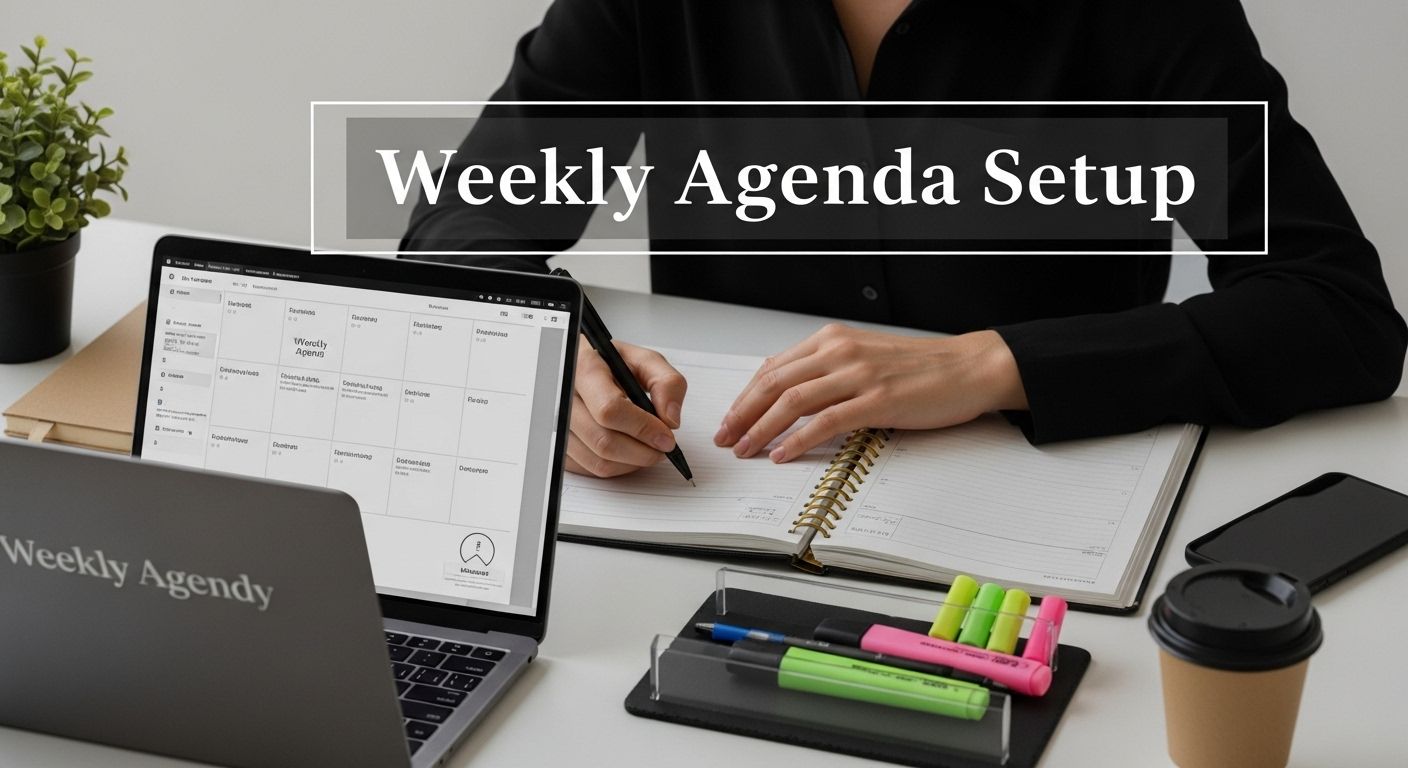
Organizing your week can feel like wrestling with chaos. Every day, there are dozens of tasks screaming for attention and it is easy to lose sight of what actually matters. But here is a fact that might surprise you. Priorities are not just to-do items—they are the true markers of your most important goals and commitments. Most people shuffle through lists and apps without ever establishing a clear hierarchy for their time. The twist is that mastering a weekly agenda is less about cramming in more tasks and much more about building a system that adapts with you, so you finally start seeing real progress where it counts.
Table of Contents
- Step 1: Identify Your Key Priorities
- Step 2: Gather Required Tools And Resources
- Step 3: Create A Weekly Agenda Template
- Step 4: Schedule Your Tasks And Activities
- Step 5: Review And Adjust Your Agenda
- Step 6: Implement And Track Your Progress
Quick Summary
| Key Point | Explanation |
|---|---|
| 1. Identify your key priorities first | Understand what matters most in your life by assessing your long-term goals and critical responsibilities. |
| 2. Gather the right tools for organization | Select digital and physical resources that enhance your productivity and suit your working style. |
| 3. Create an adaptable weekly agenda template | Design a template that allows flexibility while reflecting your commitments and personal goals. |
| 4. Schedule tasks realistically | Allocate time considering your energy levels and include buffer zones to avoid burnout. |
| 5. Review and adjust your agenda regularly | Use a weekly review to evaluate progress and make necessary adjustments for improved efficiency. |
Step 1: Identify Your Key Priorities
Successful weekly agenda setup begins with crystal clear priority identification. Before diving into scheduling, you need a strategic approach to understanding what truly matters in your personal and professional life. Priorities are not just tasks but strategic markers of your most important goals and commitments.
Start by conducting a comprehensive personal assessment that goes beyond standard to-do lists. Consider your long-term objectives, current responsibilities, and critical time-sensitive activities. This means examining academic deadlines, work projects, personal development goals, and essential personal commitments. Learn more about effective prioritization techniques to refine your approach.
To effectively map out your priorities, create a hierarchical framework that categorizes tasks based on urgency and importance. Begin by listing all potential activities across different life domains: academic work, professional responsibilities, personal growth, health, and relationships. Then, systematically evaluate each item through a critical lens. Which tasks have non-negotiable deadlines? What activities directly contribute to your most significant goals? Which commitments, if left unaddressed, would create substantial negative consequences?
The University of Minnesota Extension recommends defining clear desired results before planning any agenda. This means transforming vague intentions into specific, measurable outcomes. For instance, instead of writing “study biology,” specify “complete chapter 3 review and practice problem set by Wednesday evening.” Such precision transforms abstract goals into actionable priorities.
Remember that priority identification is not a one-time event but a dynamic process. Your priorities will shift weekly, sometimes daily. Build flexibility into your approach, allowing room for unexpected opportunities and challenges. The goal is not rigid perfection but intelligent adaptability that keeps you aligned with your most important objectives.
By the end of this step, you should have a clear, concise list of priorities ranked by their strategic importance and immediate impact. This foundational work sets the stage for a powerful, purposeful weekly agenda that transforms potential into real achievement.
Step 2: Gather Required Tools and Resources
With your priorities clearly identified, the next crucial phase of your weekly agenda setup involves strategically selecting and assembling the right tools and resources. Your toolkit is more than just physical items it represents your strategic approach to productivity and organization.
Begin by evaluating digital and physical resources that align with your specific needs. For students and professionals, this means selecting a combination of digital and analog tools that complement your working style. Explore our guide on managing daily tasks effectively to understand how different tools can streamline your workflow.
Your core toolkit should include a primary planning platform something that allows comprehensive tracking and flexible organization. This could be a digital application with robust features or a high-quality physical planner that provides structure and visual clarity. Consider platforms that offer multiple view options like daily, weekly, and monthly perspectives, enabling you to shift between granular task management and broader strategic planning.
According to Harvard’s Academic Resource Center, the most effective scheduling tools share certain characteristics: adaptability, ease of use, and the ability to integrate multiple life domains. Look for resources that allow you to color-code tasks, set priority levels, and synchronize across devices. This ensures that your agenda remains dynamic and responsive to changing circumstances.
Support your primary planning tool with complementary resources. These might include digital note-taking applications for capturing spontaneous ideas, time-tracking software to understand your productivity patterns, or physical notebooks for more reflective journaling. The key is creating an ecosystem of tools that work together seamlessly, not a complicated collection of disconnected systems.
By the conclusion of this step, you should have a carefully curated set of tools that feel intuitive and supportive. Your resources should inspire action, not create additional complexity. Test each tool briefly to ensure it genuinely enhances your workflow rather than becoming another task to manage.
Here is a summary table of essential tools and resources that support an effective weekly agenda setup, including their purposes and benefits.
| Tool/Resource | Description | Purpose/Benefit |
|---|---|---|
| Primary Planning Platform | Digital app or physical planner | Comprehensive tracking, flexible organization |
| Digital Note-Taking App | Software for capturing ideas/tasks | Supports spontaneous idea capture and quick notes |
| Time-Tracking Software | App to monitor work periods and breaks | Helps analyze productivity patterns and time use |
| Color-Coding Features | Built-in option in apps/planners | Visual differentiation of tasks and priorities |
| Physical Notebook | Paper journal for reflection/journaling | Aids in deeper thinking and personal insights |
| Device Sync Capabilities | Cross-device app or platform | Keeps agenda updated across all your devices |
| Task Priority Tagging | Option to assign task importance levels | Ensures focus on what matters most |
Step 3: Create a Weekly Agenda Template
With your priorities and tools established, crafting a personalized weekly agenda template becomes your strategic roadmap to productivity. A well-designed template transforms abstract goals into actionable steps, providing structure without strangling flexibility.
Think of your agenda template as a living document that reflects your unique rhythm and responsibilities. Learn more about managing daily tasks effectively to understand how a robust template can revolutionize your planning approach. Start by creating a visual framework that divides your week into meaningful segments. This means allocating specific time blocks for different categories of activities academic work, professional responsibilities, personal development, health, and social commitments.
Begin your template design by mapping out your non-negotiable fixed commitments. These include classes, work shifts, recurring meetings, and essential personal appointments. These anchor points provide the structural skeleton around which you’ll build more flexible activities. According to Bowdoin College’s time management guidelines, creating a structured weekly schedule reduces daily stress and prevents last-minute work rushes.
Design your template with intentional white space that allows for unexpected opportunities and potential adjustments. While structure is crucial, over-scheduling can lead to burnout and frustration. Include buffer zones between major tasks to account for transitions, potential delays, and spontaneous activities. Color-coding can be an excellent visual strategy to differentiate between various life domains, making your template more intuitive and engaging.
Consider incorporating a reflection section at the end of each week. This could be a dedicated space for noting accomplishments, tracking progress toward long-term goals, and identifying areas for improvement. Such retrospective moments transform your agenda from a mere scheduling tool into a personal development instrument.
By the end of this step, you should have a comprehensive yet adaptable template that feels like a natural extension of your personal and professional aspirations. Your weekly agenda is no longer a static document but a dynamic blueprint for intentional living.
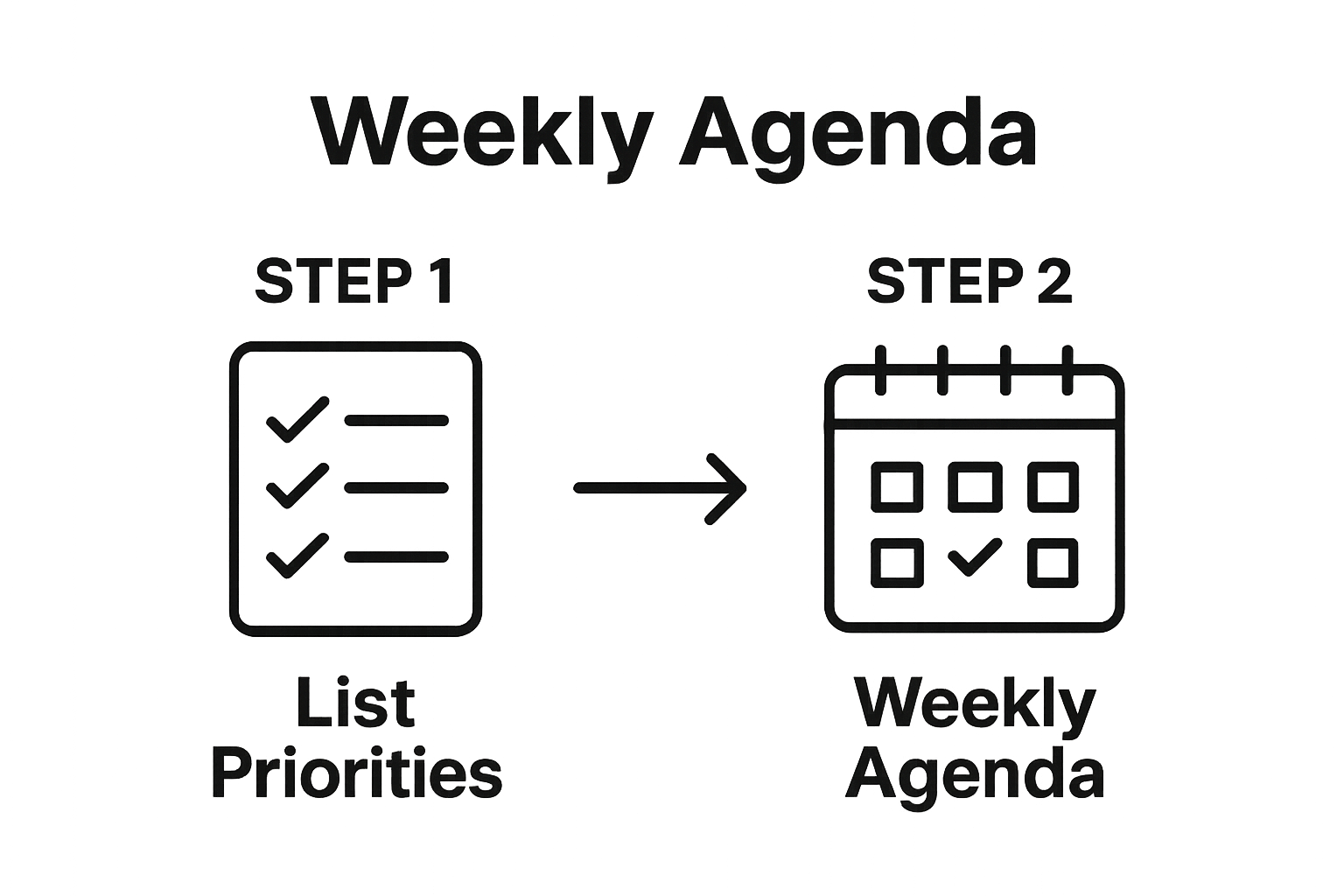
Step 4: Schedule Your Tasks and Activities
Scheduling transforms your carefully crafted agenda from a theoretical blueprint into a practical roadmap for success. The art of scheduling lies not in filling every moment, but in creating intentional, realistic time allocations that honor both your goals and your human limitations.
Begin by strategically mapping your tasks across your weekly template, paying close attention to your natural energy rhythms and existing commitments. Learn more about managing daily tasks effectively to refine your scheduling approach. Consider your most productive hours and align complex, high-concentration tasks with those peak performance windows. For most individuals, these windows occur in the morning or early afternoon when mental clarity and focus are at their highest.
According to Harvard’s Academic Resource Center, effective time management involves creating realistic schedules that account for both work and personal restoration. This means intentionally blocking not just work tasks, but also essential recovery periods. Schedule buffer zones between major tasks to prevent burnout and allow mental transitions. These transition spaces are not wasted time they are crucial moments of psychological reset that enhance overall productivity.
When scheduling, implement a tiered approach to task allocation. Prioritize mission-critical activities that have firm deadlines or significant consequences if left unaddressed. Allocate your most focused energy to these tasks first. Then, strategically place secondary tasks in remaining time blocks, ensuring you maintain flexibility for unexpected opportunities or challenges. Remember that over-scheduling is as detrimental as under-scheduling create breathable spaces in your agenda that allow for spontaneity and personal well-being.
Adopt a color-coding or tagging system that visually distinguishes between different task categories academic work, professional responsibilities, personal development, and self-care. This visual stratification helps you quickly assess your weekly balance and ensures no single life domain becomes overwhelmingly dominant. By the end of this scheduling process, your agenda should feel like a personalized roadmap that excites and motivates you, rather than a restrictive set of obligations.
Step 5: Review and Adjust Your Agenda
Reviewing and adjusting your weekly agenda is not a passive task but an active strategy for continuous personal optimization. Your agenda is a living document, designed to evolve with your changing priorities, energy levels, and unexpected life circumstances.
Schedule a dedicated weekly review session typically on Sunday evening or Monday morning to assess your previous week’s performance and recalibrate your upcoming agenda. Discover more about effective daily task management to enhance your review process. During this reflective period, examine completed tasks, unfinished objectives, and emerging priorities with a balanced, non-judgmental perspective. The goal is not perfection but progressive improvement.
According to The University of Reading’s time management guidelines, effective weekly reviews involve critically analyzing your time allocation. Look for patterns in your productivity. Which tasks consistently take longer than anticipated? Where did you experience energy dips? Which commitments felt meaningful versus those that felt draining? These insights become your strategic roadmap for agenda refinement.
Develop a systematic approach to your review process. Start by quantitatively assessing task completion rates. Then, transition to qualitative reflection. Consider not just what you accomplished, but how you felt during those accomplishments. Were you energized or overwhelmed? Did certain time blocks feel too rigid or restrictive? Your emotional and mental state are crucial indicators of an effective agenda.
Be prepared to make bold, sometimes uncomfortable adjustments. This might mean eliminating low-value activities, renegotiating commitments, or redesigning entire sections of your weekly template. Flexibility is not a sign of weakness but of intelligent adaptability. Your agenda should serve you, not constrain you. By the end of your review, you should have a refreshed weekly plan that feels both challenging and achievable, with clear insights into your personal productivity landscape.

Step 6: Implement and Track Your Progress
Implementation transforms your meticulously crafted agenda from a theoretical blueprint into tangible action. Tracking is not about perfection, but about understanding your performance patterns and creating sustainable momentum.
Learn more about essential habit tracking strategies to support your implementation process. Begin by establishing clear, measurable markers for each task and commitment. These markers should be specific enough to provide concrete feedback but flexible enough to accommodate real-world complexity. For instance, instead of a vague goal like “study more,” create a precise benchmark such as “complete 45 minutes of focused study for advanced economics course with 80% comprehension.”
According to The University of Minnesota Extension, effective implementation requires engaging with your tasks actively and systematically. Develop a daily check-in routine where you assess your progress against your weekly agenda. This might involve a morning planning session where you review your day’s objectives and an evening reflection that evaluates your actual performance. The goal is not to create additional stress but to build self-awareness and continuous improvement.
Implement a visual tracking system that provides immediate feedback and motivation. This could be a color-coded progress chart, a digital dashboard, or a physical journal where you mark completed tasks. Choose a method that resonates with your personal style and provides a sense of accomplishment. Some individuals thrive on crossing items off a list, while others prefer seeing percentage-based progress indicators.
Be compassionate with yourself during this implementation phase. Some weeks you will exceed expectations, while others might feel like a struggle. The key is maintaining consistent effort and learning from both your successes and challenges. Your tracking process should reveal insights about your energy levels, productivity patterns, and potential areas for improvement. By the end of each week, you should have a clear understanding of what worked, what didn’t, and how you can refine your approach in the coming weeks.
Take Command of Your Weekly Success with Optio Station
If you struggle with turning your priorities and detailed schedules into real, stress-free results every week, you are not alone. Many students and young professionals wrestle with missed deadlines, incomplete tasks, and overwhelming to-do lists, even with the best strategic agendas. The article highlighted how crucial clear priorities, right tools, and adaptable templates are for effective weekly planning. But staying consistent and making real progress with these systems often remains a challenge. Now imagine having an easier way.
Explore proven productivity strategies from others who have mastered their agendas and built winning routines.
Stop letting your hard work go unseen. With Optio Station, you get the ultimate second-in-command in your pocket. Our Roman-themed mobile app intelligently guides you through task, team, and time management—all in simple, student-friendly workflows.
Ready to transform your weekly agenda from static plans into rewarding achievements? Try Optio Station today. Take control and become the Centurion of your own productivity journey.
Frequently Asked Questions
How can I identify my key priorities for setting up a weekly agenda?
To identify your key priorities, conduct a personal assessment that considers your long-term objectives, current responsibilities, and critical deadlines. Create a hierarchical framework to categorize tasks based on urgency and importance, evaluating each task’s impact on your goals.
What tools should I use for effective weekly agenda management?
Select a combination of digital and physical planning tools that suit your working style. Look for applications that offer multiple view options, easy tracking, color-coding, and integration capabilities. Consider using digital note-taking and time-tracking tools as complementary resources to enhance your workflow.
How do I create a weekly agenda template that works for me?
Design your weekly agenda template by mapping out fixed commitments first, then allocating time blocks for flexible activities. Incorporate intentional white space to allow for adjustments, and consider adding a reflection section to track progress and improvements over time.
How can I effectively review and adjust my weekly agenda?
Schedule a weekly review session to assess your previous week. Examine completed and unfinished tasks to identify patterns in your productivity. Be prepared to make necessary adjustments to improve time management and align your agenda with current priorities.
Recommended
- How to Manage Daily Tasks Effectively for Success
- Understanding Why Use Task Lists for Better Productivity
- How to Manage Team Tasks Effectively for Success
- 7 Essential Habit Tracking Tips for Success
- Master Creating a Content Calendar for 2025 Success
- Content Marketing Calendar Guide for Business Owners
