

TL;DR:
- A technical project manager combines engineering expertise with project coordination to lead complex technical programs across organizations. They focus on managing dependencies, risks, and stakeholder communication, utilizing tools like Jira and Confluence to keep programs aligned and transparent. Success in this role requires significant technical experience, strong influence skills, and the ability to turn documentation into a strategic communication tool.
A technical project manager is a specialized professional who combines deep engineering knowledge with project management discipline to lead complex technical programs from concept to delivery. This role sits at the intersection of software development, cross-team coordination, and business strategy, making it one of the most demanding and rewarding positions in modern technology organizations. Unlike a traditional project manager, a technical project manager must speak fluently with engineers about AWS cloud architecture, Kubernetes deployments, and API integration while simultaneously translating those realities into business risk for executives. Tools like Jira and Asana are daily instruments, and engineering velocity is the metric that defines success or failure.
What skills does a technical project manager need?
Technical fluency is the foundation of this role, not a bonus. TPMs must demonstrate proficiency in distributed systems, cloud platforms such as AWS and Kubernetes, and API integration to engage credibly with engineering teams. Without that credibility, engineers stop bringing you their real problems, and you lose the visibility you need to manage risk.
Beyond technical knowledge, the following competency areas define a capable technical project manager:
- Agile methodologies: Scrum and Kanban adapted for complex multi-team programs are the standard operating model. You need to run sprint ceremonies, manage backlogs, and track velocity without micromanaging engineers.
- Stakeholder communication: The ability to translate a dependency conflict between two engineering teams into a clear business risk for a VP is a skill most engineers never develop. TPMs must master it.
- Tool proficiency: Jira for issue tracking, Asana for task coordination, and dependency mapping software are non-negotiable. You will spend significant time in these tools building program views that no one else is maintaining.
- Risk management: Building and maintaining living risk registers, not static spreadsheets, is how experienced TPMs stay ahead of scope creep and timeline slippage.
- Consensus building: Effective TPMs build consensus by facilitating technical discussions without dictating engineering approaches, which preserves team trust and keeps delivery momentum intact.
Pro Tip: Don’t aim to be the smartest engineer in the room. Aim to be the person who makes every engineer in the room more effective. Your technical knowledge should open doors, not turn meetings into debates about implementation choices.
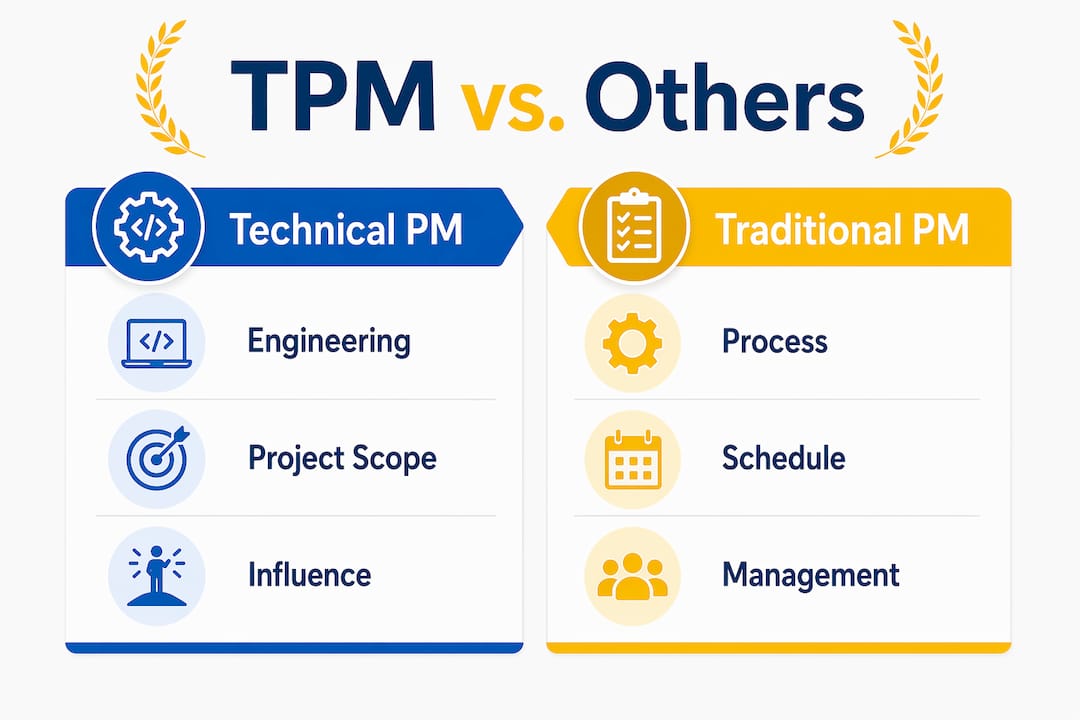
How do technical project managers differ from traditional PMs and engineering managers?

This is the question most aspiring TPMs get wrong, and the confusion costs them in interviews and on the job. The three roles overlap in surface area but diverge sharply in focus and required depth.
| Role | Primary Focus | Technical Depth Required | Authority Model |
|---|---|---|---|
| Traditional project manager | Schedule, budget, and stakeholder reporting | Low to moderate | Often formal, with direct oversight |
| Technical project manager | Cross-team technical coordination and risk | High, hands-on engineering background | Influence without direct authority |
| Engineering manager | Team leadership, hiring, and performance | Very high, active coding background common | Direct authority over engineers |
The biggest misconception about the technical program manager role is that it is administrative. TPMs are strategic leaders who optimize engineering velocity and execution, not schedulers who send status emails. An engineering manager owns the people. A traditional project manager owns the timeline. A TPM owns the program, meaning the full web of dependencies, risks, decisions, and cross-team commitments that determine whether a technical initiative actually ships.
The IT project coordinator role is sometimes confused with TPM work, but coordinators typically operate within a single team or system. TPMs operate across organizational boundaries, which is where the real complexity lives.
What are the core responsibilities of a technical project manager in 2026?
TPMs oversee initiatives involving 5 to 50 or more engineers across 3 to 12 teams, with technical investments ranging from $2 million to over $50 million. That scope demands a structured approach to daily and strategic work.
Here is what the actual job looks like week to week:
- Program planning and dependency mapping. You build and maintain the dependency map that shows how Team A’s API work blocks Team B’s integration, which blocks Team C’s release. This artifact is your most important tool against surprise delays.
- Risk register management. Maintaining living artifacts such as dependency maps and risk registers is more effective than static project plans in managing complex technical programs. You update these continuously, not quarterly.
- Cross-functional communication. You run the weekly program sync that brings engineering, product, and business stakeholders into alignment. You write the decision log that captures what was agreed and why, so no one relitigates closed debates.
- Technical decision facilitation. When two engineering teams disagree on an architecture approach that affects the program timeline, you facilitate the discussion, surface the trade-offs, and drive toward a decision. You do not make the engineering call, but you make sure one gets made.
- Metrics tracking. You monitor velocity, defect rates, and milestone completion to give leadership an accurate picture of program health. When metrics diverge from the plan, you are the first person who should know and the first to communicate it.
- Stakeholder reporting. Translating technical constraints into business risks and priorities for senior leadership is a core TPM responsibility. A Kubernetes cluster migration that is three weeks behind schedule means something different to a CTO than to a CFO. You write for both audiences.
Cloud platform migrations, microservices refactoring programs, and platform API consolidation projects are the kinds of initiatives TPMs typically lead. These are not small efforts, and the financial and reputational stakes are real.
Which methodologies and tools do technical project managers rely on?
Agile project management is the dominant framework, but experienced TPMs adapt it rather than apply it rigidly. A 12-team program running Scrum at the team level still needs a program-level coordination layer that Scrum alone does not provide. Most TPMs build a hybrid model: Scrum or Kanban at the team level, with a program increment or quarterly planning cadence at the top.
The tools that make this work in practice include:
- Jira for issue tracking, sprint management, and cross-team dependency visualization through features like Advanced Roadmaps.
- Asana for task assignment, milestone tracking, and stakeholder-facing project views that do not require Jira access to read.
- Confluence or Notion for living documentation, decision logs, and architecture notes that need to be accessible across the organization.
- Collaboration platforms like those covered in Optiostation’s collaboration tools guide for building consensus across distributed engineering and product teams.
AI tools are increasingly used by TPMs to automate status reporting and synthesize program data, augmenting capacity but not replacing judgment. Tools that generate draft status reports from Jira data or summarize meeting transcripts save hours per week. That time goes back into the higher-value work of risk identification and stakeholder alignment.
Pro Tip: Build your status report template once, then automate the data pull. The narrative interpretation, what the numbers mean and what you are doing about it, is where your judgment adds value. That part cannot be automated.
How can you build a career as a technical project manager?
Senior TPM roles typically require six or more years of experience in software engineering or related technical fields. That baseline is not arbitrary. Engineers who have shipped production systems understand why a dependency matters, why a risk is real, and why an estimate is optimistic. That lived experience is what separates credible TPMs from coordinators with a PMP certification.
A practical career path looks like this:
- Start as a software engineer or IT project coordinator. Build technical depth first. Two to four years of hands-on engineering work gives you the vocabulary and instincts the role demands.
- Move into a technical lead or scrum master role. This is where you start coordinating work across people rather than just doing it yourself. You learn to run meetings, manage blockers, and communicate status.
- Take on a junior TPM or program coordinator role. Own a workstream within a larger program. Build your dependency map, run your risk register, and practice stakeholder communication at a lower-stakes level.
- Develop your influence skills deliberately. TPMs build influence rather than depend on authority in multi-team environments without direct management control. Read about negotiation, practice facilitation, and seek feedback on how you run meetings.
- Pursue relevant certifications selectively. PMP from PMI and SAFe Agilist certification are recognized credentials. They signal commitment, but they do not substitute for technical credibility with engineering teams.
- Avoid the common early mistake of becoming a meeting scheduler. If your calendar is full but your risk register is empty, you are doing coordination, not program management.
Explore the engineering project manager frameworks that experienced practitioners use to structure their approach before stepping into your first TPM role.
Key takeaways
A technical project manager succeeds by combining engineering credibility with influence-based leadership, living documentation, and Agile coordination across multi-team programs.
| Point | Details |
|---|---|
| Technical fluency is non-negotiable | Proficiency in distributed systems, AWS, and API integration is required to earn engineer trust. |
| Influence replaces authority | TPMs coordinate across teams without direct management control, making consensus skills critical. |
| Living documentation drives execution | Dependency maps and risk registers updated continuously outperform static project plans. |
| Agile adapted for scale | Scrum and Kanban at the team level need a program-layer coordination model above them. |
| Career starts in engineering | Six or more years of technical experience is the standard baseline for senior TPM roles. |
What actually separates great TPMs from competent ones
Most articles on technical project leadership focus on tools and certifications. After working closely with teams building products for ambitious young professionals, Optiostation has observed something more specific: the TPMs who consistently deliver are the ones who treat documentation as a communication tool, not a compliance exercise.
A dependency map that no one reads is theater. A risk register updated once a quarter is a historical document. The TPMs who shape engineering culture and accelerate velocity are the ones who make their program artifacts the single source of truth that engineers, product managers, and executives all reference. That requires writing clearly, updating relentlessly, and designing documents for the audience who needs them most.
The other separator is comfort with ambiguity at the top of the organization. Junior TPMs want clear requirements before they start planning. Senior TPMs build the plan that forces clarity to emerge. They ask the questions no one else is asking, surface the risks no one wants to name, and hold the program together while the organization figures out what it actually wants to build.
In 2026, TPMs have evolved into strategic technical leaders optimizing engineering velocity and roadmaps. That shift means the bar for entry is higher, but so is the impact. If you are willing to invest in both technical depth and communication craft, this is one of the highest-leverage roles in a technology organization.
— Optiostation
How Optiostation helps technical project managers stay organized
Managing dependencies, tracking tasks across teams, and keeping stakeholders aligned requires more than a spreadsheet. Optiostation is built for exactly this kind of coordination, giving you a structured way to manage your program workstreams, assign ownership, and track progress without losing the big picture.
Whether you are coordinating a two-team sprint or managing a program across six engineering groups, Optiostation’s task and time management features keep your work visible and your priorities clear. Check out the best task management software guide to find the right tools for your technical program management workflow. You can also explore collaboration best practices that experienced TPMs use to keep distributed teams aligned and productive.
FAQ
What is a technical project manager?
A technical project manager is a specialized project management professional with a strong engineering background who leads complex technical programs by coordinating multiple teams, managing dependencies and risks, and aligning technical execution with business goals.
How is a TPM different from a regular project manager?
A TPM requires deep technical knowledge in areas like cloud architecture and distributed systems, while a traditional project manager focuses primarily on schedule, budget, and stakeholder reporting without the same engineering depth.
What tools do technical project managers use most?
Jira and Asana are the most widely used tools for issue tracking and task coordination, alongside dependency mapping software, Confluence for documentation, and increasingly AI tools that automate status reporting and data synthesis.
How long does it take to become a technical project manager?
Senior TPM positions typically require six or more years of experience in software engineering or a related technical field, though junior TPM roles are accessible after two to four years of hands-on technical work.
Do technical project managers need to write code?
Active coding is not required, but TPMs must understand how systems are built well enough to assess technical risk, evaluate engineering estimates, and facilitate architecture discussions with credibility.
Recommended
- Design project manager: master the skills and tools – Optio Station: Best Project Management App for Prioritization
- Client Project Manager: Skills, Roles, and Best Practices – Optio Station: Best Project Management App for Prioritization
- Head of Project Management: Skills to Succeed in 2026 – Optio Station: Best Project Management App for Prioritization
- Engineering project manager guide: frameworks and strategies – Optio Station: Best Project Management App for Prioritization
