

TL;DR:
- Effective accountability is built through clear roles, goals, and regular check-ins.
- Peer and collective responsibility improve engagement and team performance.
- Trust-based approaches outperform punitive methods in fostering ownership.
Assigning roles in a group project feels like accountability. It isn’t. Real accountability is what happens after the roles are handed out, when someone misses a deadline, goes quiet in the group chat, or submits work that drags everyone down. Clarity of expectations dropped 10 points, costing an estimated $438B in global productivity losses. That number sounds like a corporate problem, but the same dysfunction plays out in every group project, startup team, and early-career collaboration you’ll ever join. This article breaks down why accountability fails, what the research actually says, and exactly how you can build a team that owns its results.
Table of Contents
- Why accountability matters for student and early career teams
- Core mechanics: Building a high-accountability team
- Accountability models: From fractured teams to All-In collaboration
- Practical team accountability strategies: Student and young professional edition
- Trust vs. punishment: What most guides miss about team accountability
- Tools and resources to make team accountability easier
- Frequently asked questions
Key Takeaways
| Point | Details |
|---|---|
| Clarity is essential | Clear expectations, documented roles, and regular check-ins drive reliable team accountability. |
| Collective ownership wins | Peer-driven and collective accountability outperforms leader-only approaches and prevents free-riding. |
| Use tools and frameworks | SMART goals, task templates, and digital check-ins simplify tracking progress and resolving conflicts. |
| Trust fosters results | Trust-based accountability creates motivation and innovation, while punitive systems often erode teamwork. |
Why accountability matters for student and early career teams
Here’s a stat worth sitting with: 75% of cross-functional teams are dysfunctional. That’s not a fringe finding. That’s the majority of teams, including the ones you’re probably on right now. Dysfunctional teams don’t just feel bad to work in. They actively reduce productivity and innovation by up to 25%.
The core problem isn’t laziness or bad intentions. It’s ambiguity. When people don’t know exactly what they’re responsible for, or how their work connects to the group’s success, they disengage. And disengagement is contagious.
“Less than 50% of leaders excel at holding others accountable, and the resulting productivity losses cost organizations $438B globally.” Gallup
For college students and young professionals, this hits differently. You’re often working with people you didn’t choose, on timelines you didn’t set, without any formal authority to enforce expectations. That’s exactly why peer and collective accountability matter more than leader-only models. When everyone owns the outcome, no single person carries the weight of policing the group.
Research consistently shows that teams who document roles, responsibilities, and progress outperform those with vague or leader-dependent structures. Here’s what that looks like in practice:
- Documented roles reduce confusion about who owns what
- Shared progress tracking surfaces blockers before they become crises
- Peer accountability distributes responsibility across the whole team
- Regular check-ins create natural moments to course-correct
Using a project checklist for students at the start of every project forces your team to make these decisions explicitly instead of assuming everyone’s on the same page. That one habit alone separates high-performing student teams from the ones that scramble at the last minute.
Now that we’ve seen the real-world impact of poor accountability, let’s break down the mechanics that drive effective team performance.
Core mechanics: Building a high-accountability team
Accountability doesn’t happen by accident. It’s built through specific, repeatable practices that your team agrees to upfront. McKinsey’s research on top team performance identifies clear expectations, defined roles, regular check-ins, and mutual accountability as the core mechanics that separate high-performing teams from struggling ones.
Start with SMART goals for teams. SMART stands for Specific, Measurable, Achievable, Relevant, and Time-bound. Instead of “finish the research section,” a SMART goal looks like: “Compile five peer-reviewed sources on climate policy by Thursday at noon.” That version leaves no room for interpretation.

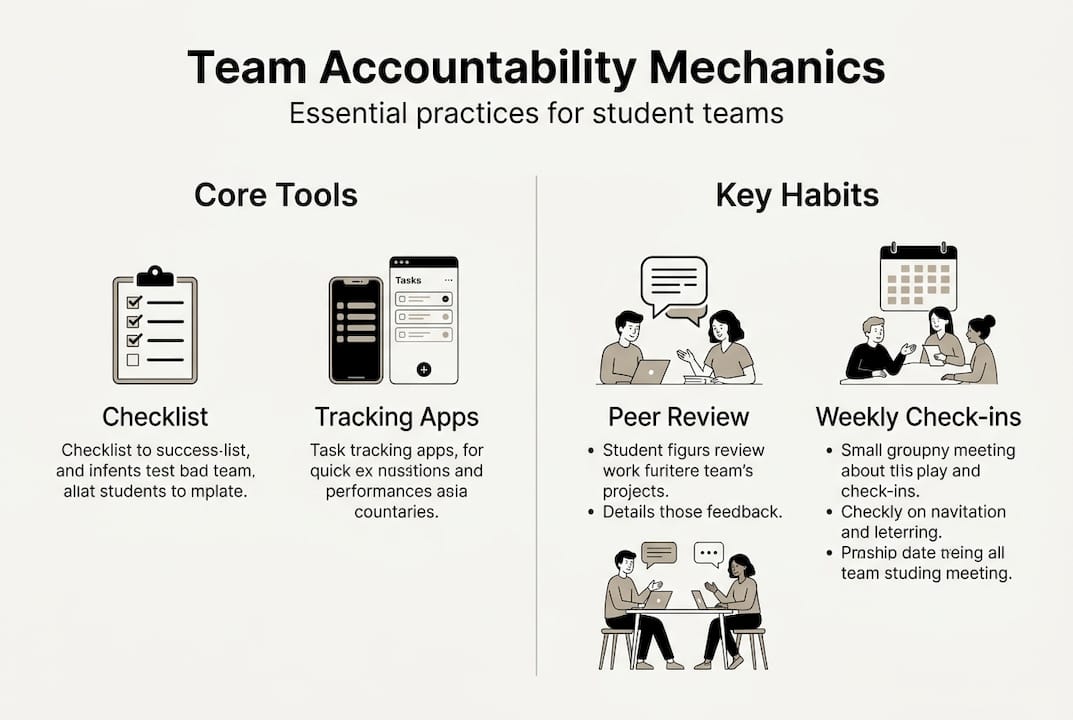
Peer review checklists are equally powerful. They prevent ambiguity about quality standards and reduce free-riding by making contributions visible to everyone on the team.
Here’s a breakdown of the core mechanics and what each one does:
| Mechanic | Purpose | Frequency |
|---|---|---|
| SMART goals | Clarify expectations and output | Project kickoff |
| Role assignments | Tie people to specific deliverables | Project kickoff |
| Micro-deadlines | Break work into trackable steps | Weekly |
| Peer review | Maintain quality and visibility | Per deliverable |
| Check-ins | Surface blockers early | 2x per week |
| Team contract | Resolve disputes and set norms | Project kickoff |
Using project tracking tools to log these mechanics in one place keeps the whole team aligned without requiring constant back-and-forth messages.
Pro Tip: Write your team contract in the first meeting, not after the first conflict. Include how decisions get made, how missed deadlines are handled, and how you’ll communicate. It feels formal, but it prevents the awkward conversations that kill team morale later.
With the foundation in place, it’s time to examine models that explain how teams transition from low to high accountability.
Accountability models: From fractured teams to All-In collaboration
Not all accountability structures are equal. The All-In Accountability Blueprint maps out a spectrum from complete dysfunction to collective excellence, and understanding where your team sits on that spectrum is the first step to moving up.
At the bottom is No Accountability: fractured teams where productivity drops up to 25% and no one feels ownership over outcomes. Above that is Leader-Only Accountability, where one person carries all the responsibility. These teams have 30% lower engagement because everyone else is just following orders. At the top is All-In Collective Accountability, where every team member owns both their role and the team’s overall success.
“Collective accountability amplifies results when team cohesion is high. Peer motivation becomes the engine, not the exception.” IZA Discussion Paper
Here’s how the models compare:
| Model | Engagement | Innovation | Free-riding risk |
|---|---|---|---|
| No accountability | Very low | Very low | Very high |
| Leader-only | Low | Moderate | Moderate |
| Peer/collective | High | High | Low |
| All-In (CHAT) | Very high | Very high | Very low |
Team incentives are stronger when cohesion is high. That means building relationships within your team isn’t just a nice thing to do. It’s a performance strategy.
Here’s the stepwise path to All-In collaboration:
- Start with self-accountability: Each person tracks and reports their own progress
- Add leader or peer check-ins: Create structured moments for shared visibility
- Introduce collective ownership: Frame wins and setbacks as team outcomes, not individual ones
- Build toward All-In: Co-create goals, celebrate shared milestones, and resolve issues as a unit
Use team reporting tools and timeline templates to make each step visible and trackable for your whole team.
Understanding these models lets us apply the lessons to practical project scenarios, especially for students and young professionals.
Practical team accountability strategies: Student and young professional edition
Knowing the theory is one thing. Here’s what accountability actually looks like in a group project or early-career team setting.
First, break your project into clear roles tied to deliverables. Common roles include:
- Coordinator: Manages deadlines, check-ins, and communication
- Researcher: Gathers sources and background information
- Editor: Reviews all written content for clarity and consistency
- Reviewer: Checks final output against the original brief
Assign roles tied to deliverables at kickoff, not mid-project. Use a signup schedule so people choose their roles rather than being assigned them. Voluntary ownership increases follow-through.
For conflict, use a four-step process from collaborative project guides:
- Clarify the facts: What actually happened, without interpretation
- Identify the causes: Why did it happen, without blame
- Co-create a path forward: What will change, agreed by everyone
- Set follow-ups: When you’ll check that the change is working
Document everything. Use team task templates to log who did what and when. This protects everyone when a free-rider tries to claim equal credit, and it gives you a record to reference if a conflict escalates.
Digital tools like Trello and Google Docs improve visibility and make check-ins faster. But tools only work if the team commits to using them consistently. Set a norm in your first meeting: all updates go in the shared space, not just in private messages.
Pro Tip: Treat every group project like a professional simulation. Practice the habits that SMART goals tips and project checklist tips recommend. The students who build these habits now are the ones who lead high-performing teams later.
Once strategies are in place, there’s still nuance in how teams build trust and handle accountability. Let’s explore that perspective.
Trust vs. punishment: What most guides miss about team accountability
Most accountability guides focus on enforcement: deadlines, penalties, grade docks. But trust-based accountability consistently outperforms punitive approaches, especially in educational and early-career settings. When people fear consequences, they protect themselves. When they trust the team, they take ownership.
Punitive systems create a specific kind of dysfunction: people do the minimum to avoid punishment, not the maximum to achieve results. They stop sharing problems early because admitting a blocker feels like admitting failure. That’s the opposite of what high-accountability teams need.
Peer check-ins and co-created commitments work because they replace fear with investment. When you helped write the team contract, you’re more likely to honor it. When your peer asks how your section is going, it feels like support, not surveillance.
We’ve seen this pattern across student teams and young professional groups: the ones that review weekly progress together, celebrate small wins, and frame accountability as shared growth consistently outperform the ones running on fear of failure.
Frame accountability as a career skill, not a compliance requirement. Every time you follow through, communicate early, and own your results, you’re building the professional reputation that will open doors long after the project is done.
Tools and resources to make team accountability easier
You’ve got the frameworks. Now you need the right tools to put them into practice without spending hours organizing spreadsheets and chasing updates.
Optio Station is built for exactly this. As your second-in-command, Optio gives Centurions like you the structure to manage roles, deadlines, check-ins, and team progress in one place. Whether you’re starting a new group project or trying to fix a team that’s already off track, the task management software guide and team collaboration guide walk you through proven workflows step by step. If you’re ready to manage tasks effectively and build the kind of team accountability that actually sticks, Optio Station has the tools and templates to make it happen.
Frequently asked questions
How can I prevent free-riding in student group projects?
Document contributions using shared tools, assign clear deliverables to each person, and use peer review checklists so every team member’s work is visible to the group.
What accountability frameworks work best in college teams?
SMART goals and defined roles combined with regular check-ins and a team contract at kickoff are proven to increase clarity and keep everyone aligned throughout the project.
How do conflicts get resolved effectively in group work?
Follow a four-step process: clarify the facts, identify root causes, co-create a path forward with the whole team, and schedule a follow-up to confirm the resolution is holding.
What is the impact of leader-dependent accountability on team performance?
Leader-dependent teams show up to 30% lower engagement and significantly reduced innovation because most members feel little ownership over outcomes.
Which tools help students and young professionals keep their teams accountable?
Task management apps, shared documents like Google Docs, and digital check-in tools like Trello help teams document progress, track roles, and stay aligned without constant back-and-forth communication.
Recommended
- Command Log – Optio Station: Best Project Management App for Prioritization
- Teamwork Advantages: Boosting Collaboration and Success – Optio Station: Best Project Management App for Prioritization
- Workflow for Team Motivation: Boost Productivity and Engagement – Optio Station: Best Project Management App for Prioritization
- Team Collaboration Explained: Boosting Group Results – Optio Station: Best Project Management App for Prioritization
