

Taking full responsibility for tasks can feel overwhelming when roles are unclear and expectations shift within busy teams. Many students and early-career professionals in tech and business environments encounter confusion about where accountability really begins. Misconceptions about task ownership often arise from unclear role definitions and administrative inequalities, making it tougher to collaborate and lead projects confidently. This guide reveals practical strategies for defining task ownership, clearing up common misunderstandings, and helping you build a proactive, collaborative approach for personal and team success.
Table of Contents
- Defining Task Ownership And Common Misconceptions
- Types Of Task Ownership In Teams And Projects
- Key Features Of Effective Task Ownership
- Responsibilities And Rights Of Task Owners
- Risks, Common Pitfalls, And How To Avoid Them
- Strategies For Fostering Task Ownership In Teams
Key Takeaways
| Point | Details |
|---|---|
| Task Ownership is Comprehensive | It involves full responsibility from initiation to completion, emphasizing accountability, collaboration, and strategic alignment with organizational goals. |
| Common Misconceptions | Misunderstandings about task ownership, such as equating it to working in isolation, can hinder effective collaboration and transparency. |
| Types of Ownership Matter | Understanding different ownership models—Supportive, Business Case, Single, and Parallel—enables tailored approaches to team dynamics and project needs. |
| Continuous Improvement is Key | Regular feedback and self-reflection are essential for cultivating a culture of ownership, accountability, and team success. |
Defining Task Ownership and Common Misconceptions
Task ownership represents a critical accountability framework where team members take full responsibility for specific tasks from initiation to completion. Far more than simply completing assigned work, true task ownership involves understanding the purpose, anticipating potential challenges, and driving outcomes with personal commitment.
In organizational settings, task ownership emerges as a complex dynamic influenced by role clarity, individual motivation, and team structure. Research on ownership distribution reveals that misconceptions frequently arise from unclear role definitions and administrative inequalities, highlighting the need for transparent expectations.
Common misconceptions about task ownership include:
- Believing task ownership means working in isolation
- Assuming ownership is the same as completing assigned work
- Thinking ownership can be mandated without proper support systems
- Expecting perfect execution without collaborative feedback
Successful task ownership requires a nuanced understanding that balances individual accountability with team collaboration. Effective task management strategies help teams develop a culture where each member feels genuinely responsible for their contributions.
Pro tip: Create a personal accountability system that tracks your tasks, documents progress, and reflects on lessons learned after project completion.
Types of Task Ownership in Teams and Projects
Task ownership is not a one-size-fits-all concept, but a dynamic framework with multiple approaches tailored to different organizational needs and project structures. Project ownership patterns reveal two primary strategic approaches that fundamentally shape how teams collaborate and deliver results.
The main types of task ownership include:
- Supportive Ownership: Where team members focus on facilitating project delivery and management processes
- Business Case Ownership: Emphasizing strategic outcomes and benefit realization beyond immediate task completion
- Single Ownership: One individual exclusively claims and drives a specific task
- Parallel Ownership: Multiple team members can simultaneously engage with and progress a task
Understanding these task management ownership patterns allows organizations to design more flexible and responsive workflow strategies. These approaches differ significantly in their implementation, requiring leaders to carefully match ownership models with project complexity, team dynamics, and organizational goals.
Different ownership models require different leadership approaches and communication strategies to succeed.
Successful task ownership transcends traditional hierarchical structures, creating collaborative environments where accountability is shared and individual contributions are valued. Teams that master these nuanced ownership approaches can dramatically improve project efficiency and team engagement.
Pro tip: Regularly rotate task ownership responsibilities to build team versatility and prevent knowledge silos.
Here’s a comparison of key task ownership models and their organizational impact:
| Ownership Model | Typical Use Case | Team Collaboration Level | Organizational Impact |
|---|---|---|---|
| Supportive Ownership | Project delivery facilitation | High | Streamlined processes |
| Business Case Ownership | Strategic benefit realization | Variable | Enhanced strategic outcomes |
| Single Ownership | Individual task accountability | Low | Faster execution, less sharing |
| Parallel Ownership | Simultaneous multi-member action | Very High | Rapid progress, potential overlap |
Key Features of Effective Task Ownership
Task ownership is a multifaceted approach that goes beyond simple task completion. Personal effectiveness in ownership represents a holistic strategy of aligning personal capabilities with organizational objectives, creating a powerful framework for team success.
The key features of effective task ownership include:
- Proactive Engagement: Anticipating challenges before they emerge
- Personal Accountability: Taking full responsibility for task outcomes
- Collaborative Influence: Inspiring and supporting team members
- Strategic Alignment: Connecting individual tasks to broader organizational goals
- Continuous Learning: Adapting and improving performance based on feedback
Successful task ownership requires a comprehensive approach that balances individual initiative with team collaboration. Manage multiple tasks effectively by developing a mindset that transforms task management from a mechanical process to a strategic opportunity for growth and impact.
Effective task ownership is not about perfection, but about consistent progress and meaningful contribution.
Ultimately, task ownership is a dynamic skill that evolves with experience, requiring continuous self-reflection, adaptability, and a commitment to personal and collective excellence. Teams that cultivate a culture of genuine ownership create environments where innovation, accountability, and performance naturally flourish.
Pro tip: Create a personal accountability journal to track task progress, reflect on challenges, and document lessons learned from each project.
Responsibilities and Rights of Task Owners
Task ownership fundamentally transforms individual contributors from passive executors to strategic decision-makers within organizational frameworks. Research on rights and responsibilities demonstrates that effective task ownership requires a delicate balance between accountability and autonomy.
The core responsibilities of task owners include:
- Ethical Conduct: Maintaining high standards of professional integrity
- Clear Communication: Transparently sharing progress, challenges, and insights
- Resource Management: Efficiently allocating time, skills, and organizational resources
- Performance Monitoring: Tracking task progression and measuring outcomes
- Continuous Improvement: Identifying opportunities for personal and team growth
Task owners possess specific rights that empower their decision-making capabilities. Task management software supports these rights by providing tools that enable comprehensive project oversight and strategic planning.
Task ownership rights are not about control, but about creating meaningful impact and driving organizational success.
The most effective task owners understand that their rights come with corresponding responsibilities. They must balance personal initiative with team collaboration, creating environments where individual contributions seamlessly integrate into broader organizational objectives.

Pro tip: Develop a personal accountability framework that documents your decision-making process, tracks performance metrics, and reflects on lessons learned.
Risks, Common Pitfalls, and How to Avoid Them
Task ownership, while powerful, comes with inherent challenges that can derail team productivity and individual performance. Common task management mistakes reveal systemic patterns that undermine effective ownership and project success.
The most critical risks and pitfalls in task ownership include:
- Undefined Responsibilities: Creating ambiguity about task boundaries
- Overcommitment: Taking on more tasks than can be realistically managed
- Poor Prioritization: Failing to distinguish between urgent and important tasks
- Excessive Multitasking: Reducing overall productivity through constant task switching
- Lack of Progress Tracking: Neglecting systematic performance reviews
Successful task owners must develop strategic approaches to mitigate these risks. Project task list templates provide structured frameworks that help teams clarify responsibilities and maintain accountability.
Risk management in task ownership is not about eliminating challenges, but creating resilient systems that adapt and overcome.
Mitigating task ownership risks requires a proactive, self-aware approach. By recognizing potential pitfalls early and implementing robust tracking and communication mechanisms, teams can transform potential obstacles into opportunities for growth and improvement.
Pro tip: Conduct weekly personal audits of your task ownership performance, identifying specific areas where you can enhance accountability and efficiency.
Strategies for Fostering Task Ownership in Teams
Task ownership represents more than individual responsibility—it’s a collaborative approach that transforms team dynamics. Fostering ownership in teams requires intentional strategies that empower individuals while maintaining collective accountability.
Effective strategies for cultivating task ownership include:
- Clear Role Definition: Explicitly outlining individual responsibilities
- Autonomy with Accountability: Providing freedom to make decisions within established frameworks
- Transparent Goal Alignment: Connecting individual tasks to broader organizational objectives
- Regular Feedback Mechanisms: Creating consistent opportunities for performance discussion
- Recognition and Empowerment: Celebrating individual contributions and team achievements
Leadership plays a crucial role in this process. Team collaboration workflows help teams establish structured yet flexible environments that encourage genuine ownership.
True task ownership emerges when team members feel genuinely invested in collective success.
Successful implementation requires ongoing commitment from both leadership and team members. By creating environments that balance individual agency with shared responsibility, organizations can unlock unprecedented levels of innovation and productivity.
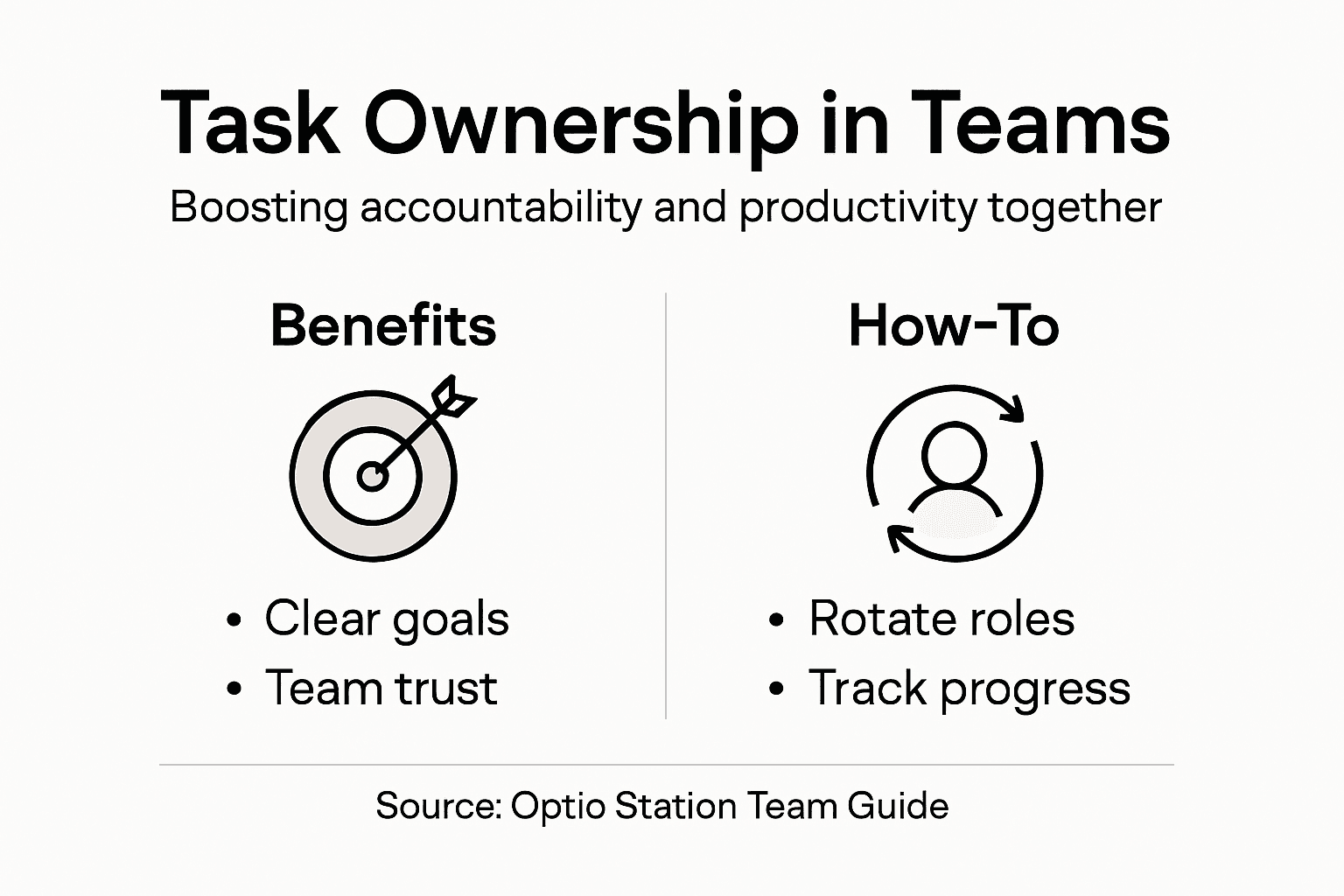
Pro tip: Implement monthly team retrospectives where members can openly discuss task ownership challenges and collaboratively develop improvement strategies.
The following table summarizes practical methods to foster genuine task ownership within teams:
| Approach | Implementation Tip | Expected Result |
|---|---|---|
| Role definition | Clarify roles in project kickoff | Reduces confusion and missteps |
| Feedback mechanisms | Schedule regular check-ins | Improves engagement and learning |
| Recognition and empowerment | Celebrate visible achievements | Boosts motivation and morale |
Elevate Your Task Ownership With Optio Station
The challenges of embracing true task ownership include balancing personal accountability with effective collaboration while managing multiple priorities and avoiding common pitfalls like overcommitment and poor progress tracking. If you are looking to boost your team productivity and refine your accountability skills, understanding supportive and parallel ownership models is key. Optio Station empowers Centurions like you to take command of your tasks with clarity and confidence, turning complex responsibilities into streamlined success.
Experience how our Roman-themed mobile app serves as your trusted Optio, or second-in-command, guiding you through task, team, and time management with intuitive features tailored for students and young professionals. Visit Optio Station now to start mastering your task ownership journey. Learn more about effective prioritization and strategies to enhance your personal and team effectiveness by exploring our Uncategorized – Optio Station: Best Project Management App for Prioritization page and stay informed with fresh insights. Take control today and transform responsibility into achievement.
Frequently Asked Questions
What is task ownership?
Task ownership is a critical accountability framework where team members take full responsibility for specific tasks from initiation to completion while understanding the purpose and driving outcomes with commitment.
How can task ownership improve team productivity?
Task ownership fosters a culture of accountability and collaboration, allowing team members to feel more invested in their work. This leads to enhanced engagement and efficient teamwork, ultimately improving productivity.
What are common misconceptions about task ownership?
Common misconceptions include believing that task ownership isolates team members, equating ownership with merely completing assigned tasks, and thinking that ownership can occur without sufficient support or feedback mechanisms.
What strategies can be used to foster task ownership in teams?
Effective strategies include clear role definition, providing autonomy with accountability, transparent goal alignment, regular feedback mechanisms, and recognizing individual contributions to boost motivation and engagement.
Recommended
- How to Manage Team Tasks Effectively for Success – Optio Station: Best Project Management App for Prioritization
- How to Improve Teamwork for Success in College and Work – Optio Station: Best Project Management App for Prioritization
- Understanding Why Use Task Lists for Better Productivity – Optio Station: Best Project Management App for Prioritization
- Understanding Why Manage Tasks for Better Productivity – Optio Station: Best Project Management App for Prioritization
