

Juggling a full course load, a part-time job, and any kind of social life can feel like running three separate races at the same time. You finish one assignment and two more appear. You skip the gym to study, then feel guilty about skipping. Sound familiar? The good news is that work-life balance is not a personality trait you either have or don’t. It’s a skill, and like any skill, it can be built with the right process. This guide walks you through exactly how to do that, step by step, so you can stop feeling stretched thin and start feeling in control.
Table of Contents
- Why work-life balance matters for students and young professionals
- Tools and habits for effective work-life management
- Step-by-step process to achieve work-life balance
- How to troubleshoot common work-life balance challenges
- Measuring your progress and enjoying the benefits
- Tools to help you stay on track
- Frequently asked questions
Key Takeaways
| Point | Details |
|---|---|
| Start with assessment | Track your time for a week to uncover improvement opportunities. |
| Use digital tools | Project and task management apps help maintain organization and balance. |
| Follow step-by-step plan | Work through each balance-building step sequentially for best results. |
| Review and adjust | Regular check-ins keep your approach effective as your life evolves. |
Why work-life balance matters for students and young professionals
Let’s be honest: most students and young professionals treat burnout like a badge of honor. Staying up until 2 a.m. feels productive. Saying yes to every opportunity feels ambitious. But work-life imbalance increases stress and chips away at your productivity over time, which means all that hustle starts working against you.
The benefits of getting this right go beyond just feeling less tired. Strong balance leads to better focus, more consistent academic or professional performance, and a genuine sense of satisfaction in your daily life. You can explore the full picture in this complete guide on work-life balance or dig into how young professionals time management habits shape long-term career outcomes.
Before you can fix the problem, you need to recognize it. Watch for these warning signs:
- You feel exhausted even after a full night of sleep
- You can’t remember the last time you did something purely for fun
- Deadlines feel like they’re always sneaking up on you
- You feel resentful toward your responsibilities
- Your social relationships are suffering because you’re always “too busy”
If two or more of those hit close to home, you’re in the right place.
Tools and habits for effective work-life management
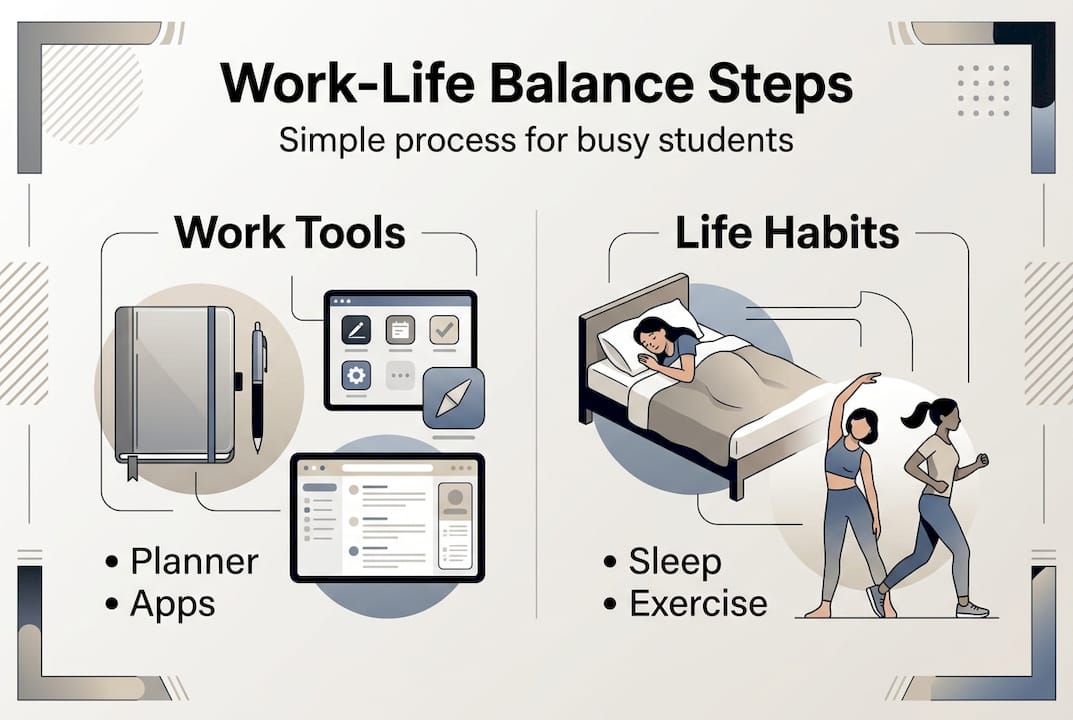
Having the right tools doesn’t fix everything, but it removes a lot of unnecessary friction. Task tracking tools are proven to increase productivity, and the best part is that most of them are free or low-cost for students.
Here’s a quick-reference table to match tools with their best use cases:
| Tool type | Best use case | Example |
|---|---|---|
| Digital calendar | Scheduling classes, shifts, and personal time | Google Calendar |
| Task management app | Tracking assignments and deadlines | Optio, Todoist |
| Project manager | Group projects and team collaboration | Trello, Notion |
| Focus timer | Deep work sessions without distraction | Forest, Be Focused |
Beyond the apps, your habits matter just as much. A few that consistently make a difference:
- Daily planning: Spend five minutes each morning deciding your top three priorities
- Weekly review: Every Sunday, look at what’s coming and adjust your schedule
- Distraction minimizing: Turn off non-essential notifications during study or work blocks
- Time awareness: Use examples of time management goals to set clear targets for each week
Understanding the role of time management in your overall performance helps you treat these habits as investments, not chores. If you’re new to digital tools, a solid overview of time management software can help you figure out where to start.
Pro Tip: Don’t try to adopt five new habits at once. Pick one tool and one habit, use them for two weeks, then add the next. Small, consistent changes stick far better than a complete overhaul.
Step-by-step process to achieve work-life balance
With tools and habits in place, here’s a step-by-step process to put them into action. Following a structured approach helps you maintain motivation and clarity even when life gets unpredictable.
- Assess your time commitments. Track everything you do for one full week. Classes, work shifts, meals, scrolling, socializing. All of it. You can’t manage what you haven’t measured.
- Identify your priorities. Sort your commitments into four buckets: study, work, health, and social. Decide which ones are non-negotiable and which ones have flexibility.
- Build a realistic weekly schedule. Use your calendar to block time for each priority. Be honest about how long things actually take, not how long you wish they took.
- Set clear boundaries. Decide on your work hours and protect them. Schedule a digital detox period each day. Let people know when you’re unavailable. Boundaries aren’t walls; they’re agreements you make with yourself.
- Review and adjust regularly. Life changes. Your schedule should too. A weekly check-in keeps your plan relevant and prevents small slips from becoming big problems.
Not sure which time management method fits your style? Here’s a quick comparison:
| Method | Best for | Core idea |
|---|---|---|
| Pomodoro Technique | Focus and avoiding burnout | 25-minute work blocks with short breaks |
| Eisenhower Matrix | Prioritizing tasks by urgency | Sort tasks into four quadrants |
| Timeboxing | Structured scheduling | Assign fixed time slots to specific tasks |
The role of timeboxing is especially useful for students who tend to let one task eat up an entire afternoon. Pair it with agile prioritization tips to keep your task list from spiraling out of control.

Pro Tip: Schedule your most demanding tasks during your personal peak energy window. If you’re sharpest at 9 a.m., don’t waste that time on emails.
How to troubleshoot common work-life balance challenges
Even with a plan, real life brings unexpected obstacles. Here’s how to tackle the most common ones.
Overcommitment is the number one balance killer for students and young professionals. The fix isn’t working harder; it’s learning to say no before your plate is already full. Before agreeing to anything new, ask yourself: does this fit my current priorities, or am I just afraid of missing out?
Unexpected demands will always show up. A professor moves a deadline. Your manager needs you to cover a shift. When this happens, don’t abandon your schedule entirely. Adjust one block, protect the rest, and use your weekly review to recalibrate.
“Consistent review and boundaries help students and new professionals maintain balance under pressure.”
Guilt about personal time is real, but it’s also counterproductive. Rest is not a reward you earn after finishing everything. It’s a requirement for doing everything well. Reframe downtime as maintenance, not laziness.
Digital distraction deserves its own strategy. Use app blockers during focus sessions, keep your phone in another room when studying, and log your screen time weekly. The command log technique is a practical way to track where your attention actually goes so you can redirect it intentionally.
A few quick troubleshooting tips to keep handy:
- When overwhelmed, reduce your task list to just three items for the day
- When behind schedule, identify what can be delegated or dropped entirely
- When burned out, take a real break instead of a guilt-filled half-break
- When distracted, change your environment before changing your willpower
Measuring your progress and enjoying the benefits
Once you’ve implemented these steps, it’s time to check your progress and enjoy the results. Tracking changes in stress and productivity helps reinforce the positive behaviors you’re building, which makes them easier to maintain long-term.
Here are the clearest indicators that your balance is improving:
- Energy levels: You wake up feeling ready for the day more often than not
- Productivity quality: You’re getting more done in less time because you’re focused
- Mood stability: Fewer emotional crashes and less Sunday-night dread
- Relationship health: You’re present with friends and family instead of mentally elsewhere
- Sleep consistency: You’re going to bed and waking up at roughly the same time
For self-assessment, ask yourself these questions at the end of each week:
- Did I complete my top priorities?
- Did I take at least one meaningful break each day?
- Did I feel in control of my time, or did my time control me?
Use measuring success with time management frameworks to turn these reflections into concrete data points you can track over time.
Finally, celebrate small wins. Finished a tough week without pulling an all-nighter? That’s a win. Kept your phone off during a two-hour study block? That’s a win too. Momentum builds on recognition, and recognizing progress keeps you motivated to keep going.
Tools to help you stay on track
You’ve got the strategy. Now you need the right support system to make it stick. Optio is built specifically for students and young professionals who want to manage their tasks, time, and teams without the overwhelm. Think of it as your second-in-command, the Optio to your Centurion.
Whether you’re looking for the best time management apps to organize your week, need a smarter way to keep track of tasks across school and work, or want a full breakdown of options in our task management software guide, Optio Station has the resources to back you up. Your balance isn’t going to build itself, but with the right tools in your corner, it’s a lot more achievable than it feels right now.
Frequently asked questions
What is the quickest way to start improving my work-life balance?
Track your daily activities for one week to pinpoint exactly where your time goes. That single action gives you the data you need to make real changes.
Which app is best for managing both studies and personal commitments?
Choose a task management tool that lets you create separate categories for school, work, and personal life so you can prioritize without mixing everything together.
How can I stick to boundaries when peers or coworkers don’t respect them?
Communicate your limits clearly and consistently, and use app settings or scheduled focus modes to enforce unavailable periods without relying solely on willpower.
Is it okay to say no to extra work or social invitations?
Absolutely. Saying no is one of the most effective tools for maintaining healthy boundaries and protecting the energy you need to perform at your best.
Recommended
- Work‑Life Balance: Complete Guide for Students & Young Pros – Optio Station: Best Project Management App for Prioritization
- Work-Life Balance Checklist: Achieve Optimal Balance Fast – Optio Station: Best Project Management App for Prioritization
- Master to-do list creation: 40% focus boost for students – Optio Station: Best Project Management App for Prioritization
- Effective Goal Setting for Students: Achieve Your Dreams – Optio Station: Best Project Management App for Prioritization
- Mindfulness for Professionals: Boosting Productivity and Wellbeing
