

TL;DR:
- A structured feedback request clearly defines the context, target, type, deadline, and next steps to obtain useful input. Preparing specific artifacts, setting realistic deadlines, and timing requests after milestones improve response quality. Following a 5-part framework and managing responses systematically enhances feedback effectiveness and reviewer engagement.
A structured feedback request is a written or verbal ask that specifies context, target areas, question type, deadline, and next steps to guide the reviewer toward useful input. Vague asks like “any thoughts?” produce low-value comments. A clear, step-by-step process for feedback requests changes that. The 5-part model, frameworks from sources like Cleverence and Loyalhato, and tools like Grammarly for tone review give you a repeatable system that works whether you’re submitting a college paper, pitching a project at work, or asking a mentor to review your resume.
What are the prerequisites for a successful feedback request?
Before you write a single word of your request, you need to do three things: define your learning goal, prepare the artifact, and choose the right channel. Skipping any one of these is the most common reason feedback comes back generic or unhelpful.
Define your learning goal first. Ask yourself what you specifically want to improve. “Make my report better” is not a goal. “Strengthen the argument in section two” is. Clear goals shape every question you write later.
Prepare the artifact. Your reviewer needs something concrete to respond to. That means attaching the draft, linking the slide deck, or sharing the specific section you want reviewed. Specific artifacts improve response relevance and make it safer for reviewers to be honest, because the feedback targets the work, not the person.
Choose the right channel. Email works for formal requests with attachments. Slack or Teams messages work for quick, informal input. In-person or video calls work when you need nuanced, back-and-forth discussion. Mismatching the channel to the request type frustrates reviewers before they even start.
- Set one clear learning goal per request
- Attach or link the specific work being reviewed
- Match the channel to the formality of the request
- Choose reviewers who have direct experience with the subject
- Time your request after a project milestone, not mid-crisis
Timing requests post-milestone improves the quality and balance of responses. Reviewers give more reflective, pattern-level insights when emotions from a recent deadline or presentation have settled. That is the difference between reactive comments and genuinely useful input.
Pro Tip: Align your feedback request with a natural project checkpoint, such as after a draft submission or a sprint review, to get responses that reflect the full picture rather than a single moment.
How do you write an effective feedback request step by step?

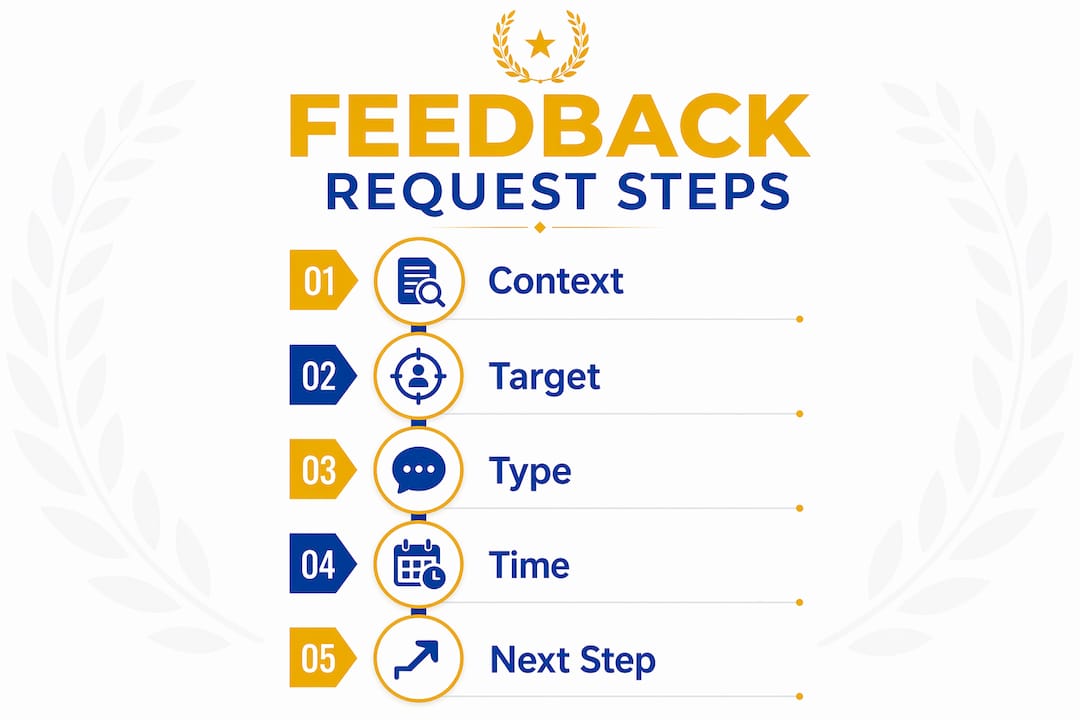
The most reliable guideline for feedback requests follows a 5-part structure: Context, Target, Type, Time, and Next Step. This 5-element framework frames each request to enhance input relevance and reduce the chance of a reviewer shrugging and moving on.
Here is the sequence:
- Write a clear subject line. “Feedback request: Section 2 argument, due Friday” beats “Quick question.” Specificity in the subject line sets expectations before the email is even opened.
- Add one sentence of context. Explain why you need feedback right now. “I’m revising this report before the final submission on Thursday” gives the reviewer a reason to prioritize your request.
- Specify the target. Name the exact section, slide, or paragraph you want reviewed. Do not ask for feedback on the whole document unless you genuinely need it.
- State the type of feedback you want. Do you want structural suggestions, tone edits, or a gut-check on your argument? Telling reviewers what type of input you need prevents them from commenting on things you did not ask about.
- Set a realistic deadline. Give reviewers enough time to respond thoughtfully. Two to three business days is standard for most academic and professional requests.
- Explain the next step. Tell reviewers what you will do with their input. “I’ll incorporate your notes into the final draft by Monday” closes the loop before it even opens.
A complete workflow includes defining learning goals, drafting structured requests with 3–6 questions, pre-reading for tone, sending to balanced reviewers, analyzing responses, and closing with summaries. That full cycle is what separates a one-time ask from a repeatable system.
| Step | Element | What to Include |
|---|---|---|
| 1 | Context | One sentence explaining why feedback is needed now |
| 2 | Target | Exact section, slide, or artifact area to review |
| 3 | Type | Structural, tonal, argumentative, or factual input |
| 4 | Time | Specific deadline, 2–3 business days minimum |
| 5 | Next Step | What you will do with the feedback after receiving it |
Limiting prompts to 3–6 with at least one scaled question makes synthesis easier across multiple reviewers. A scaled question like “On a scale of 1–5, how convincing is the opening argument?” gives you comparable data points. Open-ended questions like “What could be stronger here?” generate richer detail. Use both.
Pro Tip: Before sending, read your request out loud. If any sentence sounds defensive or apologetic, rewrite it. Tone shapes whether reviewers feel invited to be honest or pressured to be polite.
Open-ended questions that assume improvement elicit more detailed feedback than yes/no or negatively framed questions. “What could be better?” outperforms “Is this okay?” every time. Reframing your questions this way reduces shrug answers and opens a real dialog.
What are the best practices for managing feedback responses?
Receiving feedback is only half the process. How you handle, organize, and act on responses determines whether the effort was worth it.
Track responses systematically. Use a simple spreadsheet, a notes app, or a task management tool to log who responded, what they said, and which comments you plan to act on. Without a tracking system, you will lose insights in your inbox. Tools like Optiostation help you assign follow-up tasks directly to feedback items, so nothing falls through.
Sending one reminder 24 hours before the deadline and proceeding without late input keeps the process moving. Waiting indefinitely for stragglers stalls your work and signals to punctual reviewers that deadlines do not matter.
- Log each response with the reviewer’s name and date received
- Highlight patterns across multiple responses before acting on any single comment
- Flag comments that conflict with each other for a follow-up conversation
- Send a brief thank-you message once you have reviewed all input
- Share a one-paragraph summary of what you changed and why
Conflicting feedback is best handled by separating minor disagreements you can judge yourself from major ones that need a short alignment conversation. A 15-minute call to resolve a fundamental conflict beats an endless email thread. That distinction saves time and prevents you from making changes that satisfy no one.
Closing the loop matters more than most students and early-career professionals realize. Sending summaries and next steps after feedback builds trust and shows reviewers their input was taken seriously. Reviewers who feel heard respond faster and more thoroughly the next time you ask.
Pro Tip: Build a weekly review habit into your workflow. Reviewing feedback responses in a scheduled block, rather than reactively, helps you spot patterns instead of reacting to individual comments.
What common mistakes undermine your feedback requests?
Most weak feedback requests share the same flaws. Recognizing them before you send is the fastest way to improve response quality.
| Weak Request | Strong Request |
|---|---|
| “Any thoughts on my draft?” | “Does the argument in paragraph 3 support the thesis clearly?” |
| 10 open-ended questions | 3–5 focused questions with one scaled item |
| No deadline mentioned | “Please reply by Thursday at 5 p.m.” |
| Sent immediately after a stressful event | Sent after a milestone or cool-down period |
| No follow-up after receiving input | Summary email sent within 48 hours of synthesis |
Vague requests produce low-value comments. Specifying exact artifact areas and input type is the single biggest lever you have for improving response quality. This is not about being demanding. It is about making it easy for your reviewer to help you.
Other common mistakes include:
- Overloading reviewers with more than six questions
- Ignoring privacy considerations, such as whether responses are shared with others
- Failing to acknowledge feedback once received
- Asking for feedback on work that has not been proofread, which wastes the reviewer’s time
Ethics and privacy in feedback requests, including who reads the input and whether responses are anonymous, increase trust and the quality of what reviewers share. If you are collecting peer feedback in a class or team setting, be transparent about how the responses will be used.
The timing mistake is subtler. Waiting until emotions have cooled yields more balanced, pattern-level insights than asking for feedback immediately after a high-stress event. Give yourself and your reviewer a day or two after a big presentation or submission before sending the request.
Key takeaways
Effective feedback requests follow a structured 5-part process covering Context, Target, Type, Time, and Next Step, and the quality of your request directly determines the quality of input you receive.
| Point | Details |
|---|---|
| Structure every request | Use the 5-part model: Context, Target, Type, Time, and Next Step for every ask. |
| Limit your questions | Cap prompts at 3–6 and include at least one scaled question for easier synthesis. |
| Time requests strategically | Send after a project milestone or cool-down period to get reflective, balanced input. |
| Close the loop | Send a summary of changes made within 48 hours of synthesizing feedback. |
| Handle conflicts directly | Schedule a 15-minute alignment call for major disagreements instead of debating by email. |
What i have learned about feedback requests the hard way
Early in my work with students and young professionals, I noticed a pattern. The people who got the best feedback were not the ones with the most impressive work. They were the ones who made it easy to give feedback. Their requests were specific, their deadlines were reasonable, and they always followed up.
The discomfort of asking for feedback is real. There is a vulnerability in sending your work to someone and saying “tell me what’s wrong.” But that discomfort shrinks fast when you realize that a structured request removes most of the awkwardness. You are not asking someone to judge you. You are giving them a clear job to do.
The mistake I see most often is treating feedback as a one-time transaction. You send the request, you get the response, you move on. The professionals who grow fastest treat it as a relationship. They close the loop. They say thank you. They share what changed. That habit, more than any template or framework, is what turns a reviewer into a long-term mentor.
One more thing: do not wait for perfect work before asking. Asking better questions at the draft stage produces more useful input than asking for a final review of something you are already attached to. The earlier you ask, the more you can actually change.
— Optiostation
How Optiostation helps you manage feedback from start to finish
Structuring a feedback request is one skill. Tracking the responses, managing the deadlines, and following up without dropping the ball is another. That is where Optiostation steps in as your second-in-command.
Optiostation is built for students and young professionals who need to manage tasks, deadlines, and team coordination in one place. You can log feedback requests as tasks, set response deadlines, assign follow-up actions, and track the full cycle without switching between apps. Explore the best task management tools to find the right setup for your feedback workflow, or check out the top productivity apps Optiostation recommends for students and early-career professionals who want to stay organized and grow fast.
FAQ
What is the 5-part feedback request framework?
The 5-part framework includes Context, Target, Type, Time, and Next Step. Each element guides the reviewer toward specific, useful input rather than general impressions.
How many questions should a feedback request include?
Cap your prompts at 3–6 questions and include at least one scaled question. This limit makes responses faster to give and easier to synthesize across multiple reviewers.
When is the best time to send a feedback request?
Send requests after a project milestone or once emotions from a recent deadline have settled. Reviewers give more balanced, reflective input when they are not responding in the heat of the moment.
How do you handle conflicting feedback from different reviewers?
Separate minor disagreements you can resolve yourself from major conflicts that need discussion. Schedule a 15-minute alignment conversation for fundamental disagreements rather than debating over email.
What should you do after receiving feedback?
Send a brief summary within 48 hours explaining what you changed and why. This closes the loop, builds trust with your reviewers, and increases the quality of input you receive on future requests.
Recommended
- Task Delegation Steps for Effective Team Management – Optio Station: Best Project Management App for Prioritization
- The Delegation Process for Teams That Actually Works – Optio Station: Best Project Management App for Prioritization
- How to Improve Teamwork for Success in College and Work – Optio Station: Best Project Management App for Prioritization
- Streamline your progress report workflow: a guide – Optio Station: Best Project Management App for Prioritization
