

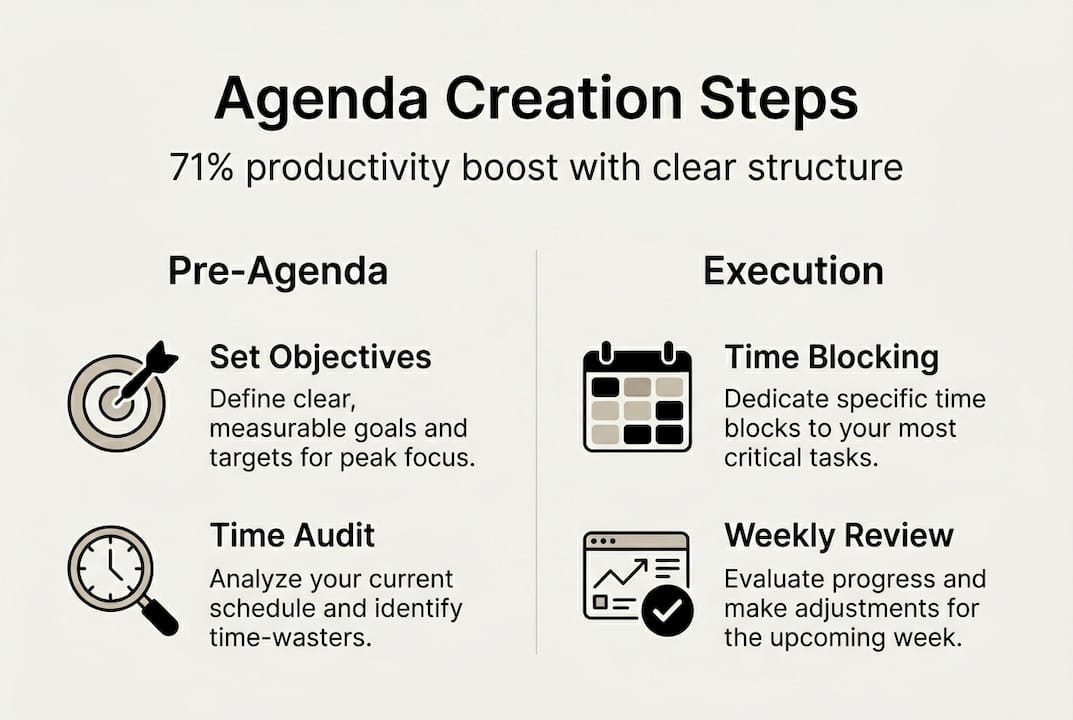
Many students and young professionals waste hours in unproductive meetings or poorly planned days, watching valuable time slip away. Creating structured agendas can transform this chaos into focused productivity, giving you control over your schedule and outcomes. Research shows that 71% of meetings become unproductive without clear agendas, while reducing meeting volume by 40% can boost productivity by 71%. This guide will teach you the step-by-step process for creating effective agendas for both meetings and personal daily planning, helping you reclaim your time and accomplish what matters most.
Table of Contents
- Key takeaways
- Understanding the importance of agendas for productivity
- Preparing to create your agenda: essentials and mindset
- Step-by-step agenda creation for meetings and personal use
- Troubleshooting common mistakes and maximizing agenda effectiveness
- Boost your productivity with Optio Station tools
- Frequently asked questions
Key Takeaways
| Point | Details |
|---|---|
| Clear objectives | Define specific outcomes for meetings or days to guide the agenda and focus discussion. |
| Clarifies purpose and topics | A well defined agenda reduces clarifications, off topic discussions, and confusion about next steps. |
| Time blocking and prioritization | Use prioritization and time blocking to dedicate peak energy to high impact tasks. |
| Flexible buffers | Flexible buffers prevent schedule failures and allow handling overruns. |
| Weekly agenda reviews | Regular reviews adjust agendas for continuous improvement. |
Understanding the importance of agendas for productivity
Unproductive meetings drain organizational resources at an alarming rate. Meetings consume 16.85% of work time, with 72% considered unproductive, creating what researchers call the meeting load paradox. This paradox reveals an optimal balance point where too few meetings limit collaboration, while too many cause burnout and diminish returns. For students and young professionals juggling classes, projects, and personal commitments, this time waste compounds quickly.
Effective agendas solve this problem by creating structure and accountability. When you clarify objectives before a meeting or day begins, everyone knows what to prepare and what outcomes to expect. This preparation reduces time spent on clarifications, off-topic discussions, and confusion about next steps. The difference is dramatic: organizations that implement structured agendas report significant improvements in meeting efficiency and overall productivity.
Students and professionals face unique time management challenges that make agendas even more critical. You’re balancing multiple responsibilities with limited hours, making every minute count. A well-designed agenda acts as your roadmap, ensuring you allocate time to high-impact activities rather than letting urgent but unimportant tasks consume your day. Understanding types of schedules for students and professionals helps you choose the right framework for your situation.
The meeting load paradox teaches us that quality beats quantity. Rather than filling your calendar with back-to-back commitments, strategic agenda planning helps you identify which meetings or tasks truly deserve your time. This selective approach prevents the cognitive overload that comes from context switching and allows deeper focus on meaningful work.
“Without a clear agenda, meetings become time sinks where participants lose focus, discussions drift off-topic, and actionable outcomes remain unclear. Structured agendas transform these sessions into productive engines of progress.”
Key benefits of effective agendas include:
- Reduced time waste through clear objectives and time limits
- Improved preparation and engagement from all participants
- Better decision-making through focused discussions
- Increased accountability with documented action items
- Enhanced work-life balance by protecting personal time
Preparing to create your agenda: essentials and mindset
Before diving into agenda creation, you need the right foundation. Start by defining clear objectives for what you want to accomplish. Ask yourself: What specific outcomes do I need from this meeting or day? Without this clarity, your agenda becomes a random list of activities rather than a strategic tool for productivity.

Conducting a time and energy audit reveals when you’re most productive and where your time actually goes. Track your activities for a week, noting energy levels throughout the day. You’ll likely discover patterns: maybe you’re sharpest in the morning or hit a slump after lunch. This self-awareness lets you schedule demanding tasks during peak hours and routine work during lower-energy periods.
The brain dump technique clears mental clutter by getting everything out of your head and onto paper or screen. List every task, commitment, project, and responsibility weighing on your mind. Don’t organize yet, just capture it all. This process reduces anxiety and creates a comprehensive inventory you can work with. Students often discover they’re mentally tracking dozens of small tasks that collectively drain cognitive resources.
Setting SMART goals transforms vague intentions into actionable targets. Instead of “do better in class,” a SMART goal reads “complete all calculus problem sets by Friday 5pm to raise my grade from B to A by semester end.” Specific, measurable, achievable, relevant, and time-bound parameters give your agenda clear direction and success criteria.
Prioritization separates what matters from what merely feels urgent. The Eisenhower Matrix categorizes tasks by importance and urgency, helping you focus on high-impact activities. Alternatively, the 1-3-5 rule limits daily tasks to one big thing, three medium things, and five small things, preventing overcommitment. Learning how to prioritize assignments ensures you tackle work in the right sequence.
Pro Tip: Before creating any agenda, map your fixed commitments first. Classes, recurring meetings, and non-negotiable obligations form the skeleton of your schedule. Building your flexible tasks around these anchors prevents double-booking and reveals actual available time.
Your mindset matters as much as your method. Approach agenda creation as a flexible guide, not a rigid prison. Life throws curveballs, and the best agendas accommodate change while maintaining forward momentum. Think of your agenda as a GPS that recalculates when you take a detour, not a printed map that becomes useless the moment you deviate.
Step-by-step agenda creation for meetings and personal use
Creating effective agendas follows different paths depending on whether you’re planning a meeting or organizing your personal day. Both require structure, but the specific elements differ based on context and participants.
For meeting agendas, follow these core steps:
- Clarify the meeting objective and desired outcomes upfront
- List specific topics to discuss with estimated time allocations
- Identify required attendees and assign facilitator roles
- Share the agenda at least 24 hours before the meeting
- Include space for action items and follow-up responsibilities
- Designate a note-taker to capture decisions and next steps
For personal daily agendas, the process emphasizes individual productivity:
- Conduct your time and energy audit to understand patterns
- Brain dump all tasks and commitments onto a master list
- Prioritize using the Eisenhower Matrix or 1-3-5 rule
- Time block your calendar with specific task assignments
- Build in 10-15 minute buffers between blocks
- Conduct weekly reviews to assess progress and adjust priorities
The table below compares these approaches side by side:
| Element | Meeting Agenda | Personal Agenda |
|---|---|---|
| Primary focus | Group coordination and decisions | Individual task completion |
| Time horizon | Single session (30-90 minutes) | Daily or weekly planning |
| Key technique | Topic lists with facilitators | Time blocking with priorities |
| Flexibility mechanism | Parking lot for off-topic items | Buffer times between blocks |
| Review frequency | Post-meeting action items | Weekly planning reviews |
Time blocking transforms your agenda from a wish list into a realistic schedule. Assign specific time slots to each task, treating them like appointments you can’t miss. A student might block 9-11am for deep work on a research paper, 11:15am-12pm for email and admin tasks, and 1-2:30pm for group project collaboration. This specificity eliminates decision fatigue about what to work on next.
Pro Tip: Incorporate the Pomodoro technique within your time blocks for sustained focus. Work in 25-minute sprints with 5-minute breaks, completing four cycles before taking a longer 15-30 minute break. This rhythm maintains energy and prevents burnout during extended work sessions.
Buffer times are non-negotiable for agenda success. Without them, a single overrun cascades through your entire day, creating stress and forcing you to abandon your plan. Those 10-15 minute gaps between blocks absorb unexpected delays, provide mental transitions between different types of work, and give you breathing room when tasks take longer than anticipated.
Weekly reviews close the loop on continuous improvement. Every Friday or Sunday, assess what worked and what didn’t in your agenda execution. Did you consistently underestimate task duration? Were certain time blocks too ambitious? This reflection informs next week’s planning, gradually calibrating your agenda to match reality rather than wishful thinking.
Troubleshooting common mistakes and maximizing agenda effectiveness
The most common agenda mistake is overloading your schedule with no breathing room. Over-scheduling without buffers leads to inevitable failure when reality doesn’t match your optimistic estimates. You end up perpetually behind, stressed, and eventually abandon the agenda altogether. This creates a vicious cycle where poor planning undermines your faith in planning itself.
Building flexibility into your agenda prevents this breakdown. Those 10-15 minute buffers between tasks or meeting topics serve multiple purposes: they absorb overruns, accommodate unexpected interruptions, provide transition time for context switching, and give you moments to regroup mentally. Think of buffers as shock absorbers that keep your schedule stable when you hit bumps.
Regular review and adjustment keeps your agenda aligned with reality. Priorities shift, new opportunities emerge, and initial estimates prove wrong. A rigid agenda that doesn’t evolve becomes obsolete within days. Weekly reviews let you course-correct before small misalignments become major problems. During these reviews, ask yourself what tasks consistently get postponed, which time blocks feel too short or too long, and whether your priorities still match your goals.
Pro Tip: Use themed days or blocks to group similar tasks for efficiency. Designate Monday for planning and admin work, Tuesday and Thursday for deep creative work, Wednesday for meetings and collaboration, and Friday for review and loose ends. This batching reduces context switching and lets you build momentum within each work mode.
The 4 P’s framework provides a mental model for customizing agendas to different situations. Purpose defines why you’re meeting or planning. Product specifies what tangible outcome you need. People identifies who must be involved. Process determines how you’ll structure the work. Applying this framework helps you design agendas that fit the specific context rather than using a one-size-fits-all template.
Common pitfalls to avoid:
- Scheduling back-to-back commitments with no transition time
- Underestimating task duration based on best-case scenarios
- Failing to account for energy fluctuations throughout the day
- Ignoring the need for breaks and mental recovery periods
- Creating agendas so detailed they become burdensome to maintain
Flexibility doesn’t mean lack of structure. It means building structure that can bend without breaking. Your agenda should guide you toward priorities while accommodating the unexpected. When something urgent arises, you can adjust without feeling like your entire day collapsed.
“The best agenda is one you’ll actually follow. Perfectionism in planning often leads to abandonment in execution. Build agendas that are good enough to provide direction while remaining flexible enough to survive contact with reality.”
Maximizing effectiveness also means knowing when to say no. Every yes to a new commitment is a no to something else on your agenda. Protecting your time requires setting boundaries around low-value activities that don’t align with your goals. This selectivity ensures your agenda focuses on what truly matters rather than accommodating every request that comes your way.
Boost your productivity with Optio Station tools
Creating effective agendas is just the beginning of your productivity journey. Optio Station offers comprehensive project and task management tools designed specifically for students and young professionals who need to maximize their limited time. As your second-in-command, our platform helps you implement the agenda strategies you’ve learned with intuitive features that reduce friction and increase follow-through.
Our curated time management apps list connects you with tools perfectly suited to your workflow and preferences. Whether you need digital calendars, task trackers, or collaboration platforms, we’ve evaluated the options so you don’t have to spend hours researching. Discover proven task tracking techniques that complement your agenda and ensure nothing falls through the cracks. When you’re ready to level up, explore our guide to the best task management software to find solutions that grow with your needs. Join the ranks of Centurions who’ve taken command of their time and productivity.
Frequently asked questions
What is the Eisenhower Matrix and how does it help in agenda creation?
The Eisenhower Matrix categorizes tasks into four quadrants based on urgency and importance: urgent and important, important but not urgent, urgent but not important, and neither urgent nor important. This framework helps you focus your agenda on high-impact activities in the important quadrants while delegating or eliminating low-value tasks. By applying this matrix during agenda creation, you ensure your schedule prioritizes what truly moves you toward your goals rather than just responding to whatever feels most pressing. Learn more prioritization techniques to refine your approach.
How do I incorporate buffer times effectively in my agenda?
Add 10-15 minute buffers between each task block or meeting topic to accommodate overruns and unexpected interruptions. These gaps serve as shock absorbers that keep your schedule on track when individual items take longer than planned. Buffer times also provide mental transition periods when switching between different types of work, reducing the cognitive load of constant context switching. Our time blocking guide shows you exactly how to structure these buffers for maximum effectiveness.
Why is sharing meeting agendas in advance important?
Sharing agendas 24+ hours before meetings gives participants time to prepare, review relevant materials, and formulate thoughtful contributions. This preparation transforms meetings from information-sharing sessions into decision-making forums where real progress happens. Advance sharing also allows attendees to suggest agenda modifications, ensuring the meeting addresses everyone’s critical needs. Without this lead time, participants arrive unprepared, leading to longer meetings with less productive outcomes.
How often should students and professionals review and adjust their agendas?
Conduct weekly reviews every Friday or Sunday to assess what worked, what didn’t, and how your priorities have shifted. This regular cadence catches problems before they compound while keeping your planning aligned with your current goals and commitments. Weekly reviews also help you calibrate time estimates based on actual performance, gradually improving your ability to create realistic agendas. Check our weekly agenda setup guide for a structured review process that takes just 20-30 minutes.
Recommended
- Master Your Weekly Agenda Setup for Success – Optio Station: Best Project Management App for Prioritization
- Daily Planning Routine How To Boost Productivity Easily – Optio Station: Best Project Management App for Prioritization
- How to Manage Multiple Tasks Easily for Better Results – Optio Station: Best Project Management App for Prioritization
- Time Management Time Blocking for Focused Productivity – Optio Station: Best Project Management App for Prioritization
- Master Group Travel Planning Workflow for Seamless Trips – Next View Tours
- 7 Keyboard Shortcuts That Actually Save Time – Daysift Blog
