

SMART goals are Specific, Measurable, Achievable, Relevant, and Time-bound targets that turn a vague ambition into something you can actually finish and prove. This article gives you copyable SMART goal examples for work across eight roles, a template for writing your own, and a plan for tracking progress without letting it fall apart by week three.
TL;DR:
- Setting no more than five SMART goals per quarter prevents attention spread and ensures focus on achievable, meaningful targets.
- Tracking progress weekly or monthly with updated metrics and integrated task lists maintains momentum and prevents goals from being forgotten.
- Linking each goal to specific, daily actionable tasks and visual dashboards significantly increases the likelihood of long-term achievement.
- Avoid vague metrics and unattainable targets by attaching precise numbers and realistic baselines rooted in historical data.
- Prioritizing quality goal setting over quantity and implementing a daily habit of review maximizes results and accountability.
Table of Contents
- What Each Letter of SMART Goal Setting Actually Requires
- How to Write a SMART Goal: Template and Step-by-Step Method
- Smart Objectives Examples by Role
- Tracking SMART Goals: Metrics, Cadence, and Dashboards
- Common Mistakes That Kill SMART Goals (And How to Fix Them)
- Why Daily Habits Matter More Than the Goal Itself
- Turn These Examples Into a Tracked, Daily Habit
- Sources
What Each Letter of SMART Goal Setting Actually Requires
Most SMART goal setting examples fail on one letter, not all five. Here’s what each one demands at work, with a one-line example so you can see the difference between a rule and a real sentence.
Specific names the exact outcome and who owns it. A vague version: “Improve customer response.” A specific one: “Cut first-reply time on support tickets.”
Measurable attaches a number you can pull from a report, not a feeling. Example: “Reduce first-reply time from 6 hours to 2 hours.”
Achievable checks that number against reality, usually your own historical data. If your team has never beaten a 4-hour average, promising 30 minutes by next month is a setup for failure, not a stretch goal.
Relevant ties the goal to something the business or your role actually needs right now. Cutting reply time matters if churn complaints cite slow support; it matters less if your real problem is product bugs.
Time-bound puts a date on it. “Eventually” is not a deadline. “By the end of Q2 2026” is.
The SMART criteria framework exists specifically to stop goals from drifting into these vague zones, and the criteria work together. Common metric types used in workplace SMART goals include:
- Percentage change (conversion rate up 15%, error rate down 8%)
- Absolute counts (40 new leads, 12 certifications completed)
- Time reductions (onboarding cut from 10 days to 6 days)
- Ratios or rates (customer satisfaction score, retention rate)
How to Write a SMART Goal: Template and Step-by-Step Method
Every solid SMART objectives sample follows roughly the same sentence shape: verb + metric + baseline/target + deadline + method. Once you internalize that formula, writing new goals takes minutes instead of a meeting.
Here’s the step-by-step process:
- Name the verb and outcome. Start with an action word: increase, reduce, launch, complete, certify.
- Attach a number. Decide what “success” looks like as a figure, not an adjective.
- Set the baseline. Where are you starting from? Without this, “achievable” is a guess.
- Pick the deadline. Match it to a natural business cycle: a sprint, a quarter, a fiscal year.
- Define the method. How will the work actually get done, and who’s doing it?
- Run it through validation questions before you finalize it.
Use this checklist to pressure-test any draft goal:
- Who is accountable for this outcome?
- How exactly will progress be measured, and by what tool or report?
- Does the person or team have the budget, headcount, or authority to hit this?
- Is the deadline tied to a real calendar date, not “soon”?
- Does this goal actually move a number the business cares about?
Before: “Get better at project management.”
After: “Complete a project management certification and lead two cross-functional projects to on-time delivery by the end of Q3 2026, tracked through the project management dashboard.”
That single rewrite illustrates the whole method: vague intention becomes a verb, a countable outcome, and a date. The SAMHSA SMART goals fact sheet uses this same who/what/measured/when structure in its worked examples, which is worth studying if you want more fully built-out samples before writing your own.
Smart Objectives Examples by Role
Generic advice doesn’t help when you’re staring at a performance review form due tomorrow. Below are practical, role-specific SMART performance goals examples you can lift directly or adjust by swapping the baseline and deadline to match your own numbers.
Marketing
- Increase organic website traffic by 20% within six months by publishing two SEO-optimized articles per week.
- Grow the email subscriber list substantially by the end of Q3 2026 through gated content offers.
- Improve email open rates significantly within several months by testing three new subject line formats.
- Launch a rebranded landing page and increase demo signups notably within two months of launch.
- Reduce cost per lead by 10% over the next quarter by reallocating ad spend toward the two best-performing channels.
- Produce and publish four customer case studies by the end of the fiscal year to support sales enablement.
Marketing goals commonly sit in the 10 to 20% growth range rather than dramatic jumps, which keeps them believable to leadership and achievable for the team executing them.
Sales
- Close significant new business revenue by the end of Q2 2026, increasing over the last quarter.
- Increase average deal size by a measurable amount within several months by upselling existing accounts on premium tiers.
- Book 30 qualified discovery calls per month starting next month, tracked in the CRM pipeline.
- Reduce sales cycle length from 45 days to 35 days by the end of the year through faster proposal turnaround.
- Achieve a meaningful win rate on qualified opportunities within the next two quarters.
- Onboard and retain three new enterprise accounts by the end of Q4 2026.
Customer Success
- Increase customer retention rate from 88% to 93% over the next fiscal year through quarterly check-in calls.
- Reduce average ticket resolution time from 24 hours to 12 hours within 90 days.
- Improve Net Promoter Score by 10 points within six months by launching a proactive outreach program.
- Achieve a 95% customer satisfaction score on support surveys by the end of Q3 2026.
- Reduce churn among at-risk accounts by 15% this quarter by flagging usage drops within 48 hours.
- Complete onboarding for 100% of new enterprise clients within their first 14 days.
HR and People Operations
- Reduce voluntary turnover by a measurable margin within 12 months by improving the first 90 days of onboarding.
- Fill open engineering roles more quickly starting this quarter, improving average time-to-hire.
- Increase employee engagement survey scores meaningfully by the next annual survey cycle.
- Launch a manager training program and enroll 90% of first-time managers by the end of Q2 2026.
- Cut time-to-hire for entry-level roles significantly over the next two quarters.
- Complete pay equity audits across all departments by the end of the fiscal year.
Turnover-reduction goals like these tend to land in smaller, defined percentage bands rather than broad promises, since HR outcomes move slowly and unrealistic targets erode trust fast.
Operations
- Reduce order fulfillment time notably within the next quarter.
- Cut operational costs by 8% over the next six months by renegotiating two vendor contracts.
- Improve inventory accuracy substantially by the end of Q3 2026 through weekly cycle counts.
- Decrease equipment downtime by 10% this quarter through a preventive maintenance schedule.
- Standardize onboarding documentation across three regional offices by the end of the year.
- Reduce customer complaint volume related to shipping errors by 20% within 90 days.
Engineering and QA
- Reduce critical production bugs significantly within two release cycles.
- Improve automated test coverage considerably by the end of Q2 2026.
- Cut average deployment time significantly within the next quarter.
- Reduce mean time to resolution on high-severity incidents from 6 hours to 2 hours over the next two months.
- Complete migration of legacy code to the new framework by the end of the fiscal year.
- Achieve high uptime on the core platform over several months.
Managers and Team Leaders
- Conduct monthly one-on-ones with all direct reports and complete 100% of scheduled sessions this quarter.
- Increase team goal completion rate from 70% to 90% by the end of the next review cycle.
- Identify and promote two internal candidates into senior roles within the next 12 months.
- Reduce team meeting time by 20% this quarter by replacing status updates with an async dashboard.
- Complete performance reviews for all direct reports within a two-week window at each cycle’s close.
- Improve team retention to 95% over the next fiscal year through structured career development plans.
New Hires and the First 90 Days
- Complete all required onboarding modules and certifications within the first two weeks.
- Shadow three cross-functional meetings and submit written takeaways by the end of week three.
- Independently manage one full project or account by the end of day 60.
- Build relationships with five key stakeholders across departments within the first 45 days.
- Meet 100% of assigned onboarding milestones by the 90-day mark, tracked with the manager weekly.
- Deliver one process improvement suggestion backed by data by the end of the first quarter.
Every example above works as a starting draft. Swap the baseline for your team’s actual current number, adjust the deadline to your next real review cycle, and the goal is ready to submit.
Tracking SMART Goals: Metrics, Cadence, and Dashboards
A goal without a tracking rhythm quietly dies somewhere around week four. Setting the target is the easy part; measuring progress consistently is where most SMART performance goals examples actually fall apart in practice.
Start by picking the right KPI and locking in a baseline before work begins. If you don’t know where you started, you can’t credibly claim where you ended up.
From there, set milestone dates inside the deadline, not just at the end of it. A six-month goal needs at least two checkpoints, not one grand reveal in month six.
Recommended review cadence:
- Weekly check-ins: quick status updates on task-level progress, five minutes per goal.
- Monthly metrics reviews: pull the actual number against the target and adjust tactics if you’re behind.
- Quarterly evaluations: decide whether the goal itself still makes sense given business priorities.
Integration matters as much as cadence. Link each SMART goal to the specific tasks that move it forward, and keep both visible in the same place, whether that’s a shared dashboard or a goal-tracking app. Goals that live in a separate document from your daily task list get forgotten. Goals that show up next to today’s to-do list get worked on.
Common Mistakes That Kill SMART Goals (And How to Fix Them)
The most common failure isn’t a badly written goal. It’s too many goals written well.
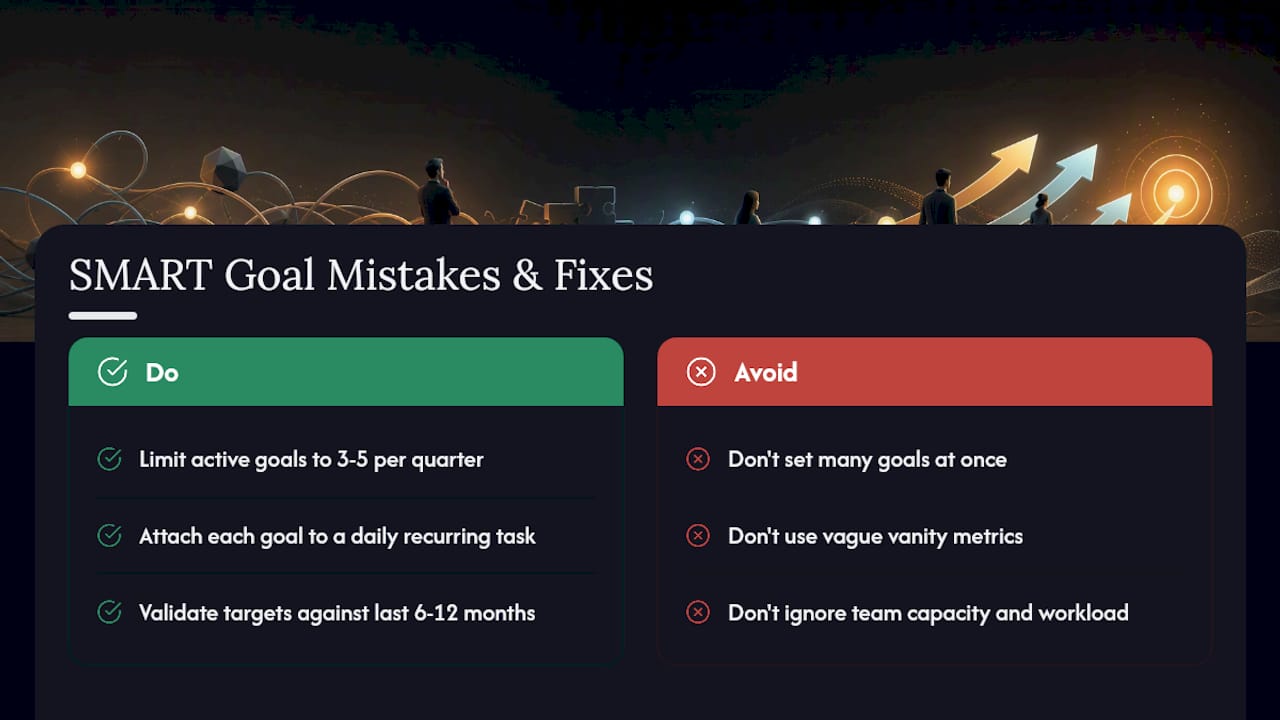
Mistake 1: Setting too many goals at once. Five ambitious goals split attention five ways and none of them get real focus. Limit yourself to 3 to 5 active goals per quarter, and treat anything beyond that as a future-quarter idea, not a current commitment.
Mistake 2: Vague or vanity metrics. “Increase brand awareness” isn’t measurable unless you attach a survey score, mention volume, or search trend to it.
Mistake 3: Ignoring team capacity. A goal that ignores current workload isn’t achievable, it’s wishful. Test any target against your last 6 to 12 months of actual output before committing to it.
Pro Tip: Attach every goal to a recurring task on your daily list instead of a standalone document. A goal you see every morning next to your actual work gets finished; a goal filed away in a slide deck gets forgotten by the second week.
Why Daily Habits Matter More Than the Goal Itself
Most people write a strong SMART goal and then never look at it again until the review that grades it. That gap between the goal and the daily task list is where good intentions quietly die.

The fix is structural, not motivational: break the goal into milestones, break the milestones into weekly tasks, and check those tasks daily.
Content built around this exact workflow has pointed to meaningfully higher goal achievement when personal work goals get tied directly into daily task management rather than left as a quarterly abstraction. The mechanism is simple: visibility drives follow-through. Pick one SMART goal from this article, break it into weekly milestones, and build a five-minute daily habit around checking it.
— Optiostation
Turn These Examples Into a Tracked, Daily Habit
Writing the goal is the fast part. Keeping it visible for 90 straight days without a system is where most people quietly give up. Some task management apps centralize your goals, milestones, and the daily tasks tied to them in one color-coded view, so a quarterly SMART goal isn’t buried in a document you open twice a quarter.

Instead of tracking goals in one app, tasks in another, and deadlines in your head, you set the goal once and let the daily task list keep it in front of you. Smart reminders can nudge you before a milestone slips, and Google Calendar integration can keep deadlines synced with the rest of your schedule. If you’re a student or young professional trying to make one of the role-specific goals above stick past week two, start with the best task management software built around exactly this problem, and set up your first goal and its milestones today.
Sources
The examples above draw on established, publicly available frameworks rather than guesswork. For deeper reading or official templates, start with these:
- Smart objectives — Economics Help
- Setting goals and developing specific, measurable, achievable, relevant, and time-bound objectives — SAMHSA
If you want a downloadable structure to fill in yourself, some providers offer SMART goals template and examples pages that walk through the same formula covered in the how-to section above.
