

TL;DR:
- A project management plan PDF outlines a project’s objectives, scope, schedule, risks, and responsibilities as a formal communication tool. It must be customized by removing irrelevant sections, replacing generic terms, and regularly updating to remain effective. Treating the plan as a living contract ensures proper control, accountability, and successful project execution.
A sample project management plan PDF is a structured document that defines a project’s objectives, scope, schedule, budget, risks, and responsibilities in one accessible reference. Known formally as a project management plan in the PMI (Project Management Institute) framework, this document serves as the primary communication contract between project managers, team leads, and sponsors. Getting it right from the start separates projects that finish on time from those that drift into scope creep and missed deadlines.
What does a sample project management plan PDF include?
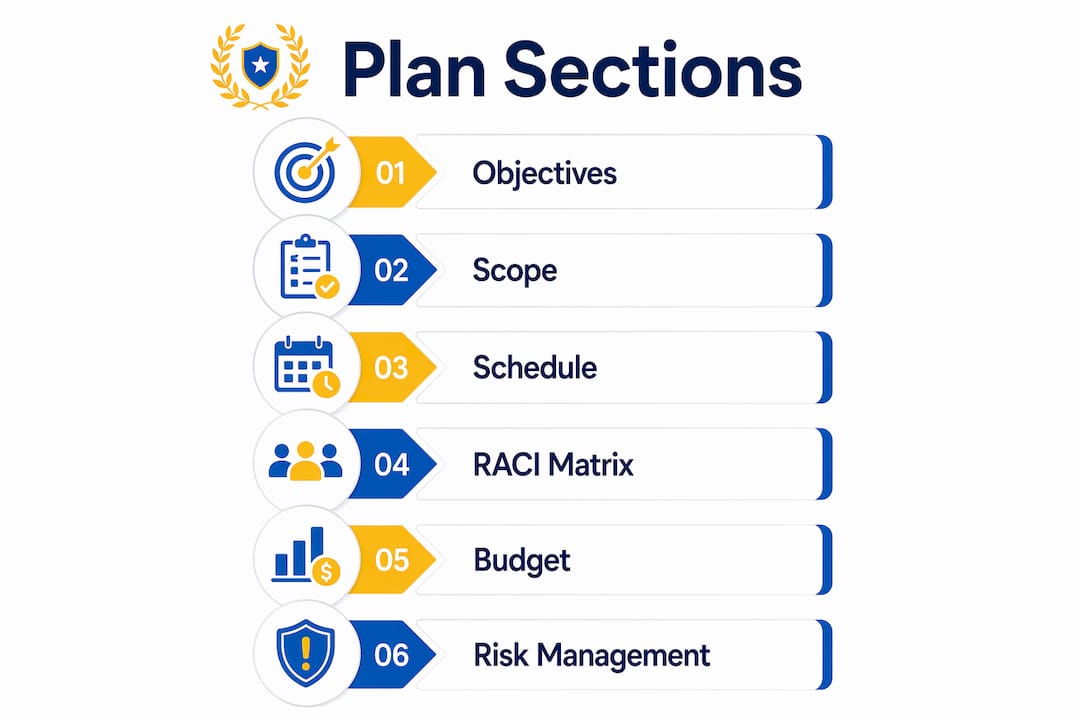
A complete project management plan covers six core components: objectives, scope, schedule, responsibilities, budget, and a risk register. Each component answers a specific question your team and stakeholders will ask during execution. Miss one, and you create a gap that confusion will fill.
The six core sections
- Project objectives and success criteria. State what the project must achieve and how you will measure success. Vague objectives are the single fastest way to lose stakeholder trust.
- Scope statement. Define what is included and, just as critically, what is excluded. Listing assumptions here prevents disputes later.
- Schedule and milestones. A milestone timeline with dependencies shows the team what must happen before the next phase can begin.
- Roles and responsibilities (RACI matrix). A RACI matrix assigns Responsible, Accountable, Consulted, and Informed roles to every major task. Without it, accountability disappears.
- Budget and resource summary. Summarize cost estimates by phase or deliverable. Detailed line items belong in a separate budget sheet, not the plan itself.
- Risk register. List known risks, their probability, their impact, and your mitigation strategy. A risk register without mitigation actions is just a worry list.
Beyond these six, three optional sections significantly improve plan quality.
| Optional Section | What it does | Time to create |
|---|---|---|
| Communication plan | Maps stakeholders to update frequency and format | ~20 minutes |
| Change control process | Defines how scope changes are requested and approved | ~30 minutes |
| Version history | Tracks document revisions and ownership | ~10 minutes |

A communication plan takes roughly 20 minutes to build but significantly improves team alignment and reporting cadence. That return on time is hard to argue with.
Pro Tip: Add a data dictionary to your plan if your project spans multiple departments. Clear definitions of acronyms and resource calculation formulas prevent mid-project confusion during reviews.
Many project management plan templates combine narrative sections with structured tables such as Gantt charts and RACI matrices. This hybrid format supports sharing with diverse stakeholders and governance bodies who have different levels of technical detail they need.
How can you customize a sample project management plan PDF for your project?
The most common mistake project managers make is treating a downloaded template as a finished product. Templates must be adapted by pruning irrelevant sections to remain useful and scannable. A construction project does not need a software deployment tab. A two-week internal audit does not need a 12-month procurement schedule.
Start customization by reading through every section of your chosen project plan example and asking one question: does my team actually need this? If the answer is no, delete it. A shorter, relevant plan gets read. A bloated one gets filed and forgotten.
Here is a practical approach to tailoring your plan:
- Match detail level to project complexity. A small internal project needs a two-page plan. An enterprise rollout may need 20 pages. Neither is wrong. Both must fit the audience.
- Replace generic language with project-specific terms. Swap “deliverable A” for the actual deliverable name. Your team should recognize their work in the document.
- Keep sections scannable. Use short paragraphs, bullet points, and tables. A plan that reads like a legal contract will not be consulted during execution.
- Incorporate your organization’s terminology. If your company calls milestones “gates,” use that word. Consistency with internal language reduces friction.
The goal is a document your team treats as a communication contract, not a theoretical exercise. A plan that reflects real project conditions gets updated. One that feels generic gets ignored.
Pro Tip: When adapting a project planning document example, create a one-page summary version for executive stakeholders. Keep the full detail in the main plan and share the summary at status meetings.
What are common pitfalls to avoid when using sample project management plan PDFs?
The biggest pitfall is treating the plan as a static document. A project management plan is a living contract that must be updated and versioned regularly to reflect project realities. Failing to update it leads to communication breakdowns and misalignment between stakeholders and teams.
Four other pitfalls show up repeatedly in real projects:
- Omitting the change control process. Leaving out a formal change control section is a frequent error that leads to scope creep, often within the first 4–8 weeks of execution. A change control procedure that defines how scope changes are requested, evaluated, and approved improves governance and minimizes disputes.
- Including too much irrelevant detail. A plan stuffed with sections your team will never use creates noise. Noise causes people to stop reading. When people stop reading the plan, they stop following it.
- Unclear responsibility assignment. A RACI matrix without clear ownership is decoration. Every deliverable needs one person who is accountable, not a committee.
- No version control. When multiple people edit the plan without a version history, the team ends up working from different versions. That is a coordination failure waiting to happen.
“A project management plan that no one reads is not a plan. It is a document. The difference is whether your team treats it as the source of truth for every decision they make.”
The fix for most of these pitfalls is the same: build the plan with your team, not for your team. When the people executing the work help write the scope statement and risk register, they own the document. Ownership drives compliance.
How do you use a project management plan PDF to drive execution?
A project management plan PDF drives execution when it answers the who, what, when, how much, and how questions clearly enough that the team can make decisions without waiting for the project manager. Covering scope, schedule, budget, risk, and responsibilities in clear formats is what makes that possible.
Use the plan actively throughout the project life cycle with these steps:
- Share it at kickoff. Walk every stakeholder through the plan at the project kickoff meeting. Do not assume people will read it independently.
- Use milestones as check-in triggers. Every time the project hits a milestone, review the risk register and update the schedule section. Milestones are natural moments to reassess.
- Route all scope change requests through the change control section. This keeps the plan current and gives you a written record of every approved change.
- Version the document on every update. Use a simple naming convention such as v1.0, v1.1, v2.0. Store the current version in one shared location and archive older versions.
- Distribute updates proactively. Do not wait for stakeholders to ask. Send a brief summary of what changed and why whenever you publish a new version.
A project tracker paired with your plan gives you real-time visibility into task completion against the schedule you documented. The plan sets the baseline. The tracker shows you where reality has diverged from it.
| Execution activity | Plan section to reference |
|---|---|
| Stakeholder status update | Communication plan |
| Scope change request | Change control process |
| New risk identified | Risk register |
| Team member replaced | RACI matrix |
| Budget overrun flagged | Budget and resource summary |
The plan is most useful when it is the first place your team looks for answers. That only happens if you keep it current and make it easy to access.
Key takeaways
A well-built project management plan PDF functions as a living contract that aligns stakeholders, controls scope, and guides every decision from kickoff to close.
| Point | Details |
|---|---|
| Six core sections are non-negotiable | Every plan needs objectives, scope, schedule, RACI, budget, and a risk register. |
| Customize before you use | Prune irrelevant sections and replace generic language with project-specific terms. |
| Add change control from day one | A formal change control process prevents scope creep within the first weeks of execution. |
| Version and update regularly | A plan that is not updated becomes a liability, not an asset. |
| Pair the plan with a tracker | A project tracker shows where execution diverges from the documented baseline. |
The plan is a contract, not a formality
After working with project teams across different industries, the pattern is clear: the plans that get used are the ones that were built to be used. That sounds obvious. The execution is harder than it sounds.
Most project managers download a sample project plan template, fill in the blanks, and move on. The plan sits in a shared folder. Nobody opens it after week two. Then, around week six, someone asks why the scope has grown and nobody can point to a written decision that authorized it. That is not a scope problem. That is a plan maintenance problem.
The fix is treating the plan as a contract from the first day. Every scope change goes through the change control section. Every new risk gets added to the register. Every version gets a number. When the team sees the project manager updating the plan in real time, they start treating it as the source of truth. That shift in behavior is worth more than any template feature.
The other thing worth saying: a plan does not need to be long to be good. The best project planning document examples are the ones that fit on a screen without scrolling past three pages of boilerplate. Cut what does not serve your team. Keep what does. Your plan should feel like a tool, not a report.
— Optiostation
Optiostation and your project management plan
A well-written plan tells you what needs to happen. Optiostation helps you track whether it actually does.
Optiostation is a mobile task, team, and time management app built for project managers and team leads who need to move fast without losing visibility. Use it to assign tasks directly from your RACI matrix, track milestones against your schedule, and keep your team aligned between plan updates. Explore the best task management software options to find the right fit for your workflow, or check out Optiostation’s guide to time management apps that complement your project plan and keep execution on track.
FAQ
What is a project management plan PDF?
A project management plan PDF is a formal document that defines a project’s objectives, scope, schedule, budget, risks, and responsibilities in a single shareable file. It serves as the primary communication and governance reference for the project team and stakeholders.
What sections should every project management plan include?
Every plan needs six core sections: objectives, scope statement, schedule with milestones, a RACI matrix, a budget summary, and a risk register. A change control process and communication plan are strongly recommended additions.
How do I customize a sample project management plan template?
Remove any sections that do not apply to your project, replace generic labels with project-specific terms, and match the level of detail to your project’s complexity. A two-week internal project needs a shorter plan than a six-month product launch.
How often should a project management plan be updated?
The plan should be updated at every milestone review and whenever a scope change, new risk, or resource change is approved. Each update should receive a new version number and be distributed to all stakeholders.
What is a RACI matrix in a project management plan?
A RACI matrix assigns Responsible, Accountable, Consulted, and Informed roles to every major task or deliverable. It eliminates ambiguity about who owns each piece of work and who needs to be kept informed.
Recommended
- 7 Key Examples of Project Management You Can Learn From – Optio Station: Best Project Management App for Prioritization
- Understanding Project Management Tips for Success – Optio Station: Best Project Management App for Prioritization
- Project management plan example PDFs: templates for students – Optio Station: Best Project Management App for Prioritization
- Project Management Plan Example: Success Blueprint For Students – Optio Station: Best Project Management App for Prioritization
