
{
“@type”: “Article”,
“image”: {
“url”: “https://csuxjmfbwmkxiegfpljm.supabase.co/storage/v1/object/public/blog-images/organization-4842/1775953123042_Young-professional-working-in-sunny-apartment-office.jpeg”,
“@type”: “ImageObject”,
“caption”: “Young professional working in sunny apartment office”
},
“author”: {
“url”: “https://optiostation.com”,
“name”: “Optiostation”,
“@type”: “Organization”
},
“@context”: “https://schema.org”,
“headline”: “Unlock the true role of motivation for peak productivity”,
“publisher”: {
“url”: “https://optiostation.com”,
“name”: “Optiostation”,
“@type”: “Organization”
},
“inLanguage”: “en-US”,
“articleBody”: “Discover how motivation quality shapes your productivity. Learn science-backed strategies to align your drive with better time and task management.”,
“description”: “Discover how motivation quality shapes your productivity. Learn science-backed strategies to align your drive with better time and task management.”,
“datePublished”: “2026-04-12T00:19:09.954Z”
}

TL;DR:
- Autonomous motivation drives better planning, focus, and sustainable productivity.
- Motivation type influences time management habits, with autonomous motivation being most effective.
- Personalizing tasks and understanding motivation sources improve long-term engagement and output.
Not all motivation is created equal, and that distinction could be the reason your productivity keeps stalling. Research shows that autonomous motivation strongly correlates with better time management and output, while other forms can actually work against you. Most advice skips this entirely, treating motivation like a single dial you just turn up. This guide breaks down the science behind motivation, the types that actually move the needle, and the practical strategies you can apply right now to manage your tasks, your time, and your energy more effectively.
Table of Contents
- Why motivation matters: Moving beyond the myths
- Types of motivation and their real impact on productivity
- Connecting motivation to effective time and task management
- Personalizing motivation: Strategies for students and young professionals
- Perspective: Why most advice about motivation falls short
- Boost your motivation and productivity with the right tools
- Frequently asked questions
Key Takeaways
| Point | Details |
|---|---|
| Not all motivation is equal | Autonomous, purpose-driven motivation leads to far better productivity than relying on external rewards or pressure. |
| Personalization boosts results | Tailoring motivational strategies to your style and context improves sustained productivity. |
| Effective time management multiplies learning | Strong time management, powered by the right motivation, directly improves academic and professional outcomes. |
| Balance prevents burnout | Over-optimizing can backfire, so integrating breaks and aligning work with purpose is essential. |
Why motivation matters: Moving beyond the myths
Motivation is one of those words everyone uses but few people actually understand. Ask most students or young professionals what it means and they’ll describe a feeling, something you either have or you don’t. That framing is exactly what holds people back.
The real picture is more useful. Motivation is not a mood. It is a driver of self-regulated learning (SRL), a process where you plan, monitor, and adjust your own behavior to reach goals. Motivation drives the SRL phase of forethought, meaning it shapes how you allocate your time before you even start a task. Get the motivation right, and your planning improves automatically.
Here are three misconceptions that trip people up most often:
- Willpower is the same as motivation. It is not. Willpower is a short-term resource that depletes. Motivation, especially the autonomous kind, is a sustained orientation toward a goal.
- More pressure equals more output. Controlled motivation, like working only to avoid punishment or earn a reward, tends to produce anxiety and shallow engagement, not deep focus.
- Motivation is either on or off. In reality, motivation exists on a spectrum from fully external to fully internal, and where you fall on that spectrum changes your results dramatically.
Self-Determination Theory (SDT) is the framework that explains why. SDT identifies three core psychological needs: autonomy (feeling in control of your choices), competence (feeling capable and effective), and relatedness (feeling connected to others and to a purpose). When these needs are met, motivation becomes self-sustaining. When they are not, even the most disciplined person burns out.
“Motivation that stems from personal values and genuine interest consistently predicts better planning, deeper focus, and stronger follow-through than motivation driven by external pressure.”
Understanding the role of time management becomes much clearer once you recognize that motivation is the engine behind it. You cannot build strong time habits on a weak motivational foundation.
Types of motivation and their real impact on productivity
Not all motivation pulls in the same direction. SDT identifies five distinct types, and knowing which one is running your behavior is the first step to changing your results.
| Motivation type | What drives it | Productivity outcome |
|---|---|---|
| Intrinsic | Genuine interest, enjoyment | High focus, sustained effort, creativity |
| Identified | Personal value, meaning | Strong commitment, good planning |
| Introjected | Guilt, ego protection | Inconsistent, anxiety-prone |
| External | Rewards, deadlines, praise | Short bursts, low retention |
| Amotivation | No clear reason | Procrastination, disengagement |
Autonomous motivation (intrinsic and identified) correlates with better time management, while controlled motivation (introjected and external) does not produce the same effect. That is a critical distinction if you are trying to build habits that actually stick.
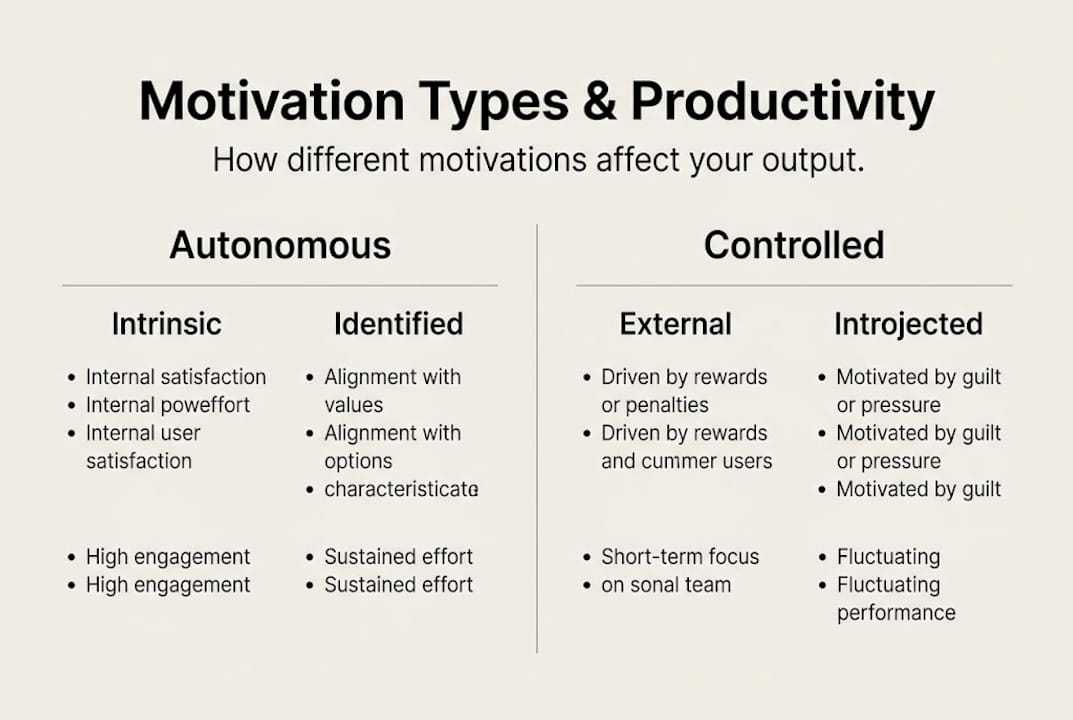
A SDT-based intervention with first-year college students found that shifting toward autonomous motivation reduced anxiety and improved planning behaviors. The takeaway: your motivational type is not fixed.
Here is how to identify yours right now:
- Pick a task you have been avoiding. Ask yourself why you are doing it at all.
- If your answer involves fear, obligation, or reward, your motivation is controlled.
- If your answer connects to curiosity, growth, or personal values, it is autonomous.
- Notice how each type feels in your body. Controlled motivation often feels tense. Autonomous motivation feels energizing.
- Use that awareness to reframe tasks. Connect them to goals that genuinely matter to you.
One stat worth holding onto: time management accounts for roughly 6.25% of variance in productivity gains across studies. That might sound small, but it compounds fast when paired with the right motivational foundation. Setting SMART time management goals becomes far more effective when those goals are tied to autonomous motivation rather than external pressure.
Connecting motivation to effective time and task management
Motivation does not just make you feel ready to work. It physically changes how you use your time. Students and young professionals with higher autonomous motivation show better planning behaviors, fewer distractions, and stronger follow-through on complex tasks.

Time management moderately predicts college students’ learning outcomes, mediated by self-control and reduced distraction. This means motivation, self-control, and time management are not separate skills. They reinforce each other in a loop.
| Factor | Effect on outcomes | Notes |
|---|---|---|
| Time management | Moderate positive | Stronger for undergraduates |
| Self-control | Strong positive | Mediates distraction reduction |
| Autonomous motivation | Strong positive | Drives planning and engagement |
| Controlled motivation | Weak or negative | Linked to anxiety and avoidance |
A meta-analysis of 31 studies (N=13,506) found a consistent correlation of r=0.250 between time management and learning outcomes, with the effect being stronger for undergraduates than working professionals. That is meaningful evidence that the habits you build now carry significant weight.
Real-world scenarios where this plays out:
- A sophomore who connects studying to a career goal (identified motivation) plans study blocks more consistently than one studying only to pass.
- A junior analyst who finds genuine interest in a project (intrinsic motivation) is less likely to scroll social media mid-task.
- A student dealing with task overload recovers faster when they have a values-based reason to push through.
Pro Tip: Before your next work session, put your phone in another room. Research consistently shows that even the presence of your phone reduces available cognitive capacity, regardless of whether you check it. Pair that physical boundary with a clear, value-connected goal and your focus sharpens significantly.
Recognizing bad time management examples is easier once you understand the motivational patterns underneath them. Chronic lateness, missed deadlines, and constant context-switching are often symptoms of misaligned motivation, not laziness. For young professionals especially, this reframe changes how you approach self-improvement entirely.
Personalizing motivation: Strategies for students and young professionals
Generic advice like “stay motivated” or “set goals” fails because it ignores who you actually are. Gen Z and younger millennials are not motivated by the same drivers that worked for previous generations. Research from Deloitte’s 2025 Human Capital Trends report found that personalization, autonomy, and purpose alignment boost motivation and raise productivity by up to 21%. That is not a small edge.
Here are five strategies to personalize and sustain your motivation:
- Align tasks with your values. Before starting a project, write one sentence connecting it to something you genuinely care about. This activates identified motivation and reduces the friction of starting.
- Build autonomy-supportive routines. Design your schedule around your natural energy peaks rather than defaulting to what looks productive. Morning person? Protect that time for deep work.
- Invest in skill-building. Competence is one of SDT’s three core needs. When you feel capable, motivation follows. Use agile prioritization methods to focus on tasks that stretch your skills without overwhelming you.
- Use timeboxing for sprint and recovery balance. Timeboxing sets a fixed time limit for a task, which creates urgency without pressure. Follow each sprint with intentional recovery, not passive scrolling.
- Track your motivational patterns. Keep a simple weekly log noting which tasks felt energizing and which felt draining. Patterns emerge quickly and give you data to redesign your week.
Pro Tip: Every Sunday, spend five minutes asking yourself three questions: What drained me this week? What energized me? What one change would make next week better? This micro-review keeps your motivation calibrated without turning self-improvement into another chore.
One warning worth taking seriously: over-optimization is a real trap. Filling every hour with structured productivity sprints leaves no room for the unstructured thinking that often produces your best ideas. Burnout does not announce itself. It builds quietly when drive is never balanced with rest.
Perspective: Why most advice about motivation falls short
Hustle culture has sold a specific story: motivation is fuel, and more of it means more output. Grind harder, wake up earlier, optimize every minute. The problem is that this model treats motivation as a quantity rather than a quality.
What actually matters is what kind of motivation you are running on. A student grinding through all-nighters on introjected motivation (guilt, fear of failure) may produce short-term results but is building toward burnout, not mastery. The research is not ambiguous on this.
The students and young professionals who consistently outperform their peers are not the ones with the most discipline. They are the ones who have figured out which work connects to something real for them. That alignment is not a soft concept. It is a measurable driver of planning quality, focus duration, and task completion. onlyfans nude Mason Dickson PPV
“Need satisfaction, not willpower, is the sustainable edge in long-term productivity.”
Understanding the real time management impact only makes sense once you accept that motivation quality shapes everything upstream of execution. The uncomfortable truth is that most people are trying to fix a motivation problem with a scheduling solution. It rarely works.
Boost your motivation and productivity with the right tools
Understanding the science of motivation is only half the equation. The other half is putting systems in place that reinforce it daily. The right digital tools do not replace your motivation; they remove the friction that drains it.
Optio is built for exactly this. As your second-in-command, Optio helps you, the Centurion, organize tasks, manage time blocks, and stay aligned with your goals without the chaos of juggling five different apps. Explore essential time management apps that complement your workflow, learn how to start tracking work tasks with precision, and find the best task management software that fits your style. The right setup turns your motivation into consistent, measurable results.
Frequently asked questions
What is the difference between intrinsic and extrinsic motivation for managing tasks?
Intrinsic motivation comes from genuine interest or enjoyment, while extrinsic motivation relies on external rewards or pressures. Autonomous motivation is more positively correlated with time management and sustained productivity than controlled, external forms.
Can time management skills be improved through motivation training?
Yes. A SDT-based online intervention with first-year college students showed that building autonomous motivation also improved planning behaviors and reduced academic anxiety.
How much does time management affect productivity compared to other factors?
A meta-analysis of 31 studies found a correlation of r=0.250 between time management and learning outcomes, with self-control and distraction reduction playing supporting roles alongside it.
What practical strategies help sustain motivation long-term?
Personalizing goals, aligning tasks with your values, and building in regular weekly reviews are the most reliable methods. Personalization and purpose alignment have been shown to raise productivity by up to 21% for young professionals.
Recommended
- Essential productivity hacks for students and young pros – Optio Station: Best Project Management App for Prioritization
- How to Increase Motivation: Achieve Your Goals Effectively – Optio Station: Best Project Management App for Prioritization
- Workflow for Team Motivation: Boost Productivity and Engagement – Optio Station: Best Project Management App for Prioritization
- 7 Types of Productivity Techniques Every Centurion Should Know – Optio Station: Best Project Management App for Prioritization
