

Most American companies face a tough challenge when deciding which projects deserve their limited resources. With constant demands and competing priorities, picking the wrong initiative can be costly. Using a project prioritization matrix has helped organizations reduce wasted effort by over 40 percent while keeping teams focused on high-impact work. Discover how a structured approach can simplify complex decisions and lead to better results for any American organization.
Table of Contents
- What Project Prioritization Matrix Means
- Key Matrix Types And Their Purpose
- How Prioritization Matrix Really Operates
- Criteria And Weighting For Matrices
- Avoiding Pitfalls In Prioritization
Key Takeaways
| Point | Details |
|---|---|
| Purpose of the Matrix | The project prioritization matrix aids in objectively assessing and ranking projects based on impact, feasibility, and strategic alignment. |
| Matrix Types | Different types of matrices, such as the Eisenhower Matrix and Effort vs. Impact Matrix, help teams categorize projects based on urgency and resource requirements. |
| Operational Steps | Establishing a structured scoring system and clear evaluation criteria enhances transparency and enables data-driven decision making. |
| Avoiding Pitfalls | Organizations should remain vigilant against biases and ensure criteria reflect real strategic priorities to maintain effective project prioritization. |
What Project Prioritization Matrix Means
A project prioritization matrix is a strategic decision-making tool designed to help teams systematically evaluate and rank multiple projects based on their potential impact, feasibility, and strategic alignment. By creating a structured framework, organizations can objectively assess which initiatives deserve immediate attention and resources. This approach transforms subjective decision making into a data-driven process.
The core purpose of a prioritization matrix is to transform complex project selection challenges into clear, actionable insights. A process improvement tool that helps teams identify critical opportunities, the matrix allows teams to establish project rankings by carefully weighing two fundamental dimensions: level of potential impact and difficulty of implementation. Imagine having a visual roadmap that cuts through organizational noise and highlights exactly where your team should focus its energy.
Typically, a project prioritization matrix involves several key components that create a comprehensive evaluation framework:
- Impact Score: Measuring potential strategic value, financial returns, or organizational benefits
- Implementation Difficulty: Assessing resource requirements, technical complexity, and potential obstacles
- Strategic Alignment: Determining how closely a project matches broader organizational goals
- Risk Assessment: Evaluating potential challenges and mitigation strategies
By systematically scoring and ranking projects across these dimensions, teams can make more informed, objective decisions about resource allocation. The matrix transforms project selection from a potentially political or emotional process into a transparent, rational approach that aligns with strategic objectives.
Key Matrix Types And Their Purpose
Project prioritization matrices come in various formats, each designed to address specific organizational needs and decision-making challenges. Some matrices categorize tasks based on their urgency and importance, helping teams focus on the most critical initiatives while managing their overall workload effectively.
Among the most popular prioritization matrices are several strategic frameworks that provide unique approaches to project evaluation:
- Eisenhower Matrix: Divides tasks into four quadrants based on urgency and importance, enabling teams to distinguish between critical activities and less significant work
- Effort vs. Impact Matrix: Helps teams categorize projects by comparing the required effort against potential strategic outcomes
- Weighted Scoring Matrix: Allows organizations to prioritize tasks using customizable decision criteria, providing a flexible approach to project selection
- Value vs. Risk Matrix: Evaluates potential projects by balancing expected value against associated implementation risks
Each matrix type offers a unique lens for analyzing projects, transforming complex decision-making processes into clear, actionable strategies. By selecting the appropriate matrix, teams can align their project selection with specific organizational goals, ensuring resources are directed toward initiatives with the highest potential for success.

How Prioritization Matrix Really Operates
A tool that helps teams visually brainstorm, identify, and decide which tasks to focus on, the prioritization matrix operates through a systematic approach that transforms complex decision-making into a structured, objective process. By establishing clear evaluation criteria, teams can methodically score and rank potential projects based on multiple strategic dimensions.
The operational framework of a prioritization matrix typically involves several critical steps:
- Identify Potential Projects: Compile a comprehensive list of all potential initiatives and projects
- Define Evaluation Criteria: Establish specific metrics for assessment, such as strategic alignment, resource requirements, potential impact, and implementation complexity
- Create Scoring Mechanism: Develop a consistent scoring system that allows objective comparison across different projects
- Weight Criteria: Assign relative importance to different evaluation dimensions
- Score Projects: Systematically rate each project against established criteria
- Rank and Prioritize: Calculate total scores and rank projects based on their cumulative performance
This methodical approach eliminates subjective decision-making by introducing a transparent, data-driven process. Teams can visualize project potential through numerical scoring, enabling leadership to make informed choices about resource allocation and strategic focus. By converting complex organizational challenges into quantifiable metrics, the prioritization matrix transforms intuitive guesswork into a precise, strategic selection mechanism.
Criteria And Weighting For Matrices
A specialized matrix designed to help prioritize options by examining how each relates to various operational and improvement criteria, the project prioritization matrix requires careful selection and strategic weighting of evaluation dimensions. The effectiveness of the matrix depends entirely on identifying the most relevant criteria and assigning appropriate importance to each.
Typical criteria for project prioritization matrices often include:
- Strategic Alignment: How closely the project matches organizational goals
- Financial Impact: Potential revenue generation or cost savings
- Resource Requirements: Staffing, budget, and technological needs
- Implementation Complexity: Technical difficulty and potential obstacles
- Risk Assessment: Potential threats and mitigation strategies
- Customer/Stakeholder Value: Direct and indirect benefits to key stakeholders
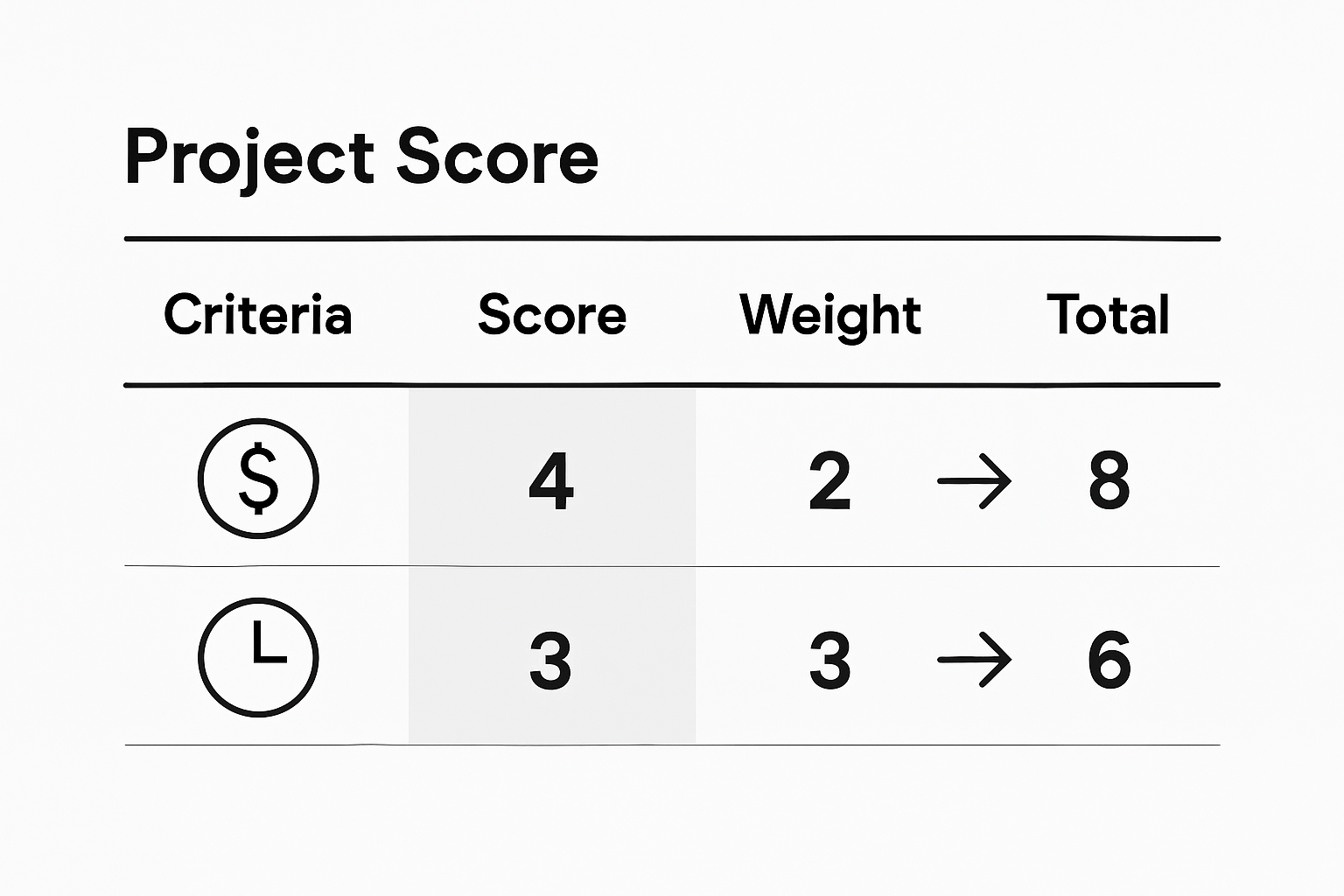
Calculating total project scores involves multiplying each criterion’s score by its corresponding weight and summing the results, which creates a comprehensive evaluation mechanism. The weighting process is crucial – not all criteria carry equal importance. Organizations must thoughtfully assign relative significance to each dimension, reflecting their unique strategic priorities and operational constraints.
Avoiding Pitfalls In Prioritization
Research highlights several limitations in traditional risk matrix approaches, revealing critical pitfalls that can undermine effective project prioritization. Understanding and proactively addressing these challenges is essential for teams seeking to develop robust, reliable decision-making frameworks that genuinely drive organizational success.
Common prioritization matrix pitfalls include:
- Bias in Criteria Selection: Allowing personal preferences or political considerations to influence evaluation metrics
- Oversimplification: Reducing complex project dynamics to overly simplistic scoring mechanisms
- Lack of Flexibility: Creating rigid frameworks that cannot adapt to changing organizational priorities
- Inadequate Weighting: Assigning equal importance to criteria with fundamentally different strategic impacts
- Confirmation Bias: Designing matrices that unconsciously confirm preexisting preferences
- Insufficient Data: Basing rankings on incomplete or outdated information
Successful prioritization requires continuous refinement of the matrix. Organizations must regularly reassess their evaluation criteria, challenge existing assumptions, and remain open to evolving their approach. By maintaining a dynamic, critical perspective, teams can transform the prioritization matrix from a static tool into a living strategy framework that genuinely drives meaningful project selection and execution.
Take Control of Your Projects with Optio Station
Struggling to navigate the complex decisions involved in applying a Project Prioritization Matrix? You are not alone. Many Centurions face challenges balancing impact scores, resource needs, and strategic alignment while avoiding common pitfalls like bias and oversimplification. Our mobile app, Optio Station, acts as your trusted second-in-command by helping you streamline task, team, and time management with clear, data-driven prioritization. Gain confidence by leveraging proven frameworks like the Effort vs. Impact and Weighted Scoring Matrix directly on your device.

Elevate your project planning today with insights from ProductivityThoughts and practical tips in CenturionTips. Visit Optio Station now to empower your workflow, avoid common prioritization mistakes, and make decisions that truly boost your impact. Start commanding your projects with clarity and precision immediately.
Frequently Asked Questions
What is a Project Prioritization Matrix?
A Project Prioritization Matrix is a strategic decision-making tool that helps teams evaluate and rank multiple projects based on their potential impact, feasibility, and alignment with organizational goals.
How do I create a Project Prioritization Matrix?
To create a Project Prioritization Matrix, identify potential projects, define evaluation criteria, establish a scoring mechanism, weigh those criteria, score each project, and finally, rank projects based on their total scores.
What criteria should I include in my Project Prioritization Matrix?
Common criteria for inclusion in a Project Prioritization Matrix are strategic alignment, financial impact, resource requirements, implementation complexity, risk assessment, and customer/stakeholder value.
What are the benefits of using a Project Prioritization Matrix?
The benefits of using a Project Prioritization Matrix include improved clarity and objectivity in project selection, efficient resource allocation, and alignment of projects with strategic organizational goals.
Recommended
- Project Management Prioritization Matrix: Expert Guide – Optio Station: Best Project Management App for Prioritization
- Task Prioritization Matrix: Complete Guide for Success – Optio Station: Best Project Management App for Prioritization
- Feature Prioritization Matrix: Everything You Need to Know – Optio Station: Best Project Management App for Prioritization
- Understanding Prioritization Techniques Guide for Success – Optio Station: Best Project Management App for Prioritization
- 7 Best Productivity Apps for Businesses to Boost Results – Projector Display
