

Racing through deadlines at midnight only to realize the to-do list keeps growing can feel discouraging for any college student or early-career professional. Balancing lectures, team projects, part-time jobs, and personal life leaves little room for error. Understanding productivity as the ratio of outputs to inputs gives you power to use your time and energy more effectively instead of just staying busy. This overview clears up common myths about productivity and introduces smarter systems to help you take control of both your work and study habits.
Table of Contents
- Core Definition And Common Misconceptions
- Major Types Of Productivity Systems
- How A Productivity System Works
- Key Features For Students And Professionals
- Common Pitfalls And What To Avoid
- Choosing The Right System For Your Needs
Key Takeaways
| Point | Details |
|---|---|
| Understanding Productivity | Productivity is about the ratio of outputs to inputs, emphasizing efficiency over simply being busy. Focus on the quality of outcomes rather than the quantity of activity. |
| Choosing the Right System | Select a productivity system that aligns with your work style, goals, and lifestyle for optimal results. Test different frameworks to find one that fits your needs. |
| Measuring Effectiveness | Track measurable metrics that reflect true productivity to avoid illusions of productivity. This includes not just how much you do, but how effectively you use your resources. |
| Avoiding Common Pitfalls | Simplify your productivity system to enhance consistency and reduce maintenance. Prioritize sustainable practices that account for rest and recovery to prevent burnout. |
Core Definition and Common Misconceptions
Productivity means something different to almost everyone you ask. Ask a student about it, and they might say it’s about finishing assignments faster. Ask a manager, and they might focus on team output. But here’s the thing: productivity is fundamentally the ratio of outputs to inputs, or how efficiently you convert resources like time, energy, and effort into meaningful results. For you as a student or early-career professional, this means getting more value out of every hour you study or work. It’s not about working longer hours. It’s about working smarter.
Where most people go wrong is believing productivity equals working faster. They think it’s purely about labor efficiency or how much you can grind through in a day. This misconception runs deep. Many students believe that if they’re not constantly busy, they’re not being productive. Others think productivity only matters if it makes money or looks impressive on a resume. The reality is messier and more interesting than that. True productivity involves all the resources you use, not just time. It includes how well your systems work, whether you’re actually focusing on what matters, and how you manage your energy throughout the day. A student who studies for three focused hours might accomplish far more than one who sits at a desk for eight hours while scrolling between tabs.
Another major misconception is that productivity means doing everything yourself faster. In fact, productivity correlates with overall growth and job creation, not job elimination. For you personally, this translates to productivity being about working with better systems, tools, and processes rather than just pushing harder. When you organize your tasks effectively, delegate group projects thoughtfully, or use tools to manage your workload, you’re actually being more productive. You’re creating space to do deeper, more valuable work instead of getting stuck in busywork. This is exactly what makes the difference between students who feel overwhelmed and students who feel in control of their schedules.
Pro tip: Stop measuring your productivity by how busy you feel and start tracking actual outputs. Did you complete that research paper? Did you understand the material? Did you ship that project on time? Focus on outcomes, not activity.
Major Types of Productivity Systems
Productivity systems come in many flavors, and the one that works best for you depends on your work style, your goals, and what actually sticks in your life. Think of these systems as different lenses for viewing your work. Some focus on measurable output, others emphasize process, and still others prioritize how you feel about your workload. Various productivity management approaches exist across industries, ranging from quantitative methods that measure efficiency and effectiveness to qualitative strategies that focus on process optimization. The key is understanding which approach aligns with your reality as a student or early-career professional.
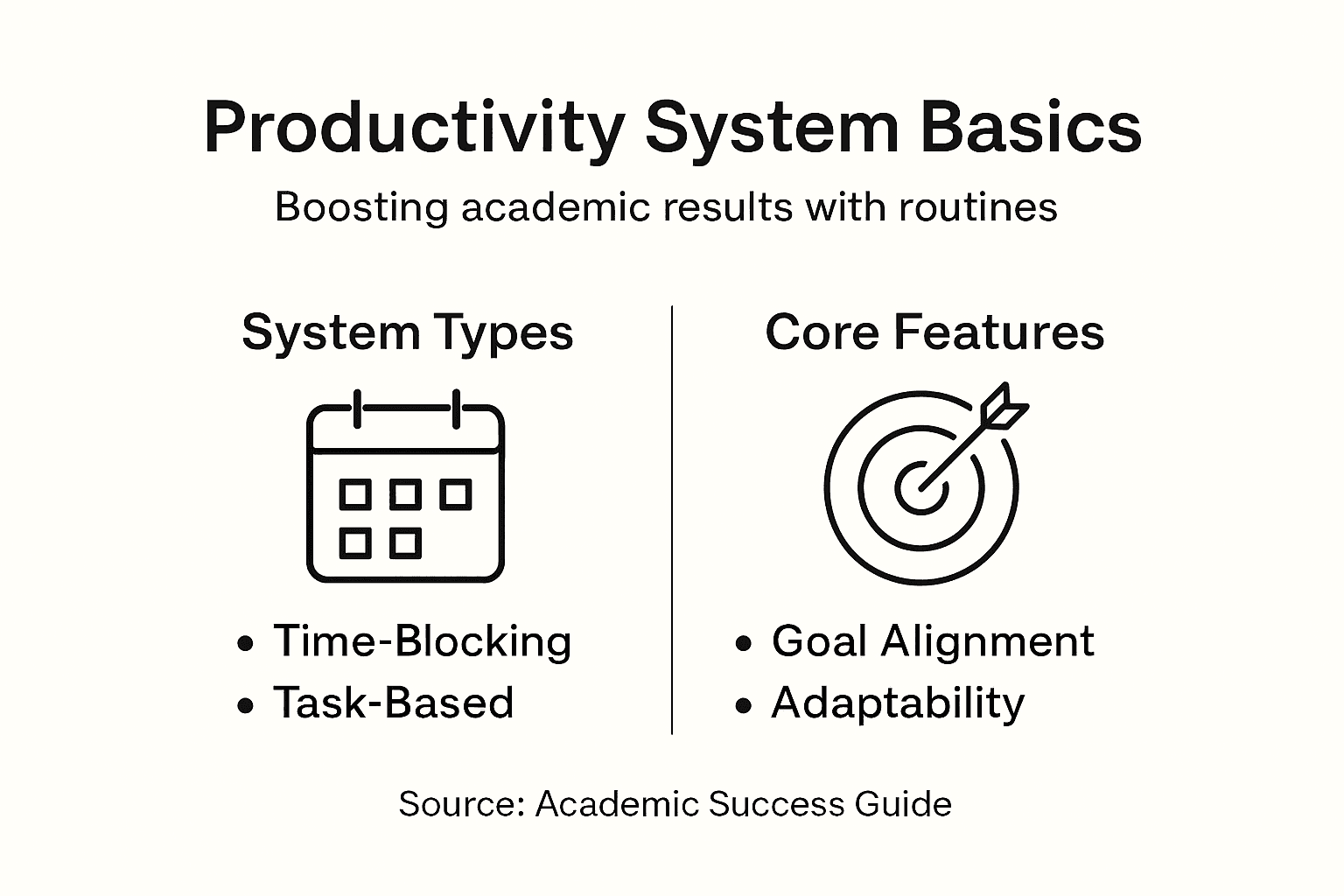
Time-blocking and task-based systems are probably the most intuitive for academic work. These systems divide your day into dedicated chunks for specific activities—two hours for studying calculus, one hour for group project work, thirty minutes for email. You’re essentially trading flexibility for clarity. The Pomodoro Technique fits here, breaking work into 25-minute focused sprints with short breaks. Another popular variant is the Eisenhower Matrix, which sorts tasks by urgency and importance, helping you identify what actually deserves your time versus what just feels pressing. Then there are goal-oriented systems like OKRs (Objectives and Key Results), which work backward from what you want to achieve. Instead of managing tasks hour by hour, you set a clear outcome, then let that outcome guide which tasks matter. For students, this might mean deciding your goal is “master statistical analysis for my thesis” rather than “complete Chapter 4 readings.”
Value-driven systems take a different angle entirely. The Getting Things Done (GTD) method focuses on capturing everything in your brain into an external system so you can stop worrying about remembering and start focusing on doing. The Kanban system, borrowed from manufacturing, visualizes your work as cards moving through columns—“To Do,” “In Progress,” “Done”—giving you constant visibility into what’s happening. Many students find that using 7 essential productivity hacks tailored to their workflow creates a system that actually works rather than one they abandon after two weeks. What matters is that you’re not just picking a system randomly. The best productivity system is the one you’ll actually use, one that reduces decision fatigue and keeps you focused on what genuinely moves your work forward.
Pro tip: Start with just one system framework for two weeks before switching. Most systems fail not because they’re bad but because people jump between them before giving any a real chance. Pick one, commit, and notice what actually works for your brain and schedule.
Here’s a summary comparing major productivity systems and their ideal use cases:
| System Type | Key Principle | Best For | Potential Drawback |
|---|---|---|---|
| Time-blocking | Schedule fixed work blocks | Students with set study tasks | Limited flexibility |
| Eisenhower Matrix | Prioritize urgent/important | Handling multiple priorities | May oversimplify priorities |
| Goal-oriented (OKRs) | Focus on desired outcomes | Long-term projects, big goals | Can lack daily structure |
| GTD Method | Externalize all commitments | Reducing mental clutter | Setup can feel overwhelming |
| Kanban | Visual workflow management | Tracking work-in-progress visually | Can become cluttered quickly |
How a Productivity System Works
A productivity system doesn’t work like a vending machine where you put in effort and get results. It’s more like the circulatory system in your body—everything connects and affects everything else. At its core, a productivity system works by optimizing processes and workflows rather than just pushing you harder. The system creates structure around how you capture tasks, prioritize what matters, execute the work, and reflect on what happened. Instead of relying on willpower alone (which depletes quickly), the system becomes your second brain, handling the mental load so you can focus on actual work.
Here’s how the mechanics actually function. First, the system captures everything demanding your attention. This might be a task list app, a notebook, or a digital tool—the format doesn’t matter as much as the consistency. You’re emptying your brain of worries about forgetting things. Second, the system helps you organize and prioritize. You sort what’s urgent from what’s important, what aligns with your goals from what’s just noise. Third comes execution, where you move through your organized tasks with clarity about what to do next. Fourth, most people skip this part, but reflection is where the system gets smart. You review what worked, what didn’t, and adjust. This cycle repeats continuously, and each time you improve because you’re learning from data, not just feeling. When you manage daily tasks effectively, you’re running through this exact cycle—capture, organize, execute, reflect.

What makes this different from just “being organized” is that the system removes decision fatigue. When you wake up, you don’t wonder what you should do. Your system tells you. You don’t waste mental energy deciding between equally important tasks. Your prioritization framework handles it. This matters enormously for students juggling exams, projects, and classes. The system creates what researchers call “contextual support,” meaning your environment and tools support better work rather than fighting against you. You stop losing time to decisions and lose time only to actual work. The best systems are flexible enough to adapt when your circumstances change. A system that worked for your first semester might need tweaking once you add an internship. Good systems account for this through modular designs where you can swap parts without dismantling everything.
Pro tip: Don’t build your system in isolation. Notice how you naturally work for one week before designing anything. Do you work in long blocks or short sprints? Do you think in checklists or visual maps? Your system should match how your brain actually operates, not how you think it should operate.
Key Features for Students and Professionals
Not all productivity systems are created equal. The ones that actually work for you share certain characteristics that separate them from systems people abandon after a month. A strong productivity system needs measurable productivity metrics so you can track what’s actually happening instead of guessing. This might mean knowing how many pages of your thesis you completed, how many coding assignments you finished, or how many client meetings you attended. The numbers give you objective feedback. Without measurement, you’re flying blind. You might feel productive without actually moving the needle on what matters. You might also be productive but not realize it because you are not tracking anything.
Beyond measurement, the system must align your daily tasks with your actual goals. This is where most students get stuck. You have a vague goal like “do well in school” but your daily tasks are scattered across different classes with no connection to the bigger picture. A real system creates explicit links. Your goal might be “understand machine learning concepts well enough to build a capstone project,” and your tasks align directly with that. This alignment matters because it creates meaning. You stop feeling like you are just checking boxes. You start seeing how each small action contributes to something you actually care about. The system also needs efficiency in resource use. Time is your scarcest resource as a student. A good system minimizes wasted effort and context switching. You batch similar work together instead of jumping between five different subjects. You protect focused time instead of fragmenting your day into five-minute chunks.
Adaptability is essential because your life changes constantly. Next semester you might have more classes. You might take an internship. You might join a club. A rigid system breaks under pressure. Flexible systems let you adjust without starting from zero. This might mean having a core structure you keep but being able to swap out how you execute certain parts. The system also requires feedback mechanisms for continuous improvement. Weekly or monthly reviews let you notice what is working and what is not. You adjust based on reality rather than assumptions. Finally, the system must balance efficiency with effectiveness. Being efficient means doing things fast. Being effective means doing the right things. You could be super efficient at something that does not matter. A good system keeps both in view.
Pro tip: Track one metric that matters to you for two weeks before changing anything. If you are a student, maybe it is pages written per day. If you are early in your career, maybe it is projects completed on time. Data beats intuition when it comes to knowing if your system actually works.
Common Pitfalls and What to Avoid
Most students and early-career professionals fail with productivity systems not because they pick the wrong framework but because they fall into predictable traps. The first major mistake is overcomplicating the system from day one. You watch a YouTube video about some elaborate color-coded system with seventeen different categories and think that is the answer. So you spend eight hours setting it up perfectly. Then real life happens. You miss one day of updates and the whole thing falls apart because it required too much maintenance. The best system is not the most complex one. It is the simplest one you will actually use consistently. Start bare bones. Add complexity only when you genuinely need it.
Another critical error is confusing activity with actual productivity. You can be incredibly busy without accomplishing anything meaningful. A student might spend three hours organizing tasks, reading articles about productivity, and refining their system without writing a single page of their paper. Overcomplicating systems and neglecting regular review are common mistakes that kill momentum. You get caught in the meta-work of managing your productivity instead of doing actual work. There is a balance here. Yes, you need to invest time in building a good system. But that investment should pay off quickly. If after two weeks your system is still not helping you complete actual work, something is wrong. Related to this is the mistake of relying on tools without building habits. You download a fancy app, set it up, and expect it to magically change your life. Apps are just containers. The real work is the habit of using them consistently. A spreadsheet with a daily check-in habit will outperform a premium app used randomly.
People also fail by ignoring rest cycles and treating productivity as an endless grind. You cannot operate at maximum output every single day. Your brain gets tired. Your motivation depletes. Sustainable productivity systems build in recovery time. This might be a day off each week, or just protecting your evenings from work. When you ignore this, you burn out within weeks and abandon the system entirely. Finally, avoid focusing solely on output volume without considering resource use. You might complete twenty tasks but spend forty hours doing it. That is not productivity. A good system helps you accomplish more with less waste. Track not just what you finished but how much effort it took. That is where real productivity lives.
Pro tip: If your productivity system requires more than ten minutes of setup or maintenance per day, it is too complicated. Ruthlessly simplify until it becomes invisible, something you use without thinking about using it.
To help differentiate between activity and true productivity, consider these key metrics:
| Metric | What It Measures | Why It Matters |
|---|---|---|
| Output Quantity | Tasks, pages, projects done | Tracks actual progress |
| Resource Use Efficiency | Time or effort per output | Reveals wasted resources |
| Outcome Relevance | Alignment with key goals | Ensures work has purpose |
| Consistency of Habits | System use frequency | Supports sustained results |
Choosing the Right System for Your Needs
There is no universal productivity system that works for everyone. What works brilliantly for a student taking eighteen credits and working part-time might completely fail for someone in their first job at a consulting firm. The key is matching your system to your specific reality. Start by honestly assessing your environment and constraints. What does your typical week look like? Are you managing multiple classes with different deadlines or juggling client projects with shifting priorities? Do you work in long, focused blocks or short fragmented sessions? Are you naturally detail-oriented or do you prefer big-picture thinking? These questions matter because system selection should reflect your specific professional environment and individual differences. A system that requires meticulous daily logging might suit someone with structured corporate work but crush a student with chaotic class schedules.
Consider whether you lean toward quantitative or qualitative tracking. Some people thrive on numbers. They want to know exactly how many hours they spent, how many tasks completed, productivity percentages. Others find numbers demotivating and prefer systems that focus on progress, momentum, and how the work feels. Neither is wrong. Pick the one that keeps you engaged. Also evaluate your relationship with technology. Some students cannot imagine managing tasks without an app. Others find apps distracting and prefer paper-based systems. Again, no judgment. Use what you will actually maintain. Your system should integrate into your existing habits rather than requiring you to become a different person. If you have never kept a detailed journal, a system built on daily reflection entries will likely fail. If you naturally plan ahead, a system requiring last-minute task definition will frustrate you.
Start your selection process by testing systems for short periods. Pick one framework, commit to it fully for two weeks, then assess. Did it help you accomplish more? Did you actually use it consistently? Did it reduce stress or add stress? Your answers reveal whether that system fits. Pay attention to friction points. If you find yourself constantly fighting the system, that is a signal. Sometimes small tweaks fix it. Sometimes you need a different approach entirely. The goal is finding something that feels like it supports your work rather than getting in the way. Remember that your system might need to evolve. What works during exam season might need adjusting during lighter weeks. A good system is flexible enough to adapt as your circumstances change.
Pro tip: Before choosing a system, spend three days tracking your actual work patterns without any system. Note your natural rhythms, when you focus best, how tasks actually flow. Then select a system designed around those patterns rather than trying to force yourself into a predetermined mold.
Take Control of Your Academic Productivity with Optio Station
The challenge of transforming scattered tasks into meaningful results is real for every student and young professional. This article showed how the right productivity system depends on aligning your goals with effective task management while avoiding burnout and complexity. If you are ready to move beyond confusion and overwhelm Optio Station stands as your reliable second-in-command. Designed specifically for Centurions balancing coursework, projects, and deadlines, it streamlines task, team, and time management without adding extra mental load.
Discover how a tailored system like Optio Station can help you track real outputs not just activity. Explore practical insights and strategic prioritization in our ProductivityThoughts category and experience firsthand why students rely on this app to master focus and follow through. Don’t wait to boost efficiency and build habits that last. Start leading your academic success journey today at Optio Station. Make the choice to work smarter and see results now.
Frequently Asked Questions
What is productivity in academic settings?
Productivity in academic settings refers to how efficiently students convert their time, energy, and effort into meaningful results, such as completing assignments or mastering course material, rather than merely working longer hours.
How can I choose the right productivity system for my study habits?
To choose the right productivity system, assess your environment, work style, and specific needs. Test different frameworks for short periods, noting which system helps you accomplish more while fitting your natural work patterns.
What are some common productivity systems for students?
Common productivity systems for students include time-blocking, the Eisenhower Matrix, goal-oriented methods like OKRs, the Getting Things Done (GTD) method, and Kanban. Each system has unique principles that cater to different types of work and study habits.
How can I measure my productivity effectively?
Measure your productivity effectively by tracking quantifiable metrics, such as tasks completed, pages written, or projects shipped. Additionally, ensure that your daily tasks align with your larger academic goals to provide a clearer picture of your productivity.
Recommended
- 7 Essential Productivity Hacks for Students and Professionals – Optio Station: Best Project Management App for Prioritization
- 7 Powerful Productivity Hacks for Students to Excel Fast – Optio Station: Best Project Management App for Prioritization
- Effective Goal Setting for Students: Achieve Your Dreams – Optio Station: Best Project Management App for Prioritization
- Understanding the Role of Time Management in Success – Optio Station: Best Project Management App for Prioritization
- blog | siift | 10 Essential Habits of Successful Entrepreneurs Explained
