

TL;DR:
- Productivity rituals are intentional actions that reduce decision fatigue and enhance focus.
- Building energy-aware, flexible rituals aligned with natural rhythms improves sustainability and results.
- Properly designed rituals significantly boost performance, motivation, and progress in both students and professionals.
Willpower is overrated. Most students and young professionals burn out not because they lack motivation, but because they rely on it too much. The truth is that productivity rituals work differently from pure discipline. They are small, consistent sequences of actions designed to create structure, reduce decision fatigue, protect focus, and ensure your highest-priority work actually gets done. This article breaks down the science behind rituals, shows you how to build them for your specific life, and gives you the tools to make them stick, whether you’re cramming for finals or navigating your first real job.
Table of Contents
- How productivity rituals work: Mechanisms and science
- Building rituals for students: Morning sequences and adaptive routines
- Professional rituals: Techniques for young professionals
- Common pitfalls and expert nuances: Getting rituals right
- A fresh perspective: Why energy-driven rituals outperform willpower
- Take your productivity rituals further with Optio Station
- Frequently asked questions
Key Takeaways
| Point | Details |
|---|---|
| Rituals boost focus | Structured rituals reduce decision fatigue and protect your concentration for high-priority tasks. |
| Adaptability matters | Flexible rituals anchored to schedules or energy cycles outperform rigid routines, especially for students and busy professionals. |
| Evidence supports rituals | Empirical studies link time management rituals to better academic performance, engagement, and workplace outcomes. |
| Expert advice | Top productivity experts emphasize intention and context cues over willpower alone when shaping rituals. |
How productivity rituals work: Mechanisms and science
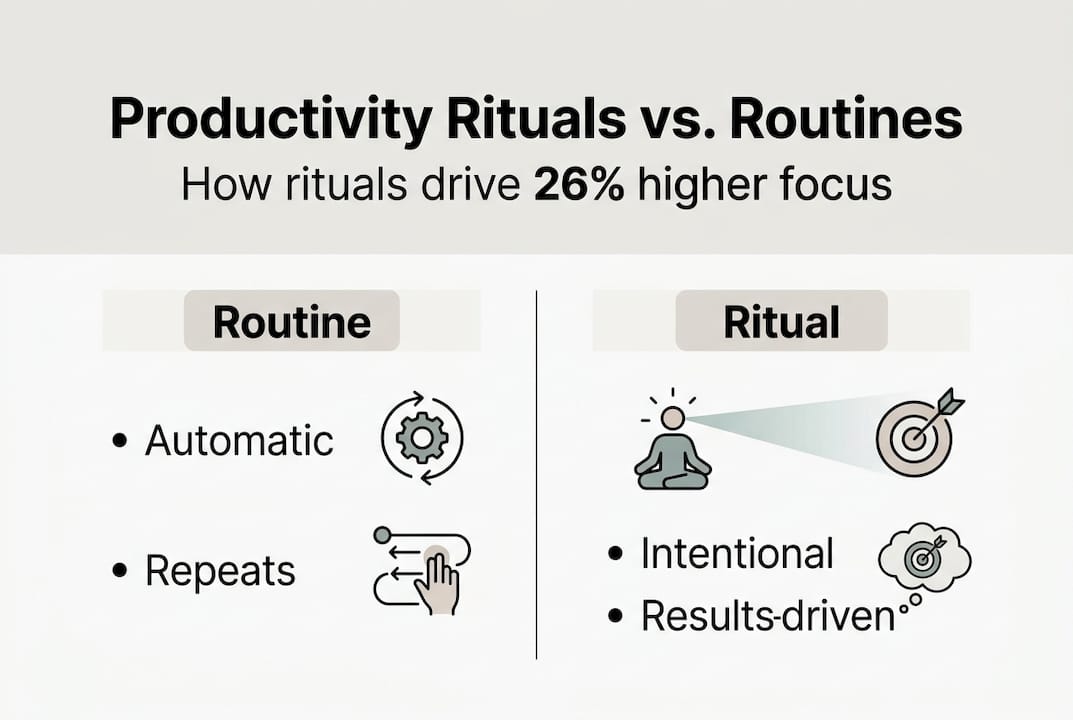
A productivity ritual is not the same as a routine. A routine is something you do out of habit, like brushing your teeth or making coffee. A ritual is intentional. It has a clear purpose: to signal to your brain that it’s time to shift into a different mode. That distinction matters more than most people realize.
According to experts like Cal Newport and Chris Bailey, the power of rituals comes from intention, not willpower. Rituals act as structural scaffolding for deep work, eliminating decision fatigue and the mental cost of context switching. When your brain learns that a specific sequence of actions always precedes focused work, it starts preparing automatically. You stop spending energy deciding what to do next, and start spending it on the actual work.
Here’s a quick breakdown of how rituals differ from routines:
| Feature | Routine | Productivity ritual |
|---|---|---|
| Purpose | Habitual, automatic | Intentional, goal-driven |
| Triggers focus? | Sometimes | Consistently |
| Reduces decision fatigue? | Partially | Strongly |
| Adapts to energy levels? | Rarely | Yes, by design |
The science behind this connects to what researchers call “context cues.” Your environment and actions send signals to your brain about what mode to enter. A ritual creates a reliable cue that says: deep work starts now. Over time, this cue becomes powerful enough to override distractions and low motivation.
Key mechanisms that make rituals effective:
- Decision fatigue reduction: Every choice you make drains mental energy. Rituals pre-decide your actions so you conserve that energy for real work.
- Context switching protection: Moving between tasks costs focus. Rituals create clean mental transitions.
- Autonomy and flexibility: Unlike rigid schedules, flexible time blocking gives you structure without trapping you.
- Deep work protection: Rituals carve out uninterrupted time for your most cognitively demanding tasks.
Understanding the role of time management is the foundation here. Without that understanding, rituals become just another to-do list. With it, they become a system that works even on your worst days.
“The goal is not to manage time more tightly, but to protect the conditions that make focused work possible.” — Cal Newport
Building a productivity system for students starts with recognizing that your brain responds to patterns, not pressure. Rituals create those patterns deliberately.
Building rituals for students: Morning sequences and adaptive routines
College schedules are unpredictable. One day you have an 8 a.m. lecture, the next you’re free until noon. That variability is exactly why rigid routines fail students, and why adaptive rituals win.
Research shows that time management correlates with learning outcomes at r=0.250 and explains up to 26% of the variance in academic performance. That’s not a small number. It means that how you structure your time matters almost as much as how hard you study.
A realistic 20-minute morning ritual built for variable student schedules looks like this:
- Hydrate immediately (2 minutes): Drink a full glass of water before touching your phone. Dehydration impairs cognitive function, and this simple act signals the start of your ritual.
- Light movement (5 minutes): A short walk, stretching, or a few jumping jacks. Physical movement increases blood flow to the prefrontal cortex, the part of your brain responsible for planning and focus.
- No-phone start (3 minutes): Avoid social media and notifications for the first few minutes of your day. This protects your attention before it gets fragmented.
- Review your day (10 minutes): Look at your tasks, identify your top three priorities, and mentally rehearse the first work block. This is the most important step.
Pro Tip: Anchor your ritual to a fixed trigger, not a fixed time. Instead of “I do my ritual at 7 a.m.,” try “I do my ritual right after I wake up.” This makes it schedule-proof.
Here’s how fixed and variable schedule anchoring compare for students:
| Ritual type | Best for | Risk |
|---|---|---|
| Fixed-time ritual | Consistent daily schedules | Breaks down when schedule changes |
| Trigger-anchored ritual | Variable class schedules | Requires habit formation |
| Task-entry ritual | Before each study session | Needs discipline to initiate |
The study schedule approach that works best pairs trigger-anchored rituals with a clear weekly plan. You’re not locking yourself into a rigid timetable. You’re creating reliable on-ramps to focused work, no matter what the day looks like.
Setting time management goals for students gives your rituals a destination. Without goals, even the best ritual becomes an empty habit. With them, every ritual session moves you forward. The types of schedules that work best for students blend structure with flexibility, which is exactly what rituals are designed to support.
Professional rituals: Techniques for young professionals
Entering the workforce means new pressures: meetings, emails, performance reviews, and the constant noise of open-plan offices or remote work distractions. Rituals don’t disappear in this environment. They become more important.

Young professionals who use structured rituals see real results. Structured rituals reduce fragmentation, improve output by 20 to 25%, and professionals who use intentional time management are 1.4 times more likely to receive promotions. Those numbers should get your attention.
Here are the most effective ritual strategies for the workplace:
- Rolling time blocking: Instead of scheduling every hour in advance, you block time in rolling windows, such as the next 2 to 3 hours. This keeps structure without over-rigidity.
- Eisenhower matrix check-in: Each morning, sort your tasks into four categories: urgent and important, important but not urgent, urgent but not important, and neither. This takes five minutes and clarifies your entire day.
- Energy-matched task allocation: Match your hardest cognitive work to your peak energy window. For most people, this is mid-morning. Save emails and admin for your low-energy periods.
- End-of-day shutdown ritual: A short sequence to close out your workday, review what got done, and set up tomorrow’s priorities. This creates a psychological boundary between work and rest.
Pro Tip: Track your energy levels for one week before building your ritual. Note when you feel sharpest, most distracted, and most creative. Then design your ritual around those patterns, not around what productivity gurus say you should do.
These productivity hacks are not about working longer. They’re about working in alignment with how your brain actually functions. And setting time management goals for employees gives your rituals measurable targets, so you can actually track whether they’re working.
Key stat: Professionals who implement energy-matched rituals report output improvements of 20 to 25% within the first month, without adding extra hours to their workday.
Common pitfalls and expert nuances: Getting rituals right
Building a ritual is easy. Sustaining one is where most people fail. Knowing the common mistakes in advance gives you a real edge.
Research confirms that time management boosts engagement and performance, but only when rituals address key behavioral obstacles like phone dependence and self-control. These aren’t minor issues. They are the primary reasons rituals break down.
The most common pitfalls:
- Phone dependence: Starting your ritual by checking notifications immediately fragments your attention before your ritual even begins. Keep your phone out of your ritual sequence entirely.
- Ignoring energy cycles: A ritual scheduled at the wrong time, like trying to do deep work during your natural afternoon slump, will feel like torture and get abandoned fast.
- Activity focus over outcome focus: Completing your ritual feels productive, but if it doesn’t connect to meaningful output, it’s just a performance. Ask: what does this ritual make possible?
- Over-rigid planning: Scheduling every minute leaves no buffer for reality. When one thing slips, the whole system collapses.
- Skipping the review step: Most people build rituals around doing tasks, but skip the reflection step that tells them whether those tasks actually mattered.
“Routines fail not because people are lazy, but because they were built around time instead of energy.” — Research insight from behavioral productivity studies
Using micro-tasking for focus inside your ritual helps prevent the overwhelm that causes abandonment. Breaking your work into smaller, defined chunks makes each ritual session feel achievable. And building a personal development workflow around your rituals ensures they evolve with you instead of becoming stale.
The expert consensus is clear: flexibility and energy awareness are not optional extras. They are the core features that separate rituals that last from ones that fade after two weeks.
A fresh perspective: Why energy-driven rituals outperform willpower
Here’s the uncomfortable truth most productivity content won’t tell you: willpower-based systems are designed to fail. They assume you have a fixed reserve of discipline that you can draw on consistently. You don’t. Nobody does.
We’ve seen this pattern repeatedly. Students and young professionals build elaborate morning routines, follow them for two weeks, hit one bad day, and abandon everything. The problem isn’t their commitment. It’s that the system was built on willpower instead of energy awareness.
Energy-driven rituals work differently. They don’t demand that you perform at peak capacity every day. They ask you to show up at the right time for the right kind of work. That’s a much more honest contract with yourself.
The academic productivity workflow that actually sustains results is one that bends without breaking. It has structure, but it also has permission to adapt. When you align your rituals with your natural energy rhythms instead of fighting them, consistency stops feeling like discipline and starts feeling like common sense.
Stop building rituals around who you wish you were. Build them around who you actually are, at 7 a.m. on a Tuesday after a rough night.
Take your productivity rituals further with Optio Station
You now have the framework. The next step is putting it into practice with tools built specifically for Centurions like you.
Optio Station is your second-in-command for building, tracking, and refining productivity rituals that actually hold up under real-world pressure. Whether you need a task management system that fits your ritual structure, or a step-by-step guide on how to manage tasks effectively, the resources at Optio Station are designed for exactly where you are right now. Stop improvising your productivity. Build a ritual system that commands results.
Frequently asked questions
What’s the difference between a productivity ritual and a routine?
A productivity ritual is a purposeful sequence designed to trigger focus and minimize decision fatigue, while a routine is a broader habitual activity that often lacks intentional structure. Rituals act as structural scaffolding for deep work in a way that routines simply don’t.
How long should a productivity ritual take?
Most effective rituals run between 10 and 30 minutes depending on your goal and schedule. Research shows that 20-minute morning rituals boost engagement and performance for students through improved self-control.
Can productivity rituals help with procrastination?
Yes. Rituals structure your environment and reduce the friction that leads to procrastination. By addressing phone dependence and self-control directly within your ritual design, you remove the triggers that cause delays.
Are energy-based rituals better than fixed routines?
Energy-matched rituals are more sustainable because they adapt to your natural productivity cycles. Research confirms that routines fail without energy alignment, leading to burnout and abandonment over time.
Do I need special tools or apps to create productivity rituals?
No special tools are required to start. Consistency and personalization matter most. That said, apps designed for task and time management can help you track progress and refine your rituals as they evolve.
Recommended
- Essential productivity hacks for students and young pros – Optio Station: Best Project Management App for Prioritization
- 7 Essential Productivity Hacks for Students and Professionals – Optio Station: Best Project Management App for Prioritization
- 7 Types of Productivity Techniques Every Centurion Should Know – Optio Station: Best Project Management App for Prioritization
- Goal visualization: boost productivity with proven techniques – Optio Station: Best Project Management App for Prioritization
- Improving Productivity with Smart Tips and Automations
- Pregame Routines in Basketball: 90% of Elite Athletes Use Them – Hoop Mentality
