

Staring down a never-ending to-do list can leave even the most organized college students and young professionals feeling overwhelmed. With classes, deadlines, work projects, and social commitments constantly competing for your attention, it’s easy to confuse what is urgent with what is truly important. A priority matrix offers a simple, visual way to sort through chaos and set clear, actionable priorities, helping you make better decisions about how to invest your time for real progress and less stress.
Table of Contents
- Priority Matrix Defined And Debunked
- Types Of Priority Matrices For Productivity
- How A Priority Matrix Actually Works
- Real-World Uses For Students And Teams
- Common Mistakes And How To Avoid Them
- Maximizing Results With Priority Matrices
Key Takeaways
| Point | Details |
|---|---|
| Understanding the Priority Matrix | A priority matrix categorizes tasks into four quadrants based on urgency and importance to enhance productivity and decision-making. |
| Types of Priority Matrices | Different matrix types, like the Eisenhower Matrix and Action Priority Matrix, provide tailored strategies for managing tasks effectively. |
| Implementation Strategy | Regularly review and adjust your matrix to maintain its relevance and effectiveness in responding to changing priorities. |
| Common Pitfalls | Avoid overcrowding high-priority zones and treating all urgent tasks as important to prevent decision paralysis and ensure focus on key objectives. |
Priority matrix defined and debunked
A priority matrix is a strategic decision-making tool that helps individuals and teams organize tasks by systematically categorizing work based on urgency and importance. Originally developed in project management contexts, this framework allows students and professionals to transform chaotic task lists into structured, actionable plans. By mapping task priorities with scientific precision, users can dramatically improve their productivity and reduce decision-making stress.
The core concept behind a priority matrix involves dividing tasks into four distinct quadrants: high urgency/high importance, high urgency/low importance, low urgency/high importance, and low urgency/low importance. This quadrant-based approach prevents common productivity traps like mistaking urgent tasks for truly important ones. Students often fall into the trap of responding to immediate demands while neglecting long-term strategic goals, but a priority matrix provides a visual framework for breaking this counterproductive cycle.
While priority matrices sound straightforward, they require nuanced implementation. Successful users learn to evaluate tasks objectively, considering not just immediate deadlines but also potential long-term impact. Academic research suggests that individuals who consistently use priority matrices report lower stress levels and higher goal achievement rates. The matrix transforms subjective decision-making into an analytical process, helping students and professionals make more intentional choices about how they invest their time and energy.
Pro tip: Create your priority matrix on a large, visible surface like a whiteboard or digital planning tool, and review and adjust your quadrants weekly to maintain optimal productivity.
Types of priority matrices for productivity
Priority matrices come in several distinct variations, each designed to address specific productivity challenges and decision-making needs. Different matrix types offer unique frameworks for categorizing and evaluating tasks based on strategic criteria. The most prominent approaches include the Eisenhower Matrix, Action Priority Matrix, and Value versus Complexity Matrix, which provide nuanced methods for managing workload and maximizing personal effectiveness.
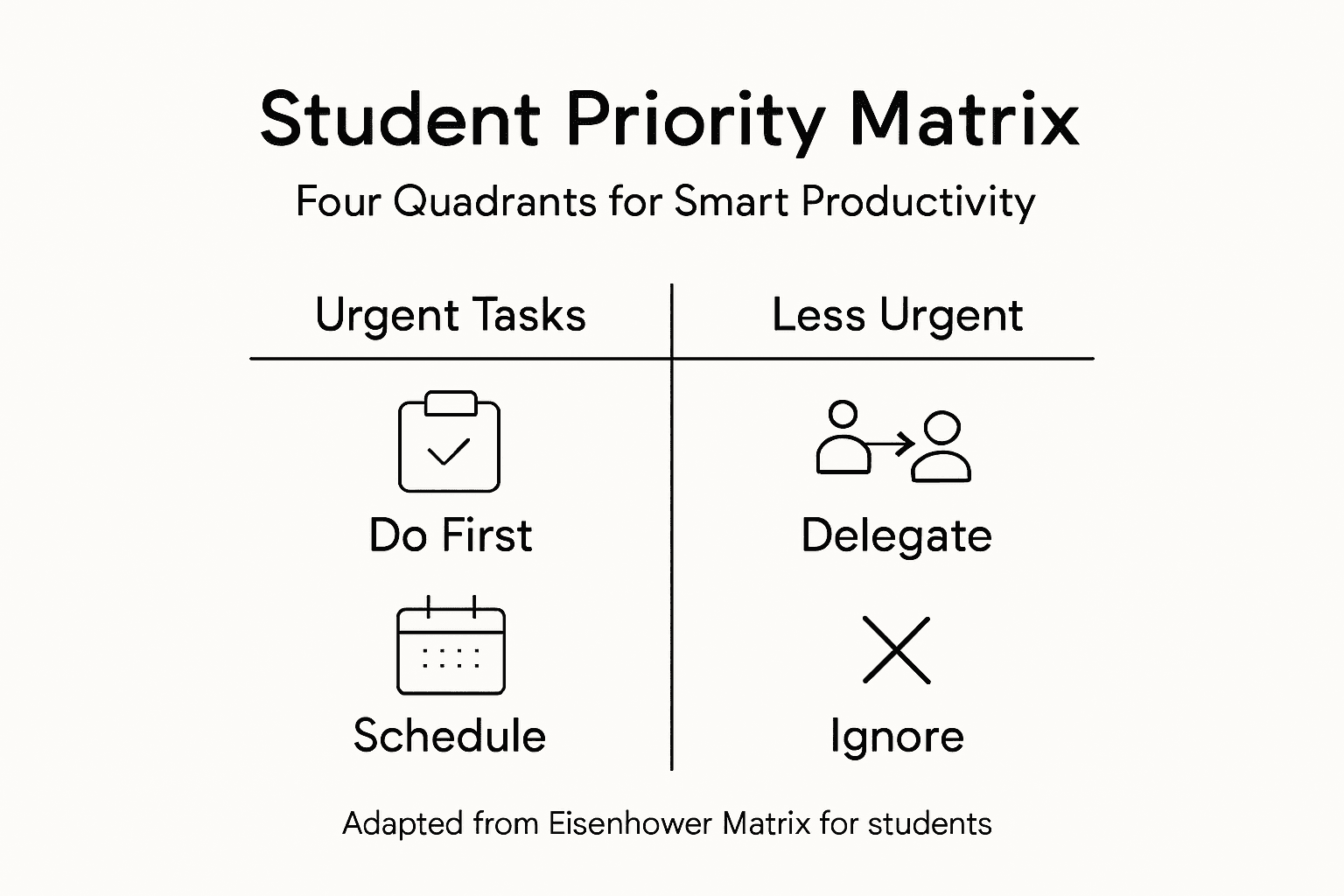
The Eisenhower Matrix stands out as the most widely recognized priority framework, dividing tasks into four quadrants based on urgency and importance. This method helps students and professionals quickly distinguish between tasks that require immediate attention, tasks that can be scheduled for later, responsibilities that can be delegated, and activities that should be eliminated entirely. By creating this clear visual hierarchy, individuals can prevent getting overwhelmed by low-value work and focus their energy on high-impact activities that drive meaningful progress.
Other specialized matrices offer more granular approaches to task management. The Action Priority Matrix evaluates tasks based on effort required versus potential impact, helping users identify ‘quick wins’ that deliver significant results with minimal investment. Similarly, the Value versus Complexity Matrix allows teams and individuals to assess project initiatives by weighing their potential value against the complexity of implementation. These strategic tools transform subjective decision-making into a more objective, analytical process that supports more intentional productivity and resource allocation.
Pro tip: Experiment with different priority matrix types to find the approach that best matches your personal workflow and productivity goals.
Here’s a comparison of the most common priority matrix types and their practical applications:
| Matrix Type | Primary Purpose | Key Decision Factors | Best For |
|---|---|---|---|
| Eisenhower Matrix | Separate urgent and important tasks | Urgency vs Importance | Managing daily tasks |
| Action Priority Matrix | Identify high-impact, low-effort actions | Effort vs Potential Impact | Quick wins and planning |
| Value vs Complexity Matrix | Balance project value and implementation | Value vs Complexity | Project evaluation |
How a priority matrix actually works
A priority matrix transforms complex decision-making into a systematic process by visually mapping tasks onto a strategic grid. The fundamental mechanism involves plotting tasks across two critical dimensions, typically urgency and importance, which creates a clear visual representation of work priorities. This approach allows individuals to move beyond subjective feelings about tasks and instead make data-driven decisions about how to allocate their time and energy most effectively.
The core operational structure of a priority matrix involves four distinct quadrants, each representing a different task classification. Tasks are carefully evaluated and placed into these quadrants based on their specific attributes: high urgency and high importance (do immediately), high urgency but low importance (delegate), low urgency but high importance (schedule), and low urgency and low importance (eliminate). By systematically scoring and positioning tasks, students and professionals can rapidly identify which activities deserve immediate attention and which can be postponed or removed from their workflow entirely.
Implementing a priority matrix requires a structured approach that goes beyond simple visual categorization. Advanced prioritization techniques involve developing specific criteria relevant to your goals, assigning weighted scores to each task, and creating a comprehensive ranking system. This method reduces personal bias and provides an objective framework for decision-making. Successful users regularly review and adjust their matrix, ensuring that their prioritization remains dynamic and responsive to changing circumstances and evolving project requirements.
Pro tip: Create a digital or physical template of your priority matrix and update it weekly, using consistent scoring criteria to track your productivity progression.
Real-world uses for students and teams
Student productivity reaches new heights when priority matrices are strategically applied across academic and personal contexts. Balancing academic responsibilities becomes significantly more manageable by systematically categorizing tasks related to studying, assignment completion, extracurricular activities, and personal commitments. The matrix transforms overwhelming workloads into clear, actionable plans that help students navigate complex schedules with precision and reduced stress.
In team environments, priority matrices serve as powerful collaboration tools that align group efforts and clarify collective objectives. Different team members can use the matrix to communicate priorities, identify potential bottlenecks, and ensure that critical tasks receive appropriate attention. Whether managing group research projects, coordinating team assignments, or planning complex collaborative initiatives, the priority matrix provides a transparent framework that helps everyone understand which activities demand immediate focus and which can be strategically scheduled or delegated.

Beyond academic settings, priority matrices demonstrate remarkable versatility across various scenarios. Students preparing for internships can use these tools to balance job applications, skill development, and academic performance. Research teams can leverage matrices to track project milestones, allocate resources efficiently, and maintain clear communication about evolving priorities. By offering a visual representation of task importance and urgency, these matrices cut through subjective interpretations and create objective, data-driven approaches to workload management.
Pro tip: Color-code your priority matrix sections to create visual distinction between different task categories, making prioritization more intuitive and engaging.
Common mistakes and how to avoid them
Priority matrices can quickly become ineffective when users fail to understand their fundamental principles. Common prioritization errors often emerge from misinterpreting the matrix’s core purpose, leading to strategic missteps that undermine productivity. The most critical mistake is treating all urgent tasks as equally important, which creates a false sense of progress while neglecting truly transformative activities that drive long-term success.
Many students and professionals stumble by overcrowding the high-priority quadrants, creating a form of decision paralysis that defeats the matrix’s original intent. Effective priority management requires disciplined restraint – limiting the number of tasks marked as urgent or important ensures that each item receives genuine attention. This means regularly reassessing and potentially removing tasks that no longer align with primary goals, maintaining a lean and focused prioritization strategy that adapts to changing circumstances.
Successful matrix implementation demands consistent review and collaborative input. Teams frequently make the error of treating the priority matrix as a static document rather than a dynamic planning tool. By failing to involve key stakeholders and neglecting regular updates, users render their matrices obsolete. The most effective approach involves weekly or biweekly reviews, allowing for real-time adjustments that reflect evolving project needs, personal circumstances, and strategic objectives. This adaptive approach transforms the priority matrix from a rigid planning document into a flexible, responsive productivity instrument.
Pro tip: Schedule a weekly 15-minute priority matrix review where you critically examine each quadrant, removing completed tasks and reassessing the relevance of existing priorities.
To help you avoid common pitfalls, here’s a summary of frequent matrix mistakes and how to prevent them:
| Mistake | Effect on Productivity | How to Avoid |
|---|---|---|
| Treating urgent as important | Focus shifts from real goals | Regularly reassess true task importance |
| Overcrowding high-priority zones | Causes decision paralysis | Limit items per quadrant; remove outdated tasks |
| Ignoring regular reviews | Matrix becomes outdated | Schedule consistent review sessions |
| Lack of collaboration | Poor team alignment | Involve stakeholders in matrix updates |
Maximizing results with priority matrices
Successful implementation of priority matrices requires a strategic and intentional approach that goes beyond simple task listing. Digital collaboration techniques dramatically enhance the matrix’s effectiveness by providing real-time visibility and accountability across teams and individual workflows. The key is transforming the matrix from a static document into a dynamic, responsive tool that adapts to changing priorities and project landscapes.
Customization is critical when maximizing matrix results. Students and professionals should resist using generic templates and instead develop matrices tailored to their specific goals and decision-making contexts. This means carefully selecting matrix axes that genuinely reflect meaningful evaluation criteria – whether that involves comparing effort versus impact, urgency versus importance, or other relevant dimensions. By creating a personalized framework, users can ensure that their priority matrix provides genuine strategic insight rather than becoming another bureaucratic checklist.
To truly unlock the potential of priority matrices, consistent application and continuous learning are essential. Teams and individuals should establish regular review cycles, involve key stakeholders in prioritization discussions, and maintain a culture of data-driven decision-making. Focusing initially on high-impact, low-effort tasks creates motivational momentum, while simultaneously planning for more complex, resource-intensive initiatives ensures comprehensive strategic management. The most effective matrices become living documents that evolve with changing circumstances, providing clarity and direction amid complexity.
Pro tip: Create a digital matrix template with predefined scoring criteria and color-coded quadrants to streamline your prioritization process and make strategic decisions more intuitive.
Take Control of Your Student Productivity with Optio Station
Struggling to master your priorities like those outlined in the Priority Matrix? Many students face the challenge of distinguishing urgent tasks from important ones while juggling assignments, study time, and extracurricular activities. If you want to avoid decision paralysis and focus on high-impact work, the Optio Station app offers a powerful solution. Designed as your second-in-command, Optio helps you create personalized priority frameworks and stay accountable in real time.

Explore practical strategies and tips tailored for students in our CenturionTips – Optio Station: Best Project Management App for Prioritization series. Embrace the tools and discipline introduced in this article by letting Optio transform your task management with intuitive prioritization features. Don’t wait to unlock your full potential—visit https://optiostation.com now to start organizing your workload like a true Centurion and elevate your productivity to new heights. For more in-depth guidance on effective prioritization, check out ProductivityThoughts – Optio Station: Best Project Management App for Prioritization.
Frequently Asked Questions
What is a priority matrix and how does it work?
A priority matrix is a strategic tool that helps organize tasks by categorizing them based on urgency and importance. It creates a visual representation of tasks in four quadrants, allowing individuals to identify which tasks need immediate attention and which can be scheduled or eliminated.
How can students effectively use a priority matrix?
Students can use a priority matrix to balance academic responsibilities by organizing tasks related to studying, assignments, and extracurricular activities. This helps transform overwhelming workloads into manageable plans, reducing stress and improving productivity.
What are the different types of priority matrices?
The primary types of priority matrices include the Eisenhower Matrix, Action Priority Matrix, and Value versus Complexity Matrix. Each type serves different purposes, such as distinguishing urgent and important tasks, identifying quick wins, or evaluating projects based on their value and complexity.
What common mistakes should I avoid when using a priority matrix?
Common mistakes include treating all urgent tasks as equally important, overcrowding high-priority quadrants, ignoring regular reviews, and lacking team collaboration. To avoid these pitfalls, regularly reassess task importance, limit the number of high-priority tasks, schedule consistent reviews, and involve key stakeholders in updates.
Recommended
- 7 Essential Productivity Hacks for Students and Professionals – Optio Station: Best Project Management App for Prioritization
- Agile Prioritization Matrix: Boosting Student Productivity – Optio Station: Best Project Management App for Prioritization
- 7 Types of Productivity Techniques Every Centurion Should Know – Optio Station: Best Project Management App for Prioritization
- 7 Powerful Productivity Hacks for Students to Excel Fast – Optio Station: Best Project Management App for Prioritization
- Outdoor Group Games For Adults Perfect for Team Building
