

Prioritization techniques in agile: student productivity
Ever feel like your agile sprint backlog is a chaotic pile of tasks screaming for attention? You’re not alone. Most students and young professionals diving into agile workflows struggle to decide what truly matters, leading to missed deadlines and constant stress. The good news? Mastering prioritization techniques transforms your task management from overwhelming to empowering. This guide breaks down proven frameworks like MoSCoW, RICE, and WSJF, showing you exactly how to apply them to boost your productivity and focus on high-impact work.
Table of Contents
- Why Prioritization Matters In Agile Workflows
- Top Agile Prioritization Techniques Explained
- How To Apply Prioritization Techniques In Your Agile Projects
- Comparing Prioritization Techniques: Selecting The Right One For You
- Boost Your Agile Productivity With Optio Station
Key takeaways
| Point | Details |
|---|---|
| Agile prioritization frameworks | Learn MoSCoW, RICE, and WSJF to organize tasks by value and urgency. |
| Clear criteria reduce stress | Structured methods eliminate guesswork and help you focus on what matters. |
| Stakeholder alignment matters | Involving others ensures priorities match real business and academic goals. |
| Flexibility drives success | Agile thrives on adapting priorities as projects evolve and new information emerges. |
Why prioritization matters in agile workflows
Agile methodologies demand constant decision making about what to tackle next. Unlike traditional project management, agile teams work in short sprints, delivering incremental value every few weeks. Without clear prioritization, you risk spending time on low-impact tasks while critical work sits untouched. Effective prioritization improves delivery speed and focus in agile teams, ensuring every sprint moves you closer to meaningful outcomes.
Poor prioritization creates a domino effect. You might start a sprint with enthusiasm, only to realize halfway through that you’re building features nobody needs. Stakeholder frustration grows, team morale drops, and deadlines slip. The root cause? Lack of clear criteria for deciding what’s truly important. When you don’t know why manage tasks systematically, you’re essentially guessing.
Common pitfalls include treating all tasks as equally urgent, ignoring stakeholder input, and failing to reassess priorities as conditions change. Agile’s iterative nature means priorities shift based on feedback, market changes, or new insights. Teams that resist updating their backlog end up delivering outdated solutions. Prioritization isn’t a one-time activity but an ongoing practice that keeps your work aligned with real value.
Understanding the ‘why’ behind prioritization motivates consistent practice. When you see how focused effort on high-value tasks accelerates progress, you’ll naturally adopt these techniques. The key is recognizing that not all tasks deserve equal attention. Some deliver massive impact with minimal effort, while others consume resources without meaningful returns. Smart prioritization helps you spot the difference and act accordingly.
- Agile requires dynamic task prioritization for iterative delivery
- Poor prioritization leads to wasted effort and delayed projects
- Understanding the ‘why’ behind prioritization motivates consistent practice
- Common pitfalls include lack of clear criteria and ignoring stakeholder value
- Prioritization enables teams to focus on high-impact, valuable work
Top agile prioritization techniques explained
Three frameworks dominate agile prioritization: MoSCoW, RICE, and Weighted Shortest Job First. Each offers unique strengths for different project contexts. MoSCoW categorizes tasks into four buckets: Must have, Should have, Could have, and Won’t have. This simple framework forces you to distinguish critical features from nice-to-haves. For example, a Must have might be user authentication for your app, while a Could have could be custom themes.
RICE prioritization uses four factors: Reach (how many users affected), Impact (degree of effect), Confidence (certainty of estimates), and Effort (time and resources required). You score each task by multiplying Reach, Impact, and Confidence, then dividing by Effort. A feature reaching 1000 users with high impact (3), 80% confidence (0.8), and low effort (2) scores 1200. This quantitative approach removes emotion from decision making.

Weighted Shortest Job First takes a different angle. WSJF balances cost of delay and job duration to optimize flow. You calculate cost of delay (business value plus time criticality plus risk reduction) and divide by job size. Tasks with high value and quick completion rise to the top. This technique excels when you need to maximize throughput and minimize wait times.
| Technique | Best For | Pros | Cons |
| — | — | — |
| MoSCoW | Simple projects, clear requirements | Easy to understand, quick categorization | Subjective, lacks quantitative rigor |
| RICE | Data-driven teams, multiple stakeholders | Objective scoring, balances multiple factors | Requires estimation effort, can be complex |
| WSJF | Flow optimization, lean environments | Maximizes value delivery speed | Needs cost of delay expertise |
Choosing between these methods depends on your team size, project complexity, and stakeholder needs. Small student projects might thrive with MoSCoW’s simplicity, while larger team initiatives benefit from RICE’s analytical depth. WSJF shines when you’re managing continuous delivery pipelines where flow efficiency matters most.
Pro Tip: Start with MoSCoW to build prioritization habits, then graduate to RICE or WSJF as your projects grow more complex and data becomes available.
Each prioritization technique serves specific scenarios. MoSCoW works brilliantly for stakeholder workshops where you need quick consensus. RICE excels in product management contexts with measurable user bases. WSJF fits lean and SAFe environments focused on economic outcomes. Understanding these nuances helps you select the right tool for each situation.
How to apply prioritization techniques in your agile projects
Implementing prioritization techniques requires a structured approach. Follow these steps to integrate frameworks into your agile workflow:
- Identify and list all backlog items, including user stories, bugs, and technical debt.
- Select a prioritization method based on project context, team maturity, and available data.
- Assign values or scores to each item using your chosen framework’s criteria.
- Rank items from highest to lowest priority, creating a clear sequence for sprint planning.
- Review and adjust priorities regularly as new information emerges or conditions change.
Stakeholder involvement is crucial. Regular backlog grooming enhances prioritization and keeps teams aligned to goals. Schedule weekly or biweekly refinement sessions where product owners, developers, and key stakeholders review the backlog together. This collaborative approach ensures technical feasibility meets business value.
Sprint planning sessions become your priority adjustment checkpoint. At the start of each sprint, revisit your ranked backlog and confirm the top items still deserve immediate attention. Market shifts, user feedback, or technical discoveries might change what’s most important. Agile’s strength lies in this flexibility, so embrace it rather than rigidly sticking to outdated priorities.
Tracking outcomes completes the cycle. After each sprint, measure whether prioritized work delivered expected value. Did that Must have feature increase user engagement? Did the high RICE score task actually impact metrics? Use these insights to refine your prioritization criteria for future sprints. Continuous improvement applies to your prioritization process itself.
Pro Tip: Use visual tools like task boards or prioritization matrices to enhance clarity. A simple quadrant chart plotting value versus effort helps teams quickly spot quick wins and avoid time sinks.
When you prioritize multiple projects effectively, you gain control over your workload instead of letting it control you. The key is making prioritization a habit, not a one-time event. Build it into your sprint rituals so it becomes second nature. Your project manager agile guide should emphasize this ongoing practice.
Comparing prioritization techniques: selecting the right one for you
Choosing the right prioritization method requires evaluating several factors. Consider project size, team experience, stakeholder involvement needs, and available data. A solo student project needs different tools than a cross-functional team building enterprise software.
| Factor | MoSCoW | RICE | WSJF |
| — | — | — |
| Ease of Use | Very easy | Moderate | Complex |
| Accuracy | Low to moderate | High | Very high |
| Stakeholder Alignment | Excellent | Good | Moderate |
| Effort Required | Minimal | Moderate | Significant |
| Best Project Size | Small to medium | Medium to large | Large, continuous delivery |
Before selecting a technique, ask yourself these key questions:
- Do I have reliable data on user reach, impact, and effort estimates?
- How many stakeholders need to agree on priorities?
- Is my project scope stable or rapidly changing?
- Does my team prefer qualitative discussion or quantitative analysis?
- Am I optimizing for stakeholder consensus or economic outcomes?
Trade-offs exist in every choice. MoSCoW’s simplicity sacrifices precision. You might categorize two features as Should have, but which truly deserves attention first? RICE’s quantitative rigor demands estimation effort that small teams might lack. WSJF’s economic focus requires understanding cost of delay, which newer agile practitioners find challenging.
Common mistakes include using complex scoring in simple projects and sticking with one method regardless of context. A student managing a semester project doesn’t need WSJF’s sophistication. Conversely, a product team serving thousands of users shouldn’t rely solely on gut feeling. Selecting the right prioritization method depends on project context and team needs.
Flexibility and iterative refinement define agile prioritization. Start with a technique that matches your current maturity level. As you gain experience and data, experiment with more sophisticated methods. You might use MoSCoW for initial backlog creation, then apply RICE scoring to the Must have category for final ordering. Hybrid approaches often work best in real-world scenarios.
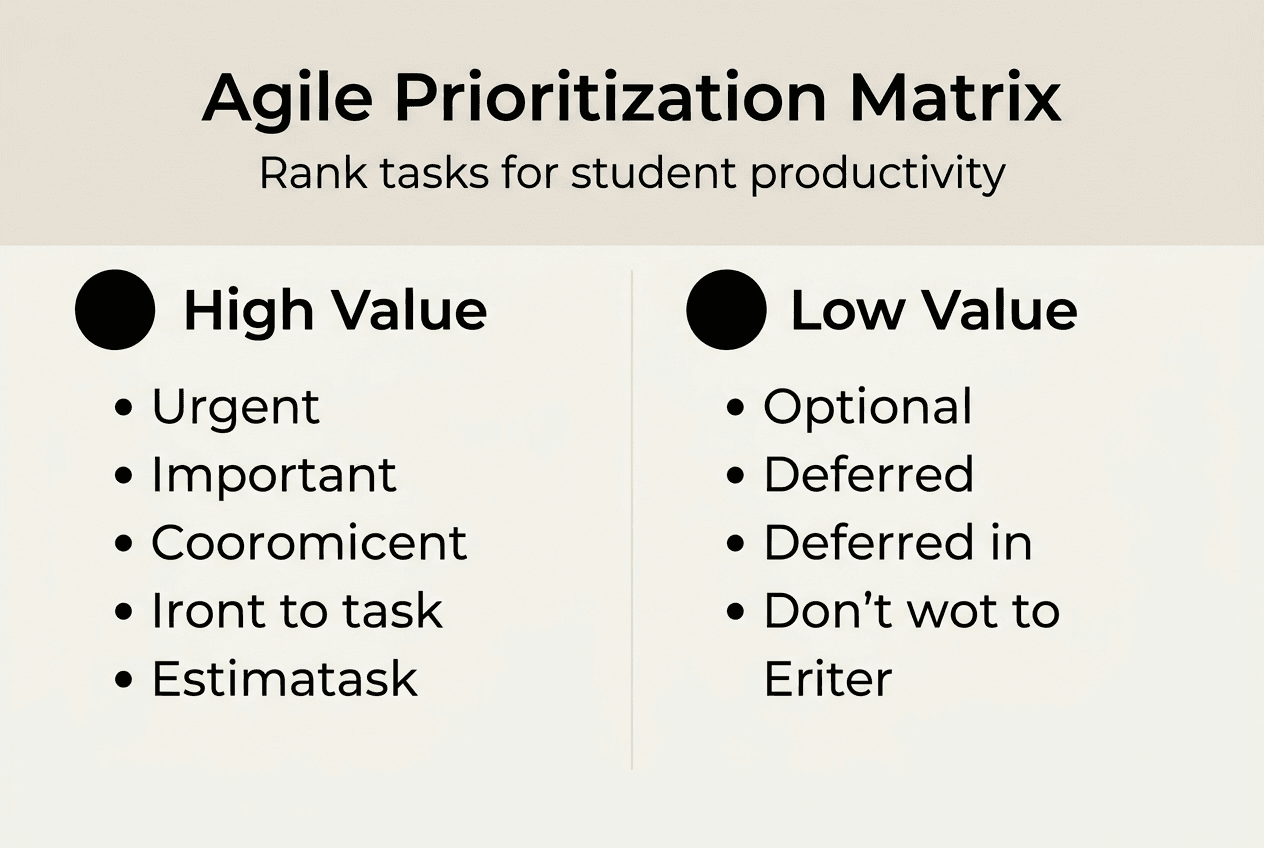
The agile prioritization matrix provides a visual way to compare options. Plot tasks on axes representing value and effort, creating four quadrants: quick wins (high value, low effort), major projects (high value, high effort), fill-ins (low value, low effort), and time wasters (low value, high effort). Focus your energy on quick wins and major projects while minimizing time wasters.
Your understanding prioritization techniques guide should evolve as you learn what works for your specific context. Document lessons learned after each sprint. Which technique helped you deliver the most value? Where did estimation go wrong? This reflection builds institutional knowledge that improves future prioritization decisions.
Boost your agile productivity with Optio Station
Mastering prioritization techniques is one thing, but having the right tools to implement them makes all the difference. Optio Station is built specifically for students and young professionals navigating agile workflows. Our platform supports all major prioritization frameworks with features like task scoring, backlog organization, and real-time collaboration.
Whether you’re juggling multiple projects or managing a team sprint, Optio Station helps you focus on what truly matters. Our Roman-themed interface positions you as the Centurion in command, with Optio as your trusted second, organizing tasks so you can concentrate on execution. Built-in guides walk you through applying MoSCoW, RICE, and WSJF to your actual work, not just theory.
Stop feeling overwhelmed by endless task lists. Manage tasks effectively with tools designed for agile prioritization. Our best task management software guide explains how Optio Station integrates with your existing workflow. Learn how to keep track of tasks at work while maintaining the flexibility agile demands. Join thousands of Centurions who’ve transformed their productivity with smarter prioritization.
Frequently asked questions
What is the best prioritization technique for agile beginners?
MoSCoW is ideal for agile beginners because it’s simple to understand and implement without requiring complex calculations. You categorize tasks into Must have, Should have, Could have, and Won’t have, which builds prioritization thinking without overwhelming new practitioners. As you gain experience, you can transition to more sophisticated methods like RICE.
How often should I reprioritize my agile backlog?
Reprioritize your backlog at least once per sprint during refinement sessions, typically weekly or biweekly. However, significant changes like new stakeholder feedback, market shifts, or technical discoveries warrant immediate reprioritization. Agile thrives on flexibility, so treat your backlog as a living document that evolves with your project.
Can I use multiple prioritization techniques together?
Absolutely. Hybrid approaches often work best in complex projects. You might use MoSCoW for initial categorization, then apply RICE scoring within the Must have category for final ordering. Combining techniques leverages each method’s strengths while compensating for individual weaknesses.
What’s the difference between RICE and WSJF prioritization?
RICE focuses on user impact by scoring Reach, Impact, Confidence, and Effort, making it ideal for product teams. WSJF emphasizes economic value by dividing cost of delay by job size, optimizing for flow efficiency in lean environments. RICE suits product management contexts, while WSJF fits continuous delivery pipelines focused on throughput.
How do I handle stakeholder disagreements about priorities?
Use objective prioritization frameworks like RICE to remove emotion from debates. Present data on reach, impact, and effort to ground discussions in facts rather than opinions. Facilitate workshops where stakeholders score tasks together using agreed criteria. When disagreements persist, defer to the product owner or project sponsor for final decisions, ensuring someone has clear authority.
Recommended
- Agile Prioritization Matrix: Boosting Student Productivity – Optio Station: Best Project Management App for Prioritization
- Understanding Prioritization Techniques for Success – Optio Station: Best Project Management App for Prioritization
- Understanding Prioritization Techniques Guide for Success – Optio Station: Best Project Management App for Prioritization
- Priority Matrix: Unlocking Student Productivity – Optio Station: Best Project Management App for Prioritization
- Increasing company efficiency: boosting collaboration with widespread adoption
