

TL;DR:
- A PRINCE2 project manager is responsible for delivering projects within defined tolerances using the governance framework of PRINCE2. Certification levels include Foundation for support roles and Practitioner for leading projects, with the latter being essential for senior roles in most organizations. Effective project management involves understanding the framework, applying judgment, and tailoring processes to real project conditions.
A project manager in PRINCE2 is the professional responsible for delivering projects within defined tolerances using the PRINCE2 methodology’s governance framework. PRINCE2, which stands for Projects in Controlled Environments, is the internationally recognized standard for structured project delivery, and the project manager PRINCE2 role sits at the center of its operational layer. With over 2 million certified professionals worldwide and 84% of them using the methodology regularly, PRINCE2 is not a niche credential. It is a career-defining framework used across government, construction, IT, and financial services globally.
What certifications define a prince2 project manager?
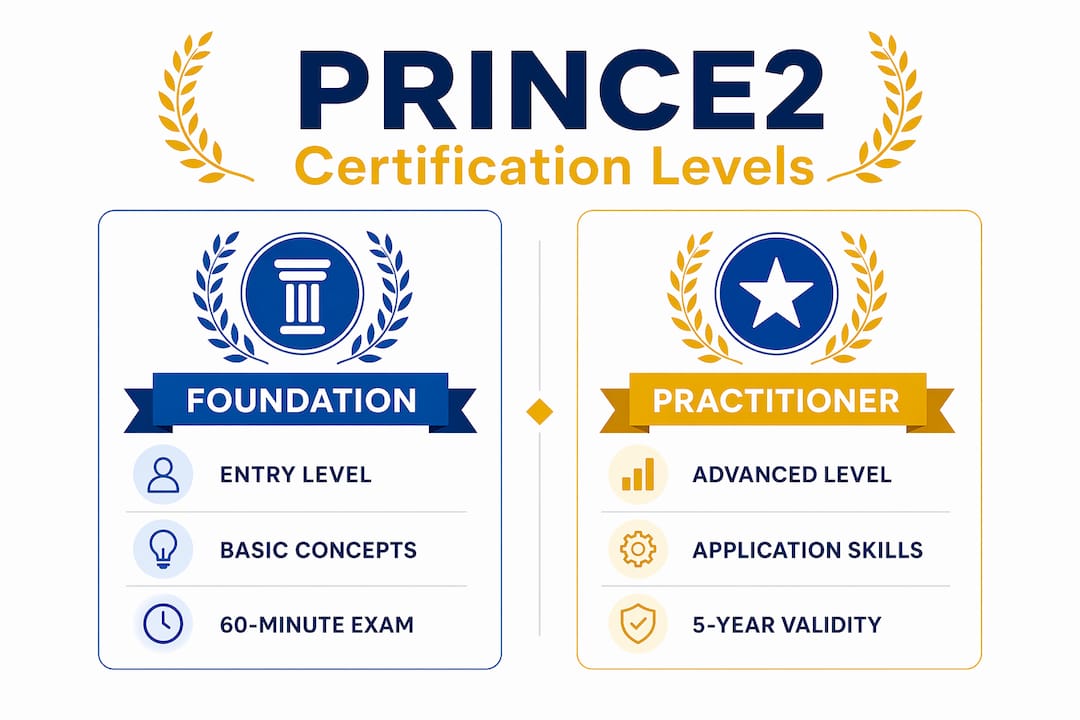
PRINCE2 certification comes in two levels: Foundation and Practitioner. Each targets a different career stage, and understanding the difference saves you from wasting time or money on the wrong exam.
Foundation is the entry point. The Foundation exam is a 60-minute, 60-question closed-book test requiring a 55% pass mark. That means you need to answer at least 33 questions correctly. Foundation proves you understand the terminology, principles, and structure of PRINCE2. It qualifies you for support and coordination roles, not full project management positions.
Practitioner is where the real career value lives. The Practitioner exam runs 150 minutes with 68 objective questions and is open-book, also requiring 55% to pass. Open-book does not mean easy. The questions test your ability to apply PRINCE2 to realistic scenarios, not just recall definitions. You must hold Foundation certification before sitting the Practitioner exam.
Here is how the two levels map to career stages:
- Foundation: Suitable for project support officers, coordinators, and team members working within PRINCE2 environments
- Practitioner: Required for project managers leading PRINCE2 projects, particularly in UK public sector roles and large enterprises
- Renewal: Practitioner certification is valid for three years and requires a renewal exam or continuing professional development to maintain
Practitioner level is widely expected for project managers in government and large enterprises. Foundation alone will not get you into a senior PM role in most UK or European organizations.
Pro Tip: Register for Foundation and Practitioner exams through PeopleCert, the official PRINCE2 examination body. Booking both together often reduces total cost and keeps your study momentum going.
How does the prince2 framework structure a project manager’s role?
The PRINCE2 7th Edition framework is built on 7 principles, 7 practices, and 7 processes. The 2026 edition places added emphasis on people, sustainability, and digital data management. This structure is not bureaucracy for its own sake. Each component exists to prevent the most common causes of project failure: unclear accountability, scope creep, and poor decision-making.

The key roles you need to know
PRINCE2 defines roles with precision. The Project Board holds strategic authority and includes three roles: the Executive (accountable for business justification), the Senior User (representing those who will use the deliverable), and the Senior Supplier (representing those building it). The Project Manager sits below the Project Board and holds operational responsibility.
PRINCE2 separates the Project Board’s strategic authority from the Project Manager’s operational responsibilities. This separation is the framework’s most important design feature. It prevents micromanagement from above while keeping the project manager accountable for day-to-day delivery.
Manage by exception: your autonomy defined
The Manage by Exception principle is the clearest expression of how PRINCE2 balances control with freedom. The Project Manager’s authority is limited by tolerances across six dimensions: time, cost, quality, scope, risk, and benefits. As long as the project stays within those tolerances, the Project Board does not interfere. The moment a tolerance is forecast to be breached, escalation to the Project Board becomes mandatory.
This is not a weakness. It is a feature. You get genuine operational freedom within agreed boundaries, and the board gets strategic oversight without drowning in daily updates.
| Concept | What It Means for the Project Manager |
|---|---|
| Manage by Exception | Full autonomy within tolerances; mandatory escalation when a tolerance is forecast to be exceeded |
| Project Initiation Documentation | The governing document that defines scope, approach, risks, and controls before work begins |
| Stage Boundaries | Formal checkpoints where the Project Board reviews progress and authorizes the next stage |
| Work Packages | Delegated assignments the Project Manager issues to Team Managers for delivery |
| Exception Reports | Formal escalation documents raised when tolerances are forecast to be breached |
Pro Tip: Master the Project Initiation Documentation before your Practitioner exam. Examiners consistently test your ability to identify what belongs in it and why. In real projects, it is the document that prevents scope arguments later.
Prince2 vs. PMP vs. agile: which fits your career?
Choosing between PRINCE2, PMP, and Agile is a geographic and industry question as much as a skills question. PRINCE2 is dominant in the UK and Europe, particularly in public sector, infrastructure, and regulated industries. In US tech sectors, PMP or Agile certifications carry more weight for career progression.
Here is a direct comparison of what each methodology prioritizes:
- PRINCE2: Governance, role clarity, escalation structure, and controlled delivery. Best for environments where accountability and audit trails matter, such as government contracts and financial services.
- PMP (Project Management Professional): A globally recognized credential from PMI that emphasizes process groups and knowledge areas. Stronger brand recognition in North America and Asia. For a detailed look at PMP certification costs, NueCareer’s breakdown covers the full investment.
- Agile (Scrum, SAFe, etc.): Iterative delivery with short feedback cycles. Preferred in software development and product teams where requirements change frequently.
The critical insight most career guides miss: PRINCE2 complements delivery approaches rather than replacing them. A PRINCE2 project manager can run an Agile delivery team inside a PRINCE2 governance structure. The framework defines who decides what and when. The delivery method defines how the work gets done. These are separate layers, and confusing them is one of the most common mistakes aspiring project managers make.
If you work in the UK, Europe, or any public sector environment, PRINCE2 Practitioner is the credential that opens doors. If you are in US tech or want global flexibility, combining PRINCE2 with a PMP or Agile certification gives you the strongest profile.
How to become an effective prince2 project manager
Passing the exams is step one. Becoming effective in the role requires a different kind of work. Here is a practical path that goes beyond the study guide.
- Start with the official manual. The PRINCE2 Managing Successful Projects guide is the exam source text. Read it cover to cover before using any third-party study materials. Most exam failures come from relying on summaries that miss nuance.
- Study the governance layer separately from the delivery layer. PRINCE2 is a governance framework, not a technical or scheduling tool. Candidates who treat it like a project scheduling methodology consistently struggle with scenario-based Practitioner questions.
- Practice with scenario questions daily. The Practitioner exam tests application, not memory. Use PeopleCert’s official sample papers and work through each question by mapping it back to a specific principle or process.
- Apply the framework on real work before your exam. Even if your current role is not a formal PRINCE2 project, you can practice writing a simplified Business Case, defining tolerances, or structuring a stage plan. Hands-on application accelerates understanding faster than any course.
- Avoid the two most common mistakes. First, do not micromanage your team. PRINCE2 delegates work through Work Packages precisely so the Project Manager can focus on control, not execution. Second, do not wait until a tolerance is already breached to escalate. Forecast breaches trigger escalation, not confirmed ones.
- Plan your renewal from day one. Practitioner certification lasts three years. Build continuing professional development into your annual plan so renewal is not a last-minute scramble.
For a broader view of project manager responsibilities and how they translate into daily tasks, Optiostation’s guide on mastering project manager tasks covers the operational side in depth.
Pro Tip: When tailoring PRINCE2 to a smaller project, reduce documentation volume but never reduce role clarity. The Executive, Senior User, and Senior Supplier roles must always exist, even if one person holds multiple roles. Role confusion is where small PRINCE2 projects fail.
Key takeaways
Becoming an effective PRINCE2 project manager requires Practitioner-level certification, deep understanding of the governance framework, and the skill to tailor the methodology to real project conditions without losing control.
| Point | Details |
|---|---|
| Certification levels matter | Foundation suits support roles; Practitioner is required for project manager positions in most organizations. |
| Governance separates authority | The Project Board holds strategic authority; the Project Manager owns operational delivery within tolerances. |
| Manage by Exception is central | Autonomy within tolerances is the rule; mandatory escalation applies the moment a tolerance is forecast to be exceeded. |
| PRINCE2 complements other methods | PRINCE2 governs who decides what; Agile or other delivery methods handle how the work gets done. |
| Tailoring is a skill, not a shortcut | Reducing documentation is acceptable; reducing role clarity is not, regardless of project size. |
The part most prince2 guides skip entirely
At Optiostation, we have watched a lot of aspiring project managers pass the Practitioner exam and then struggle in their first real PRINCE2 role. The gap is almost never knowledge. It is judgment.
The framework tells you what to do. It does not tell you when to push back on a Project Board that keeps changing the Business Case, or how to write an Exception Report that does not make you look like you failed. Those skills come from treating PRINCE2 as a thinking tool, not a compliance checklist.
Successful PRINCE2 practitioners tailor the framework instead of applying it rigidly. That means reading the room. A 12-week internal IT project does not need the same documentation weight as a five-year infrastructure contract. The principles stay constant. The paperwork scales.
The other thing worth saying plainly: PRINCE2’s role clarity and escalation mechanisms are only as good as the people filling those roles. If your Executive is disengaged or your Senior User cannot make decisions, the framework will not save your project. Part of your job as a project manager is managing upward, keeping the Project Board informed and engaged without overwhelming them. That is a people skill, and no certification teaches it.
Invest in the credential. Then invest in the judgment that makes the credential worth having.
— Optiostation
Run your prince2 projects without losing track
Managing a PRINCE2 project means tracking Work Packages, stage boundaries, risk logs, and tolerance thresholds simultaneously. That is a lot to hold in your head, and spreadsheets do not cut it when deadlines shift.
Optiostation is built for exactly this kind of structured task and time management. As your second-in-command, Optio helps you organize deliverables by priority, set milestone reminders, and keep your team aligned across every stage of a project. Whether you are preparing for your Practitioner exam or managing your first live PRINCE2 project, the right task management tools make the difference between controlled delivery and constant firefighting. Explore how Optiostation helps you keep track of tasks at work so your projects stay inside tolerance, every stage.
FAQ
What does a prince2 project manager actually do?
A PRINCE2 project manager manages the day-to-day delivery of a project within tolerances set by the Project Board, escalating only when those tolerances are forecast to be breached. The role covers planning, monitoring, reporting, and managing Work Packages delegated to Team Managers.
Do i need practitioner or foundation to work as a project manager?
Practitioner certification is widely expected for project manager roles, especially in UK public sector and large enterprises. Foundation alone qualifies you for support and coordination roles, not lead project management positions.
How long does prince2 practitioner certification last?
PRINCE2 Practitioner certification is valid for three years. After that, you must pass a renewal exam or demonstrate sufficient continuing professional development to maintain the credential.
Is prince2 better than PMP for my career?
It depends on your location and industry. PRINCE2 is dominant in the UK and Europe, while PMP carries stronger recognition in North America and Asia. Many senior project managers hold both certifications to maximize their career options.
Can prince2 be used alongside agile methods?
Yes. PRINCE2 complements delivery approaches rather than replacing them. A PRINCE2 governance structure can sit above an Agile delivery team, with the framework defining decision-making authority while Agile handles iterative delivery.
Recommended
- Engineering project manager guide: frameworks and strategies – Optio Station: Best Project Management App for Prioritization
- Project Management Officer: Roles, Skills, and Responsibilities – Optio Station: Best Project Management App for Prioritization
- Head of Project Management: Skills to Succeed in 2026 – Optio Station: Best Project Management App for Prioritization
- Design project manager: master the skills and tools – Optio Station: Best Project Management App for Prioritization
