

TL;DR:
- A PMO manager leads the project management office, focusing on governance, portfolio health, and strategic alignment. They differ from project and program managers by overseeing systemic risks, setting standards, and translating executive priorities into actionable frameworks. Effective PMO managers combine strategic thinking, strong communication, and coaching skills to enable delivery success across agile and hybrid environments.
A PMO manager is defined as the strategic leader of a project management office, responsible for governance frameworks, portfolio health, and enabling successful project delivery across an organization. This role sits above individual project managers and program directors, operating at the portfolio level where systemic risks, resource conflicts, and strategic misalignment become visible first. PMO managers hold credentials like the PMI PMP or PgMP and work daily with tools such as Microsoft Project, Jira, and Power BI dashboards. They translate executive priorities into delivery standards and translate delivery realities back to the C-suite. Getting this role right determines whether a portfolio of projects succeeds or quietly drifts off course.
What are the primary roles and responsibilities of a PMO manager?
A PMO manager’s core responsibilities span governance, portfolio visibility, risk management, and methodology standardization across every active project in the organization. This is not a project execution role. It is a portfolio-level oversight and enablement function.
The responsibilities break down across six distinct areas:
- Governance framework design. The PMO manager defines how projects are initiated, approved, and reviewed. This includes steering committee charters, portfolio review boards, and decision thresholds that determine which risks escalate to executive level.
- Portfolio visibility and reporting. PMO managers set reporting standards and use portfolio dashboards to track project health across the full program. A single executive dashboard updated on a consistent schedule drives decisions rather than compliance theater.
- Risk management at scale. When multiple projects show simultaneous delays, the PMO manager recognizes the systemic pattern before individual project managers do. They own cross-portfolio risk identification and escalation.
- Methodology oversight. The PMO manager selects and enforces delivery standards across Agile, Scrum, Waterfall, and hybrid approaches depending on what each project type demands.
- Resource allocation and capacity planning. Resolving conflicts between project teams competing for the same architects, developers, or analysts falls directly to the PMO manager.
- Training and standards development. PMO managers develop training materials and delivery process standards that raise the capability floor across all project teams.
Pro Tip: Build your governance framework before your first portfolio review. Walking into a steering committee without defined decision rights creates confusion that takes months to undo.
The most overlooked responsibility is the last one: capability uplift. PMO managers who invest in coaching project managers and building shared knowledge bases create compounding returns. Teams that understand the “why” behind governance standards follow them without enforcement.
How does a PMO manager differ from project managers and program directors?
The PMO manager role is frequently confused with both project managers and program directors, but the accountability boundaries are distinct. Understanding these differences matters when you are designing a PMO structure or considering a career move.
| Role | Scope | Risk accountability | Resource authority | Decision rights |
|---|---|---|---|---|
| Project manager | Single project | Project-level risks | Assigned team only | Within project budget and scope |
| Program director | Related group of projects | Program-level dependencies | Across program projects | Program outcomes and benefits |
| PMO manager | Full portfolio | Systemic, cross-portfolio risks | Across all active projects | Governance standards and escalation |
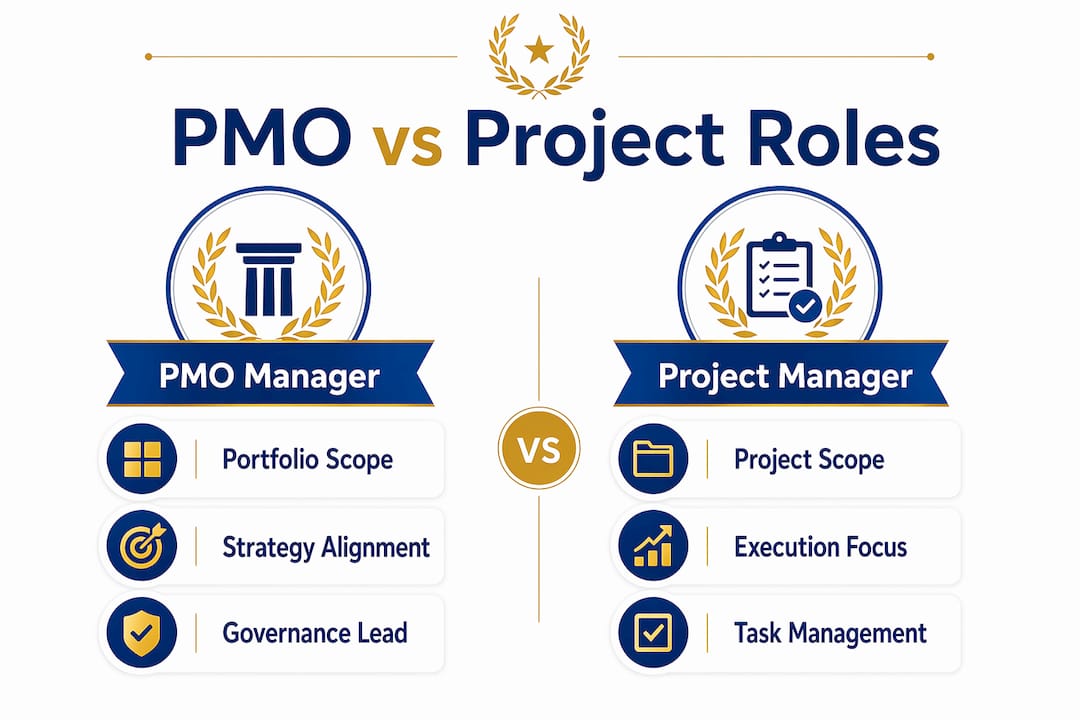
The project manager focuses on delivering a defined scope on time and within budget. The program director coordinates a cluster of related projects to realize a shared business benefit. The PMO manager sits above both, watching for patterns that neither can see from their vantage point.
A critical distinction is decision rights. Project managers approve changes within their project tolerances. Program directors approve changes within their program. The PMO manager defines what those tolerances are and determines when something must escalate to a portfolio review board or executive sponsor.
PMO leadership also differs in how it relates to strategy. Project managers execute strategy. PMO managers shape how strategy gets translated into a prioritized, funded, and governed portfolio. That requires a fundamentally different mindset, one that values portfolio alignment over individual project heroics.
Delivery experience matters more than certifications alone in this role. A PMO manager who has never managed a complex project will struggle to earn credibility with program directors and delivery teams. The authority of the role is earned through demonstrated understanding of delivery realities, not just governance theory.
What leadership skills and competencies make an effective PMO manager?
Effective PMO managers combine strategic thinking with the interpersonal range to operate credibly at every level of the organization. Technical knowledge of project management frameworks is the baseline. What separates strong PMO managers is the leadership layer on top.
The core competencies include:
- Strategic alignment. Every governance decision must connect to a business objective. PMO managers who design frameworks disconnected from organizational strategy create overhead without value.
- Executive communication. Translating portfolio data into clear, decision-ready insights for C-suite stakeholders is a distinct skill. Executives need to know what requires their attention, not a status update on every project.
- Analytical thinking. Reading a portfolio dashboard and identifying which amber indicators are genuinely at risk versus which are administrative noise requires pattern recognition built over time.
- Change management. PMO managers regularly introduce new standards, tools, or governance structures into organizations that resist change. Knowing how to sequence adoption and manage resistance is non-negotiable.
- Conflict resolution. Resource disputes between project teams are constant. The PMO manager facilitates resolution without creating winners and losers that damage long-term collaboration.
- Coaching capability. In Agile PMO environments, the PMO manager functions as a coach rather than a controller, building team capability rather than enforcing compliance.
Pro Tip: When you present portfolio data to executives, lead with the decision they need to make, not the data that supports it. Executives make faster, better decisions when the ask is explicit.
The project management officer role demands political savvy that rarely appears in job descriptions. Navigating competing stakeholder priorities, managing upward to executive sponsors, and maintaining credibility with delivery teams simultaneously requires emotional intelligence as much as technical skill.

How does the PMO manager role adapt in Agile and hybrid project environments?
The traditional PMO operated as a directive body: it set standards, monitored compliance, and reported deviations. That model breaks down in Agile environments where delivery teams need autonomy, fast feedback loops, and the freedom to adapt. The modern PMO manager must shift from controller to enabler.
An Agile PMO owns four specific functions without controlling delivery:
- Portfolio visibility. Maintaining a single view of all active work, priorities, and dependencies across Agile teams, so leadership can make informed decisions without interrupting team flow.
- Consistent minimum standards. Setting the lightest possible standards that prevent metric drift and maintain delivery consistency. Not every team needs the same process. Every team needs the same reporting language.
- Coaching and capability uplift. Supporting Scrum Masters, Product Owners, and delivery leads with frameworks, retrospectives, and cross-team learning events.
- Dependency management. Identifying and resolving cross-team dependencies before they become blockers, which is the function Agile teams are least equipped to handle themselves.
The biggest structural risk in an Agile PMO is scope creep within 18 months. Without explicit documentation of what the PMO owns versus what delivery teams own, the PMO gradually absorbs team-level responsibilities and becomes the bureaucracy it was designed to replace.
Lean portfolio governance under frameworks like SAFe replaces lengthy monthly review meetings with brief sync events and explicit decision rights. Flow efficiency and value outcomes replace compliance metrics as the primary governance signals. This shift requires PMO managers to reframe what “good governance” looks like, moving from documentation completeness to delivery throughput.
Reporting cadences also change. Traditional PMOs report monthly. Agile PMOs align reporting to sprint boundaries and quarterly portfolio sync events, giving executives timely data without disrupting team rhythm.
What are best practices and common pitfalls for PMO managers?
High-performance portfolio PMOs share a set of structural practices that distinguish them from PMOs that generate overhead without value. The gap between the two is almost always governance design and reporting discipline.
The practices that matter most:
- Design governance proportional to risk. A portfolio of five low-complexity internal projects does not need the same governance structure as a portfolio of twenty enterprise transformation programs. Calibrate decision thresholds, review cadences, and escalation channels to actual risk levels.
- Assign clear ownership for risk registers. Tiered escalation channels with defined ownership boundaries prevent RAID registers from going stale and steering committees from drowning in unfiltered risk data.
- Build a single executive dashboard. One portfolio health dashboard updated on a consistent schedule is more valuable than ten detailed reports that executives never read. The dashboard should surface decisions, not just data.
- Manage stakeholder expectations early. Conflicts between project sponsors, resource managers, and delivery teams are easier to resolve before they escalate. The PMO manager who surfaces tension early builds a reputation for foresight.
- Avoid compliance theater. Governance that exists to demonstrate process adherence rather than improve delivery outcomes destroys PMO credibility. Every governance mechanism should have a clear answer to the question: what decision does this enable?
Pro Tip: Review your governance framework every six months. A framework designed for a portfolio of ten projects will create friction in a portfolio of thirty. Governance must evolve with portfolio maturity.
The most common pitfall is the PMO becoming the “project police.” PMO managers who prioritize enforcement over enablement lose the trust of delivery teams and eventually lose executive support when portfolio performance does not improve. The PMO’s value is measured in delivery outcomes, not compliance rates.
Using a portfolio prioritization framework alongside governance design helps PMO managers make intake decisions transparent and defensible, which is where most portfolio conflicts originate.
Key takeaways
A PMO manager drives portfolio success by combining proportional governance, clear risk ownership, and an enabling leadership style that builds delivery capability rather than enforcing compliance.
| Point | Details |
|---|---|
| Governance must fit portfolio scale | Design decision rights and review cadences proportional to actual risk, not organizational habit. |
| Portfolio visibility is the PMO’s core product | A single executive dashboard updated consistently drives better decisions than multiple status reports. |
| Agile PMOs enable rather than control | Own portfolio visibility, minimum standards, and dependency management without absorbing team-level work. |
| Risk registers need tiered ownership | Assign clear roles for risk log maintenance, tolerance approvals, and executive escalation to prevent stale data. |
| Leadership skills outweigh certifications | Delivery credibility, executive communication, and coaching capability determine PMO manager effectiveness. |
The PMO role most organizations are still getting wrong
At Optiostation, we have seen a consistent pattern across organizations building or rebuilding their PMOs: they design governance for the organization they want to be, not the one they are. The result is a framework that is either too heavy for current portfolio maturity or too light to handle the complexity that arrives six months later.
The PMO managers who earn lasting executive trust share one habit. They treat governance as a product with users, not a policy with subjects. They ask delivery teams what slows them down. They ask executives what information they actually use to make decisions. Then they build the lightest structure that answers both questions.
The PMP certification from PMI is worth pursuing, and understanding PMP certification costs helps you plan that investment. But the credential opens the door. What keeps you in the room is the ability to read a portfolio under pressure, resolve a resource conflict without creating enemies, and tell an executive the truth about a project that is failing before it becomes a crisis.
The PMO manager role is one of the most politically complex positions in project management. It requires you to hold authority without always having formal power, to enforce standards without becoming the obstacle, and to represent both delivery teams and executive leadership simultaneously. That tension does not go away. Learning to operate inside it is the job.
— Optiostation
Manage your portfolio with Optiostation
PMO managers need tools that match the pace of portfolio decisions, not just task lists.
Optiostation is built for project managers and team leads who need to track priorities, manage team workloads, and maintain visibility across multiple workstreams without the overhead of enterprise software. The app’s task and time management features give you the portfolio transparency you need to make faster decisions and keep your team aligned. Explore the best task management tools available today, or check out the portfolio template guide to build a reporting structure your executives will actually use.
FAQ
What does a PMO manager do day to day?
A PMO manager oversees portfolio governance, manages cross-project risks, facilitates resource allocation decisions, and produces executive reporting on portfolio health. Daily work includes reviewing project status data, resolving escalations, and maintaining governance standards across delivery teams.
How is a PMO manager different from a project manager?
A project manager delivers a single project within defined scope, budget, and timeline. A PMO manager operates at the portfolio level, setting the governance standards, risk escalation channels, and reporting frameworks that all project managers work within.
What qualifications does a PMO manager need?
Most PMO managers hold a PMI PMP or PgMP certification alongside significant delivery experience. Practical experience managing complex projects matters more than credentials alone, since credibility with delivery teams depends on demonstrated understanding of real project challenges.
How do PMO managers support Agile teams?
An Agile PMO manager owns portfolio visibility, minimum viable delivery standards, cross-team dependency management, and coaching, without controlling how individual Agile teams execute their work. The role shifts from enforcer to enabler in Agile environments.
What is the biggest risk for a new PMO manager?
The most common failure mode is designing governance that prioritizes compliance over delivery outcomes, which erodes trust with both delivery teams and executives. Effective PMO managers build frameworks that enable faster, better decisions rather than generating reporting overhead.
Recommended
- Project Management Officer: Roles, Skills, and Responsibilities – Optio Station: Best Project Management App for Prioritization
- Design project manager: master the skills and tools – Optio Station: Best Project Management App for Prioritization
- Organizational Project Management for Students and Pros – Optio Station: Best Project Management App for Prioritization
- Client Project Manager: Skills, Roles, and Best Practices – Optio Station: Best Project Management App for Prioritization
