

TL;DR:
- Most group projects fail during the planning stage due to unclear roles and missed deadlines.
- A detailed team charter, role-to-deliverable assignments, and a backward-built timeline improve collaboration outcomes.
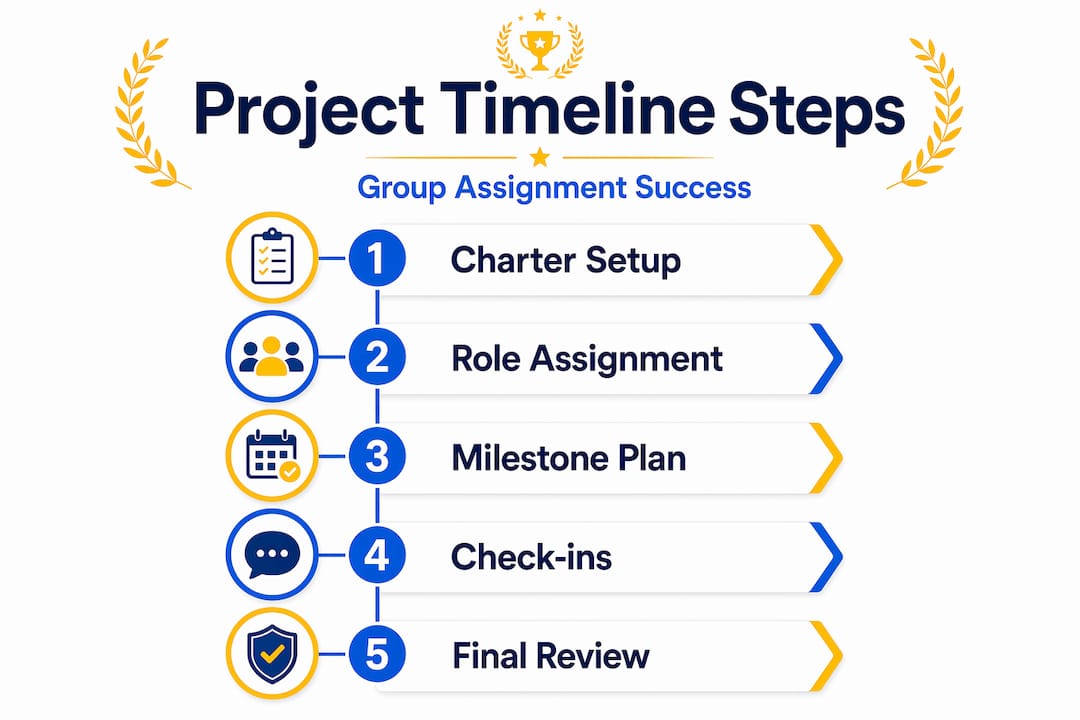
Most group projects fail at the planning stage, not the execution stage. By the time the final deadline arrives, the damage is already done: unclear roles, missed micro-deadlines, and a frantic last-night merge of four different writing styles into one incoherent document. Planning group assignments well from the start is the single most reliable way to sidestep every one of those problems. This article walks you through the exact framework, from setting up your team charter to final submission, so your group actually works like a team instead of five people doing loosely related solo projects.
Table of Contents
- Key takeaways
- Planning group assignments: the foundation that changes everything
- Defining roles that actually stick
- Building a project timeline that holds up
- Collaboration tools and workflow habits
- Finalizing, reviewing, and submitting without panic
- What I have learned about group work after watching hundreds of teams
- How Optiostation helps you take command of group projects
- FAQ
Key takeaways
| Point | Details |
|---|---|
| Start with a team charter | A charter that defines roles, norms, and deadlines prevents conflicts before they start. |
| Tie roles to deliverables | Assign roles based on outputs, not job titles, to stop free-riding and boost accountability. |
| Build your timeline backward | Work from the final due date to set milestones, including review and integration time. |
| Schedule a full draft checkpoint | Require a complete draft before editing begins to avoid chaotic last-minute merges. |
| Use shared tools consistently | One shared workspace for documents, tasks, and communication keeps everyone aligned. |
Planning group assignments: the foundation that changes everything
Before anyone opens a laptop or claims a section of the project, the group needs to agree on what it is actually building. That sounds obvious, but unclear project goals are one of the top reasons group work falls apart. Read the assignment brief together, aloud if you have to, and write down the deliverables in your own words. If your group cannot explain the task without reading from the prompt, you are not ready to start.
Once the goal is clear, your next move is forming a team charter. Think of it less like signing a contract and more like running a pregame team meeting where everyone agrees on the rules. A solid charter covers:
- Goal and scope: What you are making, what counts as done, and what is out of scope
- Roles and responsibilities: Who owns what, tied to specific outputs rather than vague titles
- Meeting cadence: When you meet, for how long, and what happens if someone misses
- Communication norms: Which platform you use, expected response times, and how decisions get made
- Conflict resolution: A simple process for handling disagreements before they escalate
Team charters provide a foundation for effective collaboration by outlining roles, communication norms, and conflict resolution protocols. Critically, they should be reviewed and adjusted as the project evolves, not filed away after the first meeting.
Schedule your first group meeting before you touch any research. Use that session to write the charter together. This is not busywork. Groups that establish operating agreements early spend far less time resolving disputes later, and they produce better collaboration outcomes across the board.
Pro Tip: Set up a shared folder before your first meeting and drop the charter, the assignment brief, and your contact list in it. When everything lives in one place from day one, you never waste meeting time searching for documents.
Defining roles that actually stick
Here is where most groups go wrong. They assign roles like “you do research, you do writing, you do the presentation slides” without linking any of those roles to specific outputs and deadlines. That ambiguity is precisely where free-riding hides.
Roles tied to outputs rather than vague titles prevent free-riding and increase accountability by connecting tasks to concrete deliverables. When every team member can point to exactly what they owe the group, and by when, accountability becomes visible rather than assumed.
A practical role structure for most academic or professional group assignments looks like this:
- Coordinator: Owns the master timeline, runs check-ins, tracks progress, and flags blockers
- Researcher(s): Responsible for sourcing, annotating, and organizing all reference material by a set date
- Writer(s): Draft assigned sections with word count targets and draft submission deadlines
- Editor: Reviews for consistency, flow, and voice after the full draft checkpoint
- Citation manager: Formats all references and checks compliance with the required style guide
Document these roles in your shared folder so every team member sees them every time they open the project. Visible documentation turns soft commitments into hard ones.
Role adjustments happen and that is fine. If a team member falls behind or a section grows larger than expected, the coordinator should catch this at the next check-in and redistribute early rather than waiting for a crisis. Early intervention helps struggling members maintain their responsibilities without derailing the entire project.

Pro Tip: Define each role in terms of observable behaviors, not just titles. Instead of “editor,” write “Editor reviews the full draft for grammar, tone consistency, and formatting by [specific date] and returns annotated feedback within 48 hours.” That specificity makes the role enforceable.
Building a project timeline that holds up
A timeline without milestones is just a due date with extra steps. Real group work organization requires working backward from the final submission and identifying every meaningful checkpoint along the way.
Here is a step-by-step process for building a timeline that actually prevents last-minute chaos:
- Write the final deadline at the top. Every milestone gets set relative to this date.
- Reserve two days before the deadline for final review and submission prep. Buffer for formatting issues, upload errors, and any last-minute instructor clarifications.
- Set the integration and editing window. Block two to three days for the editor to work through the full draft. This cannot be compressed, so protect it.
- Schedule the full draft checkpoint. All sections must be submitted to the shared folder by this date. No exceptions.
- Set individual section deadlines. Each writer gets a specific date to deliver their section, with a word count target attached.
- Mark the research cutoff. Researchers deliver their annotated sources by this date so writers are not waiting.
- Confirm the kickoff and charter completion date. This is your first real team meeting where roles and norms get locked in.
Agreeing on due dates for each task, including review and integration stages, prevents the last-minute compression that ruins otherwise solid projects. Once your milestones are set, drop them into a shared calendar or project board so everyone sees the same picture.
Here is how two common timeline approaches compare for a three-week group assignment:
| Approach | What it looks like | Risk level |
|---|---|---|
| Due-date only | One deadline, no milestones, everyone starts when they feel ready | High: last-minute rush, poor integration |
| Milestone timeline | Kickoff, research cutoff, draft deadlines, full-draft checkpoint, editing window, final review | Low: steady progress, visible delays caught early |
The milestone approach takes about twenty minutes to build together. That twenty minutes pays back hours of panic in the final week.
Collaboration tools and workflow habits
The tool matters less than the habit. You can run an excellent group project on Google Docs and a shared spreadsheet. You can also run a terrible one on the most advanced project management platform available. That said, the right tools do reduce friction when everyone actually uses them.
Effective group work organization in 2026 typically involves at least one of the following:
- Google Docs or Notion for shared documents, the team charter, and drafts
- Trello or a simple Kanban board for visualizing task status: to do, in progress, done
- Slack or a group chat for quick updates, questions, and async communication
- A shared calendar (Google Calendar works fine) for milestones and meeting invitations
Beyond picking tools, establish explicit response-time expectations for your team. “Be responsive” is not a norm. “Reply to direct messages within 24 hours on weekdays” is. That specificity reduces the low-grade anxiety that builds when someone goes quiet for three days.
Peer review slots deserve a spot on your timeline too. Rather than asking team members to “review each other’s work when they get a chance,” schedule fixed peer review sessions with required outputs. Scheduled peer review and drafting slots with required outputs turn vague intentions into finished work. Think of it this way: a meeting that ends with “great, everyone go review the draft” rarely produces useful feedback by the next meeting. A meeting that ends with “written feedback due in the shared doc by Thursday at noon” almost always does.
Pro Tip: Timebox your group work sessions. Set a timer for 50 minutes of focused work, then take 10 minutes to sync on blockers. This stops meetings from expanding into two-hour discussions where nothing gets written.
Finalizing, reviewing, and submitting without panic
The highest risk point in any group assignment is late-stage integration. This is when four separately written sections collide in a shared document and suddenly have three different citation styles, two different tones, and one section that completely contradicts another.
The fix is simple: require a complete full draft checkpoint before any deep editing begins.
Your final phase checklist should cover:
- Full draft checkpoint: All sections in the shared document, complete and readable, at least five days before submission
- Integration pass: One person (usually the editor) reads the whole document as a unit, flagging inconsistencies in voice, structure, and argument
- Citation audit: The citation manager checks every reference against the required style guide and verifies that all in-text citations match the reference list
- Formatting review: Headers, font sizes, spacing, and page numbers match the assignment specifications
- Final proofread: A fresh read for grammar and clarity, ideally by someone who did not write that section
- Submission confirmation: One person submits and confirms receipt, then shares the confirmation with the group
Here is a simple quality check you can run before hitting submit:
| Check | Owner | Status |
|---|---|---|
| All sections present and complete | Coordinator | ✓ / ✗ |
| Citations formatted correctly | Citation manager | ✓ / ✗ |
| Consistent voice and tone throughout | Editor | ✓ / ✗ |
| Formatting matches assignment specs | Editor | ✓ / ✗ |
| Submission confirmation shared with group | Coordinator | ✓ / ✗ |
Document who contributed what in a brief contributions log stored in your shared folder. This protects every team member and gives you a clean record if any disputes arise after submission.
What I have learned about group work after watching hundreds of teams
Here is my honest take: most group assignment failures are not caused by lazy teammates or poor writers. They are caused by optimistic planning. Teams consistently underestimate how long integration takes, how much revision happens after feedback, and how badly a single missed micro-deadline can compress every stage that follows.
I have seen groups with genuinely talented members produce mediocre work simply because they treated the project like parallel solo work rather than a shared product. The sections were good. The document was not. That integration gap is almost always traced back to skipping the full draft checkpoint or leaving editing until the final 24 hours.
What actually works, based on everything I have observed, is treating the team charter as a living document. Most groups write it once and forget it. The ones that revisit it at the midpoint check-in, adjust timelines when something slips, and explicitly re-confirm role ownership tend to finish stronger and with less conflict.
The other thing I will say plainly: group project skills are career skills. The person who can coordinate a five-person team, hold peers accountable without creating conflict, and deliver a polished shared product on deadline is the person companies want to hire and promote. Treat every group assignment as a chance to practice that. The grade is a side effect.
— Optiostation
How Optiostation helps you take command of group projects
If you are applying the framework in this article, you already know that the hardest part is keeping roles, deadlines, and communication in one place. That is exactly what Optiostation was built for.
Optiostation is the task, team, and time management app designed specifically for students and young professionals. As your Optio, your second-in-command, it handles the logistics while you lead. Centurions use Optiostation to assign roles with linked deadlines, visualize project timelines, and track task progress without switching between five different apps. Whether you are managing a three-person class project or a cross-functional professional team, Optiostation keeps everyone accountable and nothing gets lost.
Start with Optiostation’s guide on managing tasks effectively to build your first group project structure, then use the app to run it from kickoff to submission. Your team will notice the difference on the first project.
FAQ
What is the first step in planning a group assignment?
Start by reading the assignment brief together as a group and writing a team charter that defines roles, communication norms, and deadlines. Clear expectations upfront prevent unequal work distribution and conflicts before they start.
How do you assign roles fairly in a group project?
Assign roles based on specific deliverables rather than generic titles. Roles linked to outputs increase accountability because every team member knows exactly what they owe the group and by when.
How do you keep a group project on track?
Use a milestone timeline built backward from the final deadline, hold regular check-ins to catch delays early, and require a full draft checkpoint before editing begins to prevent last-minute integration problems.
What tools work best for group assignments?
Google Docs for shared drafts, a Kanban board for task tracking, and a shared calendar for milestones form a solid baseline. The key is consistency: one shared workspace that every team member actually uses throughout the project.
How do you handle a team member who is not pulling their weight?
Address it early through your team charter’s conflict resolution process rather than waiting until the final week. Early intervention during check-ins helps struggling members course-correct before the rest of the team absorbs their workload.
Recommended
- How to Prioritize Assignments Effectively for Success – Optio Station: Best Project Management App for Prioritization
- Assignment Tracker Setup for Effortless Task Management – Optio Station: Best Project Management App for Prioritization
- Group Project Success – Boosting Skills and Outcomes – Optio Station: Best Project Management App for Prioritization
- 7 Inspiring Examples of Group Projects for Success – Optio Station: Best Project Management App for Prioritization
