

Set a short list of SMART personal development goals that pair 1 or 2 delivery goals with 1 or 2 growth goals, then attach each one to a weekly behavior you can actually see yourself doing. That mix matters more than the goals themselves: Culture Amp’s research on goal-setting shows employees who balance current output with skill growth stay both productive and promotable, while Gallup’s strengths-based framework adds a second layer: goals built around what you’re naturally good at tend to stick. A tracking tool like Optiostation can hold the weekly behaviors that turn a goal statement into a habit; for more on building goals around your strengths, see how strengths-based careers work.
Here’s where to start today:
- Pick one high-friction task, the one you avoid or get repeated feedback on.
- Write a single SMART outcome for it, not a vague aspiration.
- Define the weekly behavior that makes hitting that outcome nearly automatic.
Key Takeaways
The most reliable path to career growth is a short list of SMART goals split between current performance and future skill, each one tied to a weekly behavior you track.
| Point | Details |
|---|---|
| Balance your goal mix | Pair 1 to 2 delivery goals with 1 to 2 growth goals so development doesn’t crowd out your current job. |
| Anchor goals to behaviors | Attach each SMART goal to a specific weekly action, not an abstract outcome, to make follow-through likely. |
| Start with friction points | Target the task you avoid or get repeated feedback on first; it usually holds the biggest career payoff. |
| Review on a set cadence | Check progress at 3, 6, and 12 months, and collect feedback in a psychologically safe way. |
| Use a tracker to stay consistent | Optiostation can hold your weekly behaviors and review notes so goals survive past the first busy month. |
Table of Contents
- What Are Personal Development Goals for Work, and Why Do They Matter?
- What Types of Personal Development Goals Should You Set?
- What Are Good Examples of Personal Development Goals for Work?
- How Do You Choose and Write Development Goals That Actually Work?
- How Do You Implement, Measure, and Review These Goals?
- Track Your Development Goals Without Losing the Thread
- Frequently Asked Questions
- Sources
What Are Personal Development Goals for Work, and Why Do They Matter?
A personal development goal for work targets a capability or behavior, things like negotiation skill, delegation habits, or public speaking confidence, rather than a specific output. That’s the line that separates it from a delivery goal: “Close 12 new accounts this quarter” is a performance target; “Get comfortable presenting to executives without notes” is a development goal. Both belong on your plan, but they do different jobs.
The payoff for taking development goals seriously shows up in a few concrete ways. Employees who set and revisit development goals tend to report stronger engagement and lower burnout, a broader and more marketable skillset, and a clearer promotion case when review time comes around. Culture Amp’s goal-setting data also flags a trap worth avoiding: if you can’t state in one sentence how a goal supports a team or business priority, it’s probably the wrong goal, or at least the wrong one to prioritize this quarter.
What Types of Personal Development Goals Should You Set?
Development goals fall into a handful of categories, and picking one or two per cycle beats trying to improve everything at once.
- Technical skills. Learning a new tool, language, or platform relevant to your role, often a short-term win within a quarter.
- Leadership and management. Delegation, giving feedback, running meetings, usually a longer build measured in months.
- Communication. Public speaking, written clarity, cross-team persuasion, useful in both short sprints and long arcs.
- Time and productivity. Prioritization habits, calendar discipline, reducing context-switching, fast to test and measure.
- Credentialing and certifications. Formal courses or licenses, almost always a long-term investment.
- Networking and mentoring. Building internal and external relationships, compounds over a year or more.
- Wellbeing and resilience. Stress management, boundary-setting, recovery habits, ongoing rather than finish-line goals.
Technical skills and productivity habits tend to produce the fastest visible wins. Leadership, credentials, and networking pay off over a longer horizon but usually matter more when a promotion decision gets made.
What Are Good Examples of Personal Development Goals for Work?
Copying a well-formed goal and swapping in your own numbers is faster than writing one from scratch. Here’s a working set, split by time horizon.
Short-term (this quarter):
- Complete one online course in a tool your team just adopted.
- Ask for feedback from your manager after every major deliverable for four weeks straight.
- Run three team meetings using a written agenda you send 24 hours in advance.
- Give one piece of constructive feedback to a peer each week for a month.
- Read one book on negotiation and apply one tactic in a real conversation.
- Track your time for two weeks to identify where focus actually goes.
- Practice a five-minute project update you can deliver without notes.
- Delegate one recurring task you currently do yourself.
- Join one internal committee or working group outside your usual scope.
- Set up a recurring 15-minute check-in with a mentor or senior colleague.
- Write and send one cold outreach message to someone in your target network monthly.
- Reduce your inbox response time to under 24 hours for two consecutive weeks.
- Shadow a colleague in a role you’re curious about for half a day.
- Draft a one-page personal brand statement for your next review cycle.
- Practice active listening by summarizing what a colleague said before responding, for one week.
Long-term (6 to 24 months):
- Earn a recognized certification tied to your career track.
- Lead a cross-functional project from kickoff to delivery.
- Build a professional network of 10 new contacts in your industry.
- Present at an internal or external conference.
- Move from individual contributor to a team lead role.
- Develop fluency in a second working language relevant to your market.
- Mentor a junior colleague through a full project cycle.
- Build a repeatable system for prioritizing your weekly workload.
- Complete an executive communication or leadership development program.
- Publish one piece of thought leadership content in your field.
Three fully SMART versions, one of each type, look like this:
- Delivery goal: “Increase my client renewal rate from 68% to 80% by the end of Q3 by running a mid-contract check-in call with every account, reviewed monthly with my manager.”
- Development goal: “Improve my delegation habit by handing off one recurring task every Monday for eight weeks, tracked in a shared log and reviewed biweekly.”
- Career-growth goal: “Qualify for a team-lead conversation within 12 months by leading two cross-functional projects and collecting 360 feedback at the 6-month mark.”
How Do You Choose and Write Development Goals That Actually Work?
Start with the SMART template, specific, measurable, attainable, relevant, time-bound, and be ruthless about replacing vague verbs. “Get better at public speaking” becomes “Deliver four team presentations without reading from notes by June 30, reviewed with my manager after each one.” The difference is that the second version tells you exactly when you’ve succeeded.
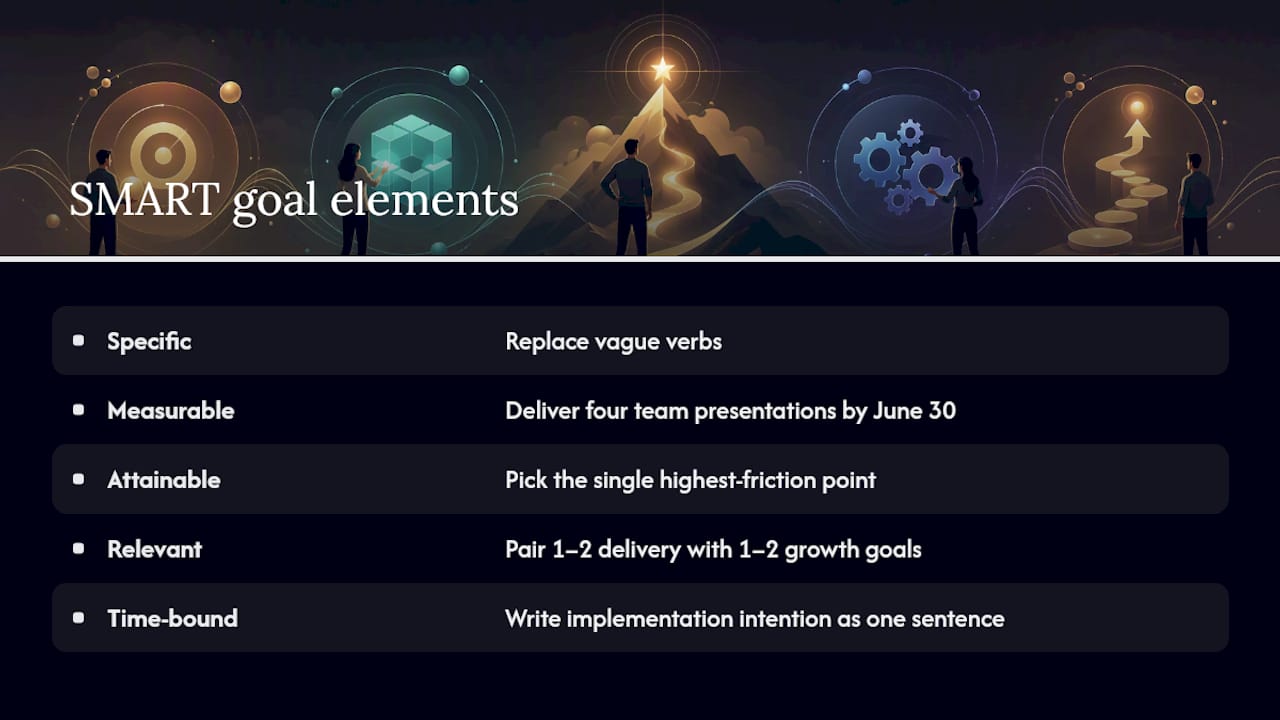
Once you’ve drafted a few candidates, prioritize using the balance Culture Amp recommends: 1 or 2 delivery goals paired with 1 or 2 growth goals, so development never quietly crowds out your actual job. From that shortlist, pick the single highest-friction point, the task you avoid, delay, or get the same feedback about repeatedly. That’s usually where the fastest career return sits.
The goal itself is only half the work. GWork’s research on goal-setting found that anchoring a new behavior to an existing routine, an implementation intention, produces meaningfully higher follow-through than an aspirational statement alone, and that tracking a behavior weekly boosts the odds it survives past the first month.
Pro Tip: Write your implementation intention as one sentence: “After I close my laptop on Friday, I will write down one thing I delegated well and one I should have delegated but didn’t.” That single sentence does more work than a paragraph of good intentions.
How Do You Implement, Measure, and Review These Goals?
A goal without an owner, a tool, and a check-in date rarely survives past week two. Build a simple system: you own the behavior, a shared document or app holds the record, and a recurring calendar block forces the review.
A workable timeline:
- 3 months: Confirm the behavior is happening consistently; success looks like a habit, not a finished outcome.
- 6 months: Look for early evidence of skill transfer, a harder conversation handled well, a task delegated cleanly.
- 12 months: Evaluate whether the goal moved your case for a raise, promotion, or new responsibility.
Useful metrics include behavior completion rate (did you do the weekly action or not), skill-demonstration tasks (a presentation delivered, a project led), and 360 feedback items collected at the 6-month mark. One caution worth building in: asking colleagues for candid feedback works far better on teams with real psychological safety, so frame requests as “help me improve” rather than “grade my performance.”
What Unconventional Development Goals Are Worth Considering?
Three overlooked options tend to move careers faster than the standard list. A friction-first goal, fixing the exact task you dread, often reveals the real skill gap holding you back. Micro-mentoring, a single 15-minute conversation with someone two levels up, builds visibility faster than a formal program. And deliberately doing one uncomfortable meeting behavior a week, disagreeing openly, asking the question everyone’s avoiding, builds the confidence conventional goals rarely touch. Reach for one of these when your standard goals haven’t moved the needle in months.

A Note From the Optiostation Team
We built Optiostation because task lists and goal statements rarely survive contact with a busy week. The behavior-first approach in this guide reflects what actually holds up under real workloads, not what looks good in a planning document.
Track Your Development Goals Without Losing the Thread
Writing a SMART goal is the easy part. Remembering to do the weekly behavior behind it, three weeks in a row, on a busy Tuesday, is where most plans quietly die. That’s the gap Optiostation is built to close: it holds your weekly behaviors, delivery goals, and review dates in one place instead of scattered across sticky notes and calendar reminders.

If you’re trying to figure out how to keep track of tasks at work without a system falling apart by week three, that’s the exact problem Optiostation solves for professionals juggling delivery goals and growth goals at the same time. Set up your first weekly behavior checkpoint today and see whether a visible tracker changes your follow-through rate.
Frequently Asked Questions
What is a good personal development goal for work?
A good one is specific enough to measure and tied to a weekly behavior, not a vague ambition. “Improve communication” is weak. “Deliver a project update without notes at four consecutive team meetings” is strong because you’ll know immediately whether you hit it.
How many development goals should I set at once?
Most guidance points to a small number, roughly one or two growth goals alongside one or two delivery goals, so you’re not spreading attention across five or six competing priorities in the same quarter.
How do I talk to my manager about my development goals?
Bring a drafted SMART goal to the conversation rather than a vague idea, and tie it to a team priority in one sentence. Co-creating the goal with your manager and setting a monthly or quarterly review point tends to keep it from quietly falling off the radar.
What’s the difference between a personal growth goal and a professional development goal?
They overlap heavily. A personal growth goal, like building resilience or confidence, often supports a professional development goal, like handling difficult client conversations. Most people benefit from having at least one goal in each category rather than treating them as separate tracks.
What tools help with tracking self development goals for work?
A shared document works for basic tracking, but a dedicated task and time app like Optiostation makes the weekly behavior visible alongside your other work instead of buried in a separate file you forget to open.
Sources
- 30 examples of goals for work | Culture Amp
- How to Set Professional Development Goals That Actually Stick 2026 | GWork
- Set goals at work to lead higher performance | Gallup
Bookmark these before your next goal-setting session or manager check-in; they’re worth revisiting when you draft your next round of SMART goals.
Recommended
- Personal Work Goals 2026: 72% Higher Achievement Rates – Optio Station: Best Project Management App for Prioritization
- 50 Goals to Set for Yourself: Practical Examples by Category – Optio Station: Best Project Management App for Prioritization
- 7 Practical Work Goal Examples for Students and Professionals – Optio Station: Best Project Management App for Prioritization
- Examples of SMART goals to boost academic success – Optio Station: Best Project Management App for Prioritization
