

TL;DR:
- Structured scheduling enhances focus, reduces fatigue, and boosts motivation, leading to better academic and work performance. Planning around clear priorities, using techniques like Pomodoro intervals, and maintaining flexibility help manage time effectively amid life’s unpredictability. Utilizing dedicated tools and conducting weekly reviews strengthen habits, ensuring schedule resilience and long-term success.
Juggling three assignments, a part-time work shift, and a social life that somehow refuses to disappear is the reality most Centurions face every single week. You sit down to study, then realize you have no idea where to start, so you spend forty minutes just deciding what to do first. That lost time adds up fast. Research consistently shows that structured scheduling dramatically improves focus, cuts fatigue, and keeps motivation alive through the longest semesters. This guide gives you a concrete, step-by-step path to building a study schedule that actually works, backed by evidence and designed for the way your life really runs.
Table of Contents
- Why structure matters for study and work schedules
- Gather your requirements: What needs scheduling?
- Step-by-step: Build your optimized study schedule
- Common mistakes and how to troubleshoot your schedule
- Why flexibility is the secret to effective scheduling
- Level up your scheduling with expert tools and resources
- Frequently asked questions
Key Takeaways
| Point | Details |
|---|---|
| Structured schedules boost focus | Using structured intervals reduces fatigue and increases motivation during study sessions. |
| Weekly overviews are essential | Listing all tasks and priorities ensures nothing important slips through the cracks. |
| Prime time helps productivity | Scheduling your most important work during your energy peak gives you the best results. |
| Adjust to avoid burnout | Flexibility and regular troubleshooting prevent overload, keeping your schedule sustainable. |
| Leverage digital tools | Apps and online resources simplify scheduling and make keeping track of your goals easier. |
Why structure matters for study and work schedules
Most students treat planning like a chore they do once and forget. That is a mistake. The difference between a student who consistently hits deadlines and one who is always scrambling is rarely about raw intelligence. It is almost always about structure.
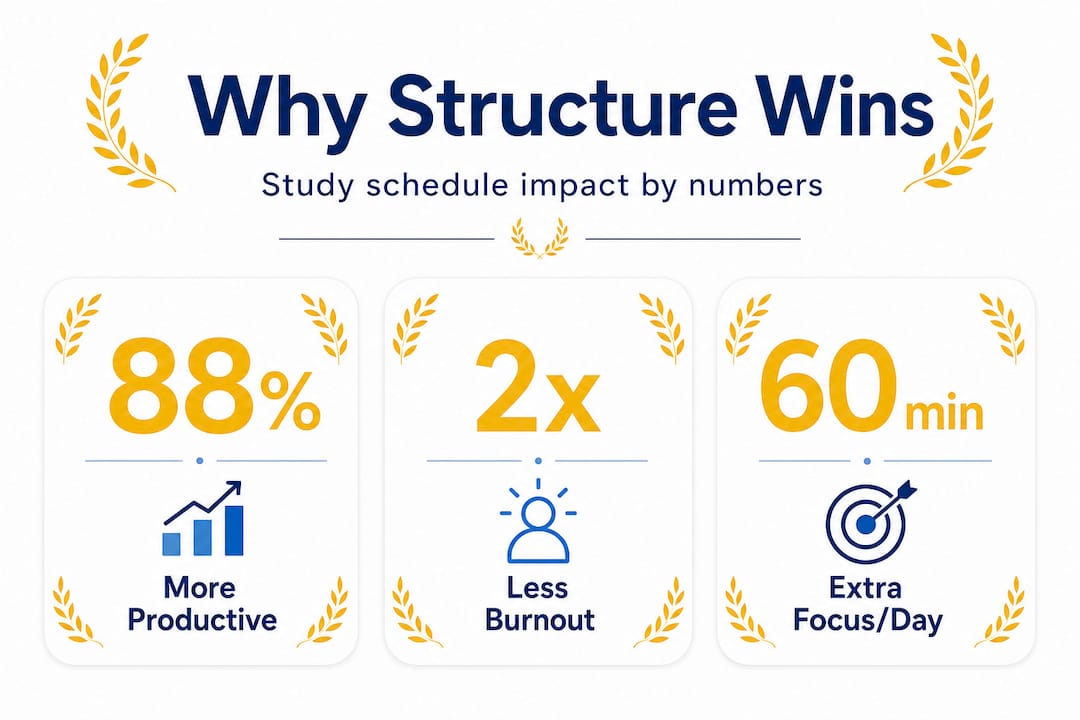
Pomodoro-style structured intervals, which pair focused work blocks with short recovery breaks, show up in study after study as more effective than unstructured self-paced studying. The evidence points to better focus, lower fatigue, and higher reported motivation when students follow a defined rhythm rather than working until they crash. That is not a small edge. That is the difference between retaining what you read and just feeling like you did.
Time-management skills are closely linked to study engagement, and here is the part most people miss: these skills are learnable. You are not born organized or disorganized. When researchers frame time management as something students can be taught, that means anyone reading this right now can build stronger scheduling habits starting today. Understanding why you should plan schedules is the first shift in mindset you need to make.
Structured vs. unstructured scheduling at a glance:
| Factor | Structured schedule | Unstructured approach |
|---|---|---|
| Focus quality | High, maintained in blocks | Inconsistent, prone to drift |
| Fatigue levels | Lower with planned breaks | Higher from marathon sessions |
| Motivation | Sustained through visible progress | Drops during long sessions |
| Task completion | Predictable and trackable | Reactive and inconsistent |
| Stress levels | Lower with clear daily goals | Higher from uncertainty |
The table above illustrates why so many high-performing students and young professionals commit to scheduling systems. The benefits are not theoretical. They show up in real grades, real work output, and real mental energy at the end of the day. Exploring the types of schedules available for students and professionals can help you pick the format that fits your actual life.
Gather your requirements: What needs scheduling?
You cannot build a schedule around vague intentions. Before you open any planner or app, you need a complete picture of everything pulling at your time. Think of this as your weekly reconnaissance mission.
Start with a full weekly overview. Write down every recurring commitment: class times, work shifts, lab sessions, club meetings, gym routines, and meal times. Then add one-time items: upcoming exams, project deadlines, social events, and appointments. Most people seriously underestimate how much they are already committed to before they add any study time.
A practical scheduling pattern is to create that weekly overview first, then set your priorities, and finally assign your most important work to your peak energy windows while reserving separate blocks for routine tasks. This sequence matters because it stops you from filling your best hours with low-value admin tasks.
Categories to capture during your weekly overview:
- Academic tasks: Readings, problem sets, papers, lab reports, exam prep
- Work commitments: Scheduled shifts, remote work hours, client calls
- Routines: Meals, commuting, exercise, sleep schedule
- Admin tasks: Emails, paying bills, grocery runs, laundry
- Personal time: Social events, hobbies, downtime you actually need
Pro Tip: Use color coding when you list these categories. Assign each type a different color before you schedule anything. When you look at your filled week, the colors instantly show you whether work is crowding out study time or whether you have left zero space for recovery.
Separating high-priority from routine items before you touch your calendar is the key move here. A comprehensive weekly planning checklist can walk you through the exact process of deciding what earns a prime slot and what gets scheduled in your low-energy hours. Also look into structured exam prep methods to see how this categorization applies during high-stakes study periods.

Once you have your full list, assign each item one of three labels: critical (must happen on a specific day), important (needs to happen this week), or routine (recurring, flexible timing). This three-tier label system is what makes your weekly agenda setup actually functional rather than just decorative.
Step-by-step: Build your optimized study schedule
With your task inventory complete, you are ready to build. Follow these steps in order. Skipping ahead is what causes the schedule-falls-apart-by-Wednesday problem.
-
Choose your scheduling tool. A physical planner, a digital calendar, or a dedicated app all work. What matters is that you will actually use it every day. Digital tools have the advantage of sending reminders and syncing across devices.
-
Block out non-negotiable commitments first. Classes, work shifts, and recurring meetings go in before anything else. These are the anchors around which everything else gets organized.
-
Identify your prime focus windows. Most people have one or two periods each day when their concentration is naturally strongest. For many students, this is mid-morning. For night-shift workers or night owls, it might be late evening. Protect these windows fiercely.
-
Assign your most demanding study tasks to prime windows. If you have a difficult exam in three weeks, your prime focus slot is where you review and practice for that exam. This is where you do the effective study schedule work that actually moves the needle on grades.
-
Apply Pomodoro intervals to your study blocks. Structured intervals produced roughly 20% lower fatigue, a 0.5-point improvement in distractibility scores, and a 0.4-point increase in motivation compared to self-paced break schedules. In practice, this means working for 25 minutes, then taking a 5-minute break before the next block. After four blocks, take a 20 to 30-minute longer break.
-
Schedule routine tasks in low-energy slots. Emails, administrative tasks, and light readings fit perfectly into the afternoon slump that follows lunch. Stop wasting your peak brain hours on tasks that do not require peak focus.
-
Build in daily transition buffers. Give yourself 10 minutes between major blocks. Life is messy, and back-to-back scheduling with no margin means one overrun task derails your entire day.
-
Set a weekly review appointment with yourself. Every Sunday (or whichever day closes your week), spend 20 minutes reviewing what happened and planning the next seven days. This is not optional. It is what separates a living schedule from a static list.
Pro Tip: Before finalizing your week, check how you prioritize your assignments and confirm that your hardest work is matched to your best hours. A mismatch here is the single most common reason students feel busy but unproductive.
For subject-specific scheduling, exam revision planning frameworks can show you how to distribute practice sessions across weeks to maximize retention rather than cramming everything into the final 48 hours.
Common mistakes and how to troubleshoot your schedule
Even a well-built schedule breaks down if you fall into predictable traps. Knowing what these traps look like means you can catch them early instead of wondering why your system stopped working.
The most common scheduling mistakes:
- Over-scheduling without breaks. Filling every hour looks productive on paper but destroys real output within days. Your brain is not a machine. It needs recovery time built into the plan, not squeezed out of it.
- Underestimating how long tasks take. Students consistently underestimate task duration by 30 to 40 percent. When you build your blocks, add a 25% buffer to your time estimates for anything that requires deep focus.
- Ignoring low-priority overload. Saying yes to extra commitments that feel small individually adds up to hours lost weekly. Guard your schedule like it is precious, because it is.
- Skipping the weekly review. This is the single biggest reason good schedules decay. Without a weekly check-in, small misalignments compound into full schedule collapse by week three.
- Treating a missed day as failure. Missing one day is not failure. It is data. Ask why it happened, adjust, and continue. Catastrophizing a missed session leads to abandoning the entire system, which is the actual failure.
“The goal of a schedule is not perfect compliance. It is a reliable return path when life interrupts.”
Across all included studies, 88% showed positive outcomes from structured intervals compared to unstructured approaches. That is an overwhelming signal. The structure itself is not the enemy. How rigidly you cling to a broken version of it is.
When you feel burned out, the instinct is to take an unstructured day off with no plan. That almost always makes re-entry harder. Instead, schedule a recovery day with light, enjoyable tasks and at least one small win. This keeps momentum alive and resets your energy without losing the habit. Pairing your schedule resets with clear goal setting practices helps you reconnect with why the schedule matters in the first place.
For further reading on preventing exam-period burnout and maintaining performance under pressure, math exam strategies apply the same principles of structured review and deliberate rest to high-stakes testing scenarios.
Why flexibility is the secret to effective scheduling
Here is a perspective most productivity articles skip entirely: the best schedule you can build right now is not the one you will need in three weeks.
Life changes constantly. A professor shifts an exam date. A work shift gets added last minute. You get sick for two days. If your schedule is a rigid grid that cannot absorb any of these changes, it does not matter how scientifically it was designed. It will fail in the first real collision with reality.
What separates Centurions who consistently outperform their peers is not a perfect schedule. It is the habit of adjusting their schedule quickly when something changes, rather than abandoning it entirely. Flexibility is not the opposite of structure. It is what makes structure survive contact with real life.
Think of your schedule as a living document rather than a signed contract. It tells you the plan for this week, not a permanent law. When something disrupts it, your job is to adapt, not apologize. Learning how to plan weekly goals with this adaptive mindset built in is what creates long-term scheduling resilience.
The adjustment skill is also rarely discussed as something that improves with practice. But it does. The first time your week falls apart, you will probably panic and lose two days. The tenth time, you will notice by Tuesday, adjust by Wednesday, and lose maybe two hours. That improvement is real and it compounds over a semester. Treat every disruption as a scheduling workout, not a scheduling failure.
Level up your scheduling with expert tools and resources
You now have the framework. The next step is putting it into motion with tools built specifically for the way students and young professionals actually work.
Optio is the second-in-command you have always needed. Built for Centurions who are managing studies, work shifts, team projects, and personal goals simultaneously, Optio brings together task management, time blocking, and team coordination in one Roman-themed command center. You do not have to manually track every moving piece when a dedicated system does it for you. Explore the full list of time management apps to see where Optio fits alongside other tools that support your scheduling system. Building stronger time management skills takes practice, and having the right app at your side accelerates that process significantly.
Frequently asked questions
What is the Pomodoro technique and why is it effective?
The Pomodoro technique divides study into 25-minute focused work sessions followed by 5-minute breaks, with a longer break after every four sessions. Structured focus intervals like these have demonstrated measurable improvements in focus and reductions in fatigue compared to unstructured study.
How often should I review or update my study schedule?
Weekly reviews are the most effective cadence for most students and young professionals. Creating a weekly overview and reassigning priorities each week keeps your schedule aligned with what is actually happening in your life rather than what you planned three weeks ago.
What should I do if I keep missing scheduled tasks?
First, check for overload: your schedule may simply have too many tasks crammed into too few hours. Reducing the volume, adding more frequent breaks, and matching intervals to motivation using structured techniques like Pomodoro can significantly improve your follow-through rate.
Are digital tools helpful for organizing study schedules?
Yes, especially apps with reminder features and visual calendar layouts that make your time blocks tangible. Digital tools also make weekly adjustments fast, which encourages you to update your schedule instead of abandoning it when plans change.
How do I balance study, work, and personal time in one schedule?
Start by listing every weekly commitment across all three areas, then limit your daily priorities to two or three critical tasks. Use dedicated blocks for routines and protect at least one personal recovery window each day to prevent burnout from eroding your overall output.
Recommended
- 7 Best Time Management Goals Examples for Centurions – Optio Station: Best Project Management App for Prioritization
- 7 Essential Types of Schedules for Students and Professionals – Optio Station: Best Project Management App for Prioritization
- Time Management Time Blocking for Focused Productivity – Optio Station: Best Project Management App for Prioritization
- 7 Types of Productivity Techniques Every Centurion Should Know – Optio Station: Best Project Management App for Prioritization
