

Nearly 60 percent of American college students and young tech professionals say they feel overwhelmed by juggling deadlines and competing priorities. Managing your day successfully takes more than just good intentions—it requires smart strategies for organizing tasks and choosing the right digital tools. Discover practical steps for evaluating your workload, picking efficient task management systems, and structuring projects so you can accomplish more without sacrificing your well-being.
Table of Contents
- Step 1: Identify And Prioritize Key Tasks
- Step 2: Set Up Task Management Tools
- Step 3: Break Down Large Projects Into Actions
- Step 4: Allocate Time And Track Progress
- Step 5: Review And Optimize Task Organization
Quick Summary
| Key Point | Explanation |
|---|---|
| 1. Prioritize Key Tasks | Focus on urgent and important tasks to maximize impact and efficiency in your workday. |
| 2. Choose the Right Tools | Select task management tools that streamline your workflow, providing features that suit your individual and team needs. |
| 3. Break Down Projects | Decompose large projects into smaller, actionable steps to create a clear and manageable roadmap to success. |
| 4. Allocate Time Wisely | Use time blocking and milestones to efficiently track progress and maintain accountability throughout your projects. |
| 5. Regularly Optimize Systems | Periodically review and adjust your task management systems to adapt to changing job demands and improve productivity. |
Step 1: Identify and Prioritize Key Tasks
Successfully organizing your workday begins with understanding which tasks truly matter and deserve your immediate attention. Effective task management isn’t about doing everything but strategically focusing on work that drives meaningful progress.
To effectively identify and prioritize tasks, start by creating a comprehensive list of all pending assignments. Experts recommend using multiple strategies for determining task importance, including assessing urgency, potential impact, and alignment with broader professional goals. A powerful technique involves categorizing tasks using the Eisenhower Matrix method, which helps you classify work across four critical quadrants: urgent and important, important but not urgent, urgent but less important, and neither urgent nor important.
Once you have your comprehensive list, evaluate each task based on its strategic value. Consider factors like project deadlines, potential consequences of delay, required effort, and alignment with your professional objectives. Some tasks might seem pressing but actually provide minimal long-term value, while others might appear less time-sensitive but carry significant strategic importance.
Pro Tip: Use a digital task management tool that allows dynamic priority shifting and provides visual representations of your workload to help you stay consistently organized.
Step 2: Set Up Task Management Tools
Successfully organizing your workflow requires selecting and implementing the right task management tools that align with your specific work style and productivity needs. The goal is to find a system that simplifies tracking, prioritizing, and completing your assignments efficiently.

Modern task management systems offer diverse features to streamline workplace productivity, ranging from simple digital checklists to comprehensive project tracking platforms. When selecting a tool, consider key factors like user interface, integration capabilities, collaboration features, and scalability. Some tools excel at individual task tracking, while others provide robust team coordination features. Look for platforms that allow you to categorize tasks, set deadlines, assign priority levels, and visualize your overall workload.
Start by exploring digital solutions that match your professional requirements. Popular options include web based project management platforms, mobile apps, and cloud synchronized task trackers. Evaluate each tool based on its ability to help you break down complex projects, track progress, and maintain clear visibility into your work responsibilities. Pay special attention to tools that offer customizable workflows, real time updates, and intuitive design that matches your personal organizational approach.
Here’s a comparison overview of popular task management tool types and their unique strengths:
| Tool Type | Best For | Unique Benefit | Potential Challenge |
|---|---|---|---|
| Web Project Platforms | Team collaboration | Real-time updates | May require training |
| Mobile Task Apps | Individual tasks | Notifications on-the-go | Smaller screen for complex tasks |
| Cloud Task Trackers | Multiple devices | Seamless sync everywhere | Internet required for access |
Pro Tip: Test multiple task management tools using free trials and choose the one that feels most natural and seamless for your specific work rhythm.
Step 3: Break Down Large Projects Into Actions
Transforming complex projects into manageable actions is the key to preventing overwhelm and maintaining steady progress. By systematically deconstructing large assignments into smaller actionable steps, you can create a clear roadmap that makes even the most intimidating projects feel achievable.
Effective project breakdown involves mapping out a comprehensive strategy that transforms big picture goals into precise executable tasks. Start by identifying the ultimate project objective and then work backwards, creating milestone markers that represent significant progress points. Each milestone should be accompanied by specific actions that are concrete, measurable, and time bound. Think of this process as creating a detailed treasure map where each X represents a critical task that moves you closer to your final destination.
Consider the dependencies and relationships between different project components. Some tasks will need to be completed in sequence, while others can be tackled simultaneously. Prioritize actions based on their complexity, resource requirements, and potential impact. By breaking down your project into granular steps, you transform an overwhelming mountain into a series of manageable hills that you can confidently climb one at a time.
Pro Tip: Create a visual project map or flowchart that illustrates the connections between different tasks to maintain clarity and motivation throughout the project lifecycle.
Step 4: Allocate Time and Track Progress
Successfully managing your workload requires strategic time allocation and consistent progress monitoring. By developing a systematic approach to tracking your tasks, you can transform abstract goals into tangible achievements and maintain momentum throughout your projects.
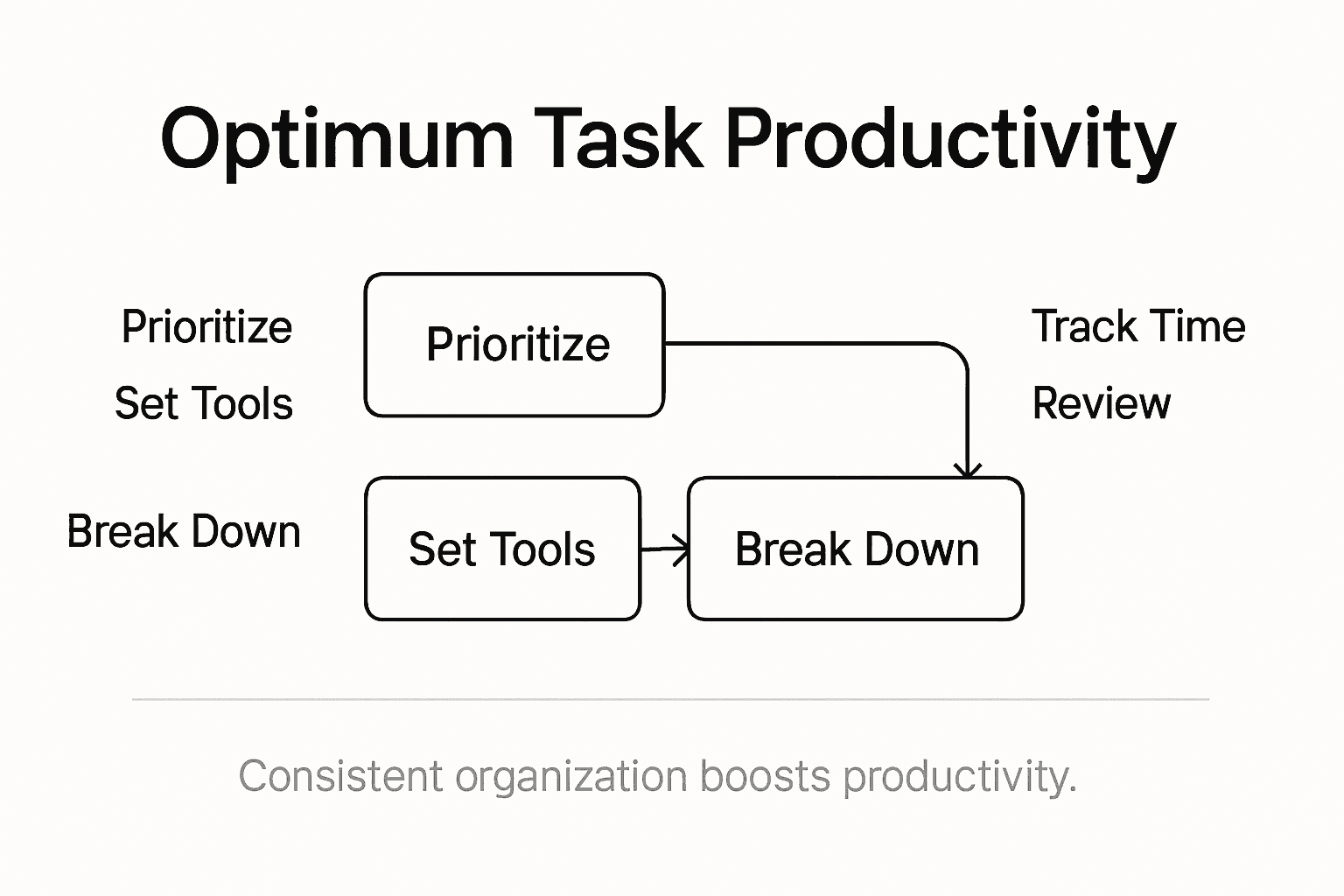
Effective time management involves implementing proven techniques for scheduling and monitoring work progress, which help you maximize productivity and maintain accountability. Begin by estimating realistic timeframes for each task, breaking down complex assignments into smaller intervals that can be tracked and measured. Consider using time blocking techniques where you assign specific time slots to different types of work, ensuring that critical tasks receive dedicated attention and preventing potential bottlenecks in your workflow.
Establish clear milestones and checkpoints that allow you to assess your progress objectively. Regularly review your task completion rates, identifying areas where you might be falling behind or excelling. Use visual tracking methods like progress bars, digital dashboards, or simple spreadsheets to provide a transparent view of your work status. This approach not only helps you stay organized but also provides motivational insights into your productivity patterns, allowing you to make data driven adjustments to your work strategy.
Pro Tip: Implement a weekly review process where you analyze your time allocation and progress, making incremental adjustments to improve your efficiency and work rhythms.
Step 5: Review and Optimize Task Organization
Regular evaluation of your task management system is crucial for maintaining peak productivity and adapting to changing work demands. The goal is to create a dynamic approach that evolves with your professional challenges and personal growth.
Organizations can significantly improve their productivity by systematically analyzing and refining their task management workflows. Start by conducting a comprehensive audit of your current task organization methods. Examine your completed tasks, tracking efficiency, identifying bottlenecks, and noting areas where your workflow breaks down or becomes unnecessarily complicated. Look for patterns in how you spend your time, which tasks consume more energy than they should, and where you consistently excel or struggle.
Develop a continuous improvement mindset by implementing regular review cycles. Set aside dedicated time monthly or quarterly to assess your task management strategy. Pay attention to both quantitative metrics like completion rates and qualitative factors such as stress levels and overall job satisfaction. Be willing to experiment with new tools, techniques, and approaches that can streamline your workflow. Remember that optimization is an ongoing process not a one time fix. Your task management system should be flexible enough to adapt to changing priorities while maintaining a clear structure that supports your professional objectives.
A breakdown of key factors to consider when reviewing and optimizing your task management system:
| Factor | What to Assess | Typical Adjustment | Impact on Productivity |
|---|---|---|---|
| Completion Rates | Tasks finished vs. planned | Revise workload distribution | Improves efficiency |
| Workflow Bottlenecks | Steps causing delays | Streamline or automate steps | Reduces wasted time |
| Stress Levels | Subjective work experience | Adjust deadlines or priorities | Boosts job satisfaction |
| Tool Use Frequency | Preferred platforms | Adopt better-suited systems | Increases engagement |
Pro Tip: Create a personal performance dashboard that tracks your productivity metrics, allowing you to visualize your progress and identify improvement opportunities in real time.
Take Command of Your Task Organization with Optio Station
Struggling to keep your tasks prioritized and organized at work can lead to stress and missed opportunities. This article emphasizes the importance of breaking down projects, prioritizing effectively, and tracking progress to boost productivity. If you want to avoid overwhelm and become the true Centurion of your workflow, embracing smart task management tools is essential.
Unlock the power of Optio Station, a mobile app designed specifically for students and young professionals who want to manage tasks, time, and teams with ease. As your second-in-command, Optio helps you prioritize like a pro and stay on top of your workload without losing momentum. Discover tips and strategies from our CenturionTips and explore insights to sharpen your focus in ProductivityThoughts. Ready to organize your workday better and see real results? Visit Optio Station now and start commanding your productivity today.
Frequently Asked Questions
How can I prioritize tasks effectively at work?
To prioritize tasks effectively, start by listing all your pending assignments and then categorize them using methods like the Eisenhower Matrix. Focus on the tasks that are both urgent and important, and allocate your time accordingly. Consider aiming to tackle your highest-priority tasks first each day to maximize productivity.
What are the best task management tools for improving productivity?
The best task management tools depend on your specific needs but look for options that allow for task categorization, deadline setting, and progress tracking. Begin by trying out a few free tools to determine which ones integrate well with your workflow and help streamline your responsibilities.
How do I break down large projects into manageable tasks?
To break down large projects into manageable tasks, start with the overall project goal and work backward to identify key milestones. Create actionable steps that are specific, measurable, and have deadlines, allowing you to focus on one small task at a time rather than feeling overwhelmed by the entire project.
What is an effective method for tracking progress on tasks?
An effective method for tracking progress is to implement visual tracking methods such as progress bars or dashboards that offer clear insights into your task completion status. Set regular milestones to review your work, adjusting your strategies based on your progress to stay on track.
How often should I review my task management strategy?
You should review your task management strategy regularly, ideally on a monthly or quarterly basis. This allows you to assess what’s working and what isn’t, enabling you to make necessary adjustments to improve your efficiency and adapt to changing work demands.
How can I enhance my time management skills for better task organization?
Enhance your time management skills by implementing techniques like time blocking, which allocates specific time slots for different tasks. Start practicing this method for a week to identify how it affects your productivity and make adjustments based on your results.
Recommended
- How to Manage Multiple Tasks Easily for Better Results – Optio Station: Best Project Management App for Prioritization
- How to Organize Daily Tasks at Work for Maximum Productivity – Optio Station: Best Project Management App for Prioritization
- 7 Essential Organization Tips for Busy Professionals – Optio Station: Best Project Management App for Prioritization
- How to Manage Daily Tasks Effectively for Success – Optio Station: Best Project Management App for Prioritization
- Netflix Shouldn’t Be A Major Part Of Your Productivity Plan – EmailEdgar
